Medical Ethics for the Administrator: Autonomy, Beneficence, Justice and the Triage Decision (UPSC Ethics — GS IV)
A clinician's patient is a person and their instrument is treatment; an administrator's patient is a population and their instrument is allocation. The four principles survive that shift in name only, and the difference is where most public-health ethics failures happen.
Medical ethics reaches most administrators in the clinician’s version: four principles, a consent form, and a set of dilemmas involving one doctor and one patient in one room. That version is not wrong, and it is not the one an officer will need. A District Magistrate signing off on a vaccination drive, a health secretary fixing which district gets the second CT scanner, or a hospital superintendent deciding who is admitted when the ward is full is doing something structurally different from what a physician does at a bedside.
The difference is precise and worth stating once, because everything else follows from it. A clinician’s patient is a person and their instrument is treatment. An administrator’s patient is a population and their instrument is allocation. The four principles survive that shift in their names and change substantially in their content, and most failures of public-health ethics come from applying the clinical version to a problem that is not clinical.
The Four Principles, Translated
The framework is Beauchamp and Childress’s, from 1979, and its durability comes from being a checklist rather than a theory: four considerations that must each be addressed, with no ranking supplied.
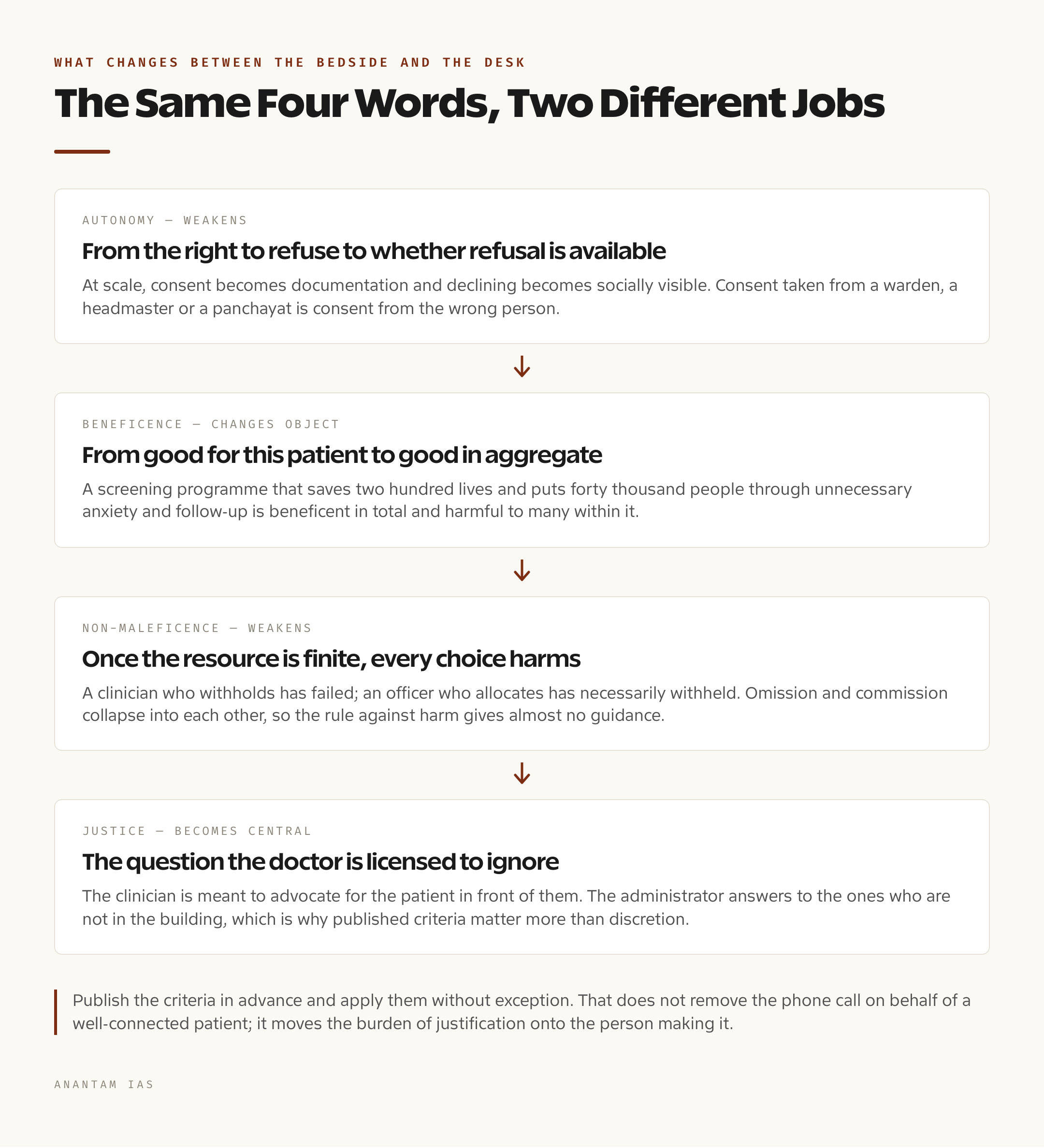
Autonomy, clinically, is the patient’s right to refuse. Administratively it becomes the harder question of whose consent is being sought and whether refusal is genuinely available. A programme designed so that declining requires arguing with a health worker in front of one’s neighbours has consent on paper.
Beneficence, clinically, is doing good for this patient. Administratively it is doing good in aggregate, which is not the same act. A screening programme that saves two hundred lives and subjects forty thousand people to unnecessary anxiety and follow-up procedures is beneficent at the population level and harmful to many individuals within it.
Non-maleficence shifts from “do not harm this patient” to the recognition that every allocation harms whoever did not receive. A clinician who withholds treatment has failed; an administrator who allocates has necessarily withheld. Omission and commission collapse into each other once the resource is finite, which is why the clinical instinct against causing harm gives an officer almost no guidance.
Justice, clinically a minor consideration, becomes the administrator’s central one. It is the question the clinician is professionally licensed to ignore — the doctor is meant to advocate for the patient in front of them — and the question the officer cannot.
That inversion is the whole argument: an officer who has learned the clinical hierarchy will systematically underweight the consideration that matters most in their own job.
Consent at Scale
Individual informed consent has a settled Indian shape. The Supreme Court in Samira Kohli v. Prabha Manchanda (2008) held that consent must be real consent, based on adequate information about the nature and consequences of the procedure and its alternatives, and that consent to a diagnostic procedure does not extend to a therapeutic operation performed under anaesthesia. The Mental Healthcare Act, 2017 went further for one class of patients, recognising advance directives and nominated representatives, and decriminalising attempted suicide.
At population scale the concept strains in three directions. Consent becomes documentation rather than a conversation, because a campaign reaching ten thousand people cannot hold ten thousand conversations. Refusal becomes socially costly, since programmes work through schools, workplaces and community pressure, all of which make declining visible. And the person consenting is often not the person deciding — a warden for a hostel, a headmaster for a school, a husband for a wife, a panchayat for a village.
There is a documented Indian illustration of exactly this failure. Studies of a human papillomavirus vaccine conducted in Andhra Pradesh and Gujarat around 2009-10 drew sustained criticism, examined at length in a parliamentary standing committee report on health in 2013, over consent obtained from hostel wardens for tribal and residential-school girls rather than from parents or guardians. Nothing in the science was disputed. The consent architecture was.
The workable administrative position is that at scale, consent has to be institutionalised rather than individualised: honest and comprehensible public information, a genuinely available and cost-free opt-out, prior ethics review of the programme design, and a real mechanism for reporting and compensating harm. Screening programmes carry an additional and less obvious duty, which is to tell people the truth about false positives before enrolling them, and this becomes acute as predictive testing expands — the terrain covered in Genome India and precision medicine.
Confidentiality and Its Limits
Confidentiality is not absolute in any medical code, and the exceptions are the interesting part. Three categories recur.
Notifiable disease reporting overrides individual confidentiality by statute. India’s operative framework runs through state public-health legislation, the colonial-era Epidemic Diseases Act of 1897, and specific notification requirements — tuberculosis was made notifiable in 2012, with the obligation extended to all providers subsequently. The justification is straightforward: a communicable disease is not a private fact.
Contact tracing raises the harder question, because the person being warned cannot usefully be warned without something being disclosed about the index case. The administrative duty is to minimise inference — notify the exposure, not the source — and to accept that in a small community this often fails in practice.
The duty to warn an identifiable third party was addressed by the Supreme Court in Mr X v. Hospital Z (1998), which upheld disclosure of a patient’s HIV-positive status to a prospective spouse, on the reasoning that the other person’s right to health under Article 21 was engaged. The statutory position was later refined by the HIV and AIDS (Prevention and Control) Act, 2017, which restricts disclosure and requires informed consent or a court order. The administrator’s takeaway is the structure of the exception rather than the case: disclosure is defensible where the third party is identifiable, the risk is serious, and disclosure is the minimum that averts it.
Triage: Clinical and Administrative
Clinical triage happens in front of the patient, in minutes, on medical criteria, by someone who can see the person and will be answerable for the outcome that afternoon. It is emotionally brutal and ethically relatively simple.
Administrative rationing is the opposite on every count. It happens in an office, in advance, on categories rather than individuals, and the officer never meets the person who does not get the ventilator, the dialysis slot, the transplant, the district’s only oncologist. Distance makes the decision easier to take and harder to take well — a criterion drafted in an office can quietly exclude a whole class of people, and nobody in the room will feel it. It also makes the decision reviewable in a way a bedside decision is not, and that is where the central obligation comes from.
Because there is time, criteria must be published in advance and applied without exception. This is the strongest available protection against allocation being captured by influence, and the reasoning deserves spelling out. In every scarcity, some patients arrive with a phone call attached — a legislator’s letter, a senior official’s relative, a journalist’s enquiry. If the criteria are unpublished, each such case is decided on its merits, and the merits will include the phone call. If they are published, the officer’s answer to the call is the criterion, and the caller must argue publicly for an exception. Publication does not remove pressure; it moves the burden of justification onto the person applying it, which is the whole mechanism of accountability and responsibility in an allocation setting.
The Allocation Criteria and Their Objections
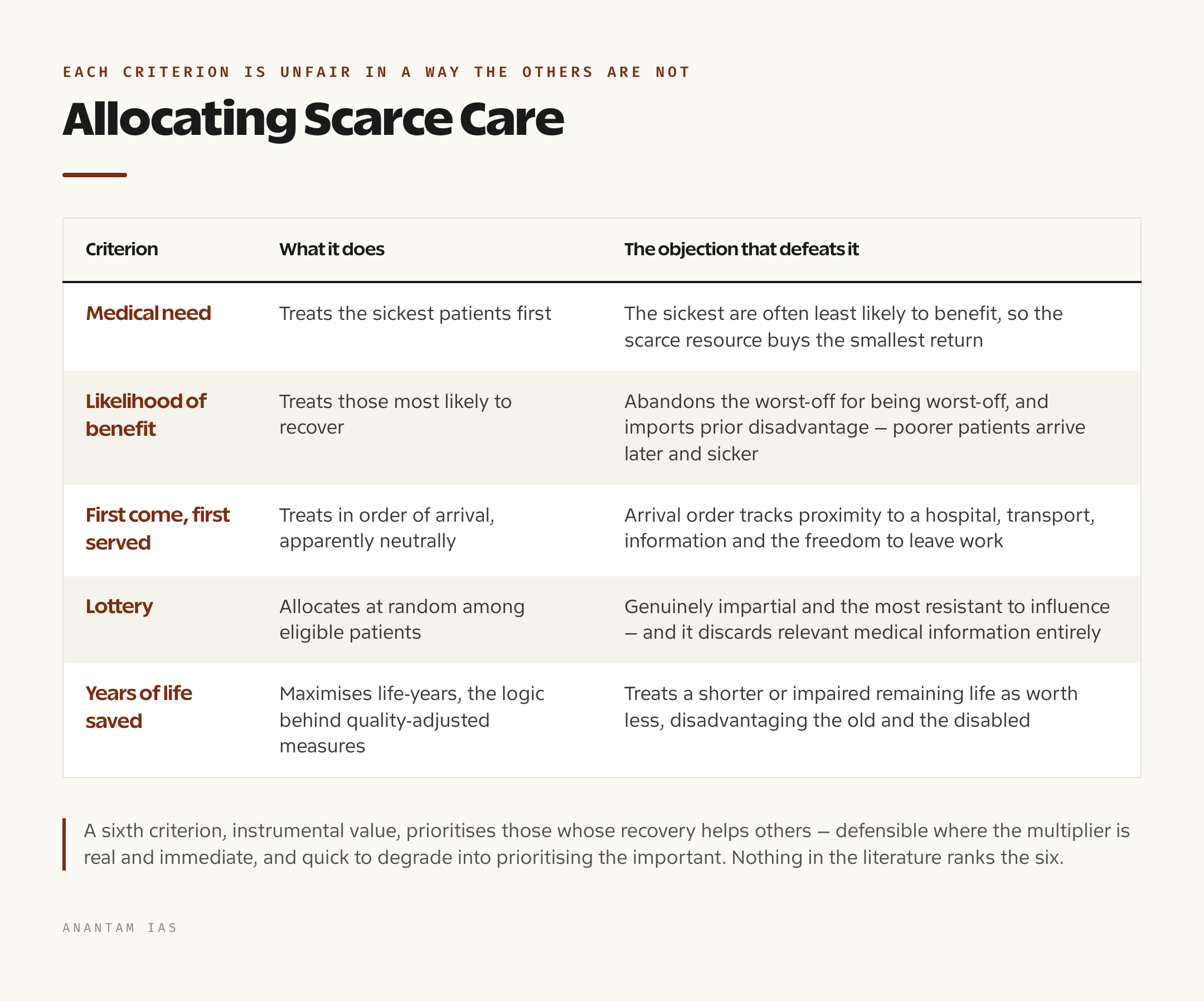
Six criteria appear in the ethics literature on scarce medical resources, and the useful exercise is to hold each against the objection that defeats it.
Medical need — treat the sickest first. The objection is that the sickest are often those least likely to benefit, so this criterion can consume a scarce resource for the smallest return.
Likelihood of benefit — treat those most likely to recover. The objection is that it abandons the worst-off precisely because they are worst off, and that it imports prior disadvantage, since poorer patients arrive later and sicker.
First come, first served — treat in order of arrival. It appears neutral and is not: arrival order tracks proximity to a hospital, transport, information and the ability to leave work.
Lottery — allocate at random. It is genuinely impartial, resists influence better than any other method, and is widely rejected because it discards relevant medical information entirely.
Instrumental value — prioritise those whose recovery helps others, such as health workers in an epidemic. It is defensible where the multiplier is real and immediate, and it degrades quickly into prioritising the important, which is how allocation gets captured.
Years of life saved — maximise life-years, the logic underlying quality-adjusted measures. The objection is the sharpest of the set: it treats a shorter or impaired remaining life as worth less, and so disadvantages the old and the disabled. Explicit rationing has run into anti-discrimination law on exactly this ground. The instructive case is the Oregon health plan of the early 1990s, the first serious attempt by a government to publish a ranked list of what it would and would not fund, which was initially refused federal approval on disability-discrimination grounds and had to be redesigned.
Nothing in the ethics literature ranks these six. A consequentialist argument of the kind associated with Peter Singer pushes hard towards benefit maximisation and life-years, and the force of the objection is precisely that it treats some lives as arithmetically smaller. The workable answer is a composite — need and likelihood of benefit as the primary filters, a lottery among the medically equivalent, instrumental value confined to narrow published categories — with the reasoning attached.
Scarcity When Nothing Is Burning
Most rationing is not an emergency, and the routine cases are where the criteria actually get bent.
Waiting lists are rationing by delay, and the ethical failure is rarely the list itself. It is the parallel channel: the private appointment that converts into an earlier public procedure, the ward reserved for referrals, the discretionary advancement that nobody records. A waiting list is defensible only if a person cannot buy their way up it.
Price control allocates by making a product affordable and by changing what is supplied. India’s mechanism runs through the Drug Prices Control Order of 2013 and the National List of Essential Medicines, administered by the pricing authority. The 2017 cap on coronary stent prices is the clearest illustration of the trade-off: prices fell sharply and access widened, and manufacturers sought to withdraw or delay newer products from the Indian market. Both effects are real. An officer who presents only the first has not made the case honestly.
Posting specialists to underserved districts is the allocation problem nobody frames as ethics. The rural health statistics series has reported shortfalls of specialists at community health centres above seventy per cent for years. Compulsory rural service bonds, differential incentives and reserved postgraduate seats are all attempts at the same conflict: the doctor’s liberty to practise where they choose against the entitlement of a population to any specialist at all. Coercive instruments produce presence without engagement; voluntary ones do not fill the posts. The honest description is a trade-off being managed, not solved.
End of Life: Where Indian Law Stands
This is worth stating carefully, because the ground has moved and half-remembered versions are common.
Active euthanasia — a positive act to end life — remains unlawful in India. Gian Kaur v. State of Punjab (1996) held there is no right to die under Article 21. Aruna Shanbaug v. Union of India (2011) permitted withdrawal of life support in specified circumstances, subject to High Court approval.
The controlling decision is Common Cause v. Union of India (2018), in which a five-judge Constitution Bench held that the right to die with dignity is part of the right to life under Article 21, recognised passive euthanasia — the withholding or withdrawal of life-sustaining treatment from a patient in a terminal or permanently vegetative condition — and, significantly, gave legal effect to the advance medical directive, a document by which a competent adult records in advance what treatment they would refuse if they lost capacity.
The 2018 judgment also laid down a detailed procedure involving medical boards and countersignature by a judicial officer. That procedure was widely reported by clinicians and hospitals to be unworkable in practice, and the Court revisited it in 2023, simplifying the requirements — including the composition and timelines of the boards and the role of the judicial magistrate. The correct statement is that passive euthanasia and advance directives are lawful in India on the authority of Common Cause, and that the operational framework has since been revised and remains a matter of administrative implementation rather than settled routine.
Organs, Trials and the Pharma Relationship
Organ transplantation in India runs on the Transplantation of Human Organs Act, 1994, amended in 2011 and supplemented by rules in 2014. Its structure answers a specific ethical problem: an organ is a resource that cannot be manufactured, so the statute prohibits commercial dealing, restricts living donation to near relatives with an authorisation committee scrutinising other cases for affection or altruism rather than payment, and defines brain-stem death with certification by a board of specified doctors. The persistent ethical pressure is the poor donor who genuinely wishes to sell, and the argument against permitting it is not paternalism but the observation that a market in organs will draw its supply from exactly one class of people.
Clinical trials rest on the Nuremberg Code of 1947, whose first principle is that voluntary consent is essential, and the Declaration of Helsinki of 1964 as amended, which added independent ethics-committee review and the requirement that research on a population be responsive to that population’s needs. India’s framework is the Indian Council of Medical Research’s 2017 guidelines and the New Drugs and Clinical Trials Rules, 2019, which require registration of ethics committees and provide for compensation for trial-related injury.
The specific problem is trials in populations without alternatives. Where a participant’s only route to any treatment at all is enrolment, consent is voluntary in form and coerced by circumstance. This is the reason for the responsiveness requirement, and it also constrains research that alters the human germline, examined separately in bioethics and gene editing, as well as interventions on the brain and the questions of cognitive liberty they open.
The doctor-pharma relationship is a conflict of interest of textbook shape: the prescriber does not pay, the payer does not choose, and the seller can reach the prescriber directly. The Indian instruments include the professional conduct regulations for registered practitioners, which since 2009 have barred gifts, travel and hospitality from pharmaceutical companies, and a marketing practices code for the industry that has remained largely self-regulatory. A parliamentary standing committee report on the drug regulator in 2012 documented how far the problem reached, finding approvals granted without required trials and expert opinion letters that appeared to have been drafted for the signatories. On the tax side, the Supreme Court held in 2022 that expenditure on freebies to doctors is not deductible as business expenditure, on the reasoning that a payment which it is an offence for the recipient to accept cannot be a legitimate business expense.
When the Clinician Wants an Exception
The recurring institutional conflict has a stable shape. A treating doctor’s professional duty runs to the patient in front of them and includes advocating for that patient against the system. An administrator’s duty runs to every patient, including the ones not in the building. These are both correct and they collide.
A hospital administrator facing a clinician who wants an exception should do four things. Hear the clinical argument on its merits, because the clinician may have information the criterion did not anticipate, and a criterion that cannot absorb new medical information is badly drafted. Distinguish a new clinical fact from a preference — that the patient is a colleague’s relative, that the family is influential, that the case will attract attention are not clinical facts. Record the decision and its reason, whichever way it goes. And fix the criterion rather than the case: if the exception is right, it is right for every similar patient, and the criterion should be amended and republished. An exception granted once and unrecorded becomes a precedent available only to those who know it exists.
The cost of holding this line is not hypothetical. An administrator who refuses an exception for a well-connected patient makes an enemy with reach, and the refusal is invisible while the resentment is not. Officers have been transferred out of hospital administration for less.
The Honest Objections
The four principles conflict and supply no ranking. Beauchamp and Childress never claimed otherwise; the framework is a checklist of considerations, not a decision procedure. Autonomy against beneficence in a vaccination programme, justice against beneficence in an allocation, non-maleficence against autonomy in a refusal of treatment — the framework tells you the tension exists and leaves the resolution to judgement. Critics have argued that this makes it a vocabulary for describing dilemmas rather than a method for resolving them, and that criticism largely lands.
Published criteria are rigid in the individual case. The argument for publishing rules in advance is that it defeats influence. The cost is that it also defeats mercy, and produces the case where everyone in the room can see that the rule gives the wrong answer for this patient. Both halves of that are true at once, and the reason to publish anyway is comparative rather than absolute: unpublished discretion is captured more often than published rules are wrong.
The tension between individual rights and population benefit cannot be dissolved. No amount of framework work makes it go away. A quarantine restricts a person for others’ benefit. A screening programme harms some to help more. An allocation criterion denies a named individual to serve an unnamed many. What is available is not a resolution but a discipline: decide, state the criterion, publish the reasoning, record the decision, accept the review, and do not pretend the person who lost did not lose anything.
FAQ
What are the four principles of biomedical ethics? Respect for autonomy, beneficence, non-maleficence and justice, set out by Beauchamp and Childress in 1979. They are considerations that must each be addressed, not a ranked hierarchy, and they routinely conflict.
How does an administrator’s ethical position differ from a clinician’s? The clinician’s obligation runs to the patient in front of them and their instrument is treatment. The administrator’s runs to a population and their instrument is allocation, so justice becomes the dominant consideration and every decision necessarily withholds something from someone.
Is passive euthanasia legal in India? Yes. In Common Cause v. Union of India (2018) a Constitution Bench held that the right to die with dignity forms part of Article 21, permitted withdrawal or withholding of life-sustaining treatment in terminal or permanently vegetative conditions, and recognised advance medical directives. The procedural framework laid down then was revised in 2023 after clinicians reported it unworkable.
Why should allocation criteria be published in advance? Because publication shifts the burden of justification. Where criteria are unpublished, every case with influence behind it is decided on merits that include the influence. Where they are published, anyone seeking an exception has to argue for it openly.
What does the Transplantation of Human Organs Act prohibit? Commercial dealing in human organs. It restricts living donation to near relatives, routes other donations through an authorisation committee that must satisfy itself of affection or altruism rather than payment, and provides for certification of brain-stem death by a board of specified doctors.
What is the main objection to allocating care by years of life saved? That it treats a shorter or impaired remaining life as worth less, and so systematically disadvantages the old and the disabled. Explicit rationing schemes built on this logic have been challenged on disability-discrimination grounds.
Practice Questions
Prelims MCQs
- The advance medical directive was given legal recognition in India by: (a) Gian Kaur v. State of Punjab (1996) (b) Aruna Shanbaug v. Union of India (2011) (c) Common Cause v. Union of India (2018) (d) The Mental Healthcare Act, 2017, for all patients — Answer: (c) the 2018 Constitution Bench judgment recognised both passive euthanasia and advance directives, with the procedure later simplified.
- Under the Transplantation of Human Organs Act, donation by a person who is not a near relative: (a) Is prohibited absolutely (b) Requires clearance by an authorisation committee satisfied as to affection or altruism (c) Requires only the donor’s written consent (d) Is permitted on payment of a regulated price — Answer: (b) the committee exists specifically to exclude commercial motive.
- The first principle of the Nuremberg Code, 1947 is: (a) Independent ethics-committee review (b) Compensation for research injury (c) The voluntary consent of the human subject is essential (d) Publication of negative results — Answer: (c) independent ethics-committee review came later, through the Declaration of Helsinki and its amendments.
- Allocating scarce treatment on a first-come-first-served basis is criticised chiefly because: (a) It ignores the patient’s consent (b) It is administratively difficult (c) Arrival order tracks proximity, transport and the ability to leave work (d) It requires a lottery — Answer: (c) the criterion appears neutral while reproducing existing advantage.
- In Mr X v. Hospital Z (1998) the Supreme Court permitted disclosure of a patient’s HIV status because: (a) Confidentiality has no legal basis in India (b) An identifiable third party’s right to health under Article 21 was engaged (c) HIV is a notifiable disease (d) The hospital had statutory immunity — Answer: (b) the statutory position was later refined by the HIV and AIDS (Prevention and Control) Act, 2017.
Mains Practice Questions
- “A clinician’s patient is a person; an administrator’s patient is a population.” Examine how this changes the content of the four principles of biomedical ethics. (150 words)
- Informed consent obtained at population scale differs in kind from consent obtained at a bedside. Discuss with reference to public-health campaigns and screening programmes. (250 words)
- Evaluate the principal criteria for allocating scarce medical resources and the fairness objection to each. Why should such criteria be published in advance? (250 words)
- A senior clinician seeks an exception to a published admission criterion for a patient with political backing. As hospital administrator, set out the steps you would take and the reasoning behind each. (150 words)
- “The tension between individual rights and population benefit in public health cannot be dissolved; it can only be decided and justified.” Critically examine. (250 words)