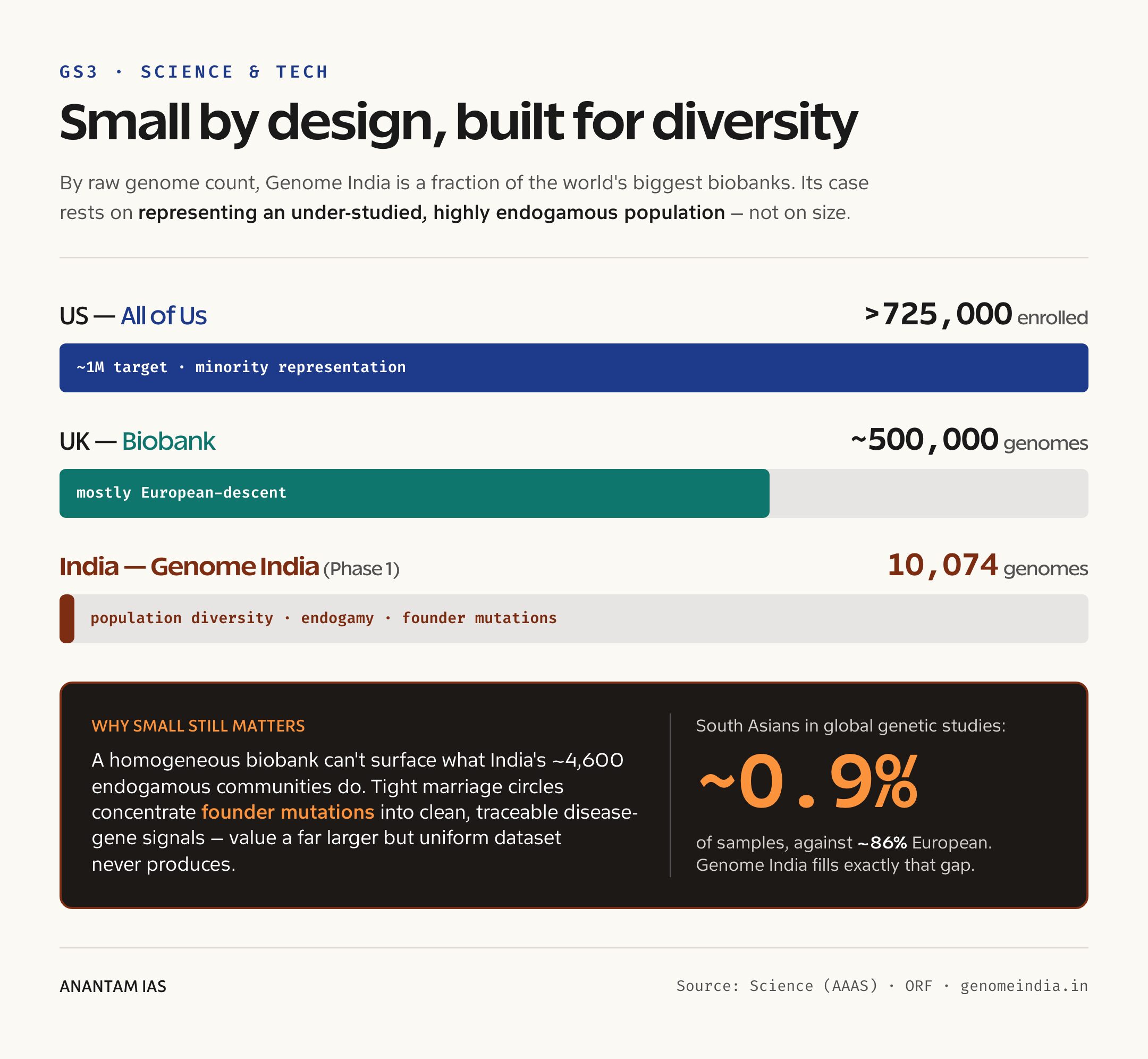
For most of the genomic era, the maps doctors used to read human DNA were drawn almost entirely from European bodies. Roughly 86 percent of the people in the world’s big genetic studies trace to European ancestry, while South Asians make up under 1 percent. So when a cardiologist in Chennai pulled a risk score off an international database, she was using a ruler calibrated for someone who looked nothing like her patient. On 9 January 2025, that started to change. The government released the first batch of the Indian Genomic Data Set, the genomes of over 10,000 Indians, and opened it to researchers in India and abroad.
That single release is a real scientific milestone and a real governance problem, and the two showed up on the same day. The science is the promise of precision medicine built for Indian bodies. The problem is that the data is the most personal information a citizen owns, India has no law stopping anyone from using it to discriminate, and the country’s new privacy statute doesn’t even treat genetic data as special. For a Mains aspirant, that’s the whole topic in one sentence: the cure and the unguarded flank arrived together.
The Issue, Framed
The argument here isn’t whether sequencing Indian genomes is worth doing. It plainly is. The argument is about what gets built around the data before, not after, the harm shows up.
Let’s fix the vocabulary first, because half the confusion around this topic comes from loose use of five words. A genome is the complete set of genetic instructions in a person’s cells, written in roughly three billion chemical letters of DNA. Whole-genome sequencing is reading that entire instruction set, every letter, rather than checking a few known spots. A reference genome is the standard template scientists line a new genome up against to spot where it differs. Each of those differences is a genetic variant, a place where your DNA reads differently from the template, and most variants are harmless while a few drive disease or change how you respond to a drug. Precision medicine is the payoff: tailoring prevention, diagnosis, and treatment to a person’s genetic make-up instead of treating everyone as an average patient.
One more term earns its place because it’s where the near-term wins live. Pharmacogenomics is the study of how your genes shape your response to medicines, why a standard dose helps one patient, does nothing for a second, and poisons a third. Drug-dosing models today lean heavily on European-descent data. So an Indian patient can get a dose tuned to a body that metabolises the drug differently.
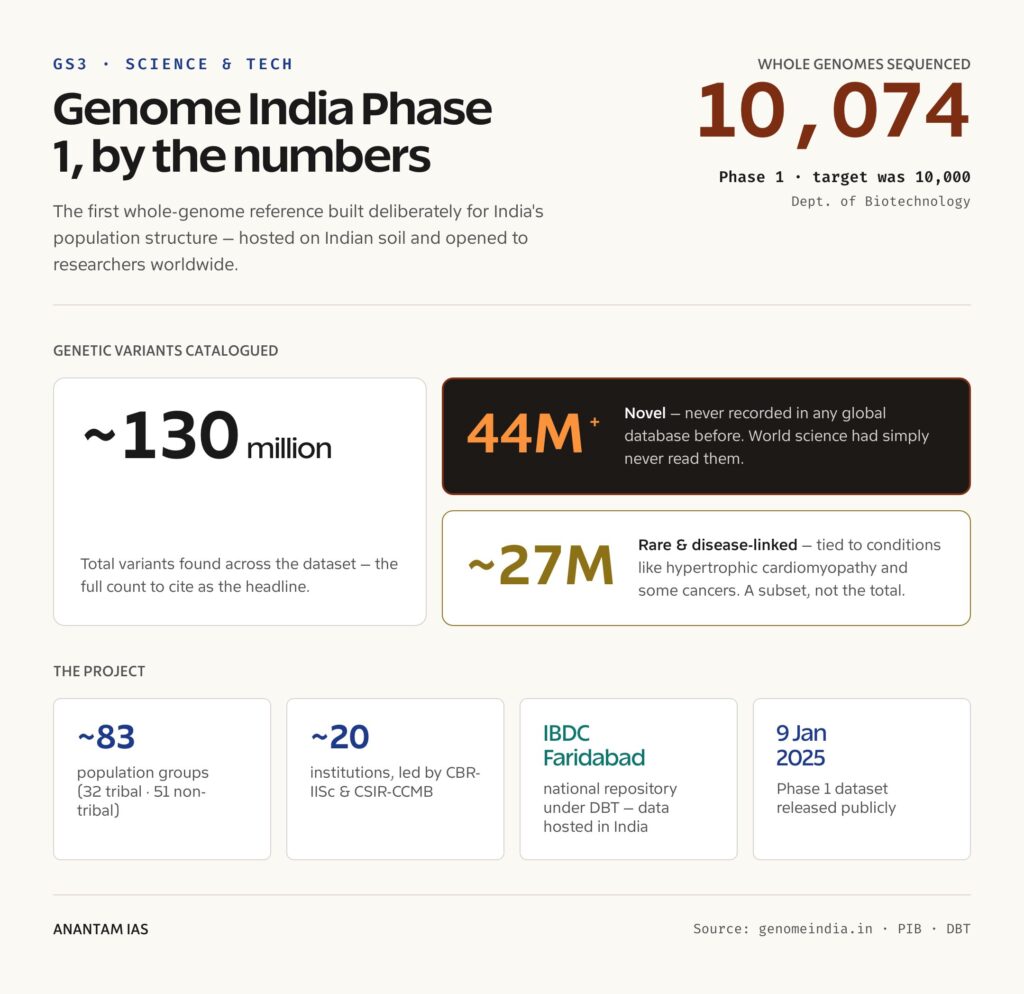
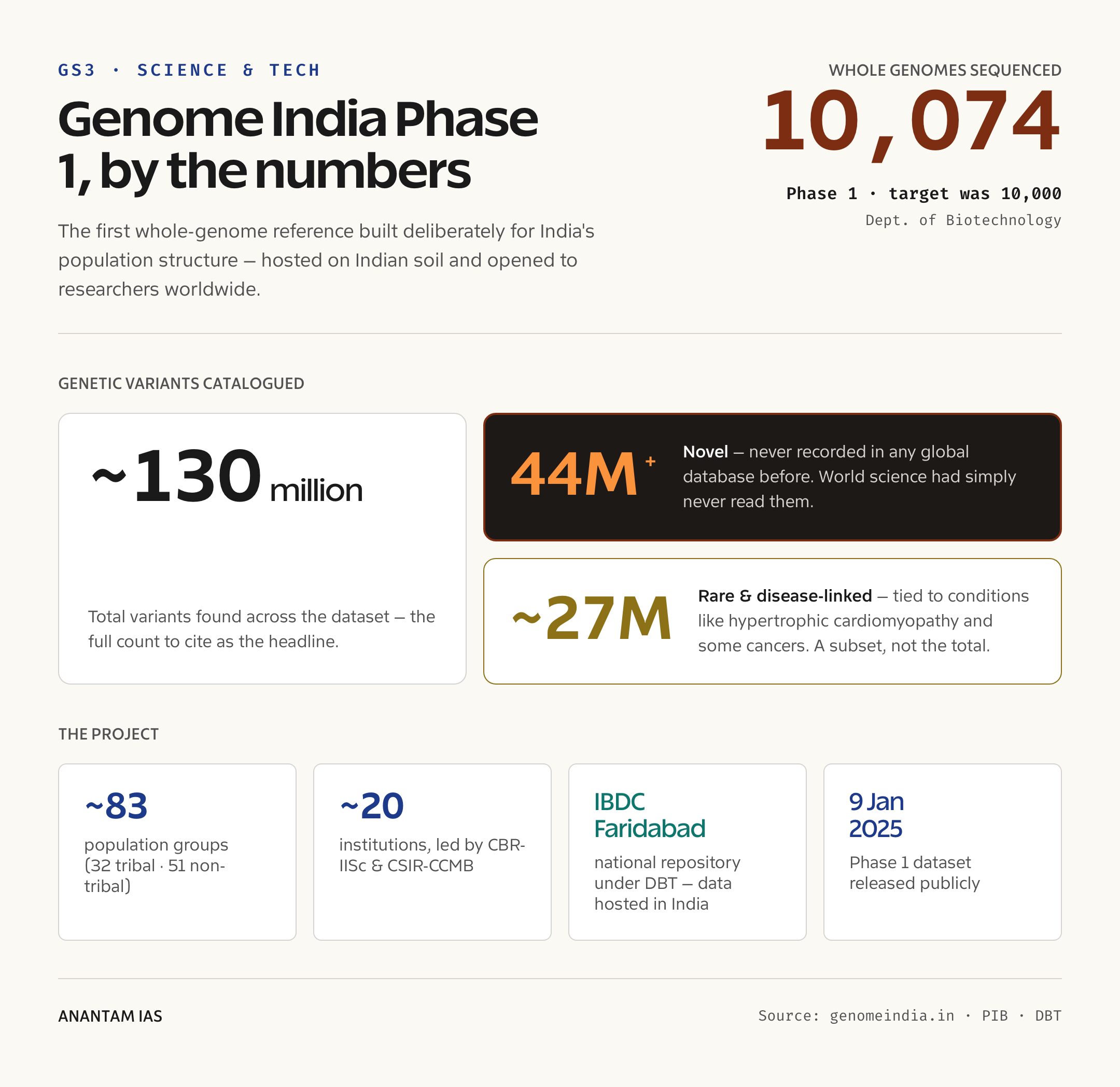
The Genome India Project is the attempt to fix that root problem. The Department of Biotechnology funds it, it launched in January 2020, and around 20 institutions ran it, with the Centre for Brain Research at IISc Bengaluru and CSIR-CCMB in Hyderabad coordinating. Phase 1 sequenced 10,074 whole genomes drawn from about 83 population groups across the country, and the resulting dataset went public on 9 January 2025.
Here’s the seam underneath the celebration. A genome isn’t like a password you can change after a breach. It’s fixed for life, it’s shared with your siblings and children, and it reveals what diseases you’re predisposed to before you ever feel sick. So the question isn’t only “what can this data cure?” It’s “who else gets to see it, and what can they do to you with it?” India answered the first question with real ambition and left the second one mostly blank.
What the Data Says
The numbers tell you why scientists are excited and why this isn’t a marketing exercise. Phase 1 produced 10,074 whole genomes, just past the 10,000 target, archived alongside a biobank of around 20,000 blood samples. The samples were spread roughly 36.7 percent rural, 32.2 percent urban, and 31.1 percent tribal, which matters because tribal and rural India is exactly what the global databases never bothered to read.
Now the headline finding, and you have to label it precisely or you’ll lose the mark. Across those genomes, researchers catalogued about 130 million genetic variants. Of those, more than 44 million had never been recorded in any global database before. Read that twice. Forty-four million places in human DNA that world science had simply never seen, surfaced from one mid-sized Indian dataset. And about 27 million of the variants are rare and disease-linked, tied to conditions like hypercholesterolaemia, hypertrophic cardiomyopathy, and some cancers, with roughly 7 million of those being both rare and new to science.
So when you cite this, separate the layers cleanly: 130 million total, 44 million-plus novel, 27 million rare and disease-relevant. The 27 million is the rare subset, not the total. Treating it as the headline, or quoting a “36 lakh” figure that no primary source supports, is the kind of slip that tells an examiner you read a coaching note instead of the announcement.
The diversity behind those numbers is the real asset. The 83 sampled groups, about 32 tribal and 51 non-tribal, are drawn from a country of roughly 4,600 distinct communities spanning four language families. India also practises high endogamy, marriage within tight community boundaries over many generations, which concentrates founder mutations, disease-causing variants that get passed down within a single group. That’s painful for families and a gift for researchers, because tightly clustered genetic signals are far easier to trace to a specific gene than the scattered signals you get from a mixed population.
The data lives at the Indian Biological Data Centre (IBDC) in Faridabad, the national life-sciences repository under DBT, and it’s released in anonymised form under the Biotech-PRIDE Guidelines of 2021 and a Framework for Exchange of Data protocol launched alongside the dataset. So India is hosting its own genomic data rather than shipping samples abroad, which is the data-sovereignty argument in a nutshell.
The Case For
The promise here is genuine, and an answer that downplays it to sound balanced is just wrong on the science. So let’s state it at full strength.
It ends India’s invisibility in the genome. Risk scores and drug models built on European data routinely misfire for Indians, because a variant that’s common and harmless in one population can be rare and dangerous in another. Genome India is the first reference panel built deliberately to reflect Indian variation. So a diagnostic test calibrated on this data should finally read an Indian patient as an Indian patient, not as an average European with a margin of error stapled on.
It captures disease biology the rest of the world missed. Those 27 million rare, disease-linked variants, many absent from global databases, hand Indian clinicians and researchers concrete, population-specific targets. You can’t develop a test or a therapy for a mutation nobody has recorded. Now thousands of them are on the map.
The near-term payoff runs through pharmacogenomics. Drug-metabolism reference panels are over 60 percent European-descent, which is why adverse drug reactions and wrong doses are a quiet, constant tax on Indian patients. An Indian-tuned reference can sharpen dosing, including for psychiatric drugs where the evidence increasingly points to genetic screening before prescribing. This is the part of the promise that could touch a clinic soonest, before the flashier gene-therapy headlines arrive.
And the diversity is the strategic moat, not a diversity-checkbox. India’s endogamy and thousands of distinct groups generate founder mutations and clean disease-gene signals that a homogeneous biobank simply can’t surface. So a dataset that’s small by world standards can still deliver outsized scientific value, because it’s reading populations no one else has read. Hosting it at IBDC under Indian governance turns the country from a sample-exporter into a research hub, which is the self-reliance argument made concrete rather than sloganised.
The Case Against
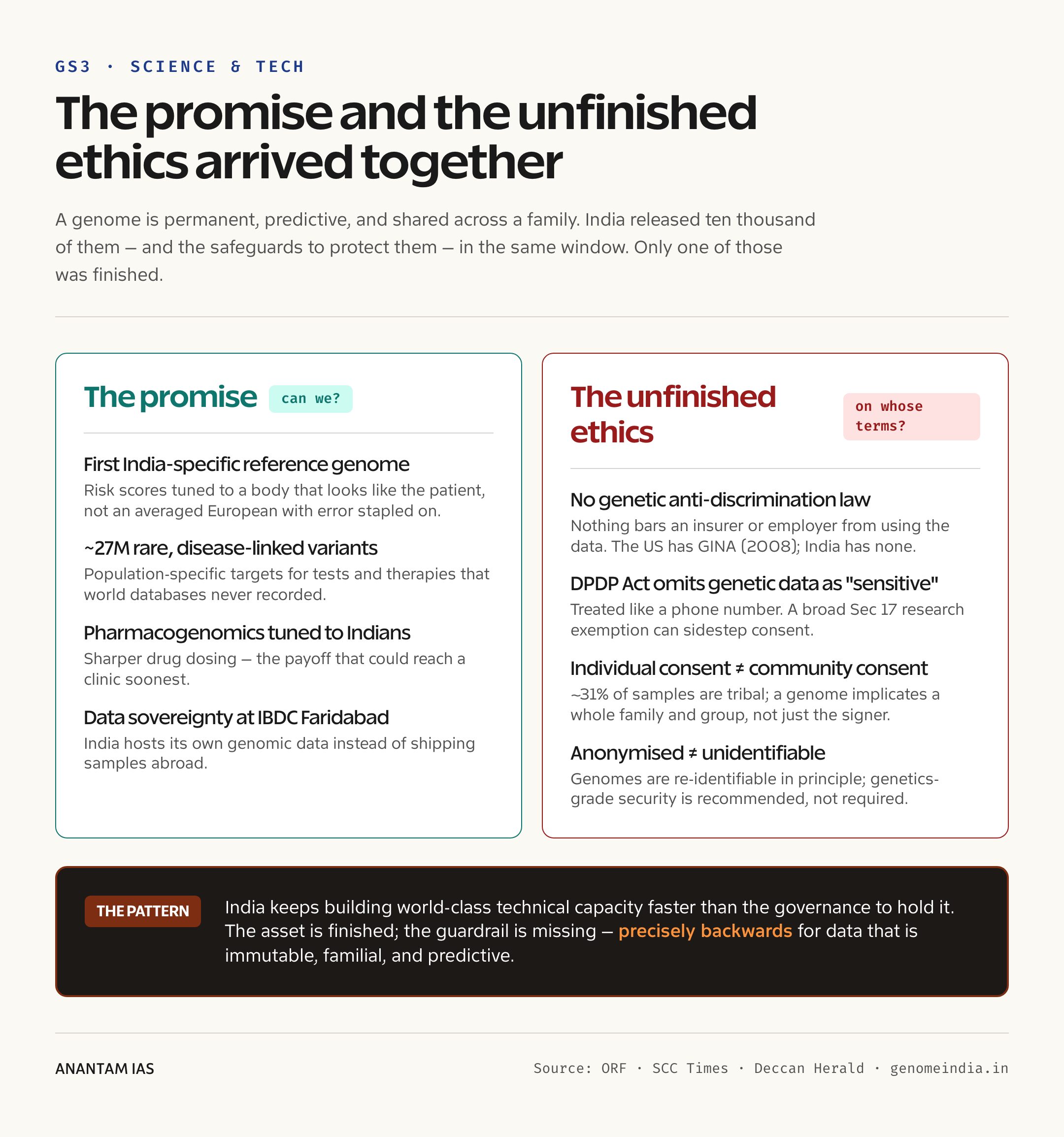
Here’s what the promise walks past. A genome is permanent, predictive, and shared across a family, and India released ten thousand of them into a legal vacuum built for ordinary data. On that test, the gaps are serious.
There’s no shield against genetic discrimination, full stop. India has no genetic anti-discrimination law, while the United States passed one back in 2008 with GINA, the Genetic Information Nondiscrimination Act, and Canada, the UK, and Australia have their own. Genomic data reveals your predispositions and your family’s, and nothing in Indian statute bars an insurer or employer from using it to deny you cover or a job. The Delhi High Court tried to close part of this gap in 2018, ruling in Jai Prakash Tayal v. United India Insurance that excluding “genetic disorders” from health cover is too broad and discriminatory and violates Article 14, the right to equality. But the Supreme Court partially stayed that judgment. So the protection isn’t settled law. It’s an open question with the citizen exposed in the meantime.
The privacy statute looks the other way. India’s Digital Personal Data Protection Act of 2023, with its 2025 Rules, is the new privacy regime, and it does not classify genetic data as a distinct sensitive category. Genomic data is treated as ordinary personal data, the same bucket as your phone number. Worse, Section 17 carves out a broad research exemption that can sidestep consent requirements, and while breach penalties can reach ₹250 crore, a penalty for losing the data isn’t the same as a rule classifying it as too sensitive to treat casually. So the country built a privacy law in the same window it built a genome bank, and the two barely acknowledge each other.
Consent for tribal and indigenous communities is structurally fraught. About 31 percent of the samples are tribal, and a genome implicates a whole family and community, not just the individual who signed the form. The ethical standard for that is community or collective consent plus benefit-sharing, so the group that contributed the data sees some of the gain. The DPDP research exemption can bypass even individual consent, never mind the collective version. Get this wrong and a project meant to include the under-studied ends up extracting from the most vulnerable.
Anonymised doesn’t mean unidentifiable. The data is released stripped of names, but genomes are, in principle, re-identifiable, and the sharing framework opens the dataset to researchers across India and the globe. Without genetics-grade security mandated by law, ISO 27799 and 27789-style controls are recommended, not required, the exposure is real.
And the clinical promise is further off than the headlines suggest. Phase 1 sequenced healthy, unrelated volunteers to build a reference, not patients to treat. So it’s a foundation, not a bedside tool yet. Most non-specialist doctors can’t interpret a genomic report, and complex-disease variants rarely translate into a clear “do this” today. Pair that with affordability, and the risk is that precision medicine, when it does arrive, reaches the metros and the well-off first, reproducing the very health gap the diversity argument promised to close.
The Deeper Structural Read
Step back from the dataset and the real pattern shows up. India keeps building world-class technical capacity faster than it builds the governance to hold it. The genome bank is the latest instance of a habit, not a one-off oversight.
Think about the sequence of events. The science ran on a clear, funded, decade-long plan, launched in 2020, delivered in 2025, hosted on sovereign infrastructure. The safeguards ran on nothing comparable. No genetic anti-discrimination law was drafted alongside the project. The privacy statute that did arrive declined to treat genetic data as special. The one judicial attempt to protect citizens, the Tayal ruling, sits half-stayed. So the asset is finished and the guardrail is missing, which is precisely backwards if you take the permanence of genetic data seriously.
The constitutional anchor makes the stakes concrete. In 2017, the Supreme Court held in K.S. Puttaswamy that privacy is a fundamental right under Article 21. Genetic privacy is the sharpest possible form of that right, because the data is immutable and familial. Read Puttaswamy next to the Tayal equality argument under Article 14, and you get the frame an examiner rewards: genetic data sits at the meeting point of the right to privacy and the right against discrimination, and right now neither is backed by an operative statute specific to genes. The rights exist in principle. The machinery to enforce them for genomic data doesn’t.
There’s a justice layer below that. The diversity pitch, that this dataset finally includes rural and tribal India, is real and admirable. But inclusion in the sample and inclusion in the benefit are different things. If the contributing communities carry the privacy risk while precision therapies stay priced for metros, the project will have collected from the margins and delivered to the centre. So the equity question isn’t a footnote to the science. It’s the test of whether the science was worth the trust people extended to it.
And here’s the part a future administrator should sit with. The strongest argument for the project, that India was invisible in global genomics, is an argument about representation and self-reliance, which the government clearly understands and acts on at scale. The weakest part, the missing safeguards, is an argument about restraint and rights, which is harder, slower, and less photogenic. India is consistently better at the first kind of project than the second. Closing that gap, capability without commensurate governance, is the structural lesson that travels well beyond genomes, into AI, into digital identity, into every frontier the state is now racing to occupy.
What Should Be Done
So what does responsible scaling actually look like? Not a vague plea to “balance innovation and ethics,” but a set of moves a ministry could put in motion this year. Six of them, and none slows the science down.
- Enact a genetic anti-discrimination law. A GINA-style statute barring the use of genetic information in insurance and employment, and codifying the Right to Privacy principle for genes, would settle the uncertainty the Supreme Court’s partial stay of the Tayal judgment left behind. This is the single biggest gap, and it’s the one with a clear international template to copy.
- Classify genetic data as sensitive personal data. Amend the Digital Personal Data Protection Act framework so genetic data sits in its own protected tier, and narrow the Section 17 research exemption so it can’t override consent for genomic data specifically. A genome is not a phone number, and the law should stop pretending it is.
- Build consent and governance for communities, not just individuals. For tribal and indigenous cohorts especially, require community or collective consent and benefit-sharing, and stand up an independent genomic-data ethics body to oversee access. Inclusion in the dataset has to come with a stake in the gains.
- Mandate genetics-grade data security at IBDC. Make ISO 27799 and 27789-style controls, audit trails, and tiered or federated access the legal floor, not a recommendation. Anonymised data that can be re-identified needs the security of identified data, by rule and not by goodwill.
- Invest in equitable clinical translation. Train non-specialist clinicians to read genomic reports, fund public-sector diagnostics, and use price controls and insurance so precision therapies reach beyond the metros. A reference genome only matters if a district hospital can eventually act on it.
- Scale toward the million-genome ambition at the speed of governance, not just sequencing. Expand to the groups and disease cohorts still under-represented, but pace the expansion to the consent, security, and oversight capacity that’s actually in place. Sequencing faster than you can govern is how a milestone turns into a liability.
Every one of these strengthens the project rather than constraining it. A genome bank citizens trust, because they know it can’t be turned against them, is a genome bank that more people will join. That trust is the real infrastructure precision medicine runs on.
For Your Mains Answer
This is a high-value GS3 topic with a clean GS2 spine, which is exactly the kind of cross-paper material examiners reward.
GS paper mapping: GS3: Science & Technology, developments and their applications and effects in everyday life; biotechnology; awareness in biotech; indigenisation and data sovereignty. GS2: governance and regulatory frameworks; fundamental rights (Article 21 privacy, Article 14 equality); protection of vulnerable sections; health-sector governance.
Likely question frames:
- The Genome India Project is a scientific milestone, but India’s genetic-data governance has not kept pace. Critically examine.
- Precision medicine promises population-specific healthcare, yet raises serious questions of genetic privacy and discrimination. Discuss in the Indian context.
- Scientific capacity without commensurate regulatory safeguards is a recurring feature of India’s technology missions. Analyse with reference to genomic data.
Quotable data points:
- 10,074 whole genomes sequenced in Phase 1, dataset released 9 January 2025.
- ~130 million genetic variants found, of which over 44 million are new to global databases and ~27 million are rare and disease-linked.
- ~83 population groups from a country of ~4,600 distinct communities, across four language families.
- In global studies, South Asians are ~0.9 percent of samples against ~86 percent European.
- UK Biobank ~500,000 genomes; US All of Us over 725,000 enrolled; Genome India is roughly 50× smaller but built for diversity.
- India has no genetic anti-discrimination law, unlike the US (GINA, 2008), Canada, UK, Australia.
- The DPDP Act, 2023 does not classify genetic data as sensitive; breach penalties can reach ₹250 crore.
- Delhi HC (2018, Tayal) held insurance exclusion of genetic disorders unconstitutional under Article 14; the Supreme Court partially stayed it.
Keywords to use: whole-genome sequencing, precision medicine, pharmacogenomics, reference genome, founder mutations, endogamy, genetic privacy, informed and community consent, data sovereignty, re-identification, clinical translation, health equity.
Syllabus linkages: science and technology in everyday life, biotechnology, indigenisation; fundamental rights, regulatory frameworks, protection of vulnerable sections, health governance; cross-cut into Ethics on consent, justice, and the science-society relationship.
Balanced conclusion line: A genome bank is only as valuable as the trust it earns; India has built the science of precision medicine ahead of the safeguards that make it safe to use, and closing that gap is now the harder, and the more important, half of the project.
How to Build the Answer
Open with the gap, not a definition. The sharpest first line is that India released ten thousand genomes and the safeguards to protect them in the same window, and only one of those was finished. That tells the examiner you’ve grasped the science and the governance failure at once. The definition of the genome or precision medicine can follow in the second sentence, where it supports the argument instead of delaying it.
Bring data in early, but ration it. A strong opening body paragraph can carry three figures: 10,074 genomes, 130 million variants with 44 million-plus novel, and South Asians at under 1 percent of global samples. Then say what they prove, that this fixes a real blind spot in world science. UPSC rewards the move from fact to inference, so never let a number sit without a “this means.”
The next paragraph should steelman the science before you critique the governance. Concede that the project is a genuine milestone, that the diversity is a true scientific asset, that pharmacogenomics could help patients soon. An answer that only attacks reads as reflexive; an answer that praises the science and then names the missing law reads as judgment.
Group the way forward, don’t scatter it. Cluster the reforms under headings the marker can scan: a genetic anti-discrimination law, sensitive-data classification under DPDP, community consent, genetics-grade security, equitable translation. Use the topic’s own vocabulary, founder mutations, endogamy, re-identification, so the answer sounds like science-and-governance analysis rather than a news recap.
Close on the structural lesson. The last line should not echo the introduction; it should show judgment, that India builds capability faster than it builds the governance to hold it, and genomics is the latest proof. That moves the answer from one project to a pattern, which is what separates a good script from a top one.
Common Mistakes to Avoid
- Don’t quote the wrong number. It’s ~130 million total variants, 44 million-plus novel, ~27 million rare. The “36 lakh” figure floating around coaching notes has no primary source. Using it signals you didn’t read the announcement.
- Don’t treat the project as purely a success or purely a scandal. The science is real and the governance gap is real. Hold both.
- Don’t confuse anonymised with safe. Genomes can be re-identified in principle, so “the data is anonymised” is not the end of the privacy argument.
- Don’t forget the family. Genetic data implicates relatives who never consented, which is why individual consent isn’t enough for tribal cohorts. Naming this shows depth.
- Don’t end on a slogan. Close with the capability-versus-governance lesson or a constitutional value, not a flourish about “the future of medicine.”
A Compact Answer Spine
- Introduction: Open with the milestone-and-missing-safeguard tension in one sentence; define genome and precision medicine in the next.
- Evidence: Use two or three attributed figures, each tied to an implication, the diversity blind spot fixed, the novel variants surfaced.
- Arguments: The promise, first-mover reference panel and pharmacogenomics, then the ethics, no anti-discrimination law, DPDP silence, consent and re-identification. Keep both fair.
- Structural diagnosis: Capability outpacing governance; Article 21 privacy meets Article 14 equality, with no operative gene-specific statute behind either.
- Way forward: Five or six grouped reforms, each with a clear actor, Parliament, the data-protection regime, an ethics body, IBDC, the health system.
- Conclusion: Adapt the balanced conclusion line to the exact wording of the question.
Diagram or Flowchart Idea
For a 15-marker, draw one logic chain, not a decorative web. The cleanest format: European-skewed databases → Indian patients mis-served → Genome India reference panel → precision medicine and pharmacogenomics → but immutable, familial data → privacy and discrimination risk → safeguards needed (anti-discrimination law, DPDP classification, community consent). The examiner reads the whole tension in five seconds.
For a 10-marker, skip the diagram and use a two-column table instead, “The Promise” against “The Unfinished Ethics,” with three rows each. It carries more under time pressure and is faster to evaluate.
Ethics and Governance Angle
Add at least one ethical line even in a GS3 answer. The science question is “can we?”; the ethics question is “should we, and on whose terms?” Here that lands on a concrete person, the tribal participant whose genome implicates a whole community, the patient who could be denied insurance for a predisposition she can’t change. Naming who bears the risk sharpens any answer.
Then convert the empathy into design, the way an administrator must. Don’t merely say “protect privacy.” Say how: classify genetic data as sensitive, require community consent and benefit-sharing, mandate genetics-grade security, pass an anti-discrimination law. That’s the move from moral language to governance maturity, and it reads as competence, not sentiment.
A sentence pattern that travels across topics: “The aim is legitimate, but its legitimacy depends on consent, security, and equity.” It accepts the State’s scientific ambition without handing it a blank cheque over the most personal data a citizen owns, which is exactly the calibrated stance the examiner is looking for.
How to Use Data Without Sounding Mechanical
Use fewer numbers than you know. Three well-explained figures beat ten dumped in a row. Lead with the scale fact (10,074 genomes), follow with the scientific payoff (44 million-plus novel variants), and use a third for contrast (South Asians under 1 percent of global samples). One scale figure, one payoff figure, one gap figure is usually enough.
Never leave a statistic standing alone. Follow it with “this means” or “the implication is.” That single move turns a fact sheet into analysis, and in Mains the analysis is where the marks live, not the recall.
Watch the labelling, because this topic punishes sloppiness. Say “130 million total variants, of which 27 million are rare” rather than blurring the two. Precision with numbers is itself an argument; it tells the examiner you understand what you’re citing rather than parroting it.
One last sweep: cut any sentence that sounds grand but does no work, and replace it with a fact, a cause, or a reform. That habit is the difference between an answer that feels informed and one that feels memorised. Write for clarity, and be specific.
FAQ
What is the Genome India Project and what did Phase 1 achieve?
The Genome India Project is a Department of Biotechnology initiative, launched in January 2020 and run by around 20 institutions led by the Centre for Brain Research at IISc and CSIR-CCMB. Phase 1 sequenced 10,074 whole genomes from about 83 population groups and released the anonymised dataset publicly on 9 January 2025, building the first whole-genome reference designed specifically for India’s population structure.
Why does India need its own genome data when global databases exist?
Because the global databases are overwhelmingly European, around 86 percent of study samples, with South Asians under 1 percent. Risk scores and drug-dosing models built on that data routinely misfire for Indians, since a variant that’s harmless in one population can be dangerous in another. India’s high endogamy also concentrates founder mutations that an India-specific reference can detect but a European one cannot.
What are the main ethical and legal risks?
A genome is permanent, predictive, and shared across a family, yet India has no genetic anti-discrimination law, and the DPDP Act, 2023 does not classify genetic data as sensitive. The Delhi High Court’s 2018 ruling against insurance discrimination on genetic grounds was partially stayed by the Supreme Court, so the protection is unsettled. Tribal and community consent, plus the re-identifiability of “anonymised” genomes, remain open concerns.
How does Genome India compare with the UK Biobank and US All of Us?
It’s far smaller by raw numbers. The UK Biobank has released around 500,000 genomes and the US All of Us programme has enrolled over 725,000 participants, while Genome India’s Phase 1 covers 10,074, roughly 50 times smaller. But the design pitch is diversity, not scale: Genome India is built to represent a highly varied, under-studied population, with a stated long-term ambition to scale toward a million genomes.
Tell Google you want more of this.
Add Anantam IAS as a preferred sourceOne tap, and this site shows up more often in your own Top Stories, AI Overviews and AI Mode. Remove it any time.