
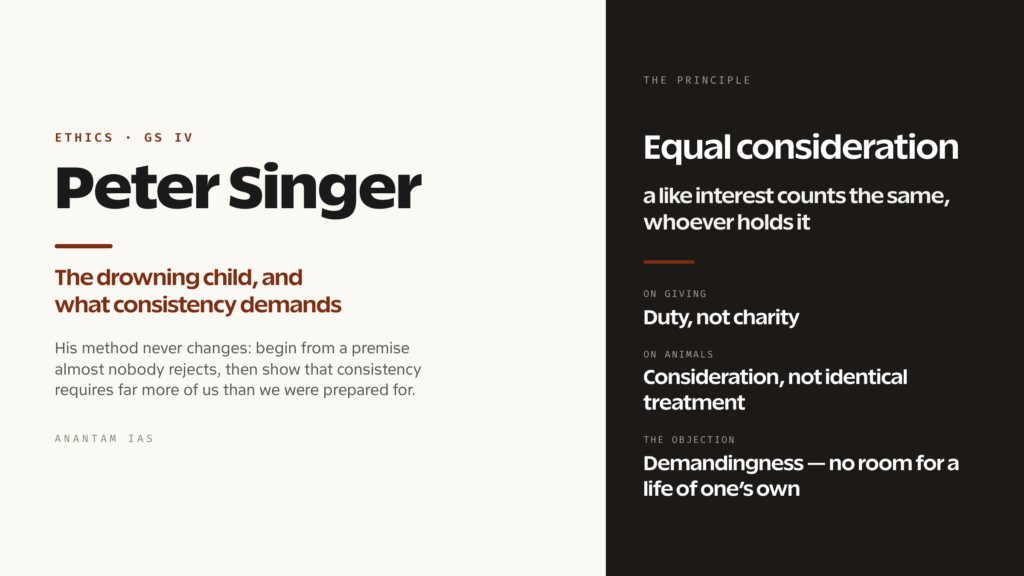
You are walking past a shallow pond and see a small child drowning in it. You can wade in and pull the child out. Doing so will ruin your clothes. Almost nobody hesitates over what you should do, and almost nobody thinks ruined clothes are a serious counter-consideration.
Peter Singer’s contribution to modern ethics is to take that unanimity and refuse to let it stay comfortable. If you are obliged to save the child at the cost of your clothes, what exactly changes when the child is a thousand miles away, when the cost is the same, and when others could also help but are not helping? Singer’s answer is: nothing that matters morally. His method throughout is the same — start from a premise readers already accept, then show that consistency demands far more than they were prepared for.
Preference Utilitarianism
Singer is a utilitarian, but not a Benthamite one. Classical utilitarianism measures pleasure and pain; Singer’s preference utilitarianism asks us to give equal weight to the preferences of all those affected by an action. What is bad is the thwarting of a preference; what is good is its satisfaction.
Two consequences follow. First, the currency of morality is not a mental state we might dispute the existence of, but interests that can be identified and compared. Second, the demand for equal consideration of interests becomes the foundational principle: a like interest counts the same wherever it is located, whoever holds it. Distance, nationality and species are not, on this view, morally relevant to the weight of an interest.
The framework’s discipline is that it is genuinely impartial about the agent. Your own interests count, but only once — not more because they are yours. That is the engine of everything below. The wider utilitarian tradition Singer works in is set out in the utilitarians.
The Drowning Child, and Famine Relief
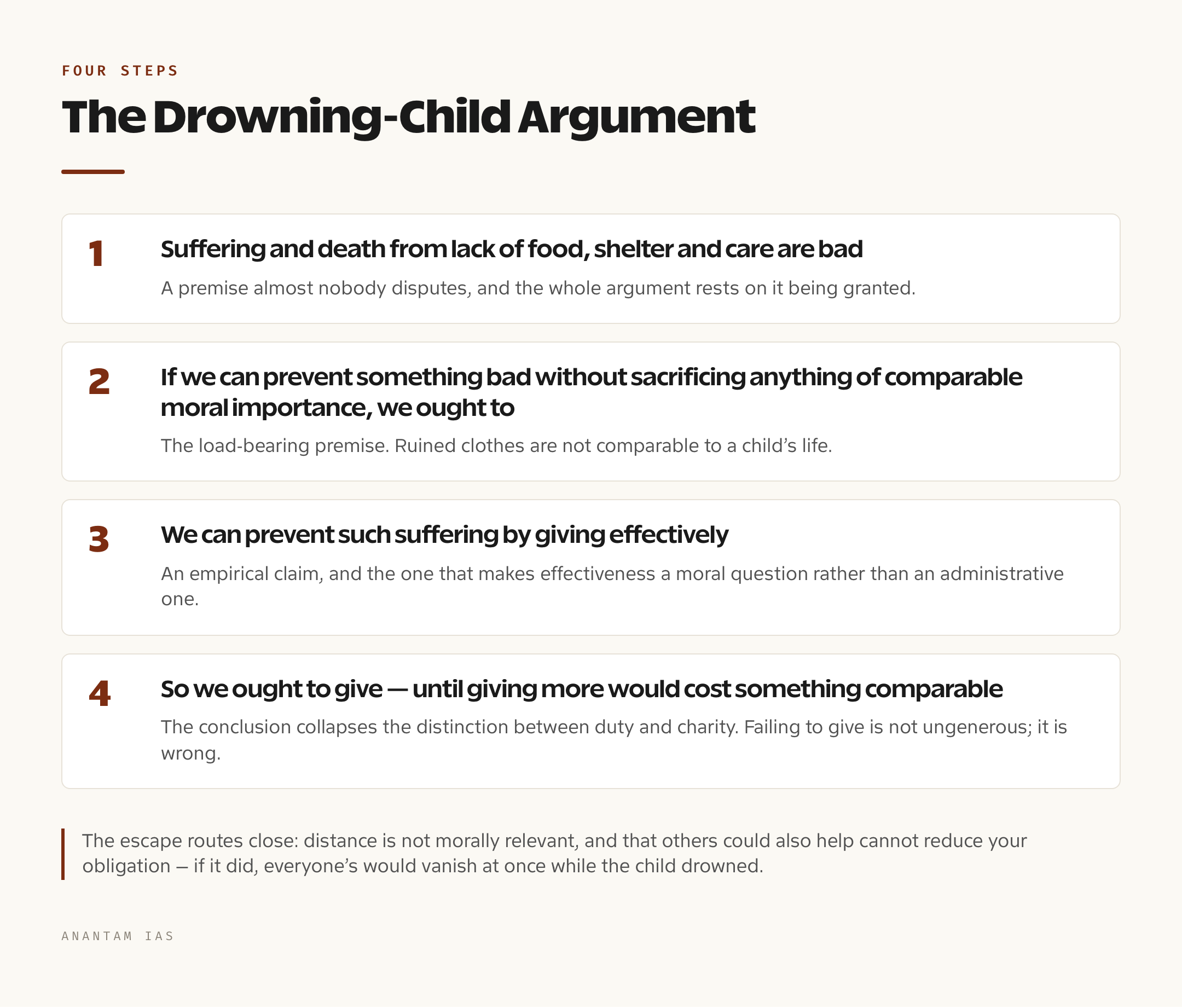
In Famine, Affluence and Morality, Singer sets out the argument that made him famous. It runs as a short chain.
Suffering and death from lack of food, shelter and medical care are bad. If we can prevent something bad from happening without thereby sacrificing anything of comparable moral importance, we ought to do it. We can prevent such suffering by donating to effective relief. So we ought to donate — and the obligation continues until giving more would cost us something of comparable moral importance.
The conclusion is radical, and Singer accepts that it is. It implies that spending on luxuries while preventable deaths continue is not merely less than ideal but wrong, and it collapses the familiar distinction between duty and charity. Giving is not a generous extra; failing to give is a failure of obligation.
He then removes the escape routes. Distance cannot matter, because moral weight does not attenuate with kilometres. Numbers cannot matter: that millions of others could also help does not reduce what you should do, since if it did, everyone’s obligation would vanish simultaneously while the child drowned. And the fact that a problem is large does not make individual contribution pointless, because each contribution saves identifiable people.
Effective Altruism
If the obligation is to prevent suffering, then how much suffering your giving actually prevents becomes a moral question rather than an administrative one. This is the root of effective altruism: the claim that we should direct resources where they do the most good per unit, judged by evidence rather than by which cause moves us.
The uncomfortable implication is that well-intentioned giving can be a moral failure. A donation that funds a photogenic but ineffective intervention, when the same money could have prevented far more harm elsewhere, has wasted the moral opportunity. Sentiment about a cause is not, on this view, a justification for it.
The movement has drawn serious criticism, some of it from sympathisers. It privileges what can be measured, which biases against political and structural change whose effects resist quantification — arguably the interventions that matter most. It can substitute individual generosity for justice, treating an unjust distribution as a fundraising problem. And the turn among some effective altruists towards speculative long-run risks has been criticised as a way of reasoning oneself out of present, verifiable obligations.
Animal Liberation and Speciesism
Singer’s other major intervention applies equal consideration across the species boundary. His argument does not claim animals are equal to humans in capacity. It claims something narrower and harder to dismiss: the capacity to suffer is what makes a being’s interests count at all, and where the capacity is present, the interest in not suffering must be weighed.
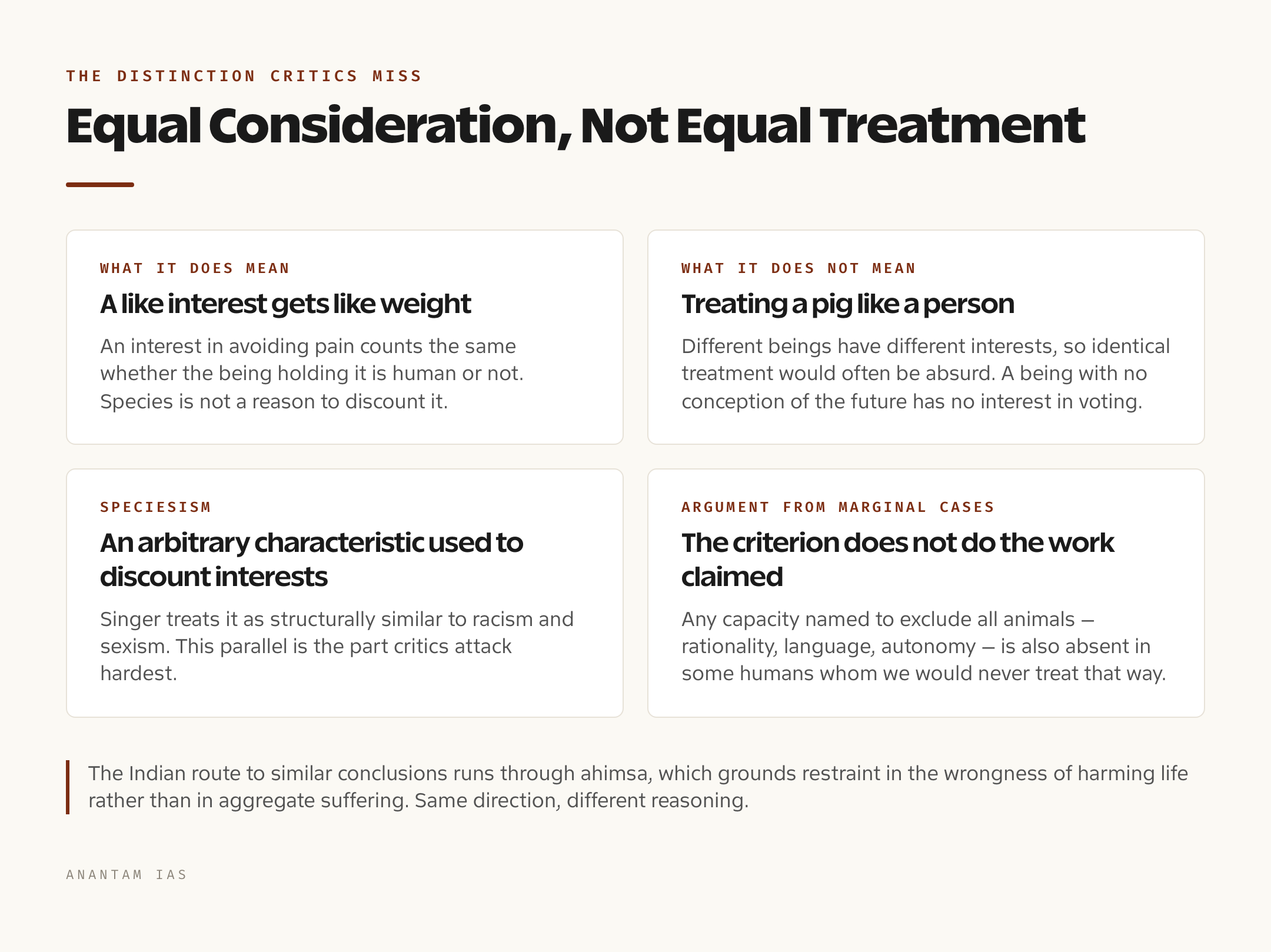
Speciesism is his term for a bias favouring the interests of one’s own species over comparable interests of another, and his charge is that it is structurally identical to racism and sexism — an arbitrary characteristic used to discount interests. The parallel is deliberately provocative and is the part critics attack hardest.
The distinction that most objections miss is between equal consideration and equal treatment. Equal consideration of interests does not mean treating a pig like a person; it means that a like interest — in avoiding pain — gets like weight. Different beings have different interests, so identical treatment would often be absurd. A being with no conception of the future has no interest in voting; it has a strong interest in not being made to suffer.
Singer’s practical conclusions concern factory farming and painful experimentation, where large amounts of suffering are imposed for marginal human benefit. The argument from marginal cases sharpens it: any capacity we name to justify excluding all animals — rationality, language, autonomy — is also absent in some humans whom we would never treat that way, so the criterion cannot be doing the work we claim.
The Objections
Demandingness. The strongest objection is that Singer’s ethics leaves no room for a life of one’s own. A morality that requires giving until further giving hurts comparably makes every ordinary attachment — a child’s music lessons, a holiday, a book — suspect. Critics argue an ethic that virtually nobody can satisfy has misidentified what morality is for. Singer’s reply is partly to accept the demand and partly to propose achievable thresholds instead, on the ground that a realistic standard actually achieves more.
Integrity and agent-centred concerns. Impartial consequentialism struggles to accommodate the thought that my projects and relationships are mine in a way that matters morally, not just as inputs to a total.
The controversies. Singer’s positions on the treatment of severely disabled infants have drawn sustained protest, particularly from disability-rights advocates who argue his framework treats certain lives as having less claim. This is the most contested part of his work, and an accurate treatment should note that the objection is not merely squeamishness — it concerns whether a preference-based criterion can adequately protect those whose preferences are hard to identify.
Aggregation. Preference utilitarianism inherits the standard problem of the tradition: aggregate totals can justify serious harm to a few, and there is no principled floor. The counter-position is Rawlsian; see John Rawls on justice.
Indian Relevance
Singer’s arguments intersect Indian debates in ways worth naming.
Charity against justice. India’s philanthropic tradition is substantial, and Singer’s collapse of the duty-charity distinction reframes it: if giving is obligatory, a culture of voluntary generosity is not a substitute for entitlement-based welfare. That argument cuts both ways in the CSR debate.
Ahimsa arrives at similar conclusions from a different route. Jain and Buddhist non-injury grounds restraint in the moral character of the agent and in the wrongness of harming life, rather than in aggregate suffering. The conclusions overlap on diet and animal treatment; the reasoning does not, and noting that difference is a genuinely strong move in an answer.
Constitutional resonance. Article 51A(g) makes it a fundamental duty to have compassion for living creatures, and Indian courts have developed animal-welfare jurisprudence around it. The doctrinal language of duty sits closer to Kant and to dharma than to Singer’s aggregation, but the practical direction is similar.
Global inequality. Singer’s famine argument is usually read in the West as an obligation of rich individuals. Read from India, the more interesting question is what it implies about domestic inequality, and whether an argument built to bridge international distance applies with more force across a city.
FAQ
What is Singer’s drowning-child argument? If you would be obliged to save a drowning child at the cost of your clothes, and distance and numbers are not morally relevant, then you are similarly obliged to prevent distant suffering you could prevent at comparable cost. It concludes that giving is a duty, not charity.
What is preference utilitarianism? Singer’s version of utilitarianism, on which what matters is the satisfaction or thwarting of the preferences of all affected, with equal weight given to like interests regardless of who holds them.
What is speciesism? A bias favouring the interests of one’s own species over comparable interests of members of another. Singer argues it is structurally similar to racism and sexism because it uses an arbitrary characteristic to discount interests.
Does Singer say animals and humans are equal? No. He argues for equal consideration of like interests, not equal treatment. Different beings have different interests, so identical treatment would often make no sense; what he rejects is discounting a like interest in avoiding suffering because of species.
What is effective altruism and what is wrong with it? The view that giving should be directed where evidence shows it does the most good. Criticisms are that it privileges the measurable, can substitute private generosity for structural justice, and in some versions drifts towards speculative long-term causes at the expense of present obligations.
What is the main objection to Singer’s ethics? Demandingness — that an obligation to give until further giving costs something comparable leaves no space for personal projects and attachments, and that a standard almost nobody can meet has misunderstood morality’s function.
Practice Questions
Prelims MCQs
- Singer’s argument in Famine, Affluence and Morality concludes that: (a) charity is supererogatory (b) giving to prevent suffering is a duty rather than charity (c) only governments have relief obligations (d) distance reduces moral obligation — Answer: (b) He collapses the distinction between duty and charity.
- “Speciesism” refers to: (a) preserving endangered species (b) classifying organisms scientifically (c) bias favouring one’s own species over comparable interests of others (d) the study of species interaction — Answer: (c) Singer treats it as analogous to racism and sexism.
- Singer’s foundational principle is best stated as: (a) the greatest happiness of the greatest number (b) equal consideration of interests (c) the categorical imperative (d) the difference principle — Answer: (b) Like interests receive like weight regardless of who holds them.
- The “argument from marginal cases” holds that: (a) marginal utility declines (b) capacities used to exclude all animals are also absent in some humans (c) marginal costs should guide giving (d) only marginal cases require ethical analysis — Answer: (b) So the stated criterion cannot be doing the excluding work claimed for it.
- Which fundamental duty relates to compassion for living creatures? (a) Article 51A(c) (b) Article 51A(e) (c) Article 51A(g) (d) Article 51A(i) — Answer: (c) Article 51A(g) covers protecting the environment and having compassion for living creatures.
Mains Practice Questions
- “If we can prevent something bad without sacrificing anything of comparable moral importance, we ought to do it.” Examine this principle and its implications for the distinction between duty and charity. (15 marks, 250 words)
- Distinguish equal consideration of interests from equal treatment. Does the distinction rescue Singer’s animal-liberation argument from the charge of absurdity? (15 marks, 250 words)
- Singer’s ahimsa-like conclusions rest on aggregation while Jain and Buddhist ethics rest on non-injury. Compare the two routes and their practical implications. (15 marks, 250 words)
- “Effective altruism privileges what can be measured.” Critically evaluate this objection. (10 marks, 150 words)
- Discuss the demandingness objection to Singer’s ethics, and whether a moral theory almost nobody can satisfy is thereby defective. (10 marks, 150 words)
Tell Google you want more of this.
Add Anantam IAS as a preferred sourceOne tap, and this site shows up more often in your own Top Stories, AI Overviews and AI Mode. Remove it any time.