Metagenomics: How DNA From a Spoon of Soil Reveals an Entire Microbial World
A complete UPSC GS-III explainer on metagenomics. Covers the sequencing pipeline, 16S rRNA vs shotgun metagenomics, applications in human gut microbiome, AMR surveillance, environmental DNA and bioremediation, India's microbiome programme and IndiGen, and policy questions.
Metagenomics is what biology looks like when you stop trying to grow microbes in a Petri dish and just sequence everything in a sample. A spoon of soil contains thousands of bacterial species. A swab of the human gut, tens of thousands. A litre of seawater, hundreds. For most of microbiology’s history, more than 99 percent of these organisms were invisible to science because they refused to grow in a laboratory. Metagenomics removed the need to culture them. Extract DNA directly from the sample, sequence it, and ask software to figure out which organisms are there and what they’re doing.
The technique has restructured fields that depend on understanding microbial communities. The Human Microbiome Project, the global Earth Microbiome Project, environmental monitoring of antibiotic resistance, the diagnosis of unexplained infections, and the discovery of new enzymes for industrial use all run on metagenomic methods. The cost of sequencing has fallen by roughly six orders of magnitude since 2003, making metagenomic studies that once took years and millions of dollars feasible for routine clinical and surveillance work.
For UPSC GS-III, metagenomics is a high-leverage topic because it cuts across health, environment, agriculture, and policy. The Antimicrobial Resistance crisis, the microbiome studies that influence diet and disease research, the eDNA surveillance methods now used in conservation, and the bioprospecting questions around traditional knowledge all run through metagenomic data. This article walks through what metagenomics is, the sequencing pipeline, the major sub-techniques, the application clusters, India’s research stack, and the policy issues that follow when you can sequence the microbial life in any sample.
Quick Facts on Metagenomics
Metagenomics is the study of genetic material recovered directly from environmental samples without culturing the organisms. The defining principle is that DNA from an entire microbial community is extracted, sequenced, and analysed at once, producing a snapshot of which organisms are present and, with deeper analysis, what they’re doing.
The term was coined in 1998 by Jo Handelsman at the University of Wisconsin. The first major applications followed in the early 2000s as the cost of DNA sequencing dropped. The Human Microbiome Project, funded by the US National Institutes of Health from 2007, mapped the bacterial communities of the human body and was one of the field’s defining demonstrations. The Earth Microbiome Project, launched in 2010, set out to do the same for global ecosystems.
The cost economics matter. The first human genome cost about three billion US dollars and took thirteen years. By 2026, a whole human genome can be sequenced for a few hundred dollars in a few hours. A metagenomic survey of a single soil sample costs in the range of a few thousand rupees and produces tens of millions of sequence reads in a single instrument run. The price floor has put metagenomics within reach of every working biology laboratory.
Why Culture-Independent Sequencing Matters
The Petri dish has been the workhorse of microbiology for more than a century, but it has a fundamental limitation. Most microbes do not grow on standard laboratory media. They depend on specific nutrients, temperature, oxygen levels, or other organisms in ways that no single agar plate can reproduce. Estimates of the fraction of microbes that can be cultured under standard conditions hover between 0.1 and 1 percent, depending on the environment. Soil and ocean communities are particularly hard. The unculturable majority is sometimes called microbial dark matter.
Culture-independent sequencing skips this problem. DNA is extracted directly from the sample, regardless of whether the organism is alive, dead, or impossible to culture. The sequence reads then map to known genomes or, where no match exists, hint at unknown species. The first big surprise from this approach was how much of microbial diversity had been missed. Whole bacterial phyla, with no cultured representatives at all, were detected only after culture-independent sequencing came online.
This matters beyond pure research. AMR surveillance, for instance, depends on detecting resistance genes in environmental and clinical samples. If most bacteria carrying resistance genes cannot be cultured, surveillance based on culture would systematically miss them. Metagenomics catches them.
The Sequencing Pipeline Step by Step
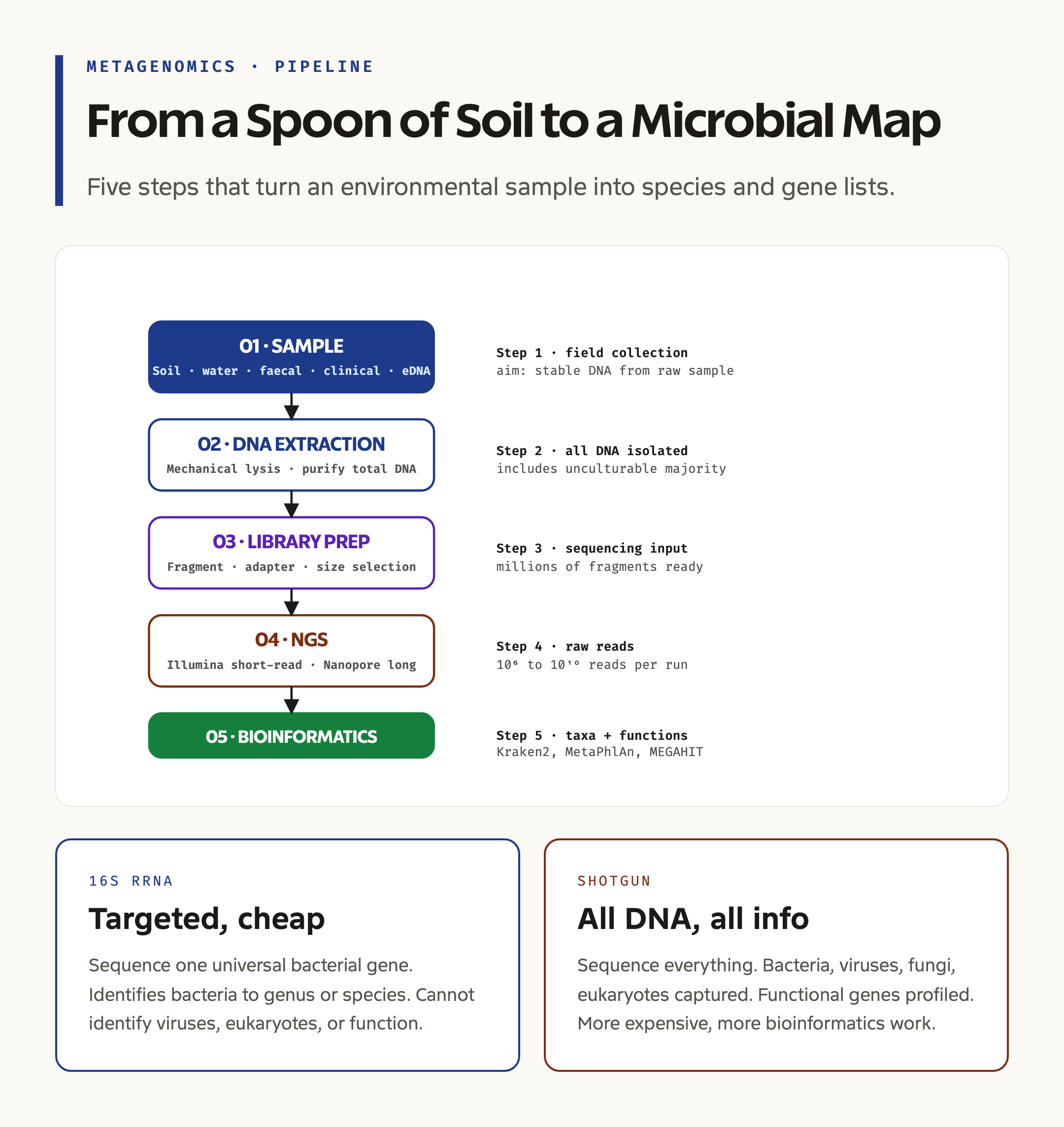
Every metagenomic study follows the same five-step pipeline.
Sample collection is the first step and often the most determinative. Soil, water, faecal, swab, or environmental samples are collected and stabilised, usually in a preservative that prevents DNA degradation between collection and laboratory processing. Sample storage temperature, timing, and contamination control all influence the final result.
DNA extraction breaks open the cells and isolates total DNA. Bacteria with thick cell walls, fungal spores, and Gram-positive species require harsher mechanical lysis than Gram-negative bacteria, and the choice of extraction method biases the final picture toward whichever organisms lyse most efficiently. This extraction bias is one of the limitations of all metagenomic studies.
Library preparation chops the DNA into fragments, attaches sequencing adapters, and selects fragments of the right size. The library is the molecular input to the sequencing instrument.
Next-Generation Sequencing, abbreviated NGS, generates millions to billions of short DNA reads from the library. Illumina platforms produce short, highly accurate reads. Long-read platforms from Pacific Biosciences and Oxford Nanopore produce longer, slightly less accurate reads that are useful for resolving repeat regions and assembling whole genomes from environmental samples.
Bioinformatics is where most of the work happens. Sequence reads are quality-trimmed, then either mapped to reference databases (taxonomic profiling) or assembled into longer sequences (de novo assembly). Tools like Kraken2, MetaPhlAn, MEGAHIT, and CheckM are workhorses of metagenomic analysis. The output is a description of which organisms are present, in what abundance, and what genes they carry.
16S rRNA vs Shotgun Metagenomics
Two flavours of metagenomic sequencing are routinely used and they have different strengths.
16S ribosomal RNA gene sequencing is targeted. The 16S rRNA gene is present in every bacterium, has highly conserved regions that allow universal PCR primers to amplify it from any sample, and has variable regions that differ between species. Sequencing a couple of hundred base pairs of 16S identifies most bacteria to genus and many to species level. The technique is cheap, fast, and well-supported by reference databases. Its limitation is that it only identifies bacteria, not viruses or eukaryotes, and it cannot tell you what genes the bacteria are carrying.
Shotgun metagenomics is untargeted. All DNA in the sample is sequenced, not just the 16S gene. This catches bacteria, viruses, fungi, and eukaryotic microbes simultaneously, and provides functional information because all genes are sequenced, not just the marker. The downside is depth. To sequence a complex community at sufficient coverage, the cost is several times higher than 16S sequencing, and the bioinformatics is more demanding. Shotgun metagenomics is the gold standard for functional and resistance-gene profiling.
A complementary approach is metatranscriptomics, which sequences RNA rather than DNA, capturing the genes that are actively expressed. This is one step removed from metagenomics but is often combined with it.
Application 1: Human Gut Microbiome
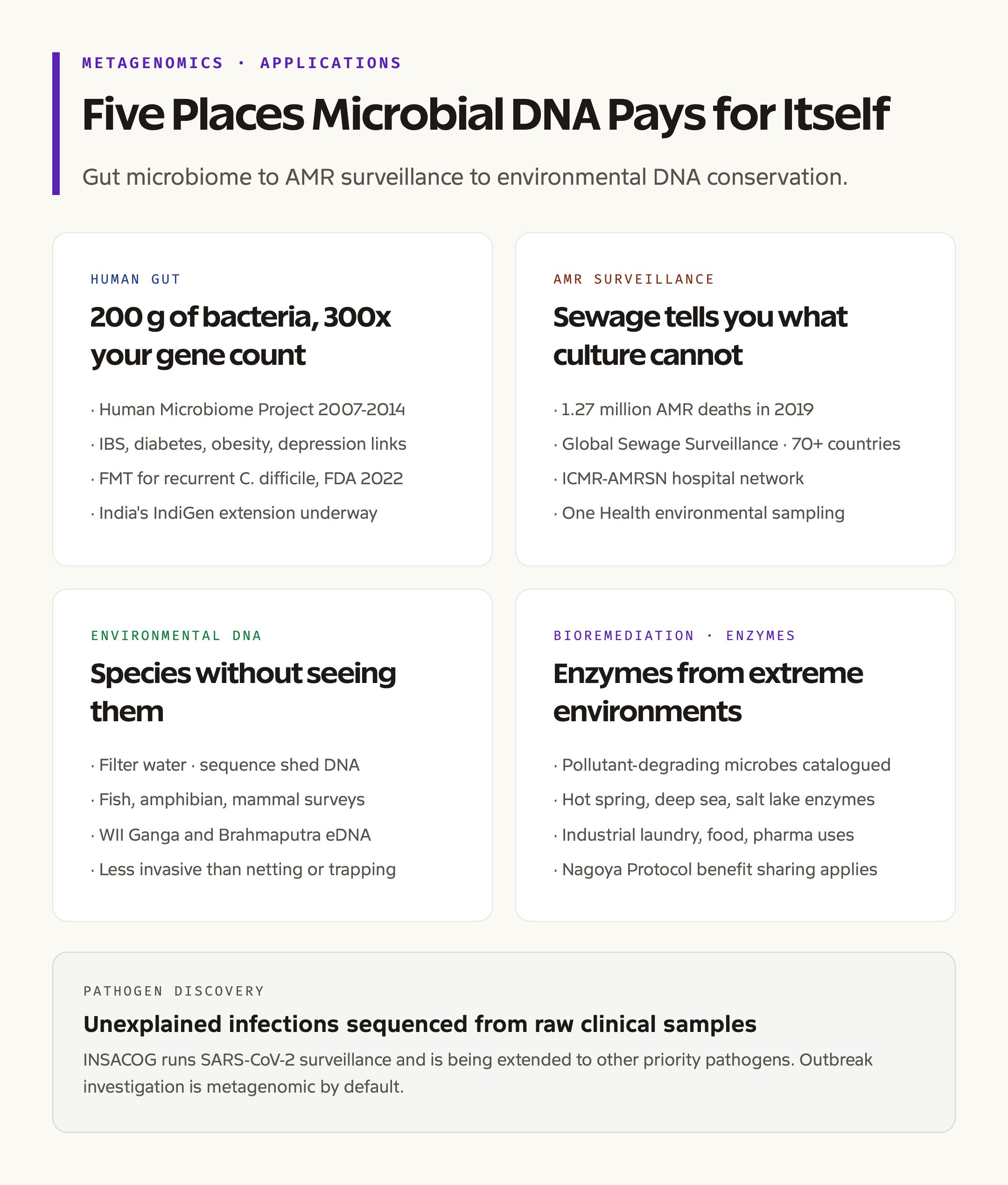
The most heavily studied microbial community in the world is the human gut. The gut harbours hundreds of bacterial species, weighing roughly 200 grammes in total, with collective gene content several hundred times that of the human genome. Imbalances in the gut microbiome, called dysbiosis, are now linked to inflammatory bowel disease, type 2 diabetes, obesity, colorectal cancer, depression, and several other conditions.
The Human Microbiome Project from 2007 to 2014 generated reference profiles of the bacterial communities at multiple body sites in healthy adults. Subsequent global microbiome consortia have sequenced gut samples from cohorts in different countries and dietary patterns. India’s IndiGen project, run by CSIR, has built genetic reference data for the Indian population and is being extended to a microbiome arm.
Faecal microbiota transplantation, where stool from a healthy donor is transferred to a recipient with severe gut infection or dysbiosis, was approved by the US FDA in 2022 for recurrent Clostridioides difficile infection. The treatment is grounded in metagenomic understanding of which bacterial profiles correlate with health and disease. Ongoing research extends FMT to inflammatory bowel disease, autism spectrum disorder, and metabolic conditions.
Application 2: Antimicrobial Resistance Surveillance
Antimicrobial resistance is one of the most urgent global health threats. The 2022 Lancet AMR report estimated that 1.27 million deaths in 2019 were directly attributable to bacterial AMR. India is among the countries with the highest absolute burden. Tracking the spread of resistance genes between human, animal, and environmental compartments is essential for any meaningful AMR control programme.
Metagenomic surveillance picks up resistance genes in samples that include unculturable organisms, biofilm communities, and environmental reservoirs that culture-based surveillance misses. Sewage and hospital wastewater are particularly informative because they aggregate resistance genes from a whole population in a few easy-to-collect samples. The Global Sewage Surveillance project, led by Denmark and now joined by India, runs metagenomic AMR surveillance across more than seventy countries.
The Indian Council of Medical Research’s Antimicrobial Resistance Surveillance and Research Network, ICMR-AMRSN, runs hospital-based culture surveillance, but environmental and One Health metagenomic surveillance is still scaling up. The DBT-funded Centre for AMR Research at IIT Delhi is one node of this work, and several state hospitals run metagenomic projects in research mode.
Application 3: Environmental DNA and Conservation
Environmental DNA, abbreviated eDNA, is genetic material shed by organisms into water, soil, or air. Fish shed scales, mucus, and faecal matter. Mammals shed hair and skin cells. Plants shed pollen and root debris. eDNA from any of these sources can be filtered, extracted, and sequenced to identify which species are present in an ecosystem without seeing or capturing them.
eDNA surveys are now the standard tool for biodiversity monitoring of fish in rivers and lakes, amphibians in ponds, and rare or invasive species in any environment. The technique is far less invasive than netting or trapping, and it picks up species that are too rare or too cryptic for sight surveys to find. The Indian Council of Agricultural Research and several state forest departments are running eDNA programmes in major rivers and protected areas. The Wildlife Institute of India runs eDNA surveys for endangered fish species in the Ganga and Brahmaputra basins.
Application 4: Bioremediation and Industrial Enzyme Discovery
Bioremediation uses microbes to break down pollutants in soil and water. Metagenomic surveys of contaminated sites reveal which organisms thrive in the polluted environment and which genes they carry for breaking down the contaminants. The next step is to use those organisms or their genes for engineered bioremediation.
Industrial enzyme discovery is a related application. Microbial communities living in extreme environments, hot springs, deep-sea vents, salt lakes, harbour enzymes that work at extreme temperatures, salinities, or pH. Sequencing the metagenomes of these communities catalogues the enzymes, which can then be cloned and produced in industrial host organisms. Several enzymes used in laundry detergents, food processing, and pharmaceutical manufacturing originated from metagenomic surveys.
Application 5: Pathogen Discovery and Outbreak Investigation
When a patient presents with an unexplained infection, traditional diagnostics rely on culturing and identifying the pathogen, or on PCR-based tests for known pathogens. If the cause is unknown or the organism uncultivable, both approaches fail. Clinical metagenomic sequencing can sometimes identify the cause directly from blood, cerebrospinal fluid, or tissue samples, even when nothing else works.
Outbreak investigation has been transformed by genomic methods, both in metagenomic and isolate-sequencing modes. The Indian SARS-CoV-2 Genomic Consortium, INSACOG, established in 2020, sequences SARS-CoV-2 samples from across India to track variants and inform public-health response. The same infrastructure is being extended to other priority pathogens.
India’s Metagenomics and Microbiome Research Stack
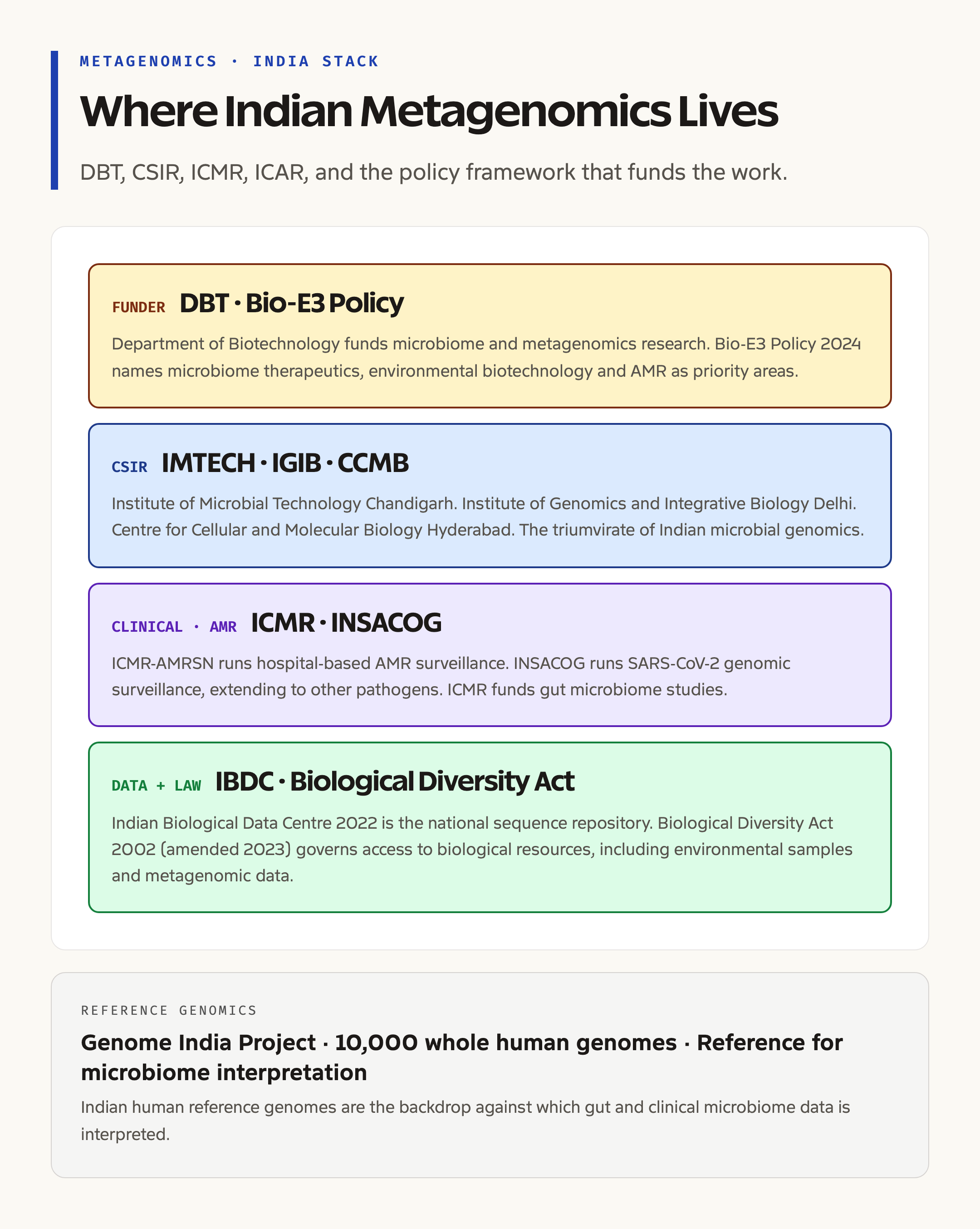
India’s metagenomics research is anchored at multiple institutions. The Department of Biotechnology funds the Centre for Cellular and Molecular Platforms in Bengaluru and several DBT-supported microbiome projects. The Council of Scientific and Industrial Research runs the Institute of Microbial Technology in Chandigarh, the Institute of Genomics and Integrative Biology in Delhi, and the Centre for Cellular and Molecular Biology in Hyderabad, all with active metagenomics programmes.
The Indian Council of Medical Research runs gut microbiome and AMR surveillance projects. ICAR runs agricultural and aquaculture microbiome work. The Indian Institutes of Science Education and Research, the IITs, and IISc Bengaluru run academic metagenomics groups. The Genome India Project provides the human reference genome backbone against which microbiome data is interpreted.
The Bio-E3 Policy of 2024, which frames Indian biotechnology priorities, names microbiome therapeutics, environmental biotechnology, and AMR as priority areas, all of which depend on metagenomic methods. A national microbiome mission, on the model of the US Human Microbiome Project, has been proposed but not yet formally announced.
Policy and Ethical Issues
Metagenomic data sits at the intersection of several policy questions. Bioprospecting and benefit sharing under the Convention on Biological Diversity and the Nagoya Protocol apply when foreign researchers sequence genetic material from Indian environmental samples. Indian regulations under the Biological Diversity Act 2002 require approvals from the National Biodiversity Authority for access to and commercial use of biological resources, and metagenomic samples fall within this framework. The 2020 amendments to the Act tightened these provisions further.
Data sovereignty is a related concern. Metagenomic datasets from Indian samples are sometimes uploaded to international databases without parallel deposition in Indian repositories. The DBT-supported Indian Biological Data Centre, launched in 2022, is the national repository for biological sequence data, and the Genome India project sets a precedent for Indian-controlled storage of genetic data.
Privacy is the third issue. Metagenomic sequencing of human samples produces incidental human DNA reads alongside the microbial DNA, and those reads can in principle be used for re-identification. Standard protocols filter out human reads before public release, but the safeguards depend on the laboratory’s discipline.
What to Watch Going Forward
Three trends will shape Indian metagenomics through the next decade. The first is the move from research-grade to clinical-grade metagenomics, with regulatory pathways for sequencing-based diagnostic tests. The second is the integration of metagenomic data with other omics data and AI models, allowing prediction of microbiome shifts under disease or dietary change. The third is the operational scale-up of AMR surveillance under One Health, integrating human, animal, and environmental sampling into a single national programme.
For UPSC, the testable elements are the definition of metagenomics, the difference between 16S and shotgun approaches, the major applications (gut microbiome, AMR, eDNA, bioremediation), and the policy framework (Biological Diversity Act, Bio-E3, Genome India). Connections to broader policy run through biotechnology regulation and the environmental laws in India that govern access to biological resources.
Frequently Asked Questions
What is metagenomics in simple terms?
Metagenomics is the study of all the DNA in an environmental sample, sequenced together, without trying to grow the organisms first. It identifies which microbes are present and what they’re doing, including organisms that cannot be cultured in a laboratory. The most common samples are soil, water, gut, and clinical specimens.
What is the difference between 16S rRNA and shotgun metagenomics?
16S rRNA sequencing targets a single bacterial gene that is conserved enough to be amplified universally and variable enough to identify species. It is cheap, fast, and bacterial-only. Shotgun metagenomics sequences all the DNA in a sample, capturing bacteria, viruses, fungi, and eukaryotes, and producing both taxonomic and functional information. Shotgun is more informative but more expensive.
What is environmental DNA (eDNA)?
eDNA is genetic material that organisms shed into their environment, in water, soil, or air. eDNA from a litre of river water can be filtered, sequenced, and used to identify which fish species live in that stretch of river without ever capturing or seeing them. eDNA is now standard practice for biodiversity monitoring and rare-species surveys.
How does metagenomics help with antimicrobial resistance?
Metagenomic sequencing of clinical, sewage, and environmental samples detects resistance genes in organisms that cannot be cultured and in environmental reservoirs that culture-based surveillance misses. Sewage metagenomics in particular is now used as a population-level surveillance tool for AMR genes. Several global and Indian surveillance networks rely on metagenomic AMR profiling.
What does India’s metagenomics research stack look like?
India’s metagenomics work is concentrated at DBT-funded centres, CSIR institutes (IMTECH, IGIB, CCMB), ICMR for clinical and AMR work, ICAR for agriculture and aquaculture, the IITs and IISc for academic research, and INSACOG for pathogen surveillance. The Bio-E3 Policy 2024 names microbiome and AMR as priority areas. The Indian Biological Data Centre serves as the national sequence-data repository.