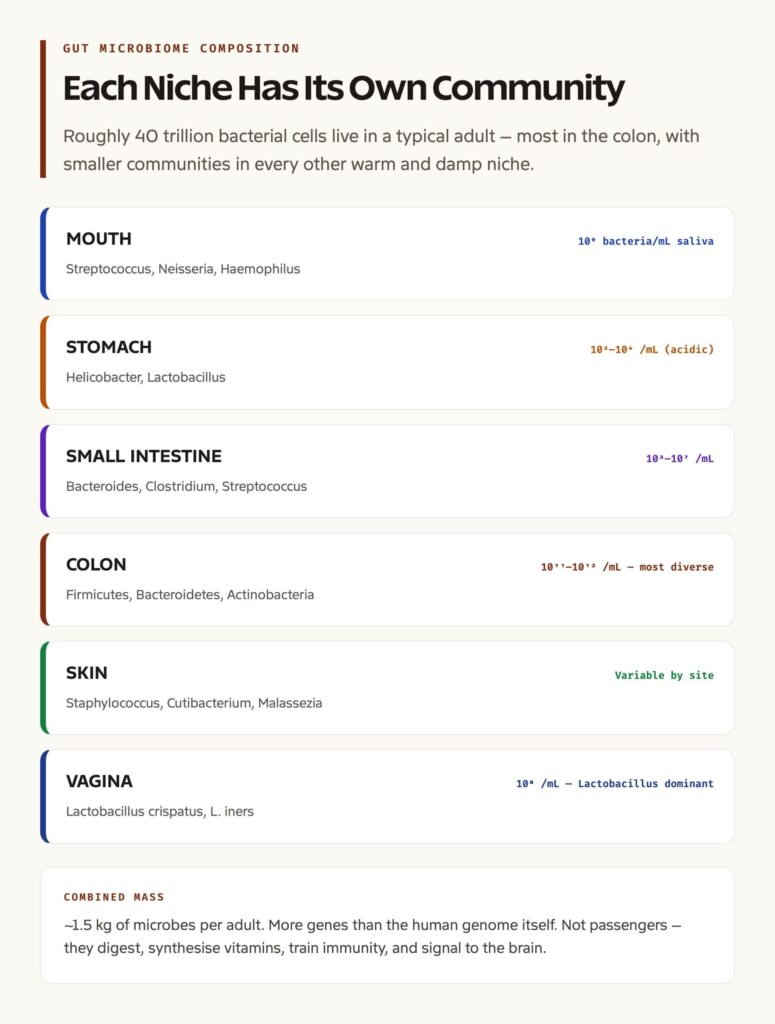
For most of medical history, microbes were the enemy. Bacteria caused tuberculosis, cholera, plague. Antibiotics, the great twentieth-century invention, were tools to wipe them out. The simpler the microbial environment, the better. That story turned out to be incomplete. The human body is not a sterile organism contaminated by occasional pathogens. It is a partnership between human cells and the trillions of microbes that live on the skin, in the mouth, in the gut, and in every other warm and damp corner. These microbes weigh roughly a kilogram and a half in a typical adult. They carry more genes than the human genome itself. They are the human microbiome.
The human microbiome refers to the entire community of microorganisms and their collective genetic material living in and on the human body. It includes bacteria, archaea, viruses, and fungi. The largest and most diverse population is in the gut, where roughly forty trillion bacterial cells live. These microbes are not passengers. They digest complex carbohydrates, synthesise essential vitamins, train the immune system, regulate inflammation, and influence everything from metabolism to mood. When the microbial community drifts out of balance, a state called dysbiosis, the consequences extend across digestive disease, autoimmune disease, metabolic disorders, and increasingly mental health.
For UPSC purposes, the topic sits at the intersection of biotechnology, public health, nutrition policy, and India’s emerging biomedical research base. It connects to the genome work, to the health system more broadly, and to the questions of antibiotic resistance and food policy. This article walks through what the microbiome is, why it matters, where the research stands, and where India fits in.
Quick Facts on the Human Microbiome
The microbiome is the community of microorganisms and their genes that live in and on the human body. The microbiota is the community of organisms themselves. The microbiome adds the genetic material to the picture. The two terms are sometimes used loosely as synonyms, but careful usage distinguishes them.
The largest microbial community is in the colon, with smaller communities in the small intestine, mouth, skin, vagina, lung, and several other niches. Each niche has its own characteristic mix of organisms. The gut microbiota of a healthy adult typically contains hundreds of bacterial species drawn from a few dominant phyla, primarily Firmicutes, Bacteroidetes, Actinobacteria, and Proteobacteria.
Humans are born nearly sterile. Colonisation begins at birth and continues through the early years of life. Mode of delivery, breastfeeding, diet, antibiotic exposure, and environment all shape the developing microbiome. By age three, the gut microbiome resembles an adult community, although it continues to evolve through life.
What the Microbiome Actually Does
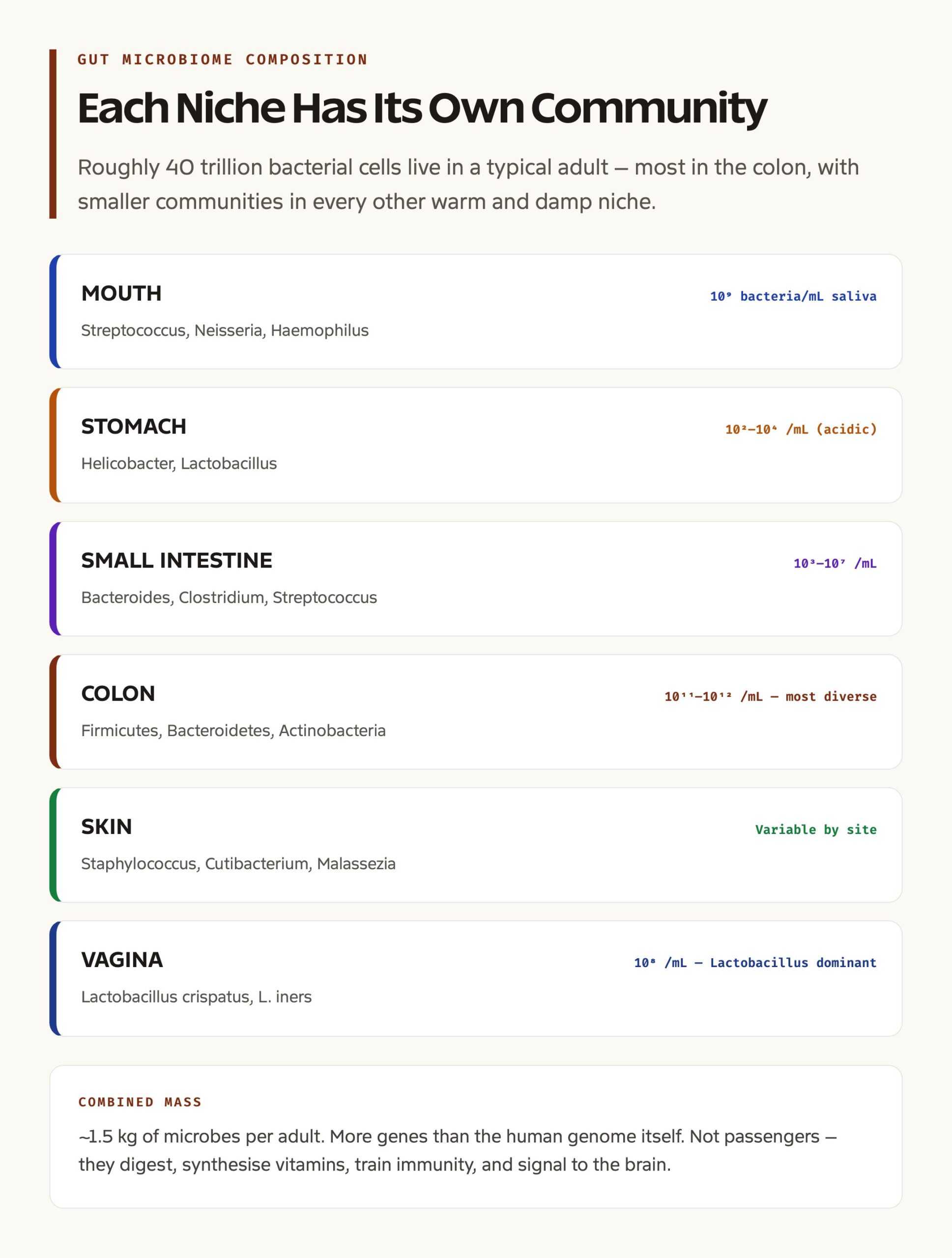
The microbiome is not just present. It does work. Five functions matter most.
The first is digestion of complex carbohydrates. Many of the dietary fibres that human cells cannot break down are fermented by gut bacteria into short-chain fatty acids, particularly butyrate, propionate, and acetate. These short-chain fatty acids feed colon cells, regulate inflammation, and contribute meaningfully to total energy intake. Without gut bacteria, the human digestive system would not extract energy from substantial parts of a typical diet.
The second is vitamin synthesis. Gut bacteria produce vitamin K and several B-group vitamins, including biotin, folate, and B12. The contribution to human nutritional requirements varies by vitamin and by diet, but it is real.
The third is immune training. The developing immune system learns to distinguish friend from foe partly by encountering the gut microbiome. Children born by caesarean section, who experience a different early colonisation pattern than children born vaginally, show somewhat different patterns of allergic disease and autoimmunity later in life. The mechanism is partly microbiome-driven.
The fourth is metabolic regulation. The gut microbiome influences glucose metabolism, lipid handling, and energy balance. Differences in microbiome composition are statistically associated with obesity and type 2 diabetes, although the causal direction is still being clarified.
The fifth is the gut-brain axis. The microbiome communicates with the central nervous system through neurotransmitter precursors, immune signalling, and the vagus nerve. Mood, anxiety, and certain neurological conditions are influenced by gut microbial activity, although the magnitude of effect in humans is still being measured.
Background and Historical Context
The microbiome became a research field in its modern form with the advent of high-throughput sequencing. Earlier microbiology depended on culturing organisms in the laboratory. Most gut bacteria do not grow under standard culture conditions. Until sequencing became cheap, the gut microbial community was effectively invisible.
The Human Microbiome Project, launched in 2008 by the US National Institutes of Health, sequenced microbiomes from multiple body sites in hundreds of healthy volunteers. The European MetaHIT project did the same for the gut. These projects defined what a healthy microbiome looks like and gave researchers a baseline for studying disease.
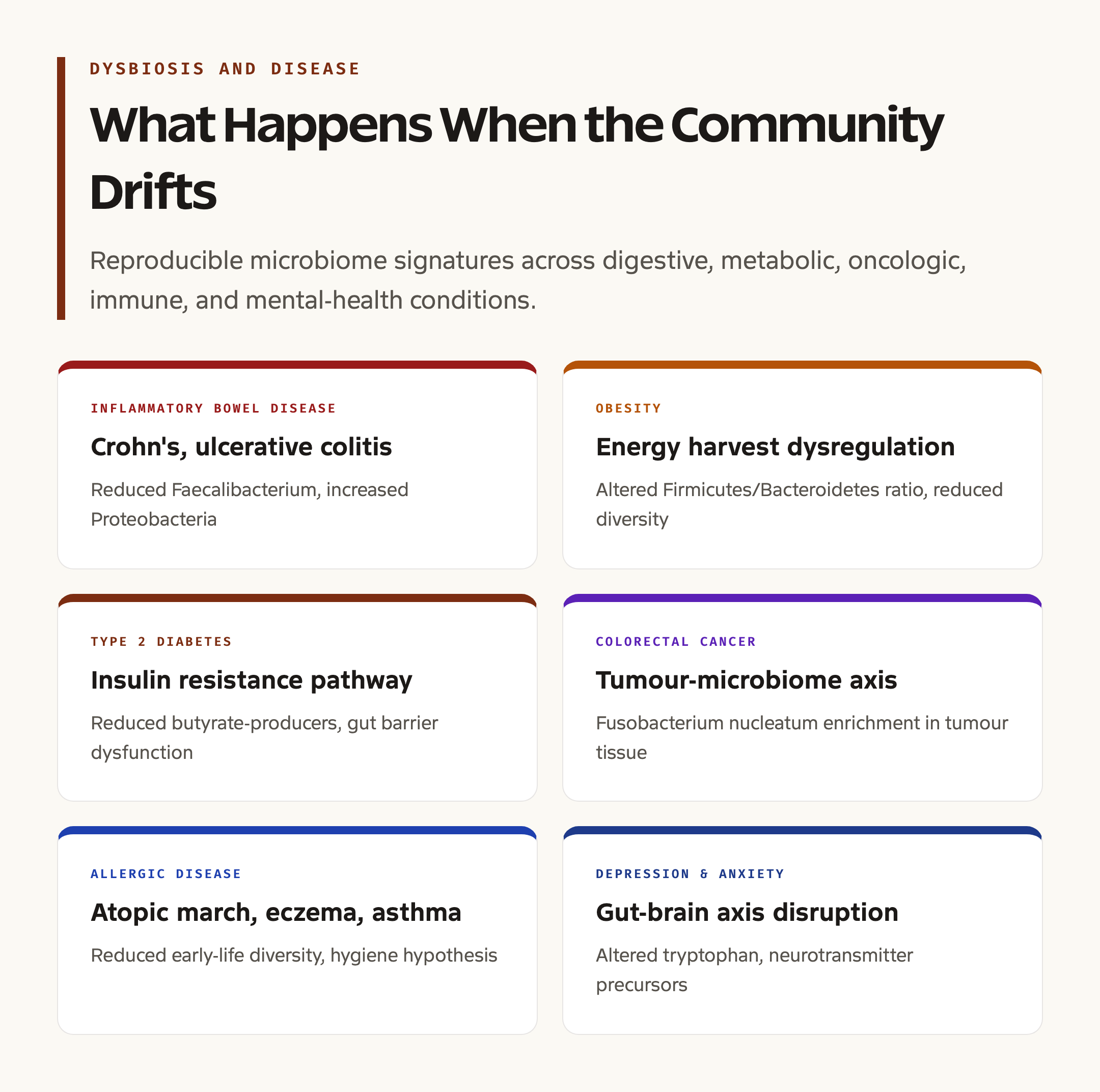
The 2010s saw the emergence of disease-specific microbiome studies. Inflammatory bowel disease, obesity, type 2 diabetes, colorectal cancer, allergic disease, and depression all showed reproducible microbiome signatures. The faecal microbiota transplant, in which stool from a healthy donor is transferred to a recipient with severe Clostridioides difficile infection, demonstrated that microbiome change could produce dramatic clinical benefit. Faecal transplant cures roughly ninety percent of recurrent C. difficile cases, far better than antibiotics alone.
Indian microbiome research began later but has grown rapidly. The Indian Microbiome Initiative and a series of cohort studies at NCBS, IGIB, NIBMG, THSTI, AIIMS, and several state research centres have begun to characterise Indian gut microbiomes. Indian populations show meaningful differences from the populations in the US and European reference databases, which matters because microbiome-disease associations and microbiome-based therapies do not transfer cleanly across populations.
Key Tools in Microbiome Research
Five tools are central.
Sixteen-S ribosomal RNA sequencing identifies which bacteria are present in a sample. The 16S rRNA gene contains conserved regions that allow PCR amplification across virtually all bacteria, and variable regions that distinguish species. Sixteen-S is fast and cheap but limited to bacterial composition.
Shotgun metagenomic sequencing sequences all DNA in a sample, including bacteria, archaea, viruses, fungi, and host DNA. It identifies organisms more precisely and characterises the genes present, allowing inference of metabolic capacity. Shotgun sequencing is more expensive but much richer in information.
Metatranscriptomics sequences RNA rather than DNA, capturing what genes are actually being expressed rather than just what is present.
Metabolomics measures the small-molecule output of microbial activity in stool, blood, urine, or tissue. Combined with sequencing, metabolomics links microbial composition to function.
Culturomics, despite the older association of culturing with limited capability, has been revived using anaerobic culture techniques and advanced media to grow previously uncultivated organisms. This matters because culture is what allows therapeutic development with specific organisms.
Why the Microbiome Matters
The microbiome matters for four reasons.
First, microbiome dysbiosis is implicated in a growing list of diseases. Inflammatory bowel disease, irritable bowel syndrome, obesity, type 2 diabetes, allergic disease, colorectal cancer, and several autoimmune conditions all show reproducible microbiome differences from healthy controls. For some conditions, microbiome modification is becoming a therapeutic strategy.
Second, microbiome modification offers therapeutic levers that pharmaceutical drugs cannot reach. Faecal microbiota transplant, defined-microbial-community products, engineered probiotic strains, and prebiotic and dietary interventions are all under active development. Several products have received regulatory approval in the US and Europe for specific indications.
Third, the microbiome shapes drug response. Many drugs are metabolised partly by gut bacteria, and the microbiome composition influences efficacy and side effects. This is becoming visible in cancer immunotherapy, where microbiome composition predicts response to checkpoint inhibitors.
Fourth, microbiome research is a window into population health. Indian gut microbiomes differ systematically from Western reference microbiomes because of differences in diet, environment, and antibiotic exposure. Building Indian microbiome reference data is a prerequisite for microbiome-based diagnostics and therapeutics for Indian patients.
Detailed Comparison: Microbiota, Microbiome, Probiotics, Prebiotics, Synbiotics
The vocabulary is often confused. The distinctions matter.
| Term | Meaning |
|---|---|
| Microbiota | The community of microorganisms living in a niche |
| Microbiome | The microbiota plus their genes and metabolites |
| Probiotic | Live microorganisms administered for health benefit |
| Prebiotic | Food substances that promote growth of beneficial microbes |
| Synbiotic | Combination of probiotic and prebiotic in one product |
| Postbiotic | Beneficial microbial metabolites or inactivated microbes |
A probiotic supplement contains live bacterial strains, typically Lactobacillus or Bifidobacterium species, intended to colonise or transit the gut and produce a benefit. A prebiotic is a food substance that selectively feeds beneficial microbes already present, typically dietary fibre fermented in the colon. A synbiotic combines both. A postbiotic uses microbial metabolites or inactivated microbes to produce benefit without live organisms.
The clinical evidence base is uneven. Specific probiotic strains have demonstrated benefit for specific indications. The general claim that any probiotic product benefits any user is not supported. Quality control of probiotic products varies, and regulatory frameworks in India and globally are still maturing.
Common Misconceptions
A frequent misunderstanding is that all gut bacteria are beneficial. They are not. The gut microbiome contains organisms that are beneficial, neutral, and potentially harmful. Health depends on the balance.
A second misconception is that yoghurt and standard probiotic products will fix a damaged microbiome. The evidence is much more limited than the marketing suggests. Specific strains have specific effects. General probiotic consumption produces small or null effects in most studies.
A third misconception is that an antibiotic course permanently destroys the microbiome. Most antibiotic courses produce temporary disruption, and the microbiome recovers, although recovery may be incomplete after repeated or prolonged courses. The damage from antibiotic overuse is real but more subtle than complete destruction.
A fourth misconception is that the microbiome is simply about diet. Diet matters substantially, but genetics, environment, antibiotic exposure, and life events all shape the microbiome. Diet is one lever among several.
India’s Microbiome Initiative
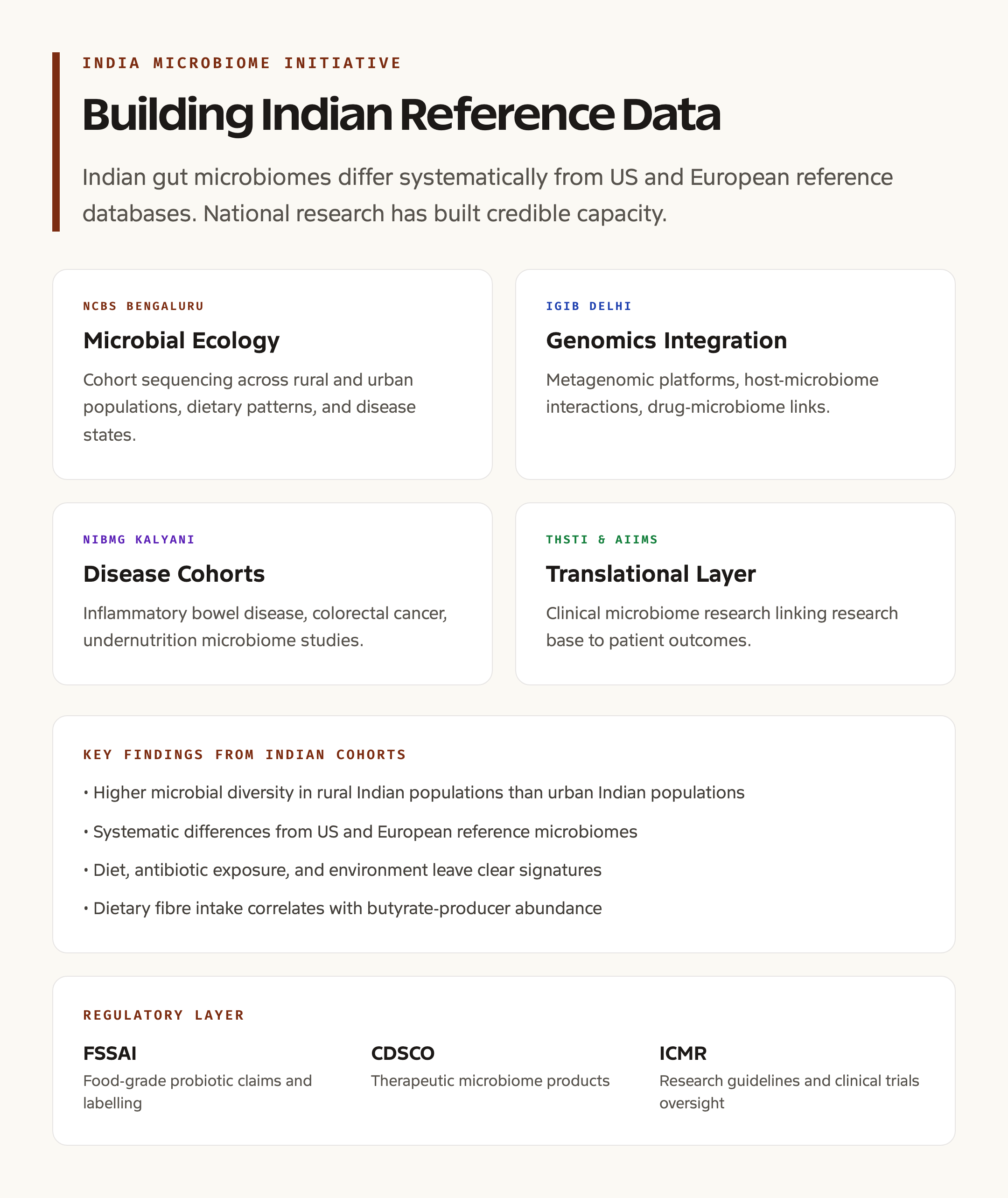
Indian microbiome research has expanded rapidly through the 2010s and 2020s. The Department of Biotechnology has funded the Indian Microbiome Initiative through several rounds. The National Centre for Biological Sciences in Bengaluru, the Institute of Genomics and Integrative Biology in Delhi, the National Institute of Biomedical Genomics in Kalyani, the Translational Health Science and Technology Institute in Faridabad, the All India Institute of Medical Sciences in Delhi, and several IIT and IISc groups have built microbiome research programmes.
Cohort studies have characterised the gut microbiomes of Indian populations across rural and urban settings, across vegetarian and non-vegetarian diets, and across health conditions including diabetes, malnutrition, and inflammatory bowel disease. The findings consistently show that Indian microbiomes are not the same as US or European reference microbiomes, that microbial diversity is higher in rural Indian populations than in urban Indian populations, and that diet, antibiotic exposure, and environment all leave clear signatures.
Indian probiotic products have a substantial market. The regulatory framework, through FSSAI for food-grade products and CDSCO for therapeutic products, is still maturing. The Indian Council of Medical Research and FSSAI have issued guidelines on probiotic claims and labelling.
Challenges in the Microbiome Ecosystem
Causality versus correlation is the first persistent challenge. The microbiome differs in disease compared to health, but determining whether microbiome change causes disease or follows from disease is methodologically hard. Animal models help but have limits. Human intervention trials, where deliberate microbiome modification is followed by clinical outcome measurement, are still early.
Reproducibility across populations is the second. A microbiome-disease association observed in one population may not transfer to another. Indian populations show systematic differences from Western populations, which limits the direct applicability of US- and Europe-derived microbiome science.
Quality control of probiotic products is the third. The label of a probiotic product often does not match the contents. Strain specificity, viability through shelf life, and dose at the time of consumption all vary. Regulatory tightening is needed.
Ethics and equity is the fourth. Microbiome-based diagnostics and therapeutics will be expensive in their early phases. Ensuring access is a question that the broader Indian health system will face.
Way Forward
Three directions look most promising for India. First, expansion of Indian microbiome reference databases across geography, diet, age, and disease, with explicit linkage to ICMR and AIIMS clinical research. Second, evidence-based regulation of probiotic products, with strain-specific labelling and quality control under FSSAI and CDSCO. Third, development of microbiome-based diagnostics and therapeutics aligned to Indian disease priorities, particularly inflammatory bowel disease, colorectal cancer, type 2 diabetes, and undernutrition.
For UPSC, the takeaway is that the microbiome is no longer a curiosity. It is part of the normal physiology, part of disease causation in many conditions, and part of an emerging therapeutic toolkit. Indian research has built credible capacity. Translation to clinical practice and regulation is the next frontier.
Frequently Asked Questions
What is the human microbiome?
The human microbiome is the entire community of microorganisms and their collective genetic material living in and on the human body. It includes bacteria, archaea, viruses, and fungi. The largest and most diverse population is in the gut.
What is the difference between microbiota and microbiome?
The microbiota is the community of microorganisms themselves. The microbiome adds the genetic material and metabolites of those organisms to the picture. The two terms are sometimes used as synonyms but careful usage distinguishes them.
What is dysbiosis?
Dysbiosis is a state in which the microbial community in a body niche is unbalanced, with reduced diversity, loss of beneficial organisms, or overgrowth of harmful ones. It is associated with a wide range of conditions including inflammatory bowel disease, obesity, type 2 diabetes, allergic disease, and colorectal cancer.
What are probiotics and prebiotics?
Probiotics are live microorganisms administered for health benefit. Prebiotics are food substances, typically dietary fibres, that promote the growth of beneficial microbes already present in the gut. Synbiotics combine both. Postbiotics are beneficial microbial metabolites or inactivated microbes.
What is the Indian Microbiome Initiative?
The Indian Microbiome Initiative is a programme funded by the Department of Biotechnology to characterise the human microbiome of Indian populations. Research is led by institutions including NCBS, IGIB, NIBMG, THSTI, and AIIMS, with the aim of building Indian reference data and supporting microbiome-based diagnostics and therapeutics.
Tell Google you want more of this.
Add Anantam IAS as a preferred sourceOne tap, and this site shows up more often in your own Top Stories, AI Overviews and AI Mode. Remove it any time.