Nanomedicine and Targeted Drug Delivery: How Nanoparticles Carry Drugs Straight to Disease
A complete UPSC GS-III explainer on nanomedicine and targeted drug delivery. Covers liposomes, dendrimers, polymeric and metallic nanoparticles, the EPR effect, active vs passive targeting, approved nanomedicines, India's nano research labs, and regulatory questions.
Nanomedicine is what happens when drug delivery stops being a brute-force exercise. Instead of flooding the bloodstream with a chemotherapy drug and hoping enough of it reaches the tumour, a nanoparticle carrier picks up the drug, navigates the circulation, slips past leaky tumour blood vessels, and unloads its cargo only where it’s needed. The healthy tissue gets a smaller dose. The diseased tissue gets a larger one. The therapeutic window widens, side effects shrink, and drugs that were too toxic to use in their free form become viable.
The shift from free-drug delivery to carrier-mediated delivery is one of the most consequential ideas in twenty-first-century medicine. Doxil, the first FDA-approved nanomedicine, came to market in 1995 and is still in use. The mRNA COVID-19 vaccines that rolled out in 2020 are nanomedicines too — the lipid nanoparticle is what protects the fragile mRNA payload and delivers it inside cells. India’s Nano Mission, launched in 2007, has built a credible research base at IIT Bombay, IIT Delhi, IIT Madras, INST Mohali, and AIIMS Delhi, and several Indian companies now manufacture nanoformulations for the domestic market.
For UPSC GS-III, nanomedicine sits at the intersection of nanotechnology, public health, and intellectual property. It is also a topic where prelims traps are common, because dendrimers, dendrites, and liposomes get confused with biological structures they merely resemble. This article walks through what nanomedicine is, how the major carrier types work, the EPR effect that makes passive targeting possible, the active targeting strategies built on top, the approved drugs in use today, India’s research and policy stack, and the regulatory questions that remain open.
Quick Facts on Nanomedicine
Nanomedicine is the application of nanotechnology to medicine, covering diagnosis, monitoring, control, prevention, and treatment of disease. The defining size range is 1 to 100 nanometres, although in practice many therapeutic nanoparticles run a little larger, between 100 and 200 nanometres. At this scale, particles behave differently from both bulk material and individual molecules, and the human body handles them differently too.
The first wave of nanomedicines reached the market in the mid-1990s with liposomal formulations of older drugs like doxorubicin and amphotericin B. The second wave, polymer-conjugated drugs and albumin-bound paclitaxel, followed in the 2000s. The third wave, RNA-based therapies delivered by lipid nanoparticles, broke through with the COVID-19 mRNA vaccines from Pfizer-BioNTech and Moderna.
The economics matter. A nanoformulation can extend the patent life of an off-patent drug, change its pharmacokinetic profile enough to count as a new product, and command a price premium. That commercial logic has driven much of the investment in the field, alongside the genuine clinical gains.
How Nanoparticles Carry Drugs
The basic problem nanomedicine solves is that small-molecule drugs do not naturally know where to go. Inject doxorubicin into a vein and it distributes through every tissue, hitting the heart and the bone marrow as hard as the tumour. The drug is also cleared rapidly, so the dose has to be high to maintain a therapeutic concentration.
A nanoparticle changes the calculation. The carrier protects the drug from breakdown in the bloodstream, extends its circulation time so it has more chances to encounter the diseased tissue, and concentrates the dose where it’s needed. Some carriers also control release, letting the drug out slowly over hours or days instead of all at once.
There are four main carrier classes. Lipid-based carriers, dominated by liposomes and lipid nanoparticles, are the most clinically successful. Polymeric carriers, including dendrimers, polymer micelles, and PLGA nanoparticles, offer flexibility in design and degradation rate. Inorganic carriers, including gold nanoparticles, iron oxide nanoparticles, and silica particles, are used mostly in imaging and a few therapeutic applications. Protein-based carriers, including albumin-bound paclitaxel, exploit the body’s natural transport proteins.
Liposomes Explained
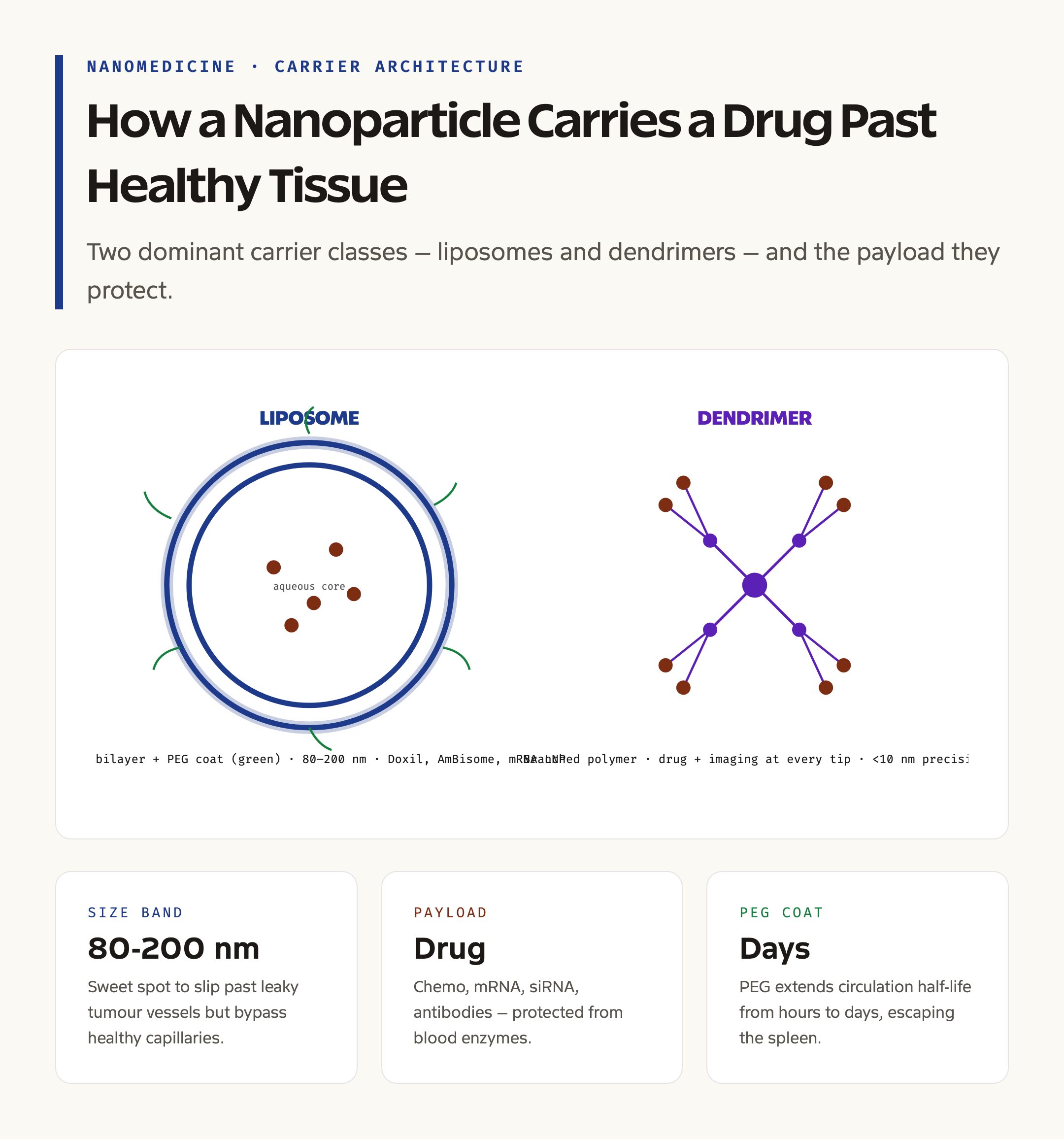
Liposomes are spherical vesicles built from a lipid bilayer, the same architecture as a cell membrane. The bilayer encloses an aqueous core where water-soluble drugs can be packed. Lipid-soluble drugs sit inside the bilayer itself. Liposomes are typically 80 to 200 nanometres across.
The first FDA-approved liposomal drug, Doxil, packs doxorubicin into a PEGylated liposome. The PEG coating, a layer of polyethylene glycol on the outer surface, prevents the immune system from recognising and clearing the particle quickly. Without PEG, liposomes are filtered out by the liver and spleen within hours. With PEG, circulation half-life extends to days.
Doxil is approved for ovarian cancer, multiple myeloma, and Kaposi sarcoma. The liposomal form has roughly the same anti-tumour effect as free doxorubicin but causes far less cardiotoxicity, the dose-limiting side effect of free doxorubicin. AmBisome, a liposomal amphotericin B, treats systemic fungal infections with much lower kidney toxicity than the free drug. Both are now generic and form the workhorse class of nanomedicines.
The mRNA COVID-19 vaccines use a slightly different lipid construct, the lipid nanoparticle or LNP, optimised for nucleic acid delivery. LNPs carry mRNA into cells through endocytosis, escape the endosome before the mRNA degrades, and release the genetic payload into the cytoplasm where ribosomes translate it. The same LNP platform is now being repurposed for mRNA vaccines against influenza, RSV, and a growing list of cancers.
Dendrimers and Polymer Carriers
Dendrimers are highly branched, tree-like polymers. The name comes from the Greek word for tree. Each generation of branching adds a layer, and the surface of the dendrimer carries reactive groups that can be loaded with drugs, imaging agents, or targeting ligands. Unlike liposomes, dendrimers are precisely defined molecules with predictable size, shape, and surface chemistry.
The pre-eminent prelims trap in this whole topic is the confusion between dendrimers and dendrites. Dendrites are the branching projections of nerve cells in the brain, a natural biological structure. Dendrimers are synthetic nanomaterials. They share a name root because both are tree-shaped, but they have nothing else in common. UPSC has flagged this distinction in past questions.
Polymer micelles assemble from amphiphilic block copolymers, with a hydrophobic core that holds water-insoluble drugs and a hydrophilic shell that keeps the particle in solution. PLGA nanoparticles, made from poly(lactic-co-glycolic acid), are biodegradable, FDA-approved as a polymer, and used in long-acting injectable formulations. Polymer-drug conjugates link the drug directly to a polymer backbone, with the drug released when an enzyme cleaves the linker.
The EPR Effect: Why Passive Targeting Works

The Enhanced Permeability and Retention effect, abbreviated EPR, is the key biological insight that made nanomedicine for solid tumours possible. The Japanese researcher Hiroshi Maeda described it in 1986, and it has shaped tumour-targeted drug delivery ever since.
Tumours grow fast. Their blood vessels, formed in a hurry to keep pace with the tumour, are leaky and disorganised. The endothelial junctions are wider than in healthy tissue, often gapping at 200 to 800 nanometres. Tumours also have poor lymphatic drainage, so anything that gets into the tumour interstitium tends to stay there.
Nanoparticles in the right size range, roughly 80 to 200 nanometres, are too large to leak out of healthy capillaries but small enough to slip through the gaps in tumour vessels. Once inside, they accumulate because the lymphatics are not removing them. Over hours to days, the drug concentration in the tumour rises far above what free drug delivery would achieve, while the concentration in healthy tissue stays low. This is passive targeting, and it works without any active targeting molecule on the nanoparticle surface.
The EPR effect is the reason Doxil reduces heart toxicity. Free doxorubicin distributes evenly. Liposomal doxorubicin concentrates in the tumour through EPR and largely avoids the heart. The same principle drives almost every approved liposomal anticancer drug.
The EPR effect has limits. It works well for some tumour types and poorly for others. Pancreatic tumours, for instance, are dense and poorly vascularised, and EPR delivery is weak. Modern nanomedicine therefore combines passive EPR targeting with active targeting strategies.
Active Targeting and Smart Nanoparticles
Active targeting decorates the nanoparticle surface with ligands that bind specific receptors overexpressed on diseased cells. Antibodies, antibody fragments, peptides, sugars, and aptamers are all used. The active ligand does not change the circulation behaviour but improves cellular uptake once the particle reaches the target tissue.
Examples in clinic include trastuzumab-conjugated nanoparticles for HER2-positive breast cancer, transferrin-decorated particles that exploit the over-expression of transferrin receptors on cancer cells, and folate-targeted particles for tumours that over-express folate receptors. Active targeting is conceptually elegant but commercially harder. The added ligand increases manufacturing complexity, regulatory burden, and cost. As of 2026, only a handful of active-targeted nanomedicines are approved.
Stimuli-responsive nanoparticles add another layer. The particle is engineered to release its payload only when triggered by a specific cue: low pH inside a tumour, an enzyme expressed by cancer cells, an external magnetic field, an infrared laser, or ultrasound. Theranostic nanoparticles combine therapy and diagnostics in a single particle, often with a metallic core for imaging and a drug payload for treatment.
Approved Nanomedicines in Clinical Use
Doxil, AmBisome, Abraxane, Onpattro, Comirnaty, and Spikevax form the backbone of the approved nanomedicine list. Doxil and its generics handle several solid tumours. AmBisome treats invasive fungal infections. Abraxane is albumin-bound paclitaxel for breast and pancreatic cancer. Onpattro, approved in 2018, was the first siRNA drug to reach the market, delivered as a lipid nanoparticle to treat hereditary transthyretin amyloidosis. Comirnaty and Spikevax are the Pfizer-BioNTech and Moderna mRNA COVID-19 vaccines.
Beyond cancer and infection, nanomedicine reaches into ophthalmology, with intraocular implants of dexamethasone in PLGA particles, into orthopaedics with bone-cement nanocomposites, and into pain medicine with long-acting bupivacaine liposomes. The pipeline is wider still, with several CAR-T-like cell therapies, RNA therapies, and gene therapies in late-stage trials, all delivered by nanoparticle carriers.
The Indian market has multiple liposomal generics, particularly liposomal amphotericin B from Cipla, Bharat Serums, and Sun Pharma, and liposomal doxorubicin from Sun Pharma. Indian nanoparticle manufacturers also supply intermediate carriers to the global mRNA vaccine supply chain. The cost-down of liposomal generics has made these therapies accessible in Indian public health programmes for kala-azar, mucormycosis, and febrile neutropenia, where they were previously priced out of reach.
India’s Nano Mission and Research Infrastructure
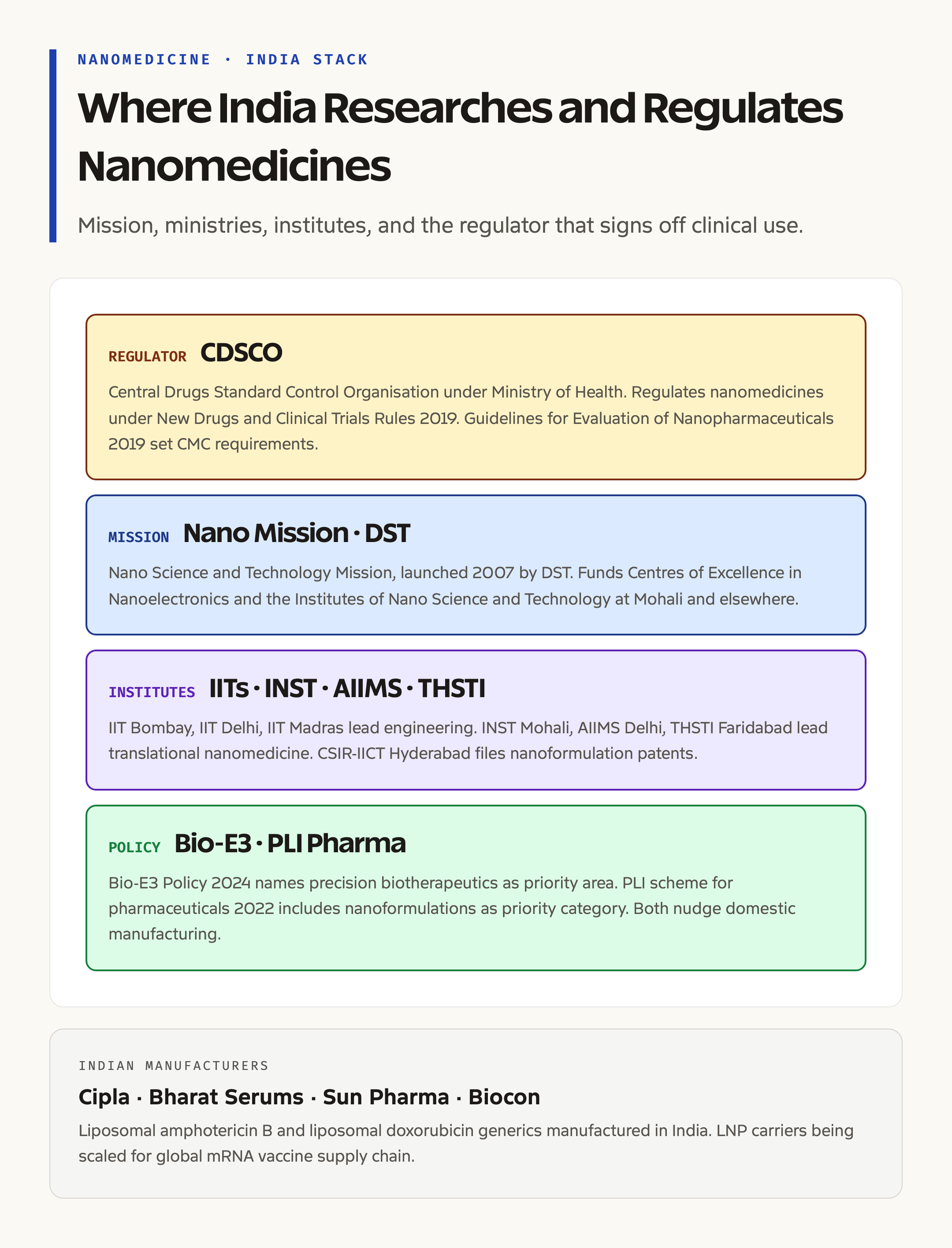
The Nano Science and Technology Mission, launched by the Department of Science and Technology in 2007 and renewed in successive five-year plans, is the umbrella programme for Indian nanotechnology research. It funds the Nano Mission Council, supports the four Centres of Excellence in Nanoelectronics, and underwrites the Institutes of Nano Science and Technology at Mohali and elsewhere.
Nanomedicine specifically is supported through DBT-funded centres, the Translational Health Science and Technology Institute in Faridabad, the National Centre for Cell Science in Pune, the Centre for Cellular and Molecular Platforms in Bengaluru, and AIIMS Delhi’s nanomedicine research wing. ICMR runs the Translational Research Consortium and supports clinical translation. The CSIR’s Indian Institute of Chemical Technology in Hyderabad has filed several nanoformulation patents that have moved to commercial licensing.
The 2022 Production-Linked Incentive scheme for pharmaceuticals included nanoformulations as one of the priority categories, providing a fiscal nudge for domestic manufacture. The Bio-E3 Policy of 2024, the same policy that frames synthetic biology and biotechnology priorities, also names precision biotherapeutics, which includes nanomedicines, as one of the six thematic areas.
Safety, Toxicology, and Regulation
Nanoparticles behave differently from bulk material. The same chemical, in nano form, may have a different surface area, reactivity, and biological distribution. Regulators therefore treat nanomedicines as new products even when the active drug inside is off-patent. Comparability and bioequivalence studies are demanding, because two nanoformulations of the same drug can differ in particle size, surface charge, drug release rate, and tissue distribution.
The Central Drugs Standard Control Organisation, abbreviated CDSCO, regulates nanomedicines under the New Drugs and Clinical Trials Rules 2019. India also published Guidelines for Evaluation of Nanopharmaceuticals in 2019, jointly developed by DBT, CDSCO, and ICMR, setting out the chemistry, manufacturing, and controls expectations for nano-formulated drugs. The guidelines align broadly with EMA and US FDA practice but add local manufacturing and clinical trial requirements.
Toxicology questions remain open. Long-term accumulation of inorganic nanoparticles in liver and spleen, immune sensitisation by repeated dosing of PEGylated particles, and environmental fate of nanowaste are areas of active study. The 2024 anti-PEG antibody literature, for instance, has shown that some patients develop neutralising antibodies against PEGylated nanoparticles after repeated exposure, which can blunt the efficacy of PEGylated drugs and is a concern for chronic therapy.
Diagnostic and Theranostic Applications
Beyond drug delivery, nanoparticles drive a new generation of diagnostics. Quantum dots, semiconductor nanocrystals that fluoresce in distinct colours, are used in imaging assays and flow cytometry. Iron oxide nanoparticles serve as contrast agents in MRI. Gold nanoparticles back the lateral flow strips used in rapid antigen tests for COVID-19, HIV, malaria, and pregnancy.
Theranostic nanoparticles combine therapy and diagnostic capability in a single platform. A nanoparticle with a magnetic core can be tracked by MRI as it accumulates in the tumour, then activated by an external magnetic field to release its drug payload. The clinical use of theranostics is still limited, but the regulatory framework for combination products is maturing.
What to Watch Going Forward
Three trends will shape Indian nanomedicine over the next five years. The first is the LNP supply chain. Indian manufacturers are scaling up to supply lipid nanoparticles for mRNA vaccines, with potential to compete in a global market that was concentrated in a handful of suppliers in 2021. The second is the entry of nanoformulations into the public-health drug list, with liposomal amphotericin B already on the National Vector Borne Disease Control Programme list and others being evaluated. The third is the regulatory catch-up around stimuli-responsive and theranostic products, where the existing guidelines need extension.
For UPSC, the testable concepts are the EPR effect, the difference between dendrimers and dendrites, the four major carrier classes, and the institutional architecture of Indian nanomedicine. The Nano Mission, the Bio-E3 Policy, and the CDSCO nanopharmaceutical guidelines are the policy citations most likely to appear in answer banks.
Frequently Asked Questions
What is nanomedicine in simple terms?
Nanomedicine uses particles between 1 and 200 nanometres to diagnose, treat, or prevent disease. The particles act as carriers that protect drugs in the bloodstream, extend circulation time, and concentrate the dose at the diseased tissue. Liposomes, dendrimers, and lipid nanoparticles are the most common carriers in clinical use.
What is the EPR effect?
The Enhanced Permeability and Retention effect describes how nanoparticles accumulate in tumours because tumour blood vessels are leaky and tumours have poor lymphatic drainage. Nanoparticles in the 80 to 200 nanometre range slip through gaps in tumour vessels, get trapped because the lymphatics do not clear them, and concentrate the drug in the tumour while sparing healthy tissue.
What is the difference between dendrimers and dendrites?
Dendrimers are synthetic, highly branched polymers used as drug carriers. Dendrites are the branching projections of nerve cells in the brain. The names share a tree-shape root but the two have nothing else in common. Confusing them is a common UPSC prelims trap.
Are mRNA vaccines a form of nanomedicine?
Yes. The Pfizer-BioNTech and Moderna COVID-19 mRNA vaccines deliver mRNA inside lipid nanoparticles. The lipid nanoparticle protects the fragile mRNA in the bloodstream, carries it into cells, and releases it inside the cytoplasm where ribosomes translate it into the spike protein. Without the LNP, naked mRNA would degrade within minutes.
Who regulates nanomedicines in India?
The Central Drugs Standard Control Organisation under the Ministry of Health regulates nanomedicines as new drugs under the New Drugs and Clinical Trials Rules 2019. India also has Guidelines for Evaluation of Nanopharmaceuticals 2019, jointly developed by DBT, CDSCO, and ICMR. The Nano Mission under DST and the Bio-E3 Policy provide policy and research support.