National Cooperative Policy 2025: Pillars, Targets and the Sahkar-se-Samriddhi Vision
National Cooperative Policy 2025 explained: 6 pillars, Sahkar-se-Samriddhi vision, PACS computerization, Tribhuvan Sahkari University, 97th Amendment and key targets.
The National Cooperative Policy 2025, formally launched in 2025 to coincide with the United Nations International Year of Cooperatives, replaces the 2002 cooperative policy after a 23-year gap and becomes the first major policy framework rolled out under the Ministry of Cooperation, the new ministry created in 2021. The policy is anchored in the slogan Sahkar-se-Samriddhi, prosperity through cooperation, and positions the cooperative sector as a “second engine” of India’s growth alongside the formal corporate sector.
The drafting was overseen by a 48-member committee headed by Suresh Prabhu, the former Union Minister, with representation from cooperative federations, state governments, academic institutions and industry bodies. The policy carries six strategic pillars, four headline quantitative targets, and a long list of programmatic initiatives ranging from Model Cooperative Villages to a Tribhuvan Sahkari University and a Sahkar Taxi initiative for the gig economy. For the UPSC aspirant, the policy is significant on three fronts: it sits at the intersection of federalism and constitutional law because cooperative societies are a state subject, it directly engages with the 97th Constitutional Amendment and the Rajendra N. Shah judgment, and it carries major implications for rural credit, agriculture and inclusive growth.
This guide walks through the policy framework, the six pillars, the quantitative targets, the constitutional and legal context, and the prelims and mains-relevant pointers.
Quick Facts on the National Cooperative Policy 2025
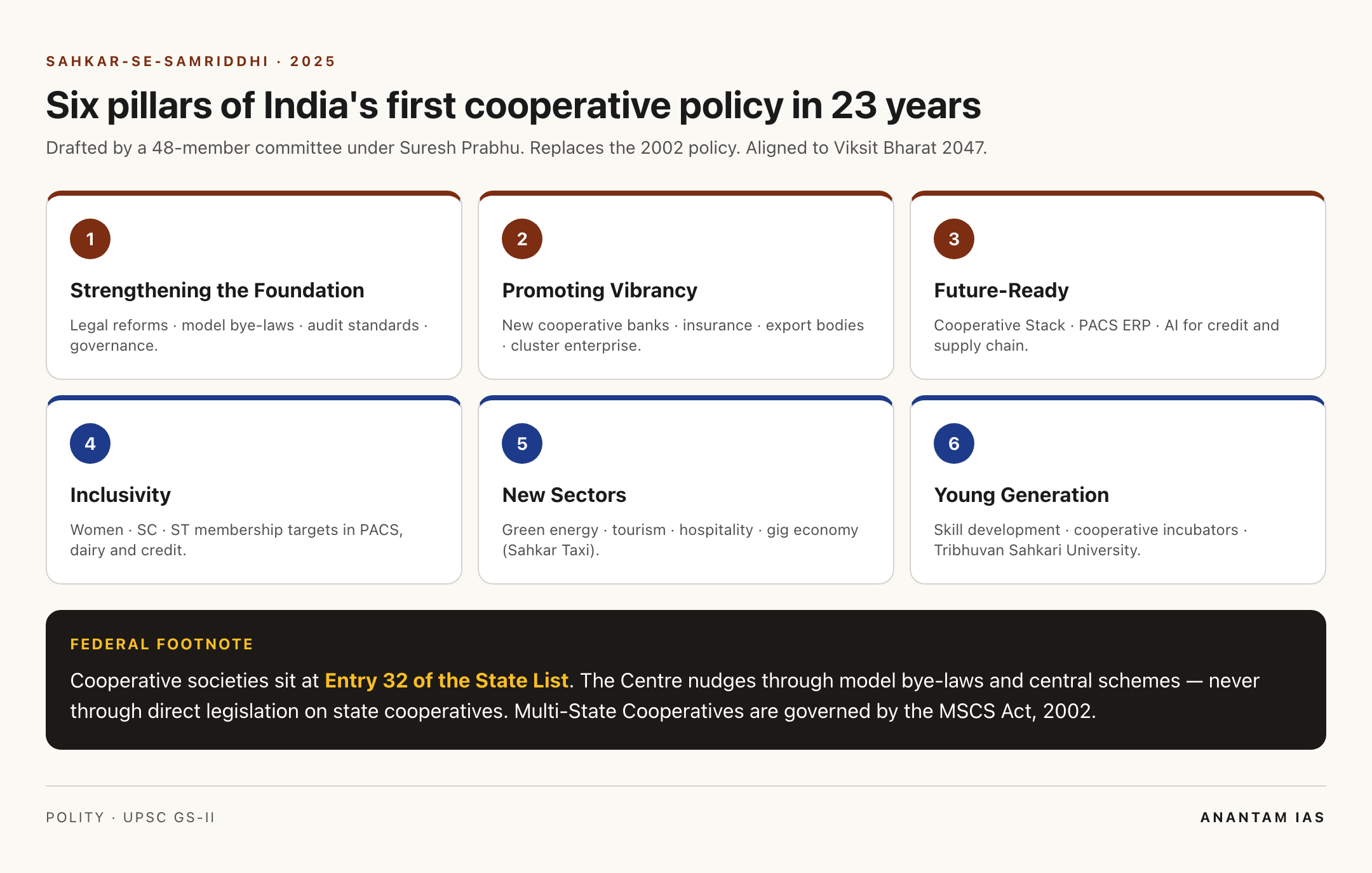
The National Cooperative Policy 2025 was launched in 2025 to align with the UN International Year of Cooperatives. It replaces the National Policy on Cooperatives, 2002. The policy was drafted by a 48-member committee headed by Suresh Prabhu. Its guiding slogan is Sahkar-se-Samriddhi. It is anchored on six pillars and has the goal of tripling the cooperative sector’s contribution to GDP by 2034 while bringing 50 crore citizens into the cooperative fold. The policy operates within the constitutional reality that cooperative societies fall under Entry 32 of the State List in the Seventh Schedule. It builds on the 97th Constitutional Amendment, 2011, which made forming a cooperative a fundamental right under Article 19(1)(c) and inserted Article 43B as a Directive Principle.
What the National Cooperative Policy 2025 Aims to Do
The policy is a comprehensive framework that lays out the government’s vision for the cooperative sector over the next two decades, with most targets oriented toward 2034 and the broader Viksit Bharat goal for 2047. It is not a statute. It does not directly amend any law. Instead, it sets out strategic priorities, model bye-laws for states to adopt, programmatic initiatives funded through central schemes, and institutional reforms.
Background and Historical Context
The cooperative movement in India has roots in the colonial period. The Cooperative Credit Societies Act of 1904 was the first formal legislation, followed by the Cooperative Societies Act of 1912 that allowed non-credit cooperatives. After independence, cooperatives became a central instrument of rural credit, dairy development through Operation Flood, sugar production in western India, and consumer distribution. The first national cooperative policy came in 2002 under the NDA government, with a focus on autonomy, professional management and member-driven cooperatives.
Three things changed between 2002 and 2025. The first was the 97th Constitutional Amendment, 2011, which gave cooperatives constitutional protection by inserting Article 19(1)(c), Article 43B and Part IX-B. The second was the creation of the separate Ministry of Cooperation in July 2021, carved out of the Ministry of Agriculture. The third was the Supreme Court’s ruling in Union of India v. Rajendra N. Shah in 2021, which struck down Part IX-B of the Constitution to the extent it applied to cooperative societies operating within a state, on the ground that the amendment had not been ratified by half the states as required by Article 368(2) for amendments touching state subjects. Part IX-B remains operative for Multi-State Cooperative Societies, which fall under Union competence.
The 2025 policy was drafted against this backdrop. It also responds to a perception that the cooperative sector had stagnated in many parts of India outside the strong belts of Maharashtra, Gujarat, Karnataka and Kerala, and that PACS, the Primary Agricultural Credit Societies, had become functionally inactive in significant numbers.
The Six Pillars of the Policy
The policy is built on six strategic pillars, each with a cluster of programmatic initiatives. The first pillar, Strengthening the Foundation, focuses on legal reforms, model bye-laws for adoption by states, professional auditing standards, and improved governance. The second pillar, Promoting Vibrancy, focuses on creating new business ecosystems through cooperative banks, cooperative insurance, cooperative export promotion bodies and cluster-based cooperative enterprise.
The third pillar, Making Cooperatives Future-Ready, deals with technology and AI integration, including the cooperative stack as a digital public infrastructure layer, ERP-based computerisation of PACS, and adoption of artificial intelligence for credit appraisal, supply chain management and member services. The fourth pillar, Promoting Inclusivity, focuses on expanding membership to women, Scheduled Castes, Scheduled Tribes and other historically underrepresented groups, with explicit gender targets in PACS, dairy cooperatives and credit cooperatives.
The fifth pillar, Entering New Sectors, pushes cooperatives into green energy, tourism, hospitality, services and gig-economy work. The sixth pillar, Shaping the Young Generation, focuses on skill development, cooperative education, and the establishment of cooperative incubators, anchored by the Tribhuvan Sahkari University as a national hub for cooperative education and research.
Quantifiable Targets and the 2034 Vision
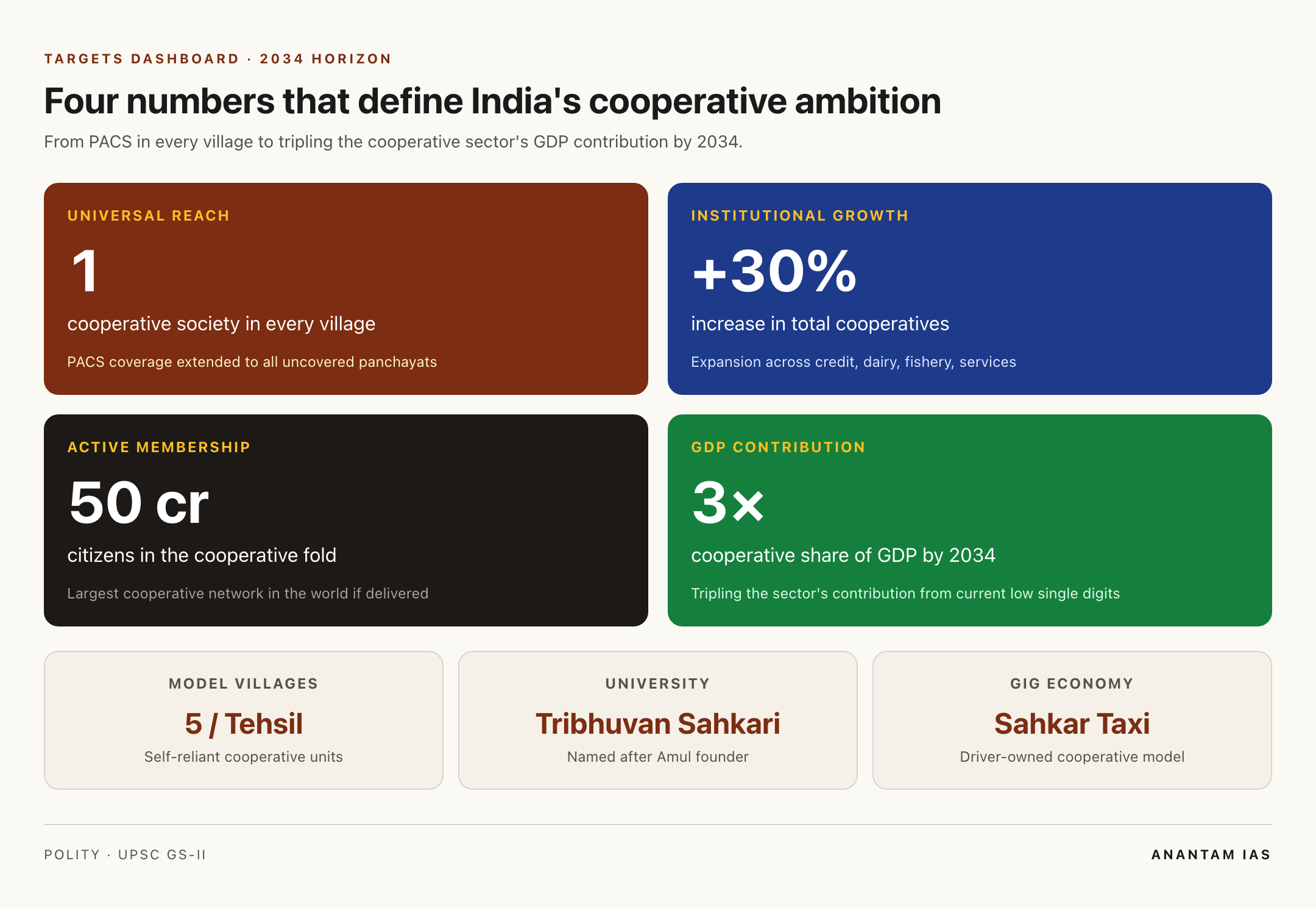
The policy lays out four headline quantitative targets. Universal Reach: at least one cooperative society, primarily a Primary Agricultural Credit Society, in every village in the country, with no panchayat left uncovered. Growth: a 30 percent increase in the total number of cooperative societies, expanding the institutional footprint significantly. Membership: bringing 50 crore citizens into active membership of cooperative bodies. GDP: tripling the cooperative sector’s contribution to GDP by 2034.
The contribution-to-GDP target is the most ambitious of the four. Estimates of the current cooperative share of GDP vary, but the broad consensus places it in the low single digits as a share of nominal GDP. Tripling that share by 2034 requires both deepening of cooperative activity within existing sectors such as dairy, fertiliser, sugar and credit, and expansion into new sectors such as renewable energy, services and the gig economy.
Why the Policy Matters
The policy matters for three reasons. First, it sits at the heart of the federal compact. Cooperative societies are a state subject, but the Centre has now created a separate Ministry of Cooperation, drafted a national policy, and rolled out central schemes such as PACS computerisation worth thousands of crores. The federal balance is being rewritten in real time, and the success of the policy will depend on whether states adopt the model bye-laws and align their state cooperative acts with the new framework.
Second, the policy is one of the few major rural-economy frameworks that explicitly attempts to bring 50 crore citizens into a single institutional fold. If executed even partially, it would create the largest cooperative network in the world. Third, the policy deliberately positions cooperatives as instruments of inclusive growth, with explicit targets for women, SCs, STs and uncovered geographies. This makes it relevant to the GS Paper 2 themes of governance, welfare, and inclusive development.
Major Initiatives Under the Policy
Five initiatives stand out. The first is the Model Cooperative Village, with a target to develop five model cooperative villages per tehsil. These villages will function as integrated units where multiple cooperative bodies, dairy, credit, marketing, fishery, tourism, work in coordination and share infrastructure. The second is Tribhuvan Sahkari University, India’s first national university dedicated to cooperative education, named after Tribhuvandas Patel, the founder of Amul. The university is expected to anchor research, training and capacity building for the sector.
The third is Sahkar Taxi, a cooperative initiative in the gig economy. The model envisages app-based mobility services owned and operated by drivers as cooperative members, with profits flowing to drivers rather than to platform aggregators. The fourth is White Revolution 2.0, an expansion of the dairy cooperative network to uncovered panchayats, with explicit gender targets and technology integration. The fifth is Digitalisation, anchored by the Cooperative Stack and the PACS computerisation programme that connects all PACS to a common national ERP platform under NABARD’s supervision.
Constitutional and Legal Framework
Three constitutional provisions structure the cooperative sector, building on the federalism scheme detailed in our Indian Polity notes and the Seventh Schedule of the Indian Constitution explainer. Entry 32 of the State List, in the Seventh Schedule, places cooperative societies in state competence, except for Multi-State Cooperative Societies which are governed by the Multi-State Cooperative Societies Act, 2002 under Union competence. The 97th Constitutional Amendment, 2011 inserted Article 19(1)(c) to make forming a cooperative society a fundamental right alongside the right to form associations and unions, and Article 43B as a Directive Principle that requires the state to promote voluntary formation, autonomous functioning, democratic control and professional management of cooperative societies. It also inserted Part IX-B, comprising Articles 243ZH to 243ZT, laying down detailed rules for incorporation, elections, audit and management of cooperatives.
In Union of India v. Rajendra N. Shah, 2021, the Supreme Court struck down Part IX-B of the Constitution to the extent it applied to cooperative societies operating within a single state, holding that the amendment had not been ratified by at least half the state legislatures as required under Article 368(2). Part IX-B continues to operate for Multi-State Cooperative Societies. This judicial check is critical to understanding why the National Cooperative Policy 2025 emphasises model bye-laws for state adoption rather than direct legislative imposition. The Centre cannot amend state cooperative laws by executive fiat. It can only nudge states through model frameworks and incentives.
Detailed Analysis: PACS, FPOs and SHGs
The policy puts PACS at the centre of its rural credit strategy. PACS, Primary Agricultural Credit Societies, are the village-level units of the three-tier short-term cooperative credit structure that runs from PACS to District Central Cooperative Banks to State Cooperative Banks. Of the roughly 1 lakh PACS in India, the government has been implementing a computerisation programme to bring all of them onto a unified ERP platform, integrated with banking systems and government schemes.
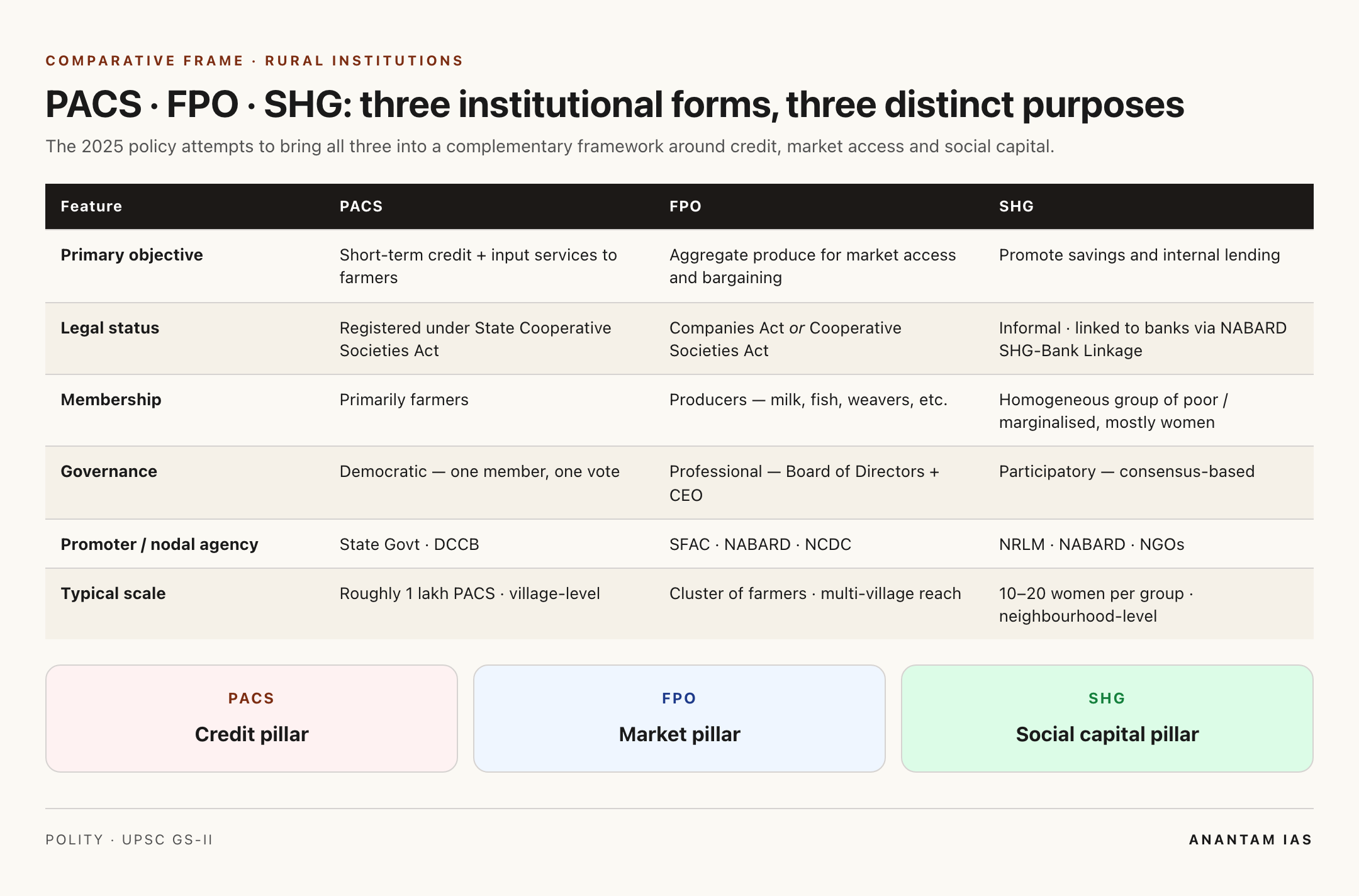
PACS differ from Farmer Producer Organisations and Self-Help Groups in three structural ways. PACS provide short-term credit and input services and operate as cooperatives registered under state cooperative law, with one member, one vote democratic governance. FPOs aggregate produce for better market access and bargaining power, can be registered under either the Companies Act or state cooperative law, and have professional governance with a board of directors and a CEO. SHGs are informal associations of poor or marginalised individuals, mostly women, that promote savings and internal lending, governed by participatory consensus and linked to banks through NABARD’s SHG-Bank Linkage Programme rather than registered as legal entities.
The policy attempts to bring these three institutional forms into a complementary framework, with PACS providing credit, FPOs providing market access, and SHGs anchoring social capital and savings.
Comparative Approach: India and Global Cooperative Models
International cooperative models show a wide spectrum. In Germany, Raiffeisen credit cooperatives anchor rural finance and command a major share of agricultural credit. In Italy, the Emilia-Romagna region runs one of the most sophisticated cooperative ecosystems in the world, where cooperatives account for a significant share of regional GDP. In the Netherlands, FrieslandCampina is a globally significant dairy cooperative. India’s cooperative sector is large in numbers but uneven in performance. The 2025 policy seeks to bring uniformity in performance and governance, drawing partly on the Maharashtra, Gujarat, Karnataka and Kerala models that have historically anchored Indian cooperatives.
Challenges in Implementation
The policy faces five chronic challenges. The first is federal coordination. With cooperatives a state subject, central policy can only nudge through model bye-laws and central schemes. State adoption has historically been uneven. The second is governance. Many cooperatives, particularly PACS, have been politically captured, with elections delayed for years and effective member control diluted. The third is dormant cooperatives. A meaningful share of the existing cooperatives are functionally inactive. The fourth is financial viability. Cooperative banks have suffered repeated stress, and several urban cooperative banks have failed in the recent past. The fifth is professional management. The shift from rule-based to professional and technology-enabled cooperative management requires investment in human capital that the sector has historically struggled to attract.
Prelims Pointers
The National Cooperative Policy 2025 replaces the 2002 policy. It was drafted by a 48-member committee headed by Suresh Prabhu. The slogan is Sahkar-se-Samriddhi. The Ministry of Cooperation was created in July 2021 by carving out functions from the Ministry of Agriculture. Cooperative societies fall under Entry 32 of the State List in the Seventh Schedule. Multi-State Cooperative Societies are governed by the MSCS Act, 2002 under Union competence. The 97th Amendment, 2011 made forming a cooperative society a fundamental right under Article 19(1)(c) and inserted Article 43B and Part IX-B. The Supreme Court in Rajendra N. Shah, 2021 struck down Part IX-B for state cooperatives but upheld it for Multi-State Cooperatives. The Tribhuvan Sahkari University is named after Tribhuvandas Patel, the founder of Amul. The policy targets tripling the cooperative sector’s GDP contribution by 2034. 2025 is the UN International Year of Cooperatives.
Mains Practice Questions
- The National Cooperative Policy 2025 attempts to make cooperatives the “second engine” of India’s growth. Evaluate the policy framework and its implications for cooperative federalism. (GS Paper 2, 250 words)
- Discuss the significance of the 97th Constitutional Amendment for the cooperative sector and analyse the Supreme Court’s ruling in Union of India v. Rajendra N. Shah. (GS Paper 2, 250 words)
- Compare and contrast the structures and roles of PACS, Farmer Producer Organisations and Self-Help Groups in rural credit and livelihood. (GS Paper 2, 150 words)
- The policy proposes a Sahkar Taxi initiative to bring cooperative principles into the gig economy. Examine the merits and challenges of this approach. (GS Paper 2, 150 words)
Way Forward
For the policy to deliver, four enabling conditions are essential. First, real federal cooperation, with states adopting model bye-laws and aligning their state cooperative acts. Without this, the policy will remain a central wishlist. Second, depoliticisation of cooperative governance, with timely elections, term limits and professional auditors free of state interference. Third, sustained investment in PACS computerisation and ERP rollout, with adequate training of staff and integration with the broader digital public infrastructure stack. Fourth, careful piloting of new initiatives such as Sahkar Taxi and Model Cooperative Villages, with rigorous evaluation before scaling.
The deeper challenge is cultural. Cooperatives can only thrive when members treat them as their own institutions and not as extensions of state subsidy. The 2025 policy frames cooperatives as instruments of inclusive growth rather than welfare delivery, which is the right conceptual move. Whether the institutional and political ecosystem can deliver on that frame is the question that will shape the next decade.
Frequently Asked Questions
What is the National Cooperative Policy 2025?
The National Cooperative Policy 2025 is the national framework launched in 2025 by the Ministry of Cooperation that replaces the 2002 cooperative policy. It is anchored on the slogan Sahkar-se-Samriddhi and built on six strategic pillars. It targets tripling the cooperative sector’s contribution to GDP by 2034 and bringing 50 crore citizens into active cooperative membership.
Who drafted the National Cooperative Policy 2025?
A 48-member committee headed by Suresh Prabhu, the former Union Minister, drafted the policy. The committee included representatives of state cooperative federations, academic institutions, industry bodies, NABARD and key central ministries. The drafting process consulted state governments and cooperative apex bodies extensively.
Are cooperative societies a state subject or a Union subject?
Cooperative societies are primarily a state subject under Entry 32 of the State List in the Seventh Schedule. The Centre has competence only over Multi-State Cooperative Societies, which are regulated under the Multi-State Cooperative Societies Act, 2002. This is why the National Cooperative Policy 2025 works largely through model bye-laws and central schemes rather than direct legislation on state cooperatives.
What is the 97th Constitutional Amendment?
The 97th Constitutional Amendment, 2011 made three changes. It inserted the right to form cooperative societies into Article 19(1)(c) as a fundamental right. It inserted Article 43B as a Directive Principle requiring the state to promote voluntary formation, autonomous functioning, democratic control and professional management of cooperative societies. It inserted Part IX-B, Articles 243ZH to 243ZT, laying down rules on incorporation, elections, board composition and audit.
What did the Supreme Court rule in Rajendra N. Shah?
In Union of India v. Rajendra N. Shah, 2021, the Supreme Court struck down Part IX-B of the Constitution to the extent it applied to cooperative societies operating within a single state, on the ground that the amendment had not been ratified by half the state legislatures as required under Article 368(2). Part IX-B continues to operate for Multi-State Cooperative Societies because they fall under Union competence, a ruling that sits within the basic structure doctrine line of constitutional reasoning.
What is the Tribhuvan Sahkari University?
The Tribhuvan Sahkari University is India’s first national university dedicated to cooperative education and research, announced under the National Cooperative Policy 2025. It is named after Tribhuvandas Patel, the founder of the Kaira District Cooperative Milk Producers’ Union, popularly known as Amul. The university is expected to anchor cooperative training, research and incubation of cooperative enterprises.
What is Sahkar Taxi?
Sahkar Taxi is a cooperative model in the gig economy proposed under the policy. It envisages app-based taxi services owned and operated by drivers as cooperative members. Profits flow to drivers as cooperative members rather than to platform aggregators. The model is being piloted in select cities.
What are the headline targets of the policy?
The four headline targets are: at least one cooperative society in every village in the country, a 30 percent increase in the total number of cooperative societies, bringing 50 crore citizens into active cooperative membership, and tripling the cooperative sector’s contribution to GDP by 2034.
Is forming a cooperative society a fundamental right?
Yes. After the 97th Constitutional Amendment, 2011, the right to form cooperative societies is part of the fundamental right under Article 19(1)(c), alongside the right to form associations and unions. This means restrictions on forming a cooperative must satisfy the reasonableness test under Article 19(4).
What is the difference between PACS, FPOs and SHGs?
PACS are Primary Agricultural Credit Societies that provide short-term credit and input services, registered under state cooperative law with one member, one vote governance. FPOs are Farmer Producer Organisations that aggregate produce for market access, registered under the Companies Act or cooperative law, governed professionally with a board and CEO. SHGs are informal Self-Help Groups, mostly women, that promote savings and internal lending, linked to banks through NABARD’s SHG-Bank Linkage Programme.