National Investigation Agency (NIA): Mandate, Jurisdiction, and Scheduled Offences
National Investigation Agency explained for UPSC: NIA Act 2008, 2019 amendment, scheduled offences, jurisdiction, Special NIA Courts, and comparison with CBI and ED.
The National Investigation Agency (NIA) is India’s central counter-terrorism investigation agency, set up by Parliament after the Mumbai terror attacks of November 2008. The agency was created to do something the existing Indian investigation architecture could not: probe terror offences across state boundaries, prosecute them in dedicated Special NIA Courts, and pursue terror finance and recruitment networks that operate transnationally. The NIA Act 2008 gave the agency this mandate, and the 2019 amendment expanded both the agency’s territorial reach and its list of scheduled offences.
The National Investigation Agency is headquartered in New Delhi and operates through regional offices across the country. It is led by a Director General of NIA, an officer of the rank of Director General of Police drawn from the Indian Police Service. The agency takes up an investigation either suo motu, when the central government directs it after receiving information about a scheduled offence, or on the request of a state government accepted by the central government.
This explainer covers the legal basis for the National Investigation Agency, the 2019 amendments that expanded jurisdiction to property attachment and offences abroad, the schedule of offences the agency can investigate, the Special NIA Courts that try its cases, and the institutional comparison with the CBI and the Enforcement Directorate.
Quick Facts on the National Investigation Agency
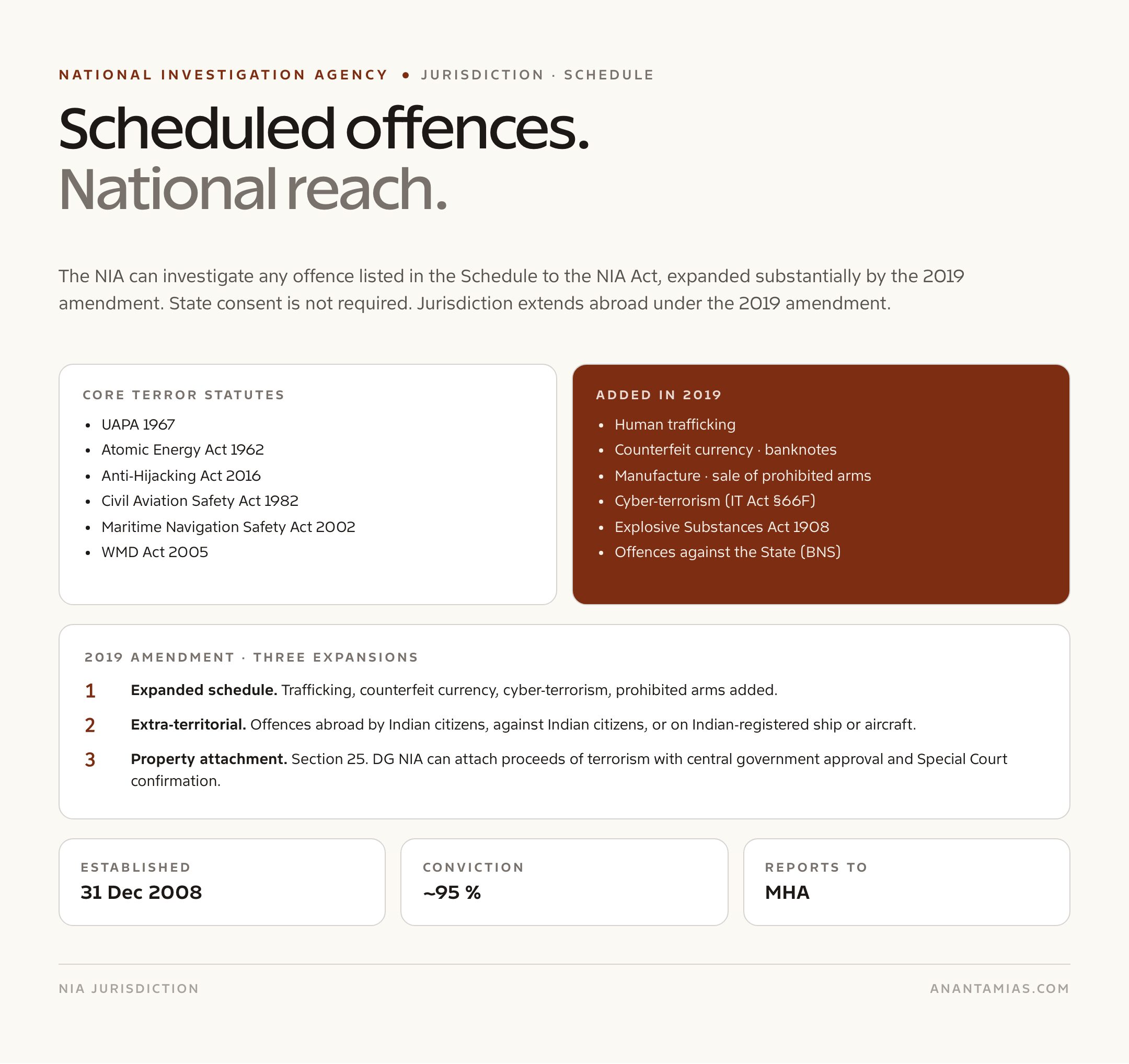
- Established. 31 December 2008, under the NIA Act 2008.
- Trigger. Mumbai terror attacks of 26 November 2008.
- Headquarters. New Delhi.
- Headed by. Director General of NIA, an IPS officer of the rank of DG.
- Reports to. Ministry of Home Affairs.
- First case registered. February 2009, a terror financing case from Kerala.
- Major amendment. NIA (Amendment) Act 2019.
- Special Courts. Sessions Courts designated as Special NIA Courts under Section 11.
- Conviction rate. Approximately 95 percent (one of the highest among Indian investigative agencies).
- Scheduled offences. Listed in the Schedule to the NIA Act, expanded by the 2019 amendment.
Origin: The NIA Act 2008
The National Investigation Agency Act was introduced in Parliament within days of the 26 November 2008 Mumbai attacks, in which ten Lashkar-e-Taiba operatives killed 166 people across the city. The pre-2008 architecture had no central terror agency. State police forces investigated terror cases within their state, the CBI took up cases referred to it under the Delhi Special Police Establishment Act 1946 (a state-consent regime), and the Intelligence Bureau collected intelligence but had no investigative powers.
The NIA Act 2008 changed three things. First, it created a central agency with statutory power to investigate offences listed in the Schedule, without the state-consent requirement that applies to the CBI. Second, it created Special Courts to try scheduled offences with procedures designed for terror cases, including in-camera proceedings and witness protection. Third, it gave the central government an explicit power under Section 6 to direct the NIA to take over an investigation from any state agency.
The constitutionality of the NIA Act was upheld by the Bombay High Court in 2020 and is currently pending in the Supreme Court in a federalism challenge by some state governments. The fundamental-rights backdrop, especially the protections under Article 20 of the Indian Constitution, is invariably cited by the defence in NIA trials.
The 2019 Amendment and Its Three Expansions
The NIA (Amendment) Act 2019 expanded the agency’s powers in three significant ways.
Expansion of scheduled offences. The 2019 amendment added human trafficking, counterfeit currency or banknotes, manufacture or sale of prohibited arms, cyber-terrorism, and offences under the Explosive Substances Act 1908 to the Schedule. Before the amendment, the NIA could only investigate offences under specified counter-terror statutes such as the Unlawful Activities (Prevention) Act 1967, the Atomic Energy Act 1962, and the SAARC Convention (Suppression of Terrorism) Act 1993.
Extra-territorial jurisdiction. Section 1(2) was amended to allow the NIA to investigate scheduled offences committed outside India by Indian citizens, by foreign nationals against Indian citizens, or in any aircraft or ship registered in India. The agency can investigate such cases as if the offence had been committed in India, subject to international treaties and the domestic law of the country where the act took place.
Property attachment. A new Section 25 was inserted to allow the Director General of NIA to attach property derived from proceeds of terrorism, with the approval of the central government and judicial confirmation by the Special Court. Earlier, attachment in terror cases was available only under the Unlawful Activities (Prevention) Act.
These three changes shifted the National Investigation Agency from a domestic terror-investigation body to a near-equivalent of foreign counter-terror agencies such as the US FBI’s National Security Branch.
Scheduled Offences: What the NIA Can Investigate
The Schedule to the NIA Act lists the offences the agency can investigate. After the 2019 amendment, the Schedule covers the following statutes and offences.
- Unlawful Activities (Prevention) Act 1967, the principal anti-terror statute.
- Atomic Energy Act 1962, in respect of offences linked to terrorism.
- Anti-Hijacking Act 2016.
- Suppression of Unlawful Acts Against Safety of Civil Aviation Act 1982.
- SAARC Convention (Suppression of Terrorism) Act 1993.
- Suppression of Unlawful Acts Against Safety of Maritime Navigation and Fixed Platforms on Continental Shelf Act 2002.
- Weapons of Mass Destruction and their Delivery Systems (Prohibition of Unlawful Activities) Act 2005.
- Sections of the Indian Penal Code 1860 (now Bharatiya Nyaya Sanhita 2023) relating to waging war against the Government of India, offences against the State, and use of explosives.
- Explosive Substances Act 1908.
- Sections of the Arms Act 1959 relating to prohibited arms.
- Sections of the Information Technology Act 2000 dealing with cyber-terrorism (Section 66F).
- Sections of the Bharatiya Nyaya Sanhita 2023 dealing with counterfeit currency, human trafficking, and offences relating to economic security of India.
The 2019 amendment thus widened the schedule from a narrow terror list to a broader internal-security list that includes economic-security offences.
Special NIA Courts and Their Procedure
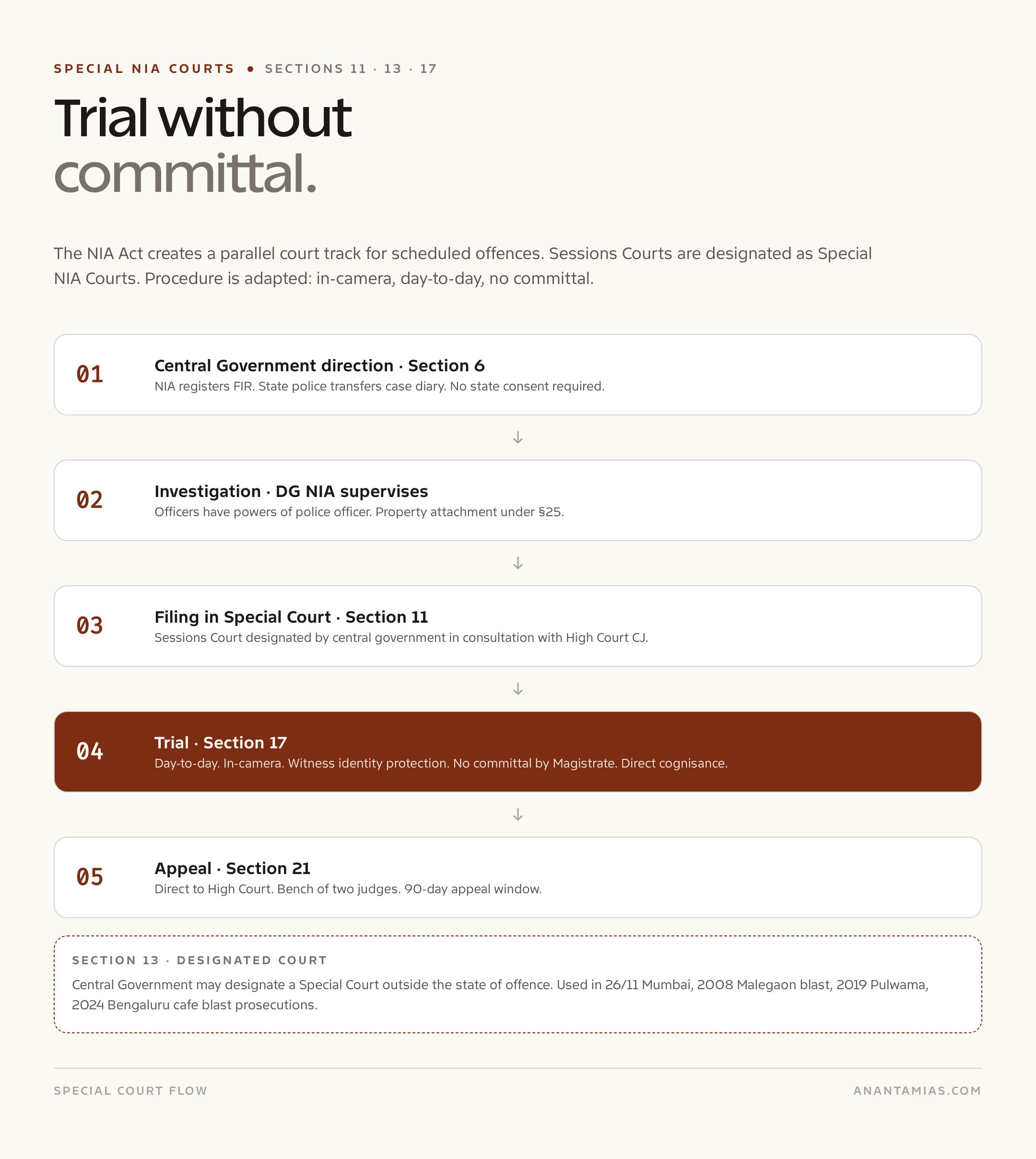
The NIA Act 2008 created Special Courts for the trial of scheduled offences. Section 11 lets the central government designate Sessions Courts as Special NIA Courts. The designation is made in consultation with the Chief Justice of the High Court under which the Sessions Court functions.
Special NIA Courts follow procedures adapted for terror trials. Trials are held on a day-to-day basis. The court can hold proceedings in camera under Section 17, can withhold witness identity under Section 17, and can take cognisance of a scheduled offence without committal by a Magistrate. The Code of Criminal Procedure 1973 (now the Bharatiya Nagarik Suraksha Sanhita 2023) applies subject to the modifications in the NIA Act.
Section 13 allows the central government to designate any Special Court, including one outside the state where the offence was committed, as the trial court for a particular case. This was used in the 26/11 Mumbai attack prosecution, the 2008 Malegaon blast case, and the 2019 Pulwama investigation, among others.
The NIA has a conviction rate of approximately 95 percent in cases that have reached trial completion, which is among the highest of any Indian investigative agency. The high rate is partly a function of case selection (the NIA prosecutes only after extensive evidence-gathering) and partly a function of the Special Court procedure that streamlines trial conduct.
Power to Take Over State Investigations
Section 6 of the NIA Act 2008 lets the central government direct the NIA to investigate a scheduled offence reported by a state government, or to take over an investigation already in progress by the state police.
The state-consent requirement that applies to the CBI under the Delhi Special Police Establishment Act 1946 does not apply to the NIA. Once the central government issues a direction under Section 6, the state police is required to transfer the case to the NIA, hand over the case diary, and assist in further investigation.
This unilateral take-over power has been controversial. Some state governments have argued that it violates the federal scheme by allowing the central government to displace state police investigations in subjects (law and order, police) that are state list entries. The Supreme Court has so far upheld the provision on the basis that scheduled offences fall within the central government’s residuary powers and Entry 8 of the Union List (Central Bureau of Intelligence and Investigation). The federal balance here also depends on the Rajya Sabha using its Article 249 and 312 powers responsibly.
The constitutional challenge to the NIA Act by the Government of Tamil Nadu and the Government of West Bengal is pending in the Supreme Court.
Property Attachment Under the 2019 Amendment
Section 25 of the NIA Act, inserted in 2019, gives the Director General of NIA the power to attach property derived from proceeds of terrorism, with the approval of the central government. Within thirty days of the attachment order, the NIA must file a confirmation petition before the Special Court.
The Special Court hears the affected party, examines the evidence, and either confirms the attachment, modifies it, or sets it aside. If confirmed, the property may eventually be forfeited to the central government on conviction. The procedure is analogous to attachment under the Prevention of Money Laundering Act 2002, but the trigger is the terror investigation rather than a money-laundering predicate offence.
The 2019 amendment to Section 25 plugged a gap in the previous architecture, where the NIA had to rely on the Enforcement Directorate to attach proceeds of terror finance. The agency can now run an end-to-end investigation, prosecution, and asset-recovery cycle within a single statute.
NIA versus CBI versus ED: Institutional Comparison
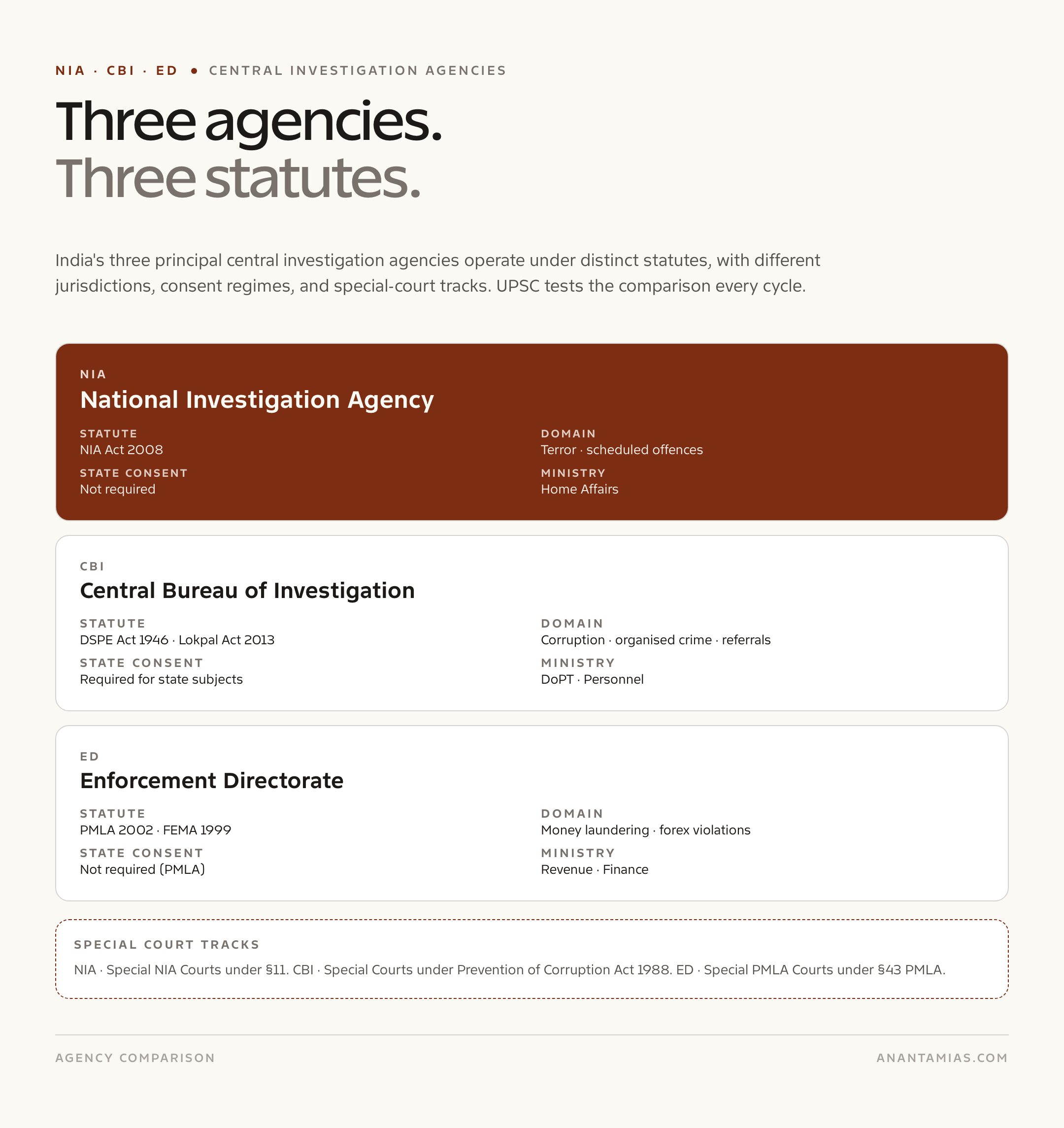
A common UPSC question is the comparative position of the three principal central investigation agencies.
Jurisdictional basis. The NIA operates under the NIA Act 2008. The CBI operates under the Delhi Special Police Establishment Act 1946 and the Lokpal and Lokayuktas Act 2013. The Enforcement Directorate operates under the Prevention of Money Laundering Act 2002 and the Foreign Exchange Management Act 1999.
Subject matter. The NIA investigates scheduled terror and security offences. The CBI investigates corruption, organised crime, and offences referred by central or state governments or by courts. The ED investigates money laundering and foreign exchange violations.
State consent. The NIA does not require state consent. The CBI requires state consent for investigations in state subjects. The ED operates under its own statute and does not require state consent for PMLA investigations.
Special courts. The NIA cases go to Special NIA Courts. CBI corruption cases go to CBI Special Courts under the Prevention of Corruption Act 1988. ED cases go to Special PMLA Courts.
Reporting. The NIA reports to the Ministry of Home Affairs. The CBI reports to the Department of Personnel and Training, Ministry of Personnel, Public Grievances and Pensions. The ED reports to the Department of Revenue, Ministry of Finance.
The three agencies often co-investigate complex cases, with the NIA handling the terror angle, the ED tracing the money trail, and the CBI prosecuting any underlying corruption or organised-crime element.
Notable Cases and Operational Record
The National Investigation Agency has investigated and prosecuted a long list of high-profile cases since 2009. A selected record gives a sense of the agency’s operational range.
The 26 November 2008 Mumbai attack prosecution resulted in the conviction of Mohammed Ajmal Kasab, who was hanged in November 2012. The 2008 Malegaon blast case, the 2007 Samjhauta Express bombing, and the 2007 Mecca Masjid blast cases were transferred to the NIA after constitution.
The 2016 Pathankot airbase attack, the 2016 Uri attack, and the 2019 Pulwama suicide bombing were all investigated by the NIA. The 2016 Burdwan blast and the 2018 Bodh Gaya blast cases also fell to the agency. More recent cases include the 2024 Bengaluru Rameshwaram Cafe blast investigation, the 2025 Khalistani referendum-related conspiracy cases, and ongoing investigations into cyber-terrorism and online radicalisation networks.
The agency has built a parallel record on transnational terror finance, with cases involving hawala channels routing money to terror outfits in the Kashmir Valley, fake currency networks operating from across the western border, and cyber-recruitment cases linked to ISKP and other transnational outfits. The agency frequently coordinates with the National Disaster Response Force in the aftermath of terror incidents that cause mass-casualty damage.
UPSC Angles on the National Investigation Agency
For prelims, the National Investigation Agency is tested on the year of constitution, the legal basis (NIA Act 2008), the 2019 amendment provisions, the schedule of offences, and the institutional comparison with CBI and ED.
For mains GS-III, the internal security chapter asks about the institutional architecture of counter-terror investigation in India, the relative roles of NIA, IB, RAW, and state police, the 2019 amendment’s federalism implications, and questions on uniformed services that include the Indian Air Force ranks hierarchy and the central armed police forces. The agency is also tested in GS-II under the federal-relations chapter, with the take-over power under Section 6 cited as a hard case in centre-state cooperation.
For ethics and probity, the high conviction rate of the NIA has been cited as a case in institutional capacity-building and the value of specialist expertise.
Frequently Asked Questions
What is the National Investigation Agency?
The National Investigation Agency is India’s central counter-terrorism investigation agency, set up under the NIA Act 2008 after the 26/11 Mumbai attacks. It investigates and prosecutes scheduled offences listed in the NIA Act, including offences under the Unlawful Activities (Prevention) Act and other terror-related statutes.
Under which Act was the NIA established?
The National Investigation Agency was established under the National Investigation Agency Act 2008, which Parliament passed in December 2008 in response to the 26/11 Mumbai terror attacks.
What did the 2019 amendment to the NIA Act do?
The 2019 amendment expanded the NIA’s powers in three ways: it added new scheduled offences such as human trafficking, counterfeit currency, and cyber-terrorism; it gave the agency extra-territorial jurisdiction to investigate offences committed outside India; and it inserted Section 25 allowing attachment of property derived from proceeds of terrorism.
Does the NIA need state consent to investigate?
No. Unlike the CBI, which requires state consent under the Delhi Special Police Establishment Act, the NIA can take over a state investigation on a direction from the central government under Section 6 of the NIA Act.
What are Special NIA Courts?
Special NIA Courts are Sessions Courts designated by the central government under Section 11 of the NIA Act for the trial of scheduled offences. They follow procedures adapted for terror trials, including day-to-day hearings, in-camera proceedings, and witness identity protection.
How does the NIA differ from the CBI?
The NIA investigates terror and internal-security offences under the NIA Act and does not require state consent. The CBI investigates corruption, organised crime, and cases referred by governments and courts under the Delhi Special Police Establishment Act and the Lokpal and Lokayuktas Act, and requires state consent for cases in state subjects.
What is the NIA’s conviction rate?
The NIA’s conviction rate in cases that have reached trial completion is approximately 95 percent, one of the highest among Indian investigative agencies, partly a result of selective case-building and Special Court procedure.