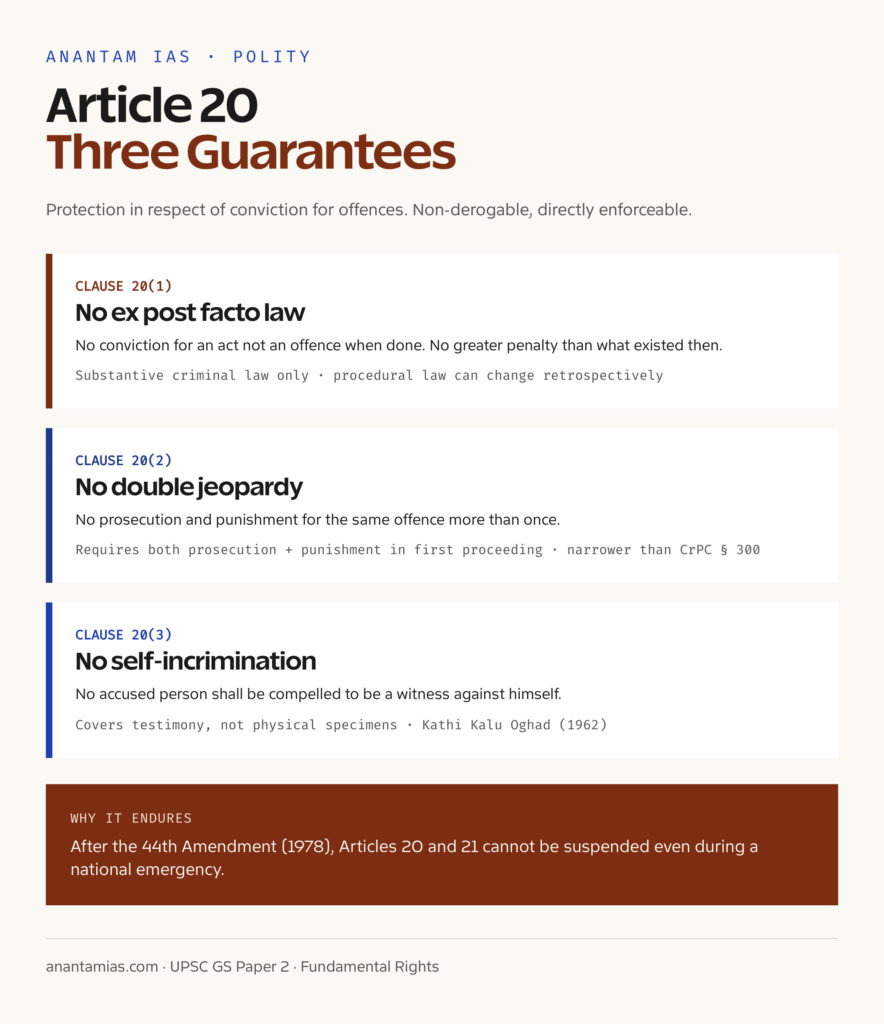
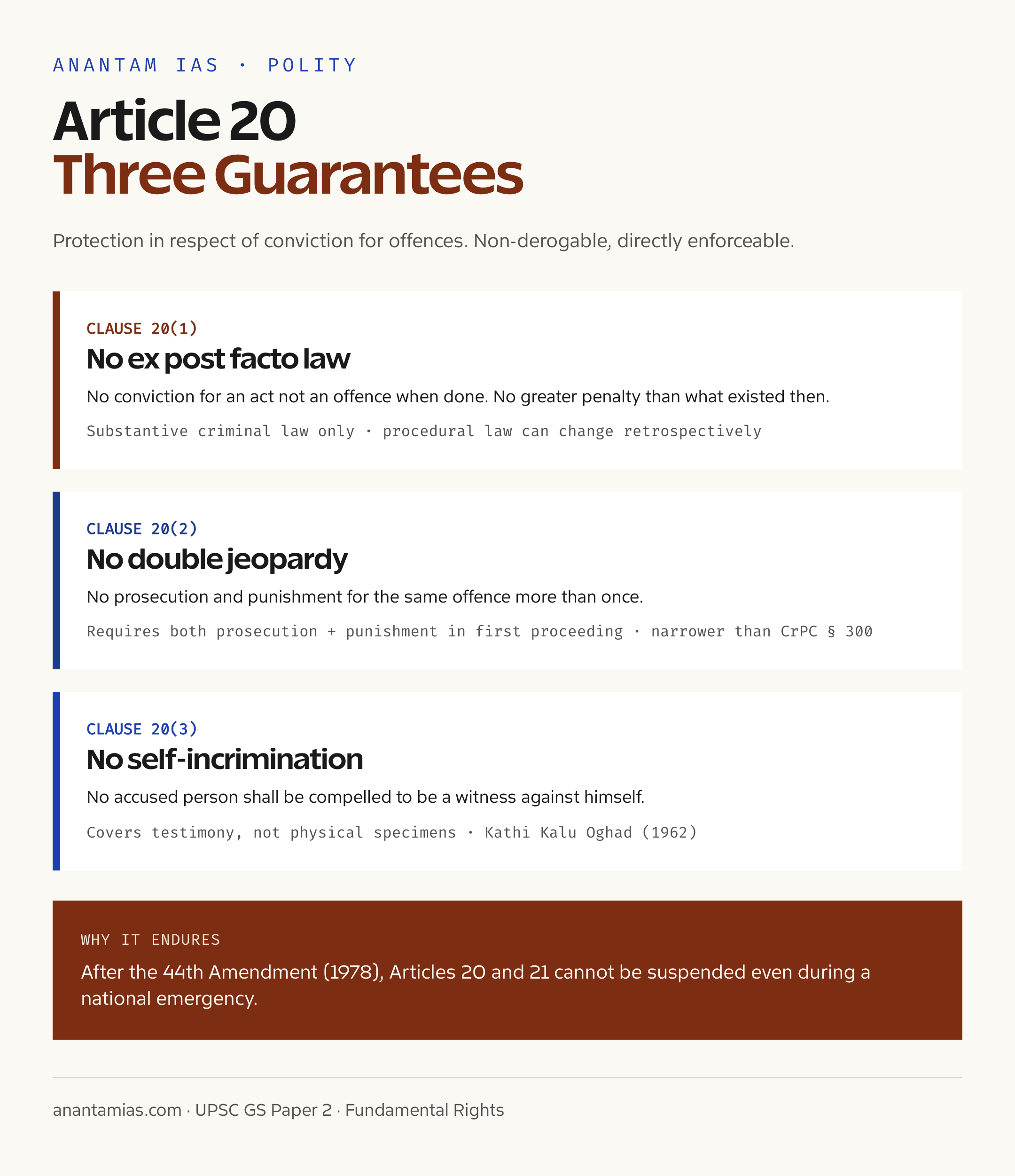
Article 20 Indian Constitution sits in the chapter on Fundamental Rights and protects an accused person from three specific kinds of state overreach in criminal proceedings. It is one of the most narrowly drafted but most foundational rights in the Constitution because it is non-derogable. Even during a national emergency under Article 359, the rights guaranteed by Article 20 cannot be suspended. This makes Article 20 Indian Constitution a permanent floor on which the criminal justice system stands.
The Article packs three guarantees into three clauses: protection against ex post facto laws (Article 20(1)), the right against double jeopardy (Article 20(2)), and the right against self-incrimination (Article 20(3)). Each clause has been tested, refined, and occasionally narrowed by the Supreme Court through landmark cases. Together they restrict what Parliament can criminalise retrospectively, what prosecutors can prosecute twice, and what investigators can compel an accused to say.
This explainer breaks down Article 20 Indian Constitution clause by clause, walks through the leading Supreme Court judgments, traces the comparative position in other constitutions, and maps the prelims and mains angles UPSC has favoured. We’ll also note where the Article interfaces with the modern criminal procedure code and the new Bharatiya Nyaya Sanhita.
Quick Facts on Article 20
- Location. Part III of the Constitution, under Fundamental Rights.
- Three clauses. Ex post facto law, double jeopardy, self-incrimination.
- Non-derogable. Cannot be suspended even during a national emergency (Article 359).
- Applies to. Both citizens and non-citizens within India.
- Original adoption. Part of the Constitution as adopted on 26 January 1950.
- Borrowed from. US Constitution’s Fifth Amendment for double jeopardy and self-incrimination; English law for ex post facto principle.
- Related provisions. Article 21 (life and liberty), Article 22 (arrest), Article 14 (equality).
- Key cases. Maneka Gandhi (1978), M.P. Sharma (1954), Selvi (2010), K.S. Puttaswamy (2017).
What Article 20 Indian Constitution Says
Article 20 Indian Constitution is titled “Protection in respect of conviction for offences.” It reads in three short clauses:
Article 20(1): No person shall be convicted of any offence except for violation of a law in force at the time of the commission of the act charged as an offence, nor be subjected to a penalty greater than that which might have been inflicted under the law in force at the time of the commission of the offence.
Article 20(2): No person shall be prosecuted and punished for the same offence more than once.
Article 20(3): No person accused of any offence shall be compelled to be a witness against himself.
Each clause is a self-contained guarantee. None of them needs Parliamentary legislation to give effect. They are directly enforceable through writs under Article 32 (Supreme Court) and Article 226 (High Courts). The Article applies to every person within India, citizen or not, natural or juridical to the extent the right by its nature applies to a corporation.
The Article does not require the consent of Parliament for activation, and it does not yield to ordinary law. A statute that violates Article 20 Indian Constitution is void to the extent of the inconsistency under Article 13(2).
Background and Historical Context
Article 20 Indian Constitution emerged from the Constituent Assembly debates in 1948 and 1949. The Drafting Committee under B. R. Ambedkar took the ex post facto principle from English common law and the Bill of Rights, 1689, and adapted the double jeopardy and self-incrimination clauses from the US Constitution’s Fifth Amendment.
The original draft was numbered as Article 14 in the draft Constitution. Ambedkar made the case that these three protections were the bare minimum any constitutional order owed to a person facing criminal prosecution. The Assembly accepted the formulation almost without amendment, reflecting broad consensus that criminal justice must rest on these guarantees.
The first significant test came soon after the Constitution was adopted. In Kedar Nath Bajoria v. State of West Bengal (1953), the Supreme Court addressed whether a law enhancing the punishment after the commission of the offence violated Article 20(1). The court held it did, and laid down the principle that only laws in force at the time of the act could be applied.
The 44th Constitutional Amendment in 1978, enacted in the aftermath of the Emergency, strengthened Article 20 by placing it (along with Article 21) outside the scope of suspension during a national emergency. Before the amendment, Article 359 allowed even Article 20 rights to be suspended. The 44th Amendment made the right non-derogable.
Over decades, the Supreme Court has read Article 20 Indian Constitution alongside Articles 14, 19, and 21 to build the broader framework of due process. After Maneka Gandhi v. Union of India (1978), procedural fairness in criminal cases became enforceable through the combined reading of these articles.
Clause 1: Ex Post Facto Law (Article 20(1))
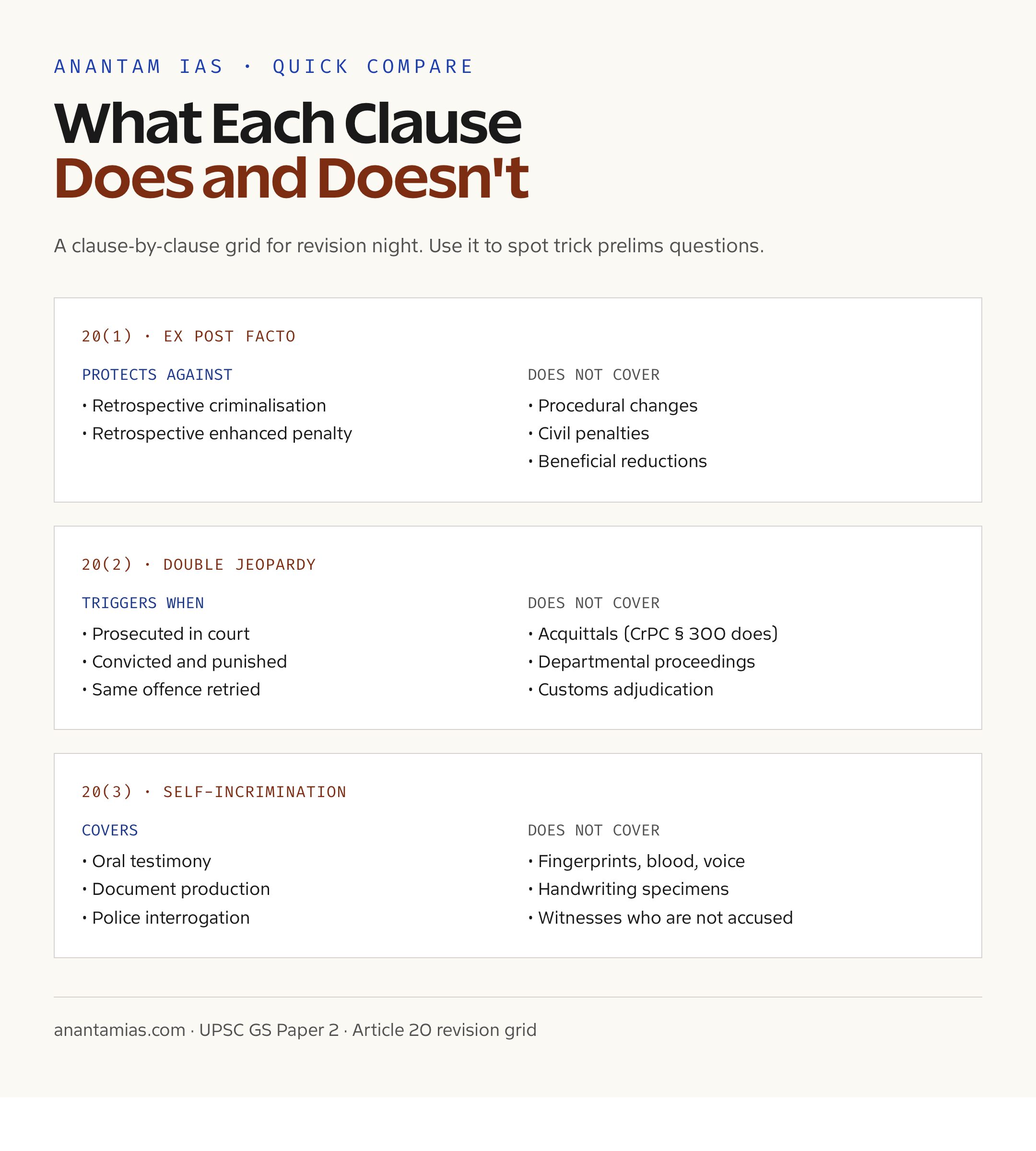
Article 20(1) bars two things. One, conviction for an act that was not an offence at the time it was done. Two, imposition of a penalty greater than the one that existed when the act was committed.
The prohibition applies only to substantive criminal law. Procedural law can change retrospectively without violating Article 20(1), as the Supreme Court held in Rao Shiv Bahadur Singh v. State of Vindhya Pradesh (1953). If Parliament tomorrow changes how a trial is conducted but does not change what is a crime or what the maximum sentence is, the change can apply to ongoing cases.
The clause covers two scenarios. First, an act that was perfectly legal when done cannot be retroactively criminalised. Second, even if the act was illegal when done, the punishment cannot be increased retrospectively. So if a person committed an offence in 2020 carrying a 5-year maximum sentence, and Parliament in 2025 enhanced the maximum to 10 years, the accused can only be sentenced under the 2020 ceiling.
The protection does not extend to beneficial changes. If Parliament reduces a punishment, the lower punishment can apply to ongoing cases. This was held in T. Barai v. Henry Ah Hoe (1983), where a reduction of penalty was applied retrospectively in favour of the accused.
The clause also does not apply to preventive detention laws, civil penalties, or disciplinary proceedings. Cancellation of a passport or revocation of a licence, even if treated as a “penalty” in common usage, is not a “penalty” within Article 20(1) unless it is part of a criminal sentence.
Clause 2: Double Jeopardy (Article 20(2))
Article 20(2) protects against being “prosecuted and punished for the same offence more than once.” The Indian formulation is narrower than the American Fifth Amendment, which protects against being “twice put in jeopardy of life or limb.” In India, the bar applies only when there has been both a prosecution and a punishment in the first case.
The Supreme Court has consistently held that all three conditions must be met for Article 20(2) to apply:
- The person must have been prosecuted before a court or judicial tribunal.
- The earlier prosecution must have resulted in conviction and punishment.
- The second prosecution must be for the same offence.
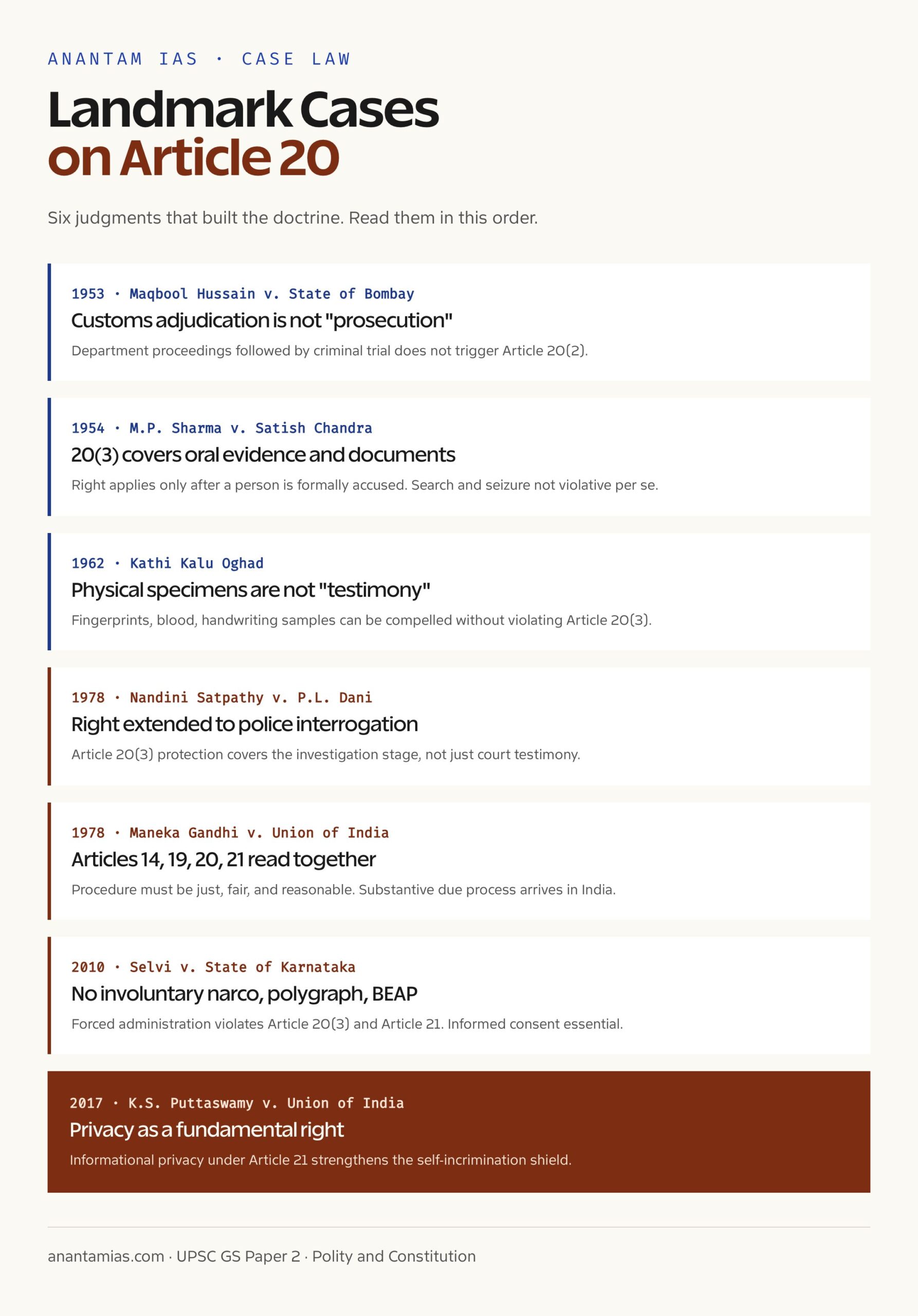
If the first proceeding ended in acquittal, Article 20(2) does not bar a second prosecution on appeal by the state. If the first proceeding was before a department in disciplinary action, the bar does not apply to a subsequent criminal trial. In Maqbool Hussain v. State of Bombay (1953), the Supreme Court held that customs adjudication proceedings are not a “prosecution” within Article 20(2), so a subsequent criminal trial for the same set of facts was not barred.
The Code of Criminal Procedure, 1973, and now the Bharatiya Nagarik Suraksha Sanhita, 2023, contain a broader bar in Section 300 (CrPC) and Section 337 (BNSS) called autrefois acquit and autrefois convict. These statutory provisions cover acquittals as well as convictions, providing wider protection than Article 20(2). UPSC frequently tests this distinction.
Clause 3: Self-Incrimination (Article 20(3))
Article 20(3) provides that no person accused of an offence shall be compelled to be a witness against himself. The clause has three working parts: there must be an accused, there must be compulsion, and the testimony must be incriminating.
The leading case is M.P. Sharma v. Satish Chandra (1954), where the Supreme Court held that the protection covers oral testimony as well as the production of documents, but only after a person becomes an accused. Compulsion includes physical, mental, and emotional pressure.
The protection does not extend to:
- Physical evidence like fingerprints, blood samples, voice samples, handwriting specimens. State of Bombay v. Kathi Kalu Oghad (1962) held that physical specimens are not “testimonial” evidence.
- Witnesses who are not accused.
- Statements made before being accused (though the Supreme Court has narrowed this).
The protection was significantly expanded in Selvi v. State of Karnataka (2010), where the Supreme Court held that narco-analysis, polygraph tests, and brain electrical activation profiling cannot be administered without informed consent. The court held that involuntary administration of these tests violates Article 20(3) and Article 21 (right to mental privacy).
K.S. Puttaswamy v. Union of India (2017), the privacy judgment, further strengthened the right by recognising informational privacy as a facet of Article 21 that interfaces with Article 20(3) in self-incrimination contexts.
Why Article 20 Indian Constitution Matters
Article 20 Indian Constitution matters because it is the structural floor of criminal justice in India. The Article works alongside the Election Commission’s appointment framework discussions that have animated polity debates, in that both are about institutional restraints on state power.
Five reasons make Article 20 Indian Constitution important.
First, non-derogability. During the 1975-77 Emergency, several fundamental rights were suspended. After the 44th Amendment, Articles 20 and 21 are permanently outside the suspension power. This makes them the irreducible minimum of constitutional protection.
Second, double protection. Article 20 protects both citizens and non-citizens, natural and juridical persons (to the extent applicable). A foreign national accused in an Indian court enjoys the same Article 20 protections as an Indian citizen.
Third, direct enforceability. The rights can be enforced through writ jurisdiction under Articles 32 and 226 without needing implementing legislation.
Fourth, interaction with Article 21. After Maneka Gandhi (1978), the procedural protections under Article 20 are read together with the right to life and personal liberty under Article 21, the right to fair trial, and the right to legal counsel.
Fifth, modernisation through case law. Each new investigative technology — narco-analysis, brain mapping, DNA profiling, electronic surveillance — has had to pass the Article 20 test. The Article therefore evolves with technology, even though its text remains unchanged.
Detailed Analysis of Landmark Cases
M.P. Sharma v. Satish Chandra (1954). Held that Article 20(3) covers oral evidence and documents, but only after a person is accused. The Supreme Court also held that search and seizure under the CrPC did not by itself violate Article 20(3) because it does not compel the accused to be a witness against himself.
State of Bombay v. Kathi Kalu Oghad (1962). Held that physical evidence — fingerprints, blood samples, footprints, handwriting specimens — is not “testimony” within Article 20(3). The court distinguished between testimonial compulsion and physical specimens that exist independent of the accused’s volition.
Nandini Satpathy v. P.L. Dani (1978). Extended Article 20(3) protection to the investigation stage, holding that the right to silence applies during police interrogation, not just in court. The court read Article 20(3) alongside Section 161(2) of the CrPC.
Maneka Gandhi v. Union of India (1978). Although primarily a passport case under Article 21, the judgment reshaped the relationship between Articles 14, 19, 20, and 21, holding that procedure must be “just, fair, and reasonable”, not merely prescribed by law. Article 20 protections gained substantive backing.
Selvi v. State of Karnataka (2010). Held that narco-analysis, polygraph tests, and BEAP cannot be administered without the informed consent of the subject. Involuntary administration violates Article 20(3) and Article 21.
K.S. Puttaswamy v. Union of India (2017). Recognised informational privacy as a fundamental right under Article 21. The judgment strengthened Article 20(3) by making the right to mental privacy explicit.
Comparison With Other Constitutions
| Country | Equivalent provision | Scope |
|---|---|---|
| United States | Fifth Amendment | Self-incrimination; broader double jeopardy |
| United Kingdom | Common law + PACE 1984 | Right to silence; ex post facto principle |
| Canada | Section 11, Charter | All three protections with safeguards |
| Germany | Article 103, Basic Law | Ex post facto; right to be heard |
| India | Article 20 | All three in a single article |
The Indian formulation is the most compact among major constitutions. The US Fifth Amendment is broader in self-incrimination (it applies to any person, accused or not) and in double jeopardy (it covers acquittals). The Canadian Charter goes further by requiring “proof beyond reasonable doubt” as a constitutional value. Indian courts have closed some of these gaps through CrPC Section 300 and judicial interpretation under Article 21.
Challenges in Application
- Tax and customs proceedings. The line between civil penalties and criminal punishment is often blurred. Courts continue to refine when Article 20 applies.
- Disciplinary proceedings. Departmental enquiries can run parallel to criminal trials, with the Article 20(2) bar applying only to the criminal track.
- Money-laundering and economic offences. The PMLA, 2002 has provisions on burden of proof that have been challenged for Article 20(3) compatibility. The Vijay Madanlal Choudhary judgment in 2022 partly upheld the framework, leaving the door open for further review.
- Electronic evidence. Compelling unlocking of phones or biometric authentication raises new Article 20(3) questions that the Supreme Court has not finally resolved.
- Forensic techniques. While Selvi protects against involuntary narco-analysis, the procedural safeguards for voluntary administration remain underdeveloped.
- BNS-BNSS-BSA transition. The new criminal laws have changed procedural provisions, and the Article 20 interface with them is being litigated.
Prelims Pointers
- Article 20 is part of Part III (Fundamental Rights) of the Indian Constitution.
- It cannot be suspended under Article 359 even during a national emergency (post 44th Amendment).
- Article 20(1) bars ex post facto criminal law and enhanced retrospective penalty.
- Article 20(2) requires both prosecution and punishment in the first proceeding for double jeopardy bar to apply.
- Article 20(3) protects against testimonial compulsion, not physical specimens.
- Section 300 of CrPC (now Section 337 BNSS) provides a wider statutory double jeopardy bar.
- Maneka Gandhi (1978) is the gateway case for due process reading of Article 20.
- 44th Constitutional Amendment, 1978 placed Articles 20 and 21 outside the suspension power.
Mains Questions
- Article 20 Indian Constitution provides a structural floor for criminal justice. Examine its three guarantees and discuss how the Supreme Court has interpreted them in landmark cases. GS Paper 2.
- The right against self-incrimination under Article 20(3) has evolved through judicial interpretation. Discuss with reference to M.P. Sharma, Kathi Kalu Oghad, and Selvi judgments. GS Paper 2.
- Compare the double jeopardy protection in India under Article 20(2) with the broader bar in the Code of Criminal Procedure. Why does the Constitution adopt the narrower formulation? GS Paper 2.
- How have new investigative technologies tested the limits of Article 20 Indian Constitution? Discuss with reference to narco-analysis, brain mapping, and digital evidence. GS Paper 2 and 3.
Way Forward
Article 20 Indian Constitution remains one of the most resilient parts of the Constitution because it is non-derogable, directly enforceable, and resistant to dilution by ordinary legislation. The next decade will test how it adapts to digital investigation, AI-driven forensics, and cross-border evidence collection. Courts will have to clarify when compelling biometric unlocks, surrendering passwords, or producing cloud-stored documents amounts to testimonial compulsion under Article 20(3).
The transition from the CrPC to the Bharatiya Nagarik Suraksha Sanhita and from the Indian Evidence Act to the Bharatiya Sakshya Adhiniyam will produce a new set of cases on how Article 20 applies to expedited trials, electronic evidence, and forensic protocols. The doctrinal foundation laid by M.P. Sharma, Kathi Kalu Oghad, Nandini Satpathy, Maneka Gandhi, Selvi, and Puttaswamy will be the lens through which these new questions are resolved.
For aspirants, Article 20 Indian Constitution rewards careful clause-by-clause study and a clear grasp of the leading cases. The Article is a high-yield prelims topic and a recurring mains question, especially when paired with Article 21 in due process contexts. Read the bare provisions, then read M.P. Sharma, Maneka Gandhi, Selvi, and Puttaswamy in that order to build a complete picture.
Frequently Asked Questions
What is Article 20 of the Indian Constitution?
Article 20 Indian Constitution is a fundamental right titled u0022Protection in respect of conviction for offences.u0022 It provides three guarantees: protection against ex post facto law, protection against double jeopardy, and protection against self-incrimination. It is non-derogable, meaning it cannot be suspended even during a national emergency.
What are the three clauses of Article 20?
The three clauses are Article 20(1) on ex post facto law, Article 20(2) on double jeopardy, and Article 20(3) on self-incrimination. Each is directly enforceable through writs under Articles 32 and 226 and applies to both citizens and non-citizens in India.
What is ex post facto law under Article 20(1)?
Article 20(1) bars conviction for an act that was not an offence at the time it was done, and bars a penalty greater than the one in force at the time of the offence. The protection covers substantive criminal law but not procedural law, civil penalties, or beneficial reductions in punishment.
What is double jeopardy under Article 20(2)?
Article 20(2) bars prosecution and punishment for the same offence more than once. The first proceeding must have resulted in both prosecution and punishment for the bar to apply. The CrPC Section 300 and the BNSS Section 337 provide a wider statutory bar that includes acquittals.
What is the right against self-incrimination?
Article 20(3) protects an accused person from being compelled to be a witness against himself. The protection covers oral testimony and documents but not physical specimens like fingerprints, blood samples, and handwriting under Kathi Kalu Oghad. Narco-analysis without consent is barred after Selvi.
Can Article 20 be suspended during an emergency?
No. After the 44th Constitutional Amendment in 1978, Articles 20 and 21 are placed outside the suspension power under Article 359. Even during a national emergency, the rights under Article 20 Indian Constitution remain enforceable.
What is the Selvi judgment on Article 20?
Selvi v. State of Karnataka (2010) held that narco-analysis, polygraph tests, and brain electrical activation profiling cannot be administered involuntarily. Involuntary administration violates Article 20(3) and Article 21. Voluntary administration requires informed consent and procedural safeguards.
Does Article 20 apply to non-citizens?
Yes. Article 20 applies to all persons within India, whether citizens or non-citizens, natural or juridical. A foreign national facing prosecution in an Indian court enjoys the same Article 20 protections as an Indian citizen.
What is the difference between Article 20(2) and Section 300 of CrPC?
Article 20(2) is narrower because it requires both prosecution and punishment in the first proceeding. Section 300 of the CrPC, now Section 337 of the BNSS, is wider and bars retrial after either acquittal or conviction. Both protections operate together but the statutory provision offers broader coverage.
How does Maneka Gandhi connect to Article 20?
Maneka Gandhi v. Union of India (1978) is the gateway case for due process in India. Although primarily an Article 21 case, it changed how Articles 14, 19, 20, and 21 are read together. Procedure in criminal cases must now be u0022just, fair, and reasonableu0022, which strengthens the substantive protection under Article 20.
Tell Google you want more of this.
Add Anantam IAS as a preferred sourceOne tap, and this site shows up more often in your own Top Stories, AI Overviews and AI Mode. Remove it any time.