Nitin Singhania Art and Culture: Which Edition, Which Chapters First and What to Skip
Nitin Singhania's Indian Art and Culture is now the 6th edition Courseware, 538 pages in 31 chapters. Which edition to buy, which chapters to read first and what to skip.
Nitin Singhania art and culture is the default answer whenever someone asks which book covers the subject for UPSC, so the real question isn’t which book. It’s how much of it, and in what order. The 6th edition, now sold by McGraw Hill as Courseware on Indian Art and Culture, runs to 538 pages in 31 chapters. For UPSC Prelims that’s more than the subject’s six or seven questions a year strictly need. For Mains GS Paper I it covers the ground, and the framing still has to come from you.
Most aspirants handle the book in one of two ways. The first group opens chapter 1, prehistoric cultures, and reads in order through architecture, sculpture, coins and cities, and runs out of steam somewhere in Indian music. The second group treats it as a list of dances and painting schools to memorize the week before Prelims. Both miss where the questions sit.
Read it out of order. Religion and philosophy first, architecture with a pencil second, literature third, and the rest as reference you open when a question sends you there. The reasons are in the question bank, but the edition comes first, because the new title has confused a lot of buyers.
What the Nitin Singhania book is, and which edition to buy
Indian Art and Culture by Nitin Singhania is published by McGraw Hill, and its 6th edition carries a new title, Courseware on Indian Art and Culture. McGraw Hill lists it as a 2026 copyright, published in November 2025. The English paperback runs to about 538 pages. The Hindi edition, Bhartiya Kala Evam Sanskriti, is also a 6th edition, about 568 pages, released in January 2026.
What the 6th edition contains, per the publisher:
- 31 chapters in five sections: Visual Arts, Performing Arts, Literary Arts, Indian Heritage and Indian Culture.
- 400+ previous-year questions placed chapter by chapter, from UPSC CSE, CAPF, CDS and NDA papers, including 2025.
- 500+ practice questions, 50+ author videos and annual current affairs.
- A full-color eBook and a pluck-out glossary chart for revision.
Buying the right print matters for one plain reason: older editions are still on sale. Some listings sell the 5th edition, and at least one is marked old edition, so check for “6e” in the title before you pay. The 6th edition’s question bank is the one that runs to the 2025 paper.
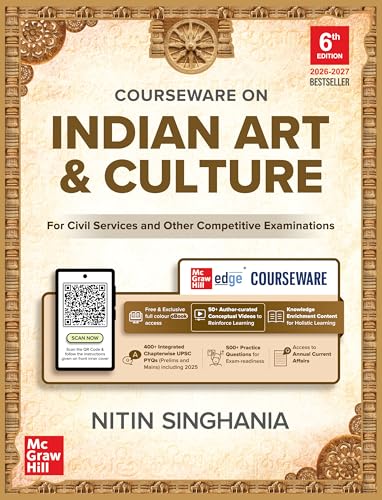
Courseware on Indian Art and Culture, Nitin Singhania (McGraw Hill), 6th edition
- About 538 pages, McGraw Hill, 6th edition with a 2026 copyright
- 31 chapters in five sections: visual arts, performing arts, literary arts, heritage and Indian culture
- 400+ chapter-wise PYQs from CSE, CAPF, CDS and NDA up to 2025, with a full-color eBook
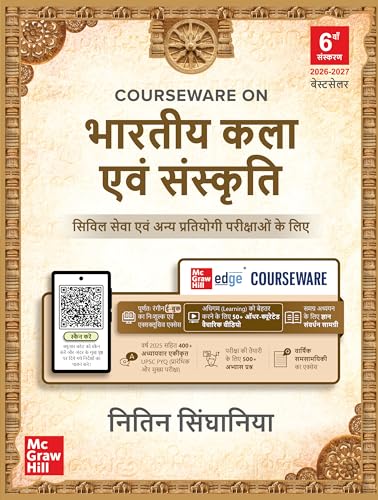
भारतीय कला एवं संस्कृति, नितिन सिंघानिया (McGraw Hill, छठा संस्करण)
- लगभग 568 पेज, McGraw Hill, जनवरी 2026 में जारी
- 400 से ज़्यादा हल किए गए PYQ (2013 से 2025) और 500 से ज़्यादा अभ्यास प्रश्न
- रंगीन छपाई, हिंदी माध्यम से परीक्षा देने वालों के लिए यही संस्करण
If you write in Hindi, buy Bhartiya Kala Evam Sanskriti. Art and culture is a vocabulary subject: shikhara, vimana, garbhagriha, chaitya. The Hindi paper uses the Hindi terms, and learning them twice is a waste of a revision cycle. The Hindi-medium booklist has the rest of the stack.
Who it is for, and who should read less of it
For UPSC Prelims and Mains together, Singhania is the one book the subject needs. For Prelims alone it is more book than the paper asks for, and that’s worth knowing before you plan six weeks around it.
The numbers set the scale. Across the fourteen Prelims papers from 2013 to 2026, art and culture accounts for 92 questions, 6.6% of the paper, according to our Prelims art and culture analysis. The count swings between 2 and 15 a year and has been drifting down: 7.4 a year in 2013 to 2019, 5.7 a year in 2020 to 2026, and just two in 2025. A subject that can still spike to 15 needs a floor of preparation. It doesn’t need 538 pages memorized.
Mains is the other way round. Art and culture is 38 of 270 GS Paper I questions from 2013 to 2025, 14.1% of the paper and more than modern Indian history’s 32. It turns up every single year, two to five questions at a time. The Mains art and culture analysis makes one more point that matters for this book: ancient and medieval India are barely asked as political history in Mains, and heavily asked as culture.
Singhania should be read in full if:
- You’re preparing for Prelims and Mains in the same year.
- CAPF, CDS or NDA is also on your list; the book’s question bank already includes those papers.
- Art and culture is the subject your mocks keep exposing.
It should be read selectively if:
- Prelims is eight weeks away. Take the religion, architecture and literature chapters and leave the rest.
- You’re a Mains-only reader who has finished it once. Your time is better spent on answer frames than on a second full pass.
The chapter map, and what each section is worth
The five sections of the Nitin Singhania art and culture book are uneven, and the biggest surprise is where the Prelims weight sits. The counts below are from the 92 topic-tagged questions in our question bank.
| Chapters | What they hold | Prelims questions, 2013 to 2026 | UPSC reading | State PSC, CAPF, CDS |
|---|---|---|---|---|
| 1. Pre-Historic Cultures in India | Prehistoric cultures and their art | Part of art and architecture | Read once | Read |
| 2. Indian Architecture | Architecture through the periods | 13 on art and architecture, 5 on temple architecture | Core; draw the plans | Core |
| 3 to 5. Sculpture and Pottery, Edicts and Inscriptions, Coins | Sculpture, pottery, edicts, inscriptions and coinage | Part of art and architecture | Read; inscriptions and coins double as historical sources | Read |
| 6. Legendary Cities of India | The historic cities of India | Not tagged separately | Read once | Read |
| 7. Indian Paintings | Painting traditions | 4 | Core | Core |
| 8 and 9. Indian Handicrafts, Geographical Indications | Crafts and GI-tagged products | 4 on handicrafts | Read; check GI facts against current lists | Read |
| 10 and 11. Indian Music, Indian Dance | Music and dance traditions | 3 and 4 | Core; the classical dance list must be exact | Core |
| 12. Theatre, Puppetry, Circus, Martial Arts and Sports Forms | Theatre, puppetry, circus, martial arts and sports forms | 1 on theatre | Read theater and puppetry, skim the rest | Read |
| 13. Indian Cinema | Film history | Not tagged | Skip | Skim |
| 14 and 15. Languages and Scripts, Indian Literature | Languages, scripts and literature | 4 and 11 | Core | Core |
| 16 and 17. UNESCO World Heritage Sites, Intangible Cultural Heritage | India’s inscribed sites and elements | 1 tagged as heritage | Read against the current list | Core |
| 18 to 21. Religion, Buddhism and Jainism, Bhakti and Sufi, Schools of Philosophy | Religions, Buddhist and Jain thought, Bhakti and Sufi traditions, philosophical schools | 18 on religions, 5 on philosophy, 3 on Bhakti | Core; start here | Core |
| 22 to 31. Fairs, Festivals, Education, Science and Technology, Calendars, Institutions, Awards, Law and Culture, Trade, Foreign Travellers | The remaining aspects of Indian culture, from fairs to foreign travelers | 12 on other aspects of Indian culture | Read science, calendars, trade and travelers; skip awards | Read |
Three blocks carry 59 of the 92 questions: the religion and philosophy chapters (26), architecture (18) and languages with literature (15). The religion block alone is bigger than architecture, and it sits in the last section of the book, which is exactly where readers who start at chapter 1 arrive tired.
Mains changes the value of two chapters that Prelims hardly touches. Chapter 30 on trade and cultural exchange and chapter 31 on foreign travelers are the raw material for the evidence and influence questions Mains keeps setting: what a traveler’s account tells us about its age, what one tradition owed another. Read those two properly even if you skim the rest of Section E.
How to read Nitin Singhania art and culture in five weeks
Around 18 pages a day, six days a week, covers the book in five weeks, in this order rather than the printed one. The previous-year questions are placed chapter by chapter, so each session closes with that chapter’s questions, not with a highlighter.
- Week 1, chapters 18 to 21. Religion, Buddhism and Jainism, Bhakti and Sufi, philosophy. Build one table: school or sect, founder, key text, core idea.
- Week 2, chapters 1 to 3. Architecture with a pencil. Sketch a Nagara and a Dravida temple plan from memory, then check them against the temple architecture note and the Indo-Islamic architecture note. The Bhimbetka note is a good companion to chapter 1.
- Week 3, chapters 14, 15, 4, 5, 30 and 31. Languages, literature, inscriptions, coins, trade and travelers: the chapters that turn culture into historical evidence.
- Week 4, chapters 7 and 10 to 12. Painting, music, dance, theater and puppetry, with the site’s notes on classical dance forms, painting schools and puppetry and theater for the images the book can’t show at full size.
- Week 5, what’s left. The heritage lists, handicrafts and GIs, the remaining Section E chapters, then a mixed set from the book’s practice questions.
A useful check at the end of each week: close the book and name five things from memory with one precise term each. If the terms come out vague, the chapter needs a second look before you move on.
What to skip, and what to cross-check
Skip for UPSC: chapter 13 on cinema, chapter 28 on awards and honours, and the circus and sports forms in chapter 12. None of them has its own tag in our Prelims bank, and Mains has no use for them.
Cross-check anything with a count or a list that changes:
- UNESCO’s World Heritage and intangible heritage lists grow every year; check the book’s lists against the current World Heritage list for India.
- Geographical Indication registrations change continually, so never quote a GI count from print.
- Anything the book marks as recent or as current affairs, since it was fixed when the book went to press.
The habit is the same as with any printed reference: a fact with a date or a number attached gets confirmed on an official site before it goes into your notes.
What the book will not do
It won’t frame a Mains answer. Our Mains analysis puts it plainly: Singhania covers the ground, and what it doesn’t supply is the habit of reading culture as historical evidence. A temple answer that lists architectural features is describing; one that reads the sculpture for guilds, dress and patronage is answering, and that second move is yours to practice.
It won’t replace seeing the objects either. The layout has plenty of images, but a line drawing of a stupa isn’t a stupa. And it won’t keep itself current past its print date, which is why the lists above need checking.
Singhania vs Facets of Indian Culture vs NCERT An Introduction to Indian Art
Three books compete for the same shelf space, and one of them is free.
| Book | Pages and edition | What it is | Verdict |
|---|---|---|---|
| Courseware on Indian Art and Culture, Nitin Singhania (McGraw Hill) | About 538, 6th edition | The full subject in 31 chapters, with PYQs and practice questions | The pick for UPSC |
| Facets of Indian Culture (Spectrum) | About 544, 32nd edition (2026) | A multi-author survey of the same subject | Only if you prefer its layout; never alongside Singhania |
| An Introduction to Indian Art, Part I, Class XI (NCERT) | Free on NCERT’s website | NCERT’s Class XI fine arts textbook on the history of Indian art | Read it first for the images, then Singhania for coverage |
Buy one of the first two, not both. The NCERT textbook is the free companion that makes Singhania’s architecture chapter easier to picture, and the art and culture notes on this site go deeper on single topics when the book’s treatment runs short.
Is there a Nitin Singhania art and culture PDF?
There is an official digital version, but it isn’t free. McGraw Hill includes a full-color eBook with the 6th edition and also sells a digital courseware separately. What it doesn’t do is give the book away as a PDF.
The files passed around as a nitin singhania art and culture pdf are unauthorized copies. If the copy is an older edition, its UNESCO and GI lists are out of date, which is precisely the kind of error this subject punishes, and no copy comes with the videos and practice questions McGraw Hill ties to the book. If you want something free and legitimate, the NCERT fine arts textbook above is the one to download.
Nitin Singhania’s art and culture book is the right book read in the wrong order by most of the people who buy it. Get the 6th edition, start with the religion and philosophy chapters, draw your way through architecture, give the travelers and trade chapters the attention Mains wants, and let the chapter-end questions decide what needs a second pass. Read like that, it covers both Prelims and Mains. Start with chapter 18 this week, not chapter 1.
Frequently Asked Questions
Is Nitin Singhania enough for UPSC art and culture?
For coverage, yes: it is the one book the subject needs for Prelims and Mains. What it does not supply is the Mains habit of reading culture as historical evidence, so pair it with answer practice on previous-year questions and check its dated lists against official sources.
Which edition of Nitin Singhania art and culture is the latest?
The 6th edition from McGraw Hill, sold as Courseware on Indian Art and Culture, with a 2026 copyright and about 538 pages. Its chapter-wise question bank runs to the 2025 papers. Older 5th edition listings are still on sale, so check for 6e in the title.
Is Courseware on Indian Art and Culture the same as Singhania’s Indian Art and Culture?
Yes. It is the same author and publisher; McGraw Hill renamed the book for its 6th edition and added author videos, practice questions and a full-color eBook to the print book.
Which chapters of Nitin Singhania matter most for Prelims?
The religion and philosophy chapters (18 to 21), architecture (chapter 2) and languages with literature (chapters 14 and 15). Together they match 59 of the 92 art and culture questions in our Prelims bank from 2013 to 2026, and religion alone is the largest single topic.
Is Nitin Singhania available in Hindi?
Yes. Bhartiya Kala Evam Sanskriti is the Hindi 6th edition from McGraw Hill, about 568 pages, released in January 2026. Hindi-medium aspirants should buy it rather than the English book, because the subject turns on technical terms.
How long does it take to finish Nitin Singhania art and culture?
About five weeks at around 18 pages a day, six days a week, read in the order of importance rather than the printed order. Starting with chapter 18 on religion rather than chapter 1 saves the most time.
Should I read the NCERT An Introduction to Indian Art before Singhania?
It helps, especially for architecture and sculpture. The Class XI NCERT fine arts textbook is free on NCERT’s website and makes the architecture chapters easier to picture. Read it first for the visual grounding, then Singhania for coverage.
Is there a free Nitin Singhania art and culture PDF?
There is no free official PDF. McGraw Hill includes a full-color eBook with the 6th edition and sells a digital courseware separately. Free files online are unauthorized copies, and older ones carry outdated UNESCO and GI lists.