Ask an aspirant to name India’s oldest surviving art, and you’ll usually hear “Ajanta”. That’s off by roughly ten thousand years. The oldest painted surfaces in the subcontinent are not inside a fifth-century Buddhist cave in Maharashtra; they’re on the rough sandstone walls of a cluster of rock shelters in a forested ridge of Madhya Pradesh, where hunter-gatherers ground up minerals and drew the animals they hunted, tens of thousands of years before anyone built a temple or wrote a word. That place is Bhimbetka, and it’s one of the few sites in the world where you can trace human life, and human art, in one unbroken sequence from the Stone Age to almost the present day.
What makes Bhimbetka so valuable for the exam is not any single spectacular painting. It’s the continuity. The same shelters were used, and decorated, across the Palaeolithic, the Mesolithic, the Chalcolithic, the early historic and the medieval periods, so the walls read like a stacked timeline of who lived here and how they saw their world. Get that idea straight and Bhimbetka stops being a stray fact about “prehistoric caves” and becomes one of the most quotable case studies you own, useful for art and culture, for ancient history, and for any answer on the roots of Indian civilization.
Where Bhimbetka is, and why the location made it a shelter
Bhimbetka sits in the Raisen district of Madhya Pradesh, about 45 kilometres south-east of Bhopal, in the southern foothills of the Vindhyan range where it meets the northern edge of the Deccan plateau. The shelters are strung across seven sandstone hills inside dense forest, and that setting is the whole reason people lived here for so long.
The rock is soft sandstone, and over millions of years wind and water carved it into overhangs, hollows and natural caverns, hundreds of them, that gave ready-made roofs against the sun and the monsoon. The forest around supplied game, fruit and roots, and there was perennial water nearby. In short, the place solved a hunter-gatherer’s three basic problems, shelter, food and water, without anyone having to build a thing. When you’re explaining why prehistoric humans chose a site, Bhimbetka is the clean example: they settled where the land already did the work.
The location also ties Bhimbetka to the wider landscape you study elsewhere. It lies in the foothills of the Vindhya range, the old block-mountain wall that separates north India from the Deccan, and it sits within easy reach of the Narmada valley, a corridor famous for some of the earliest human fossils found in India. That neighbourhood is not a coincidence; the Narmada-Vindhya belt was one of the subcontinent’s oldest zones of human occupation, and Bhimbetka is its most complete surviving record.
The name itself carries a story. Bhimbetka is usually read as Bhimbaithka, “the sitting place of Bhima”, the strongest of the five Pandava brothers from the Mahabharata, whom local legend links to these giant rocks. It’s a folk association, not history, but it’s worth carrying as a memory hook and as a small lesson in how living communities weave old sites into their own myths.
Who found Bhimbetka, and how it was dated
Bhimbetka was brought to scholarly attention by the archaeologist Vishnu Shridhar Wakankar, who spotted the rock formations from a train in 1957 and recognised that they resembled the painted caves he’d seen in Europe. He returned to survey them, and between roughly 1959 and 1965 he led systematic surveys, working with the Archaeological Survey of India (ASI), that documented the shelters, recorded the paintings and excavated the deposits on the shelter floors.
That excavation is what turns Bhimbetka from a curiosity into evidence. Digging into the layers of soil and debris that had built up on the cave floors, archaeologists recovered stone tools in sequence, the heavy hand-axes and cleavers of the Palaeolithic near the bottom, the tiny, delicate microliths of the Mesolithic above them, and later pottery and metal near the top. Because the tools sit in datable layers, they anchor the human occupation of Bhimbetka across a vast span, with the earliest stone-tool evidence reaching back to the Lower Palaeolithic, well over a hundred thousand years. The paintings themselves are younger and harder to date directly, but the oldest are generally placed in the Upper Palaeolithic, and the sequence runs continuously from there.
Hold on to the count, because factual questions come straight from it. The complex has more than 750 rock shelters, spread across about 10 kilometres and seven hills, of which roughly 500 carry paintings. The core, most-studied cluster, the group people usually mean when they say “Bhimbetka”, holds a little over 240 of these shelters. Those are the numbers to memorise: 750-plus shelters, seven hills, about 500 painted.
The paintings: what prehistoric India drew, and in what colours
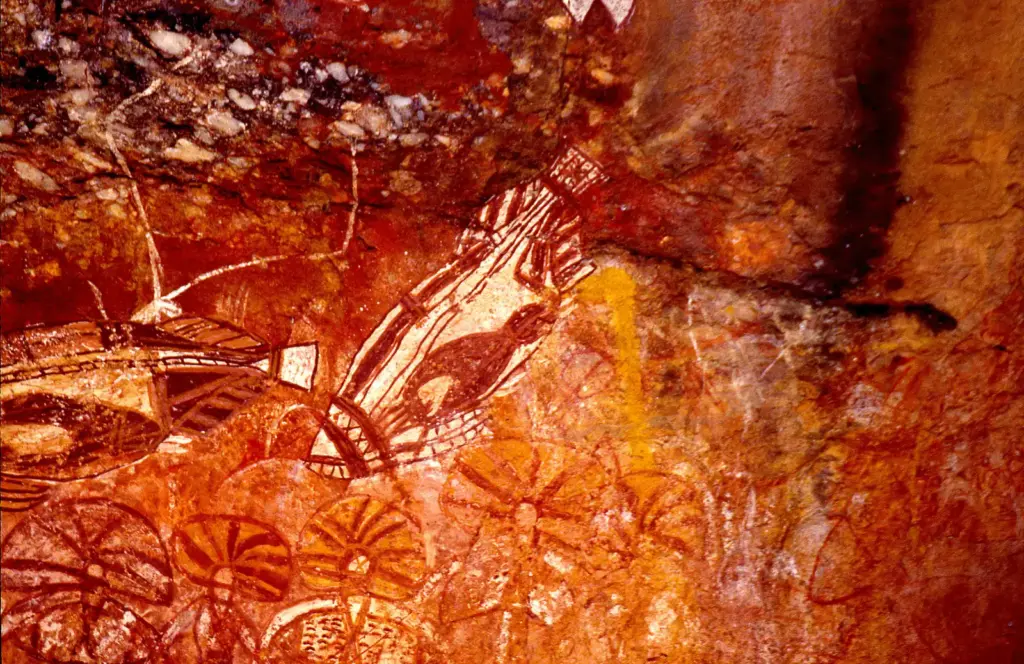
The single most important thing to understand about Bhimbetka’s art is that it isn’t one style from one time. The walls were painted, and repainted, over thousands of years, so a single shelter can carry the crude, thick outlines of a Stone Age hunter directly beneath a fine, decorative figure added in the historic period. Reading Bhimbetka means reading these layers, and the shift in what people chose to draw tells you how their lives changed.
The oldest paintings, from the Upper Palaeolithic, are large, simple figures of animals, bison, tigers, elephants, rhinoceroses, drawn in bold lines. This was the world of a hunter who lived among big, dangerous game, and the art is almost entirely about that animal world. The colours are dominated by green and dark red.
The Mesolithic layer, the richest and most numerous, is where the art gets busy and human. These are smaller, livelier scenes packed with people: hunting parties carrying bows, spears and barbed arrows; communal dances; the collection of honey; animals being trapped; and everyday activity. You start to see the hunter-gatherer community itself, not just its prey, which fits exactly the way of life you study under the Mesolithic period, when microlith tools let people hunt small game and live in larger, more settled bands.
The later layers record the arrival of a different world. Chalcolithic paintings show contact with settled farming communities on the Malwa plains nearby. The early historic figures, drawn in red, white and yellow, bring horse and elephant riders, men carrying swords, shields, bows and spears, and religious motifs, the mark of an age of chariots, kingdoms and organised religion. The medieval paintings, the youngest, are more schematic and decorative, and some use manganese and charcoal.
| Period | What the paintings show | Typical colours |
|---|---|---|
| Upper Palaeolithic | Large, bold single animals: bison, tiger, rhino, elephant | Green, dark red |
| Mesolithic (richest layer) | Small lively scenes: hunting, dancing, honey collection, group life | Red, white |
| Chalcolithic | Contact with farming settlements of the Malwa plains | Red, white |
| Early historic | Horse and elephant riders, weapons, religious symbols | Red, white, yellow |
| Medieval | Schematic, decorative, geometric figures | Red, white, manganese, charcoal |
The colours came from the earth. Prehistoric painters ground up minerals, mainly haematite for red and various iron oxides for yellow, and mixed the powder with a binder, probably animal fat or plant gum, to make a paint that has clung to the rock for millennia. That the pigment was mineral, not vegetable, is why so much of it survives; organic colours would have faded long ago. This is the same mineral-pigment tradition that runs forward into the classical mural painting of Ajanta and beyond, which is why Bhimbetka belongs at the very start of any account of Indian painting rather than as a separate curiosity.
The famous shelters and the standout images
A few individual shelters and images at Bhimbetka are worth carrying by name, because a specific detail is what lifts an answer above the generic.
The best known is the shelter often called the “Zoo Rock”, a single panel crowded with dozens of animals, elephants, deer, bison and more, layered together across different periods, so it looks like a prehistoric bestiary crammed onto one wall. It’s the clearest demonstration of how these surfaces were reused and repainted over thousands of years.
Another celebrated image is a large red boar or mythical beast bearing down on a tiny human figure, a striking, almost cinematic composition that shows the artists could handle scale and drama, not just outline. There are famous scenes of a communal dance, of hunters surrounding game, and of honey-collectors climbing to a hive, each a small window into daily life. What unites the best of them is movement: prehistoric Bhimbetka is full of running, dancing, hunting, climbing figures, art about doing, not just about things.
The point to make in an answer is that this is narrative art. The Mesolithic painters weren’t just recording that a bison existed; they were showing a hunt unfolding, a dance happening, a community at work. That storytelling impulse, tens of thousands of years old, is the deepest root of the Indian visual tradition that later produces the great mural and painting schools you study for the medieval and modern periods.
Cultural continuity: the living link to nearby villages
Here’s the feature that makes Bhimbetka genuinely special among the world’s prehistoric sites, and it’s the point examiners love. The art of Bhimbetka is not a dead tradition sealed off in the past. In the 21 villages in the surrounding area, tribal and rural communities still practise decorative traditions, on the walls of their houses, on pottery, in festival designs, that echo the geometric patterns and motifs on the ancient rock walls.
This is why UNESCO describes Bhimbetka as showing an “unbroken” association with its cultural landscape. The visual grammar the prehistoric painters used, certain patterns, certain ways of drawing animals and people, did not vanish; it flowed on into the folk and tribal art of the region, so the modern villages nearby are, in a real sense, the living heirs of the Bhimbetka artists. When an answer asks about continuity in Indian culture, this is a gold-standard example: a tradition that runs, visibly, from the Stone Age to a house wall you could photograph today.
That continuity also reframes what the site is. Bhimbetka is not just an archive of dead people’s pictures; it’s evidence that the deep roots of Indian civilization, its art, its relationship with the forest, its way of marking a home, reach back far beyond the cities and scriptures we usually start the story with. It sits alongside sites like Dholavira as proof that the subcontinent’s cultural record is both very old and, in places, still alive.
Why Bhimbetka is a UNESCO World Heritage Site
In 2003, the Rock Shelters of Bhimbetka were inscribed on the UNESCO World Heritage List. That year and that status are the hard facts to fix.
UNESCO recognised Bhimbetka on two of its cultural criteria. The first is that the site’s paintings and the way of life they record are in close and continuing association with the tribal villages nearby, the living-tradition point made above. The second is that Bhimbetka is an outstanding example of a human settlement and a hunter-gatherer way of life adapted to its natural environment, preserved in an unusually complete and readable form. In plain terms, UNESCO honoured Bhimbetka both for its incredible age and range, and for the fact that its story never fully stopped.
For revision, slot Bhimbetka into the country’s inscribed sites alongside the others: the full list of UNESCO World Heritage Sites in India is worth keeping in one place, and the significance of World Heritage Day and the criteria behind inscription are worth understanding rather than memorising, because that “why it qualified” reasoning is exactly what a good answer supplies.
How Bhimbetka connects to the rest of your syllabus
Bhimbetka is high-value because it plugs into several parts of the syllabus at once, so learn it as a hub rather than an island.
For prehistory and the Stone Age, it’s the anchor example. The tool sequence in its excavated layers gives you the Palaeolithic-to-Mesolithic transition in one place, and the paintings put a human face on periods you’d otherwise know only through stone tools. For art and culture, it’s the starting point of the whole Indian painting story; you can draw a line from a Bhimbetka bison to the rock-cut murals of Ajanta and the rock-cut tradition and on to the classical schools. For ancient history, the early-historic layer, with its riders and weapons, overlaps with the age of the Mauryan empire and the spread of organised states, and the region’s stone-and-cave heritage sits close to the achievements you study under Mauryan art and architecture. And for any question on cultural continuity, the living link to the surrounding villages is your best single illustration.
That versatility is the reason to invest in Bhimbetka properly. A fact learned once here pays off in half a dozen different answers, from a Prelims one-liner on “India’s oldest paintings” to a Mains paragraph on the unbroken thread of Indian culture.
How to study Bhimbetka for the exam
Start with the five anchor facts, because that’s where most factual questions land: Bhimbetka is in Raisen district, Madhya Pradesh, in the Vindhyan foothills near the Narmada valley; it was discovered by V. S. Wakankar in 1957; it has more than 750 rock shelters, about 500 painted; the paintings run from the Upper Palaeolithic through the Mesolithic to the medieval period; and it became a UNESCO World Heritage Site in 2003.
Next, hold the two ideas that carry the marks. The first is continuity in time, one site used and painted across every prehistoric and historic period, so the walls are a layered timeline. The second is continuity in culture, the living link between the ancient motifs and the art of the nearby villages, which is what makes Bhimbetka a “living” heritage site rather than a dead ruin. If you can state those two continuities in a sentence each, you can answer almost anything on Bhimbetka.
For Mains, practise deploying Bhimbetka as evidence, not as a topic in itself. It backs answers on the antiquity of Indian art, on prehistoric ways of life, on the human-forest relationship, and on the unbroken roots of Indian civilization. For sourcing, lean on the ASI and UNESCO for the site facts and on standard NCERT and art-and-culture material for the framing. Don’t try to memorise individual shelters beyond one or two like the Zoo Rock; the concept, the location, the colours and the five anchor facts are what score.
Frequently Asked Questions
Where are the Bhimbetka rock shelters located?
In the Raisen district of Madhya Pradesh, about 45 kilometres south-east of Bhopal, in the southern foothills of the Vindhyan range near the Narmada valley. The shelters are cut into soft sandstone hills inside a forest reserve.
Who discovered Bhimbetka?
The archaeologist V. S. Wakankar, who first noticed the rock formations from a passing train in 1957 and later surveyed them systematically with the Archaeological Survey of India between about 1959 and 1965.
How old are the Bhimbetka paintings?
The oldest paintings are generally dated to the Upper Palaeolithic, and painting continued in successive layers through the Mesolithic, Chalcolithic, early historic and medieval periods. Stone tools found in the shelter floors push human occupation of the site back much further, into the Lower Palaeolithic.
What do the Bhimbetka paintings depict?
The earliest show large single animals like bison, tigers and elephants. The rich Mesolithic layer shows lively scenes of hunting, dancing, honey collection and community life. Later layers add horse and elephant riders, weapons and religious symbols. The colours came mainly from mineral pigments such as haematite.
Why is Bhimbetka a UNESCO World Heritage Site?
It was inscribed in 2003 for two reasons: the paintings and the way of life they record remain in close association with the traditions of nearby tribal villages, and the site is an outstanding, unusually complete record of a hunter-gatherer settlement adapted to its environment.
What does the name Bhimbetka mean?
It is usually read as “Bhimbaithka”, the sitting place of Bhima, the powerful Pandava of the Mahabharata, whom local legend links to the giant rocks. It is a folk association rather than documented history.
What makes Bhimbetka’s art a case of cultural continuity?
The geometric patterns and motifs on the ancient rock walls are still echoed in the decorative traditions of the villages around the site, on house walls, pottery and festival designs, so the visual tradition runs unbroken from prehistory to the present.
Practice Questions
1. The Bhimbetka rock shelters are located in which state?
a) Maharashtra
b) Madhya Pradesh
c) Chhattisgarh
d) Rajasthan
Answer: b) Madhya Pradesh
2. Who is credited with the discovery of the Bhimbetka rock shelters?
a) Alexander Cunningham
b) R. S. Bisht
c) V. S. Wakankar
d) John Marshall
Answer: c) V. S. Wakankar
3. The richest and most numerous layer of paintings at Bhimbetka, showing hunting, dancing and honey collection, belongs to which period?
a) Upper Palaeolithic
b) Mesolithic
c) Chalcolithic
d) Early historic
Answer: b) Mesolithic
4. Consider the following about the Bhimbetka rock shelters:
- They lie in the foothills of the Vindhyan range.
- The paintings were made using mineral pigments such as haematite.
- The site was inscribed as a UNESCO World Heritage Site in 2003.
Which of the statements are correct?
a) 1 and 2 only
b) 2 and 3 only
c) 1 and 3 only
d) 1, 2 and 3
Answer: d) 1, 2 and 3
5. Bhimbetka is often cited as an example of “living heritage” because:
a) people still live inside the rock shelters
b) its motifs survive in the art traditions of nearby villages
c) new paintings are added to the shelters every year
d) it is the only painted site of its kind in the world
Answer: b) its motifs survive in the art traditions of nearby villages
Mains-style questions
- “Bhimbetka is less a single monument than a stacked timeline of human life.” Discuss, with reference to the range of periods represented in its rock art.
- Examine why the Bhimbetka rock shelters are regarded as the starting point of the Indian painting tradition.
- The Bhimbetka rock shelters illustrate an unbroken cultural continuity from prehistory to the present. Analyse this claim.
- Account for the choice of the Vindhya-Narmada belt as one of the earliest zones of human occupation in the subcontinent, using Bhimbetka as your central example.
- Evaluate the criteria on which Bhimbetka was inscribed as a UNESCO World Heritage Site, and what its recognition tells us about how heritage value is judged.
Bhimbetka rewards study because it quietly rewrites where the story of Indian art begins. Long before the first stupa or temple, people sheltering under these sandstone overhangs were already artists, recording their hunts and dances in mineral red and white on the rock, and their descendants in the villages nearby have never quite stopped. Carry the location, the discoverer, the layered periods and the two continuities, and you’re holding a site that works as easily in a one-line Prelims fact as in a full Mains argument about the ancient, and still living, roots of Indian civilization.
Tell Google you want more of this.
Add Anantam IAS as a preferred sourceOne tap, and this site shows up more often in your own Top Stories, AI Overviews and AI Mode. Remove it any time.