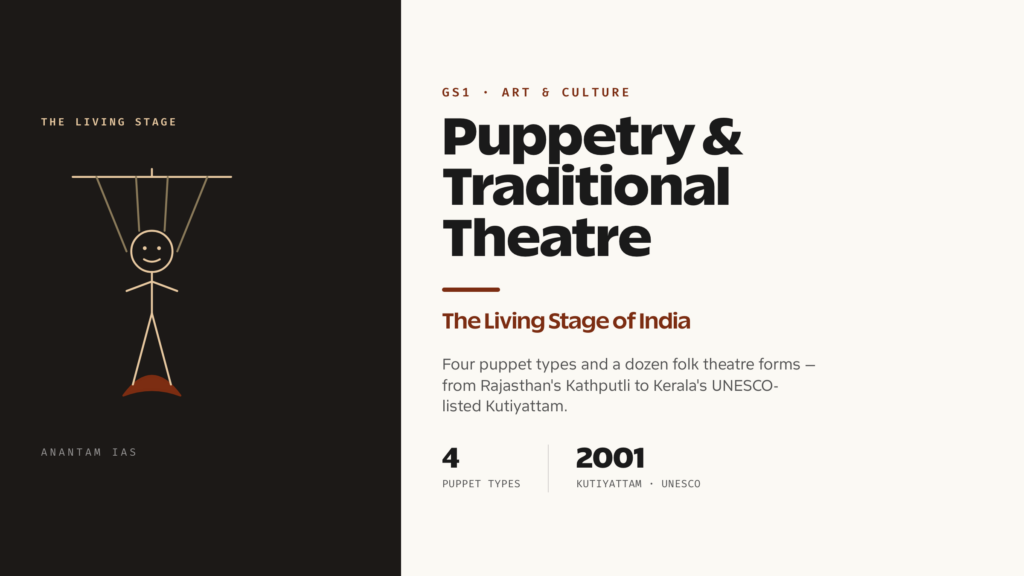
Pick up a Kathputli in a Jaipur bazaar and you’re holding a piece of theatre that’s older than most nations. A puppeteer flicks a single string, the wooden figure tilts its head, and a story that’s been told for centuries flickers back to life on a roadside cloth screen. India’s stage has always been like this — half ritual, half entertainment, stitched into temple courtyards, harvest nights and royal courts. Long before cinema or the proscenium playhouse arrived, India was watching gods and kings argue, lovers part, and demons fall, in a hundred regional tongues and a dozen distinct craft traditions. Puppetry and folk theatre are two branches of that same living tree.
And for a UPSC aspirant, this is one of the most reliably tested corners of GS1 Art and Culture, because it rewards the one thing many candidates get wrong — the exact pairing of a form with its home state. Examiners love a clean “match the column” question: which puppet belongs to which region, which theatre form grew out of which devotional movement, which performance UNESCO honoured first. Get the map right and the marks follow. So the goal here isn’t to memorise everything but to fix the geography in your head, understand why each form looks the way it does, and carry a few sharp facts — a GI tag, a UNESCO date, a founder’s name — that turn a flat list into a confident answer.
String and Shadow Puppets Across India
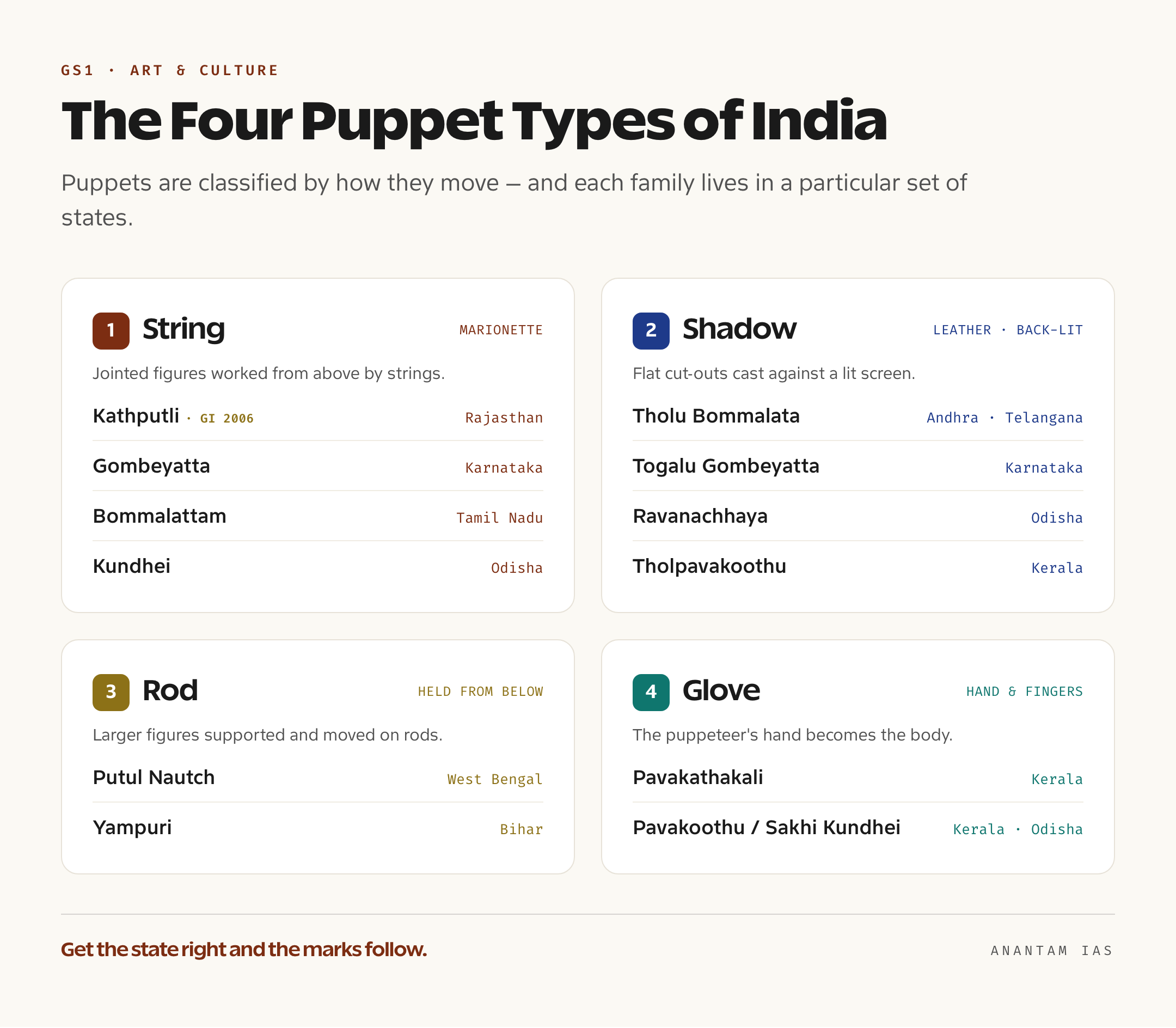
Puppetry in India is classified by how the puppet is made to move, and there are four families — string, shadow, rod and glove. Get these four buckets clear, slot each named form into the right one, and you’ve already covered most of what an examiner can ask. The first two families, string and shadow, are the largest and the most widely spread.
String puppets, or marionettes, are jointed wooden figures worked from above by strings tied to the limbs and head. The most famous is the Kathputli of Rajasthan — carved from a single block of mango wood, dressed in bright Rajasthani costume, with elongated eyes and no legs to speak of, the lower body lost in a flowing skirt. It’s so iconic that it carries a Geographical Indication tag, registered in 2006, which protects “Kathputlis of Rajasthan” as a regional craft. Karnataka has Gombeyatta, whose figures are styled and costumed after characters from the Yakshagana stage and moved with strings tied to a ring the puppeteer wears. Tamil Nadu’s Bommalattam marionettes are the largest and heaviest in the country, some standing four to five feet, manipulated by strings attached to an iron ring on the puppeteer’s head — a blend of rod and string control. Odisha contributes Kundhei, light wooden puppets in long skirts, again with no legs.
Shadow puppets are flat leather cut-outs pressed against a back-lit white screen so the audience watches their coloured or opaque shadows, not the figures themselves. The grandest is Tholu Bommalata of Andhra Pradesh (and Telangana) — the name means “the dance of leather puppets” — with large figures, often life-sized, coloured on both sides so the shadow glows in tint. Karnataka’s version is Togalu Gombeyatta, where the size of a puppet signals the rank of the character, kings looming large and servants kept small. Odisha has Ravanachhaya, the most austere of them all — small deer-skin puppets in one piece, with no joints and no colour, so they throw pure black silhouettes, which many consider the most lyrical shadow play in India. Kerala and parts of Tamil Nadu keep Tholpavakoothu, a temple shadow theatre lit by rows of oil lamps in coconut shells, traditionally narrating the Ramayana.
Rod and Glove Puppets and Their Homes
The two remaining families are smaller in scale but no less distinct, and they cluster in the east and the south.
Rod puppets are an enlargement of the glove form — larger figures supported and moved from below on rods. Putul Nautch of West Bengal is the classic example, near human-sized figures fixed on a bamboo rod held at the waist, the puppeteer dancing and swaying so the puppet seems to move on its own. Bihar’s Yampuri rod puppets are unusual — carved from wood in one piece, with no joints, demanding far more dexterity from the handler.
Glove puppets, also called sleeve or hand puppets, are the smallest and most intimate — the puppeteer’s hand becomes the body, with fingers working the head and arms. Kerala’s Pavakathakali is the jewel here: a glove-puppet version of the Kathakali dance-drama that grew up in the Palakkad region in the eighteenth century, its tiny figures wearing the same elaborate make-up and headgear as live Kathakali actors, faces dressed with gilded tin and peacock feathers. Glove puppetry under names like Pavakoothu and Sakhi Kundhei also appears in Kerala, Odisha, Tamil Nadu and West Bengal, often telling stories of Radha and Krishna to the beat of a dholak.
Sanskrit Roots and the Birth of Indian Theatre
To understand the folk stage, you have to start at the source — and the source is a text. The Natyashastra, attributed to the sage Bharata and usually dated between roughly 200 BCE and 200 CE, is the world’s oldest and most complete treatise on dramaturgy. It covers everything from stage design and acting to music, dance and the famous theory of rasa — the emotional “flavours” a performance should evoke in its audience. Indian tradition treats drama as a divine gift, calling it the “fifth Veda,” a synthesis meant to teach and delight every kind of person at once. Almost every later form, classical or folk, traces some of its grammar back to Bharata’s rules.
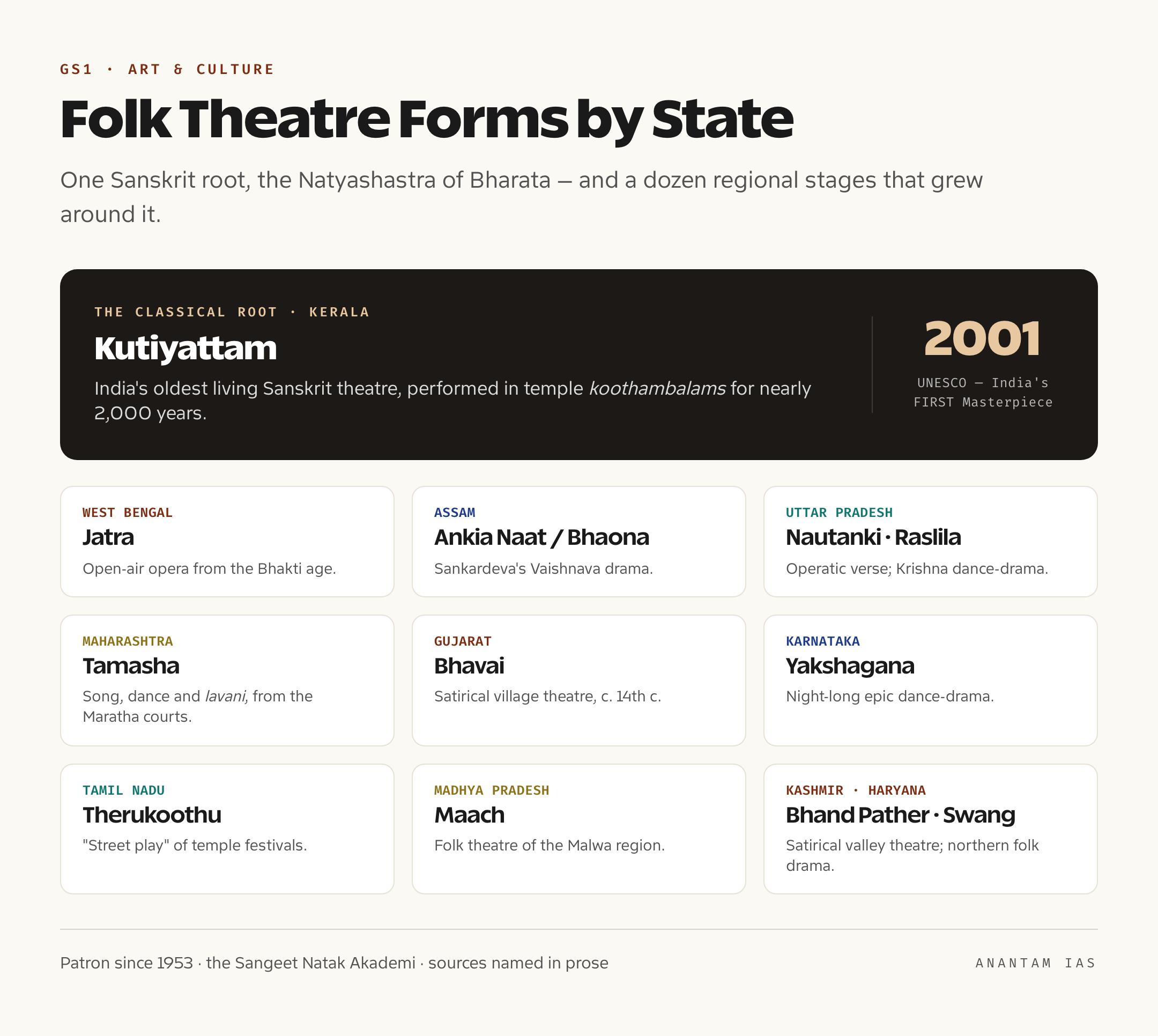
Out of that Sanskrit tradition comes Kutiyattam of Kerala, and this is the single most important fact in the whole topic. Kutiyattam is the oldest surviving form of Sanskrit theatre in India, performed for around two thousand years in temple theatres called koothambalams, with a single act sometimes stretched across many nights through the slow, codified gestures of the actor. In 2001, UNESCO proclaimed it a “Masterpiece of the Oral and Intangible Heritage of Humanity” — and it was the very first Indian art form to receive that honour, later inscribed on the Representative List of the Intangible Cultural Heritage of Humanity. So if you remember one UNESCO fact for this paper, make it this one.
Then the picture splits. The classical Sanskrit theatre was the stage of the temple and the court — refined, ritualised, often in a language ordinary people no longer spoke. Around it, in marketplaces and village squares, grew a parallel world of folk theatre in regional languages — louder, broader, comic, devotional, and free of the courtly rulebook. The Bhakti movement of the medieval centuries poured fuel on this folk stage, because singing and dramatising the lives of Krishna and Rama was itself an act of devotion. So a great many of the forms below were born not as entertainment alone but as worship that happened to be wildly entertaining.
The Major Folk Theatre Forms by Region
Now to the regional map, which is where the marks sit. Move roughly across the country and the forms line up state by state.
In the east, Jatra is Bengal’s open-air operatic theatre, born in the fifteenth century out of the Bhakti wave and Chaitanya’s Krishna devotion — it began as Krishna Jatra before turning to social and historical themes, and it survives as a hugely popular travelling theatre to this day. Assam has the Ankia Naat, the one-act devotional plays written by the fifteenth-century Vaishnava saint Srimanta Sankardeva in a hybrid Brajavali language, with a full staged performance of one called a Bhaona — opera-like, narrated by a sutradhar, and still performed in the monastery-villages called sattras.
In the north, Nautanki of Uttar Pradesh is a musical theatre of operatic song and verse, with roots people trace back to the Swang tradition and references found as far back as the Mughal court. Ramlila, the dramatic enactment of Rama’s life over the days leading to Dussehra, and Raslila, the dance-drama of Krishna’s life centred on Mathura and Vrindavan, are both spread across the Hindi belt — Ramlila itself has UNESCO recognition as intangible heritage. Swang is the broad folk-drama form of Haryana and the wider north, heavy on dialogue and song, and is often named as the ancestor from which Nautanki grew.
In the west, Tamasha of Maharashtra flowered in the courts of the Maratha rulers in the eighteenth and nineteenth centuries — a lively, often bawdy form built on song, dance and the lavani, traditionally featuring a female lead called the murki. Gujarat’s Bhavai is a satirical village theatre, said to date from the fourteenth century and credited to the poet Asaita Thakar, performed in the open with a sharp social and comic edge.
In the south, Yakshagana of Karnataka is the spectacular night-long dance-drama of coastal Karnataka, fusing elaborate costume and towering headgear with music, dance and improvised dialogue drawn from the epics — the same form, recall, that lends its look to Gombeyatta string puppets. Tamil Nadu’s Therukoothu, literally “street play,” is a vigorous open-air form tied to village temple festivals, often staging episodes from the Mahabharata, especially the story of Draupadi. And in the heart of the country, Maach is the folk theatre of Madhya Pradesh’s Malwa region, while up in the valley Bhand Pather is the centuries-old satirical folk theatre of Kashmir, performed by communities of bhands who blend dance, music and biting social comedy.
Decline, State Support and Revival
Here’s the hard part of the story. Almost every form on this map is under pressure. Television, cinema and the phone have eaten into the night-long village audiences these arts depended on; younger generations in performing families often choose steadier work; and the patrons — temples, princely courts, landlords — who once funded them have mostly vanished. Bhavai, by many accounts, is dying less for want of an audience than for want of performers, because families no longer push their children to learn it. Yakshagana, Tholu Bommalata and the puppet traditions face the same slow squeeze, with the leather and wooden crafts behind them thinning as artisans age out.
So the state has stepped in. The Sangeet Natak Akademi, India’s national academy for music, dance and drama set up in 1953, is the chief institutional patron — it documents these forms, runs grants and fellowships, honours master practitioners with its awards (which it expanded to cover puppetry and folk arts), and supports festivals and training. The Akademi runs a dedicated puppetry training and a National School of Drama feeds the wider theatre ecosystem, while GI tags like the one on Rajasthan’s Kathputli give a craft both legal protection and a marketing edge. UNESCO recognition for Kutiyattam and Ramlila has, in turn, brought money, prestige and a measure of protection from neglect.
But institutional support only goes so far, and the more interesting revival is happening sideways. Puppeteers now perform for development campaigns, school programmes and tourism circuits; Yakshagana and Jatra troupes update their stories and tour; festivals and digital archives keep the forms visible. The honest way to frame this for an answer is that these arts aren’t simply fading — they’re being asked to find new audiences and new economic models, and the ones that manage it survive. That tension between heritage value and commercial survival is exactly the kind of nuance examiners reward.
For Your Mains Answer
This is core GS Paper 1 material under Indian heritage, art and culture, and it can surface in two shapes — a factual “name the form and its state” demand, or an analytical question on the decline and revival of traditional performing arts. It’s also rich essay fodder for themes of cultural diversity, intangible heritage and the tension between tradition and modernity. The marks reward precision on state pairings plus one layer of analysis on why these forms matter and why they’re at risk.
How to Build the Answer
Open by classifying — puppetry into its four types, theatre into its classical (Sanskrit, Kutiyattam) and folk streams. Then map: name forms with their exact states, clustering them region by region so the answer reads as a tour, not a dump. Add the value tags as you go — GI for Kathputli, UNESCO 2001 for Kutiyattam, Sankardeva for Bhaona. Close with the decline-and-revival arc and the role of the Sangeet Natak Akademi. That gives you definition, geography, significance and the way forward in one clean flow.
Common Mistakes to Avoid
Don’t muddle the states — Tholu Bommalata is Andhra (and Telangana), not Karnataka; Ravanachhaya is Odisha; Putul Nautch is Bengal. Don’t confuse Kerala’s two puppet traditions — Pavakathakali is the glove form, Tholpavakoothu the shadow form. Don’t call Kutiyattam a folk form — it’s classical Sanskrit theatre, and it’s the first Indian entry on UNESCO’s list, not just any entry. And don’t present every form as simply “dying”; show the revival side too.
A Compact Answer Spine
Four puppet types — string (Kathputli/Rajasthan, GI 2006; Gombeyatta/Karnataka; Bommalattam/Tamil Nadu), shadow (Tholu Bommalata/Andhra; Togalu Gombeyatta/Karnataka; Ravanachhaya/Odisha), rod (Putul Nautch/Bengal; Yampuri/Bihar), glove (Pavakathakali/Kerala) → theatre roots in Bharata’s Natyashastra and rasa → Kutiyattam (Kerala), oldest Sanskrit theatre, UNESCO 2001, India’s first → folk forms: Jatra (Bengal), Bhaona/Ankia Naat (Assam, Sankardeva), Nautanki (UP), Tamasha (Maharashtra), Bhavai (Gujarat), Yakshagana (Karnataka), Therukoothu (TN), Maach (MP), Bhand Pather (Kashmir), Ramlila and Raslila → decline → Sangeet Natak Akademi, GI tags, UNESCO → revival through new audiences.
Diagram or Flowchart Idea
Draw a simple two-column map of India sketched in words, not borders — left column “Puppetry” with the four types branching to states, right column “Theatre” with classical (Kutiyattam) above folk forms grouped by region. A clean two-panel layout like this shows the examiner you hold the whole landscape, and it’s quick to rough out in the margin.
A Balanced-Conclusion Line
A line that lands the marks: “India’s puppets and folk stages are intangible heritage in the truest sense — knowledge held in living hands, not in stone — and their survival now depends less on nostalgia than on finding them new audiences, new patrons and a working place in the cultural economy.”
How to Use Data Without Cramming
You need anchors, not an encyclopaedia: Kathputli’s GI tag (2006), Kutiyattam’s UNESCO 2001 as India’s first, Sankardeva’s Bhaona, the Sangeet Natak Akademi (1953) as patron. Drop those four into the right sentences and attribute them plainly, and the answer reads as authoritative without turning into a list.
FAQ
What are the four types of puppetry in India? String, shadow, rod and glove. String puppets (marionettes) include Rajasthan’s Kathputli, Karnataka’s Gombeyatta and Tamil Nadu’s Bommalattam. Shadow puppets include Andhra’s Tholu Bommalata, Karnataka’s Togalu Gombeyatta and Odisha’s Ravanachhaya. Rod puppets include Bengal’s Putul Nautch and Bihar’s Yampuri. Glove puppets include Kerala’s Pavakathakali. The classification is by how the puppet is made to move.
Which Indian theatre form is recognised by UNESCO, and when? Kutiyattam, the Sanskrit theatre of Kerala, was proclaimed a UNESCO Masterpiece of the Oral and Intangible Heritage of Humanity in 2001 — the first Indian art form to be so recognised. Ramlila, the traditional performance of the Ramayana, was later also inscribed on UNESCO’s intangible heritage list.
What is the difference between classical and folk theatre in India? Classical theatre, rooted in Bharata’s Natyashastra and surviving as Kutiyattam, was the refined, ritualised stage of temples and courts, often in Sanskrit. Folk theatre — Jatra, Tamasha, Nautanki, Yakshagana and the rest — grew in regional languages in village squares and marketplaces, broader and more accessible, and was strongly shaped by the devotional Bhakti movement.
Why are India’s traditional puppetry and theatre forms declining, and who supports them? Mass media, the loss of old patrons and younger generations moving to other work have shrunk their audiences and practitioners — Bhavai, for instance, struggles more for performers than for viewers. The Sangeet Natak Akademi, set up in 1953, is the main institutional patron, with grants, awards and documentation, while GI tags and UNESCO listings add protection, and troupes survive by finding new audiences in tourism, schools and digital platforms.
Practice Questions
Prelims MCQs
- Match the puppet form with its home state:
1. Tholu Bommalata 2. Putul Nautch 3. Yampuri 4. Pavakathakali. Which is correctly paired?
(a) Tholu Bommalata — Karnataka
(b) Putul Nautch — West Bengal
(c) Yampuri — Odisha
(d) Pavakathakali — Tamil Nadu
Answer: (b) Putul Nautch is the rod puppet of West Bengal; Tholu Bommalata is Andhra (and Telangana), Yampuri is Bihar, and Pavakathakali is Kerala. - Which of the following is a shadow puppet tradition of India?
(a) Kathputli
(b) Bommalattam
(c) Ravanachhaya
(d) Kundhei
Answer: (c) Ravanachhaya of Odisha is a shadow puppet form using uncoloured, jointless deer-skin figures; Kathputli, Bommalattam and Kundhei are all string puppets. - Consider the following pairs of folk theatre and state:
1. Bhavai — Gujarat 2. Maach — Madhya Pradesh 3. Bhand Pather — Kerala 4. Tamasha — Maharashtra. Which pairs are correctly matched?
(a) 1, 2 and 4 only
(b) 1, 3 and 4 only
(c) 2 and 3 only
(d) 1, 2, 3 and 4
Answer: (a) Bhand Pather is the folk theatre of Kashmir, not Kerala; the other three pairings are correct. - With reference to Kutiyattam, which statement is correct?
(a) It is a folk puppet theatre of Andhra Pradesh
(b) It is the oldest surviving Sanskrit theatre and was UNESCO’s first Indian Masterpiece, in 2001
(c) It was founded by Srimanta Sankardeva in Assam
(d) It received a Geographical Indication tag in 2006
Answer: (b) Kutiyattam of Kerala is the oldest living Sanskrit theatre and the first Indian art form recognised by UNESCO as a Masterpiece of Intangible Heritage, in 2001. - Match the theatre form with the figure or feature associated with it:
1. Bhaona — Srimanta Sankardeva 2. Natyashastra — Bharata 3. Jatra — West Bengal. Which of these are correctly matched?
(a) 1 and 2 only
(b) 2 and 3 only
(c) 1 and 3 only
(d) 1, 2 and 3
Answer: (d) All three are correct — Bhaona stages Sankardeva’s Ankia Naat, the Natyashastra is attributed to Bharata, and Jatra is the open-air operatic theatre of Bengal.
Mains Practice Questions
- Classify the puppetry traditions of India and discuss how regional craft and performance styles shaped each of the four types. (15 marks, 250 words)
- “India’s classical and folk theatre forms grew from a single Sanskrit root yet diverged sharply in language, audience and purpose.” Examine this statement with reference to the Natyashastra, Kutiyattam and the major folk forms. (15 marks, 250 words)
- Discuss the role of the Bhakti movement in shaping the folk theatre traditions of India, with suitable regional examples. (10 marks, 150 words)
- Traditional performing arts are increasingly recognised as intangible cultural heritage. Critically analyse the causes of their decline and the measures needed to sustain them. (15 marks, 250 words)
- Evaluate the role of institutions such as the Sangeet Natak Akademi, along with GI tags and UNESCO recognition, in preserving India’s puppetry and folk theatre traditions. (15 marks, 250 words)
Tell Google you want more of this.
Add Anantam IAS as a preferred sourceOne tap, and this site shows up more often in your own Top Stories, AI Overviews and AI Mode. Remove it any time.