Parliament of India — Structure, Functions, Powers and Reforms (UPSC Polity)
UPSC guide to the Parliament of India: bicameral structure, legislative-financial-judicial functions, declining sittings, productivity issues, and 2024-26 reforms.
The Parliament of India is the supreme legislative body and the central institution of Indian democracy. Article 79 establishes it as consisting of the President and two Houses — the Council of States (Rajya Sabha) and the House of the People (Lok Sabha). As the elected representation of 1.4 billion people, the Parliament is meant to be the deliberative heart of the Republic — the forum where laws are made, the executive is held accountable, the budget is sanctioned, and the will of the people finds expression.
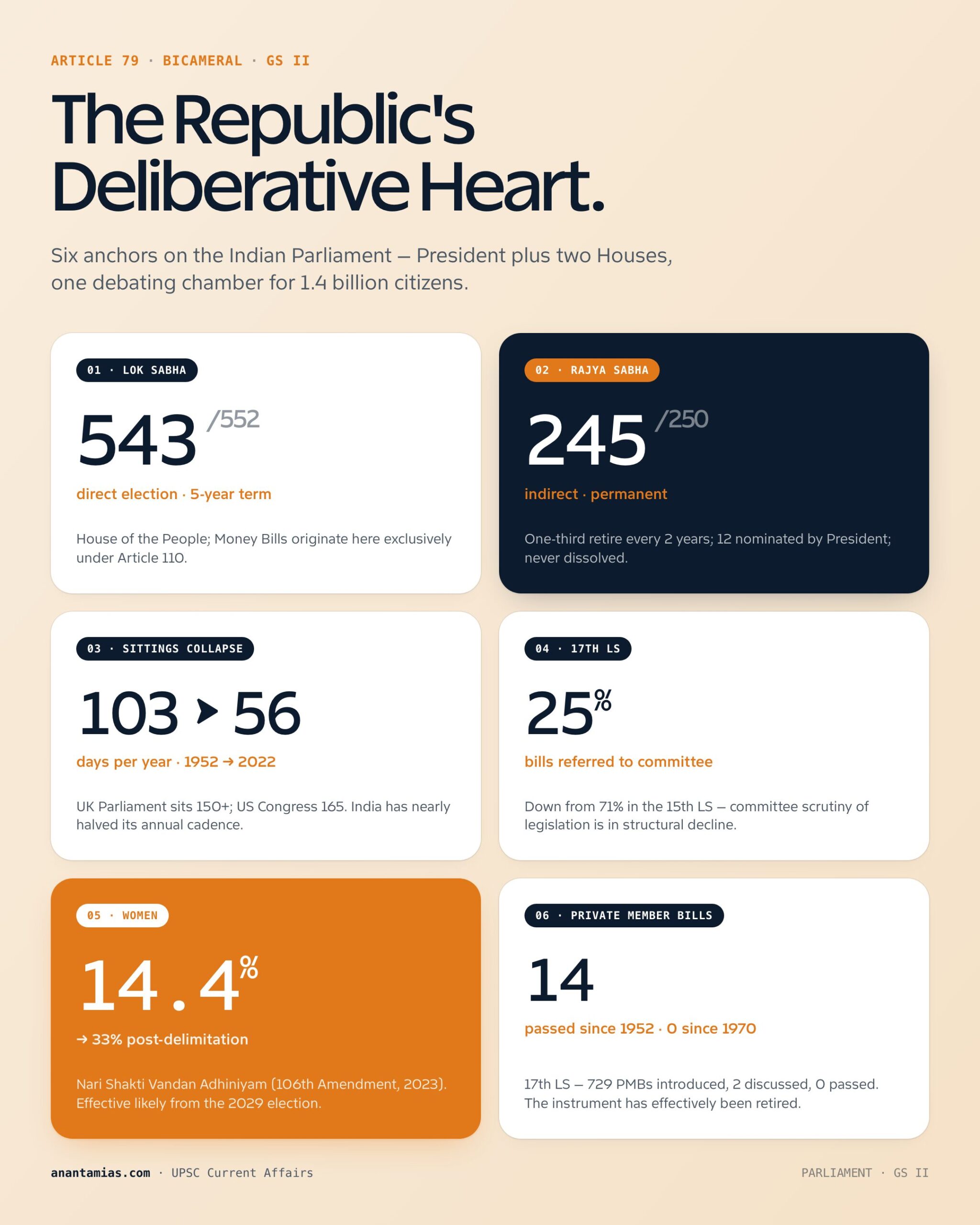
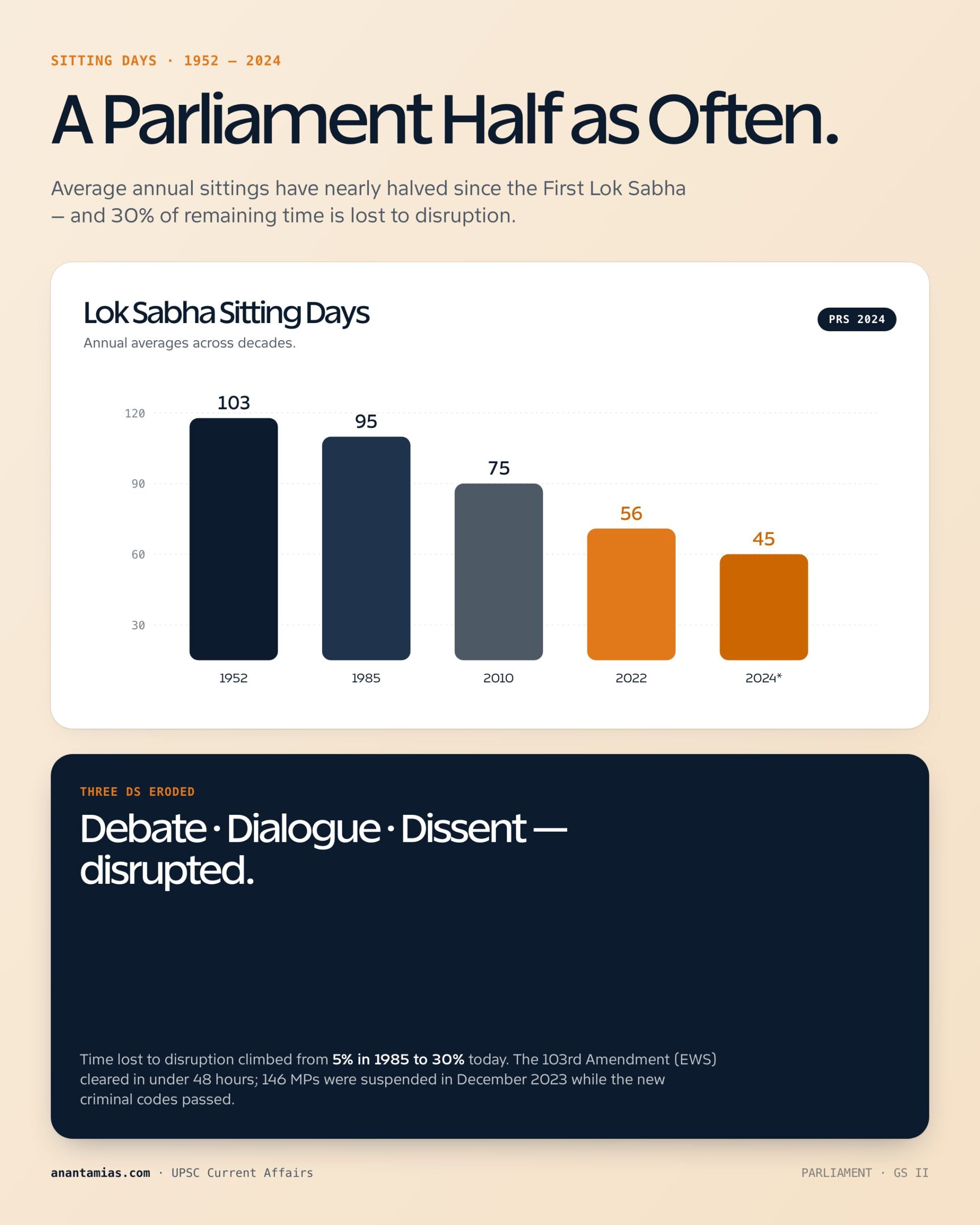
But the Parliament of 2026 looks very different from the one envisioned by the framers. Average sittings have collapsed from 103 days (1952) to 56 days (2022). Time lost to disruption has risen from 5% in 1985 to nearly 30% today. Major laws — including the 103rd Constitutional Amendment (EWS reservation) — pass with minimal debate. Private member bills have become near-extinct (only 14 passed since 1952; none since 1970). The committee system is weakening. Women's representation, after rising slowly, leaped to 14.4% with the Nari Shakti Vandan Adhiniyam, 2023, but actual implementation awaits delimitation.
This guide examines the structure, functions, powers, challenges, and reforms of the Indian Parliament — and contextualises the 2024-26 inflection point with the new Parliament House, simultaneous elections debate, the women's reservation rollout, and the post-delimitation reshaping of the Lok Sabha.
Constitutional basis
- Article 79 — Constitution of Parliament.
- Article 80 — Composition of Rajya Sabha (max 250: 238 elected + 12 nominated).
- Article 81 — Composition of Lok Sabha (max 552: 530 from states + 20 from UTs + 2 Anglo-Indian, latter abolished by 104th Amendment, 2019).
- Article 83 — Duration: Lok Sabha 5 years; Rajya Sabha permanent (one-third retire every 2 years).
- Article 85 — Sessions of Parliament; max gap of 6 months between two sessions.
- Article 86-122 — Officers, procedure, privileges, joint sittings.
Structure of Parliament
Lok Sabha (House of the People)
- Maximum 552 members; current strength 543.
- Direct election by adult franchise from territorial constituencies.
- Term: 5 years, dissolvable earlier.
- Speaker presides; Pro-tem Speaker for the first sitting.
- Money Bills can originate only here (Article 110).
Rajya Sabha (Council of States)
- Maximum 250 members; current 245 (233 elected + 12 nominated).
- Indirect election by State Legislative Assemblies through proportional representation by single transferable vote.
- Permanent body — never dissolved; one-third retire every 2 years.
- Vice-President is ex-officio Chairman.
- Members nominated for distinguished service in literature, science, art, social service.
Officers
- Speaker and Deputy Speaker of Lok Sabha (Article 93-94).
- Chairman (VP) and Deputy Chairman of Rajya Sabha (Article 89-90).
- Salaries charged on the Consolidated Fund of India.
Functions of Parliament
Legislative function
- Enactment of laws on Union List and Concurrent List (Article 245-246).
- Power to legislate on State List under Articles 249, 250, 252, 253.
- Constitutional amendment under Article 368.
- All bills (except money bills and finance bills) can originate in either House.
Deliberative / accountability function
- Highest deliberative forum.
- Holds the executive accountable through:
- Question Hour (first hour of every sitting).
- Zero Hour (informal, post-Question Hour).
- No-Confidence Motion (Article 75(3)).
- Adjournment Motion.
- Calling Attention Motion.
- Half-an-hour discussion.
- Short duration discussion.
Representative function
- Represents the will of the people.
- Geographical, demographic, ideological diversity.
Electoral function
- Elects the President of India (Article 54) — Lok Sabha + Rajya Sabha + State Legislative Assemblies.
- Elects the Vice-President (Article 66) — both Houses of Parliament.
- Elects Speaker, Deputy Speaker, Deputy Chairman.
Financial function
- Annual Financial Statement (Budget) under Article 112.
- No tax can be levied without the authority of law (Article 265).
- Expenditure charged on Consolidated Fund of India requires sanction (Article 113).
- Financial Emergency under Article 360 requires Parliamentary approval.
Judicial / quasi-judicial function
- Impeachment of the President (Article 61).
- Removal of judges of the Supreme Court and High Courts (Article 124(4), 217).
- Removal of CEC, CAG, Chairman UPSC.
- Punishment for breach of privilege (Article 105, 194).
Constituent function
- Amending the Constitution through Article 368 — simple majority, special majority, special majority with state ratification.
Comparing Lok Sabha and Rajya Sabha
| Feature | Lok Sabha | Rajya Sabha |
|---|---|---|
| Strength | 552 max (currently 543) | 250 max (currently 245) |
| Election | Direct, adult franchise | Indirect, by MLAs of states |
| Term | 5 years (dissolvable) | Permanent; 1/3 retire every 2 years |
| Presiding officer | Speaker | Chairman (VP) |
| Money bills | Originates here | Cannot reject or amend; only recommend within 14 days |
| Financial bills | Originates here | Discusses, amendment requires LS approval |
| No-confidence motion | Can be moved here | Cannot be moved |
| Joint sitting | Article 108 | Joint sitting |
| Powers under Art 249, 312 | No | Exclusive |
| Nomination | No | 12 nominated by President |
Challenges — the Three Ds: Debate, Dialogue, Dissent
The institutional decline of Indian Parliament is documented across multiple dimensions:
Declining sittings
- 103 days (1952) → 56 days (2022) → 75 days (2023) → 45 days (2024 truncated).
- The 17th Lok Sabha (2019-24) was the lowest in productivity — averaging just 55 days/year.
- Comparison: UK Parliament sits 150+ days; US Congress 165 days.
Disruption and time loss
- 5% time lost (1985) → 30%+ today.
- 17th Lok Sabha lost 18% of total time to disruption.
- Question Hour productivity fell to as low as 20% in some sessions.
Lack of debate
- 103rd Constitutional Amendment (EWS reservation) was passed in less than 48 hours, with limited debate.
- Three Farm Laws (2020) were passed by voice vote without referring to committee — leading to year-long protests and eventual repeal in 2021.
- Bharatiya Nyaya Sanhita, BNSS, BSA (2023) passed during opposition suspension; over 140 MPs were suspended.
Decline of private member bills
- Total 14 passed since 1952; none since 1970.
- Only one Friday a session is allotted.
- 17th LS: 729 PMBs introduced, 2 discussed, 0 passed.
Weak committee system
- Bills referred to committees: 71% (15th LS) → 25% (17th LS) → revival under 18th LS attempted.
- Standing Committees lack research staff and tenure for specialisation.
Women representation
- Pre-2023: 14.4% in Lok Sabha.
- Nari Shakti Vandan Adhiniyam (106th Amendment, 2023) reserves 33% seats for women in Lok Sabha and State Assemblies.
- Operationalisation tied to delimitation post-2026 census — full effect likely from 2029 election.
Disruption (Obstructionism)
- The "Ability to debate has been replaced by the Ability to shout."
- Rajya Sabha Chairman's powers under Rule 256 used to suspend members.
Criminalisation and corruption
- 43% of 17th LS MPs had criminal cases; 29% serious cases (ADR data).
- Successive ECI affidavits show rising trend.
Underlying causes
- Anti-defection law (10th Schedule) — discourages voting by conscience; binds MPs to party whip.
- Lack of recorded voting — most votes by voice; reduces accountability.
- Speaker-party affiliation — Speakers are members of ruling party; partisan use of disqualification powers.
- Lack of fixed parliamentary calendar — government decides session dates; executive control over agenda.
Reforms — what should be done
Ethical
- Code of Conduct for MPs (Nolan Committee, UK; 2nd ARC).
- Strengthening of Ethics Committee of both Houses.
- Penalty for unruly behaviour (suspension, fines, public censure).
Logistical
- Minimum number of sitting days — Rajya Sabha 100 days, Lok Sabha 120 days (NCRWC, 2002).
- Proper training for new MPs.
- Linking salaries to performance and attendance.
Political parties
- Pre-poll coalition disclosure (2nd ARC).
- Mid-term realignment requires fresh mandate.
- Constructive vote of no-confidence (German model) — overthrow only if alternative majority is shown.
- Bring political parties under RTI.
Procedural
- Mandatory reference of bills to committees (UK model).
- Recorded voting as default.
- Live committee proceedings (selective).
- Permanent calendar of sittings.
Recent committee reports and developments (2024-26)
- PRS Legislative Research Annual Review (2024) — productivity, committee referral, privilege issues.
- High-Level Committee on Simultaneous Elections (Kovind Committee, 2024) — implications for parliamentary cycles.
- 18th Lok Sabha (2024-29) — early sittings show modest revival of committee referrals; question hour better utilised.
- Anti-defection reform — Supreme Court in Subhash Desai (2023) called for time-bound Speaker decisions.
- Privilege motion against Speaker — first-of-its-kind in 18th LS, raising governance questions.
Mains-style answer hook
"The Parliament of India was designed as the deliberative heart of the Republic, but the data of the past two decades show institutional erosion: declining sittings, rising disruptions, fewer bills referred to committees, and pre-emptive use of money-bill route. The 18th Lok Sabha, the new Parliament House, the rollout of women's reservation post-delimitation, and the Kovind Committee on simultaneous elections together create the most consequential reform window since the 91st Amendment. Whether India's Parliament reclaims debate, dialogue, dissent — its three Ds — depends on procedural reforms, an independent Speaker, and stronger Standing Committees."
Prelims pointers
- Parliament = President + Lok Sabha + Rajya Sabha (Article 79).
- Lok Sabha max 552; Rajya Sabha max 250.
- Money Bill (Article 110) — Lok Sabha exclusive.
- Joint sitting — Article 108 — only for ordinary bills, not for Money or Constitutional Amendment Bills.
- Article 249 — RS can authorise Parliament to legislate on State List by 2/3 majority; valid for one year.
- Article 312 — RS can create All-India Services by 2/3 majority.
- 104th Amendment, 2019 — abolished Anglo-Indian nomination.
- 106th Amendment, 2023 — Nari Shakti Vandan Adhiniyam, 33% women's reservation.
- Article 100 — Quorum: 1/10th of total membership.
FAQ
Why is Lok Sabha called the u0022lower houseu0022?
By procedural convention from the Westminster system; in fact, Lok Sabha is the dominant chamber on money matters and confidence.
Can Rajya Sabha be dissolved?
No. It is a permanent body; one-third retire every two years.
What is the difference between adjournment, prorogation and dissolution?
What is a u0022Money Billu0022 under Article 110?
A bill that exclusively deals with imposition, abolition, remission, alteration or regulation of any tax; borrowing of money by the Government; custody of the Consolidated Fund; appropriation of money out of CFI; or matters incidental to these. The Speaker certifies a bill as a Money Bill, and the certification is final. Rajya Sabha can only recommend amendments within 14 days; Lok Sabha may accept or reject.
Why has Parliament’s productivity declined?
A combination of fewer sittings, higher disruption, declining bill referrals to committees, growing executive control over the legislative calendar, anti-defection law that discourages independent voting, and a partisan Speaker's role. Reform requires both procedural changes (mandatory committee referral, recorded voting, fixed calendar) and political will from both sides of the aisle.
- Adjournment — termination of a sitting; House meets again.
- Prorogation — termination of a session by the President.
- Dissolution — termination of the Lok Sabha itself; new election follows.
Related: Parliamentary Committees, Anti-Defection Law, New Parliament House, Office of Profit.