The office of profit doctrine is one of the oldest checks in parliamentary democracy. Its purpose is simple: a legislator must not become beholden to the executive by simultaneously holding a paid government position. The principle traces back to the English Act of Settlement, 1701, which barred holders of government office from sitting in the House of Commons. India inherited the doctrine through the Government of India Act, 1935, and embedded it in the Constitution through Articles 102(1)(a) and 191(1)(a).
In recent years, the doctrine has been tested by AAP's 21 MLAs disqualification (2018, partially overturned by Delhi HC in 2018), the Jaya Bachchan case (2006), the Sonia Gandhi episode (2006) that led to the 2006 amendment, and the ongoing controversies around chairperson positions, parliamentary secretaries, and government corporations. For UPSC, office of profit is a recurring GS-II topic linked to disqualification, separation of powers, and conflict of interest.
This guide explains the constitutional basis, statutory framework, judicial tests, recent cases, and reform agenda — including the 2024-26 context where state-level disqualification petitions and ECI references have once again brought the doctrine into focus.
Constitutional basis
Two parallel provisions govern Parliament and State Legislatures:
- Article 102(1)(a) — A Member of Parliament is disqualified if they hold any "office of profit" under the Government of India or a State Government, other than an office declared by Parliament by law not to disqualify its holder.
- Article 191(1)(a) — Same provision for Members of State Legislatures.
The crucial caveat: the office must not be one that Parliament (for MPs) or the State Legislature (for MLAs) has, by law, exempted from disqualification. This is the basis for the Parliament (Prevention of Disqualification) Act, 1959.
What is an "office of profit"?
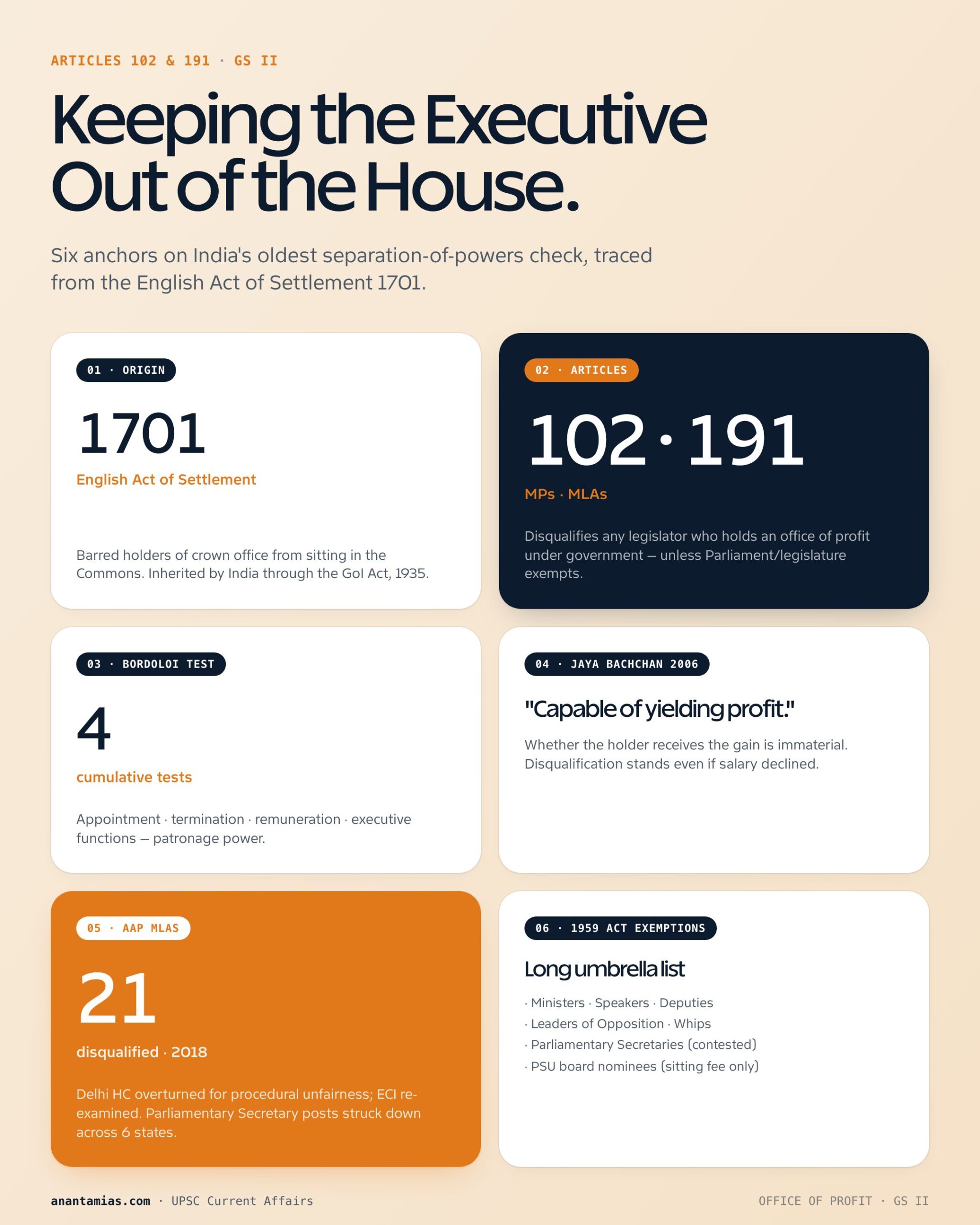
The Constitution does not define "office of profit." The Supreme Court has filled the gap through case law. Across decisions, four cumulative tests have emerged:
- Whether the government makes the appointment.
- Whether the government has the power to terminate the appointment.
- Whether the government determines the remuneration.
- What is the source of the remuneration?
- Whether the body in which the office is held has executive functions — allotment of land, release of funds, grant of licences, patronage.
If the answer to most of these is "yes," the office is an office of profit.
Why the doctrine matters — separation of powers
- Independence of the legislator — without it, the executive can buy off legislators with sinecures.
- Conflict of interest — a legislator scrutinising the executive cannot also serve under it.
- Separation of powers — keeps legislative and executive functions distinct.
- Accountability — legislators answerable to voters, not to ministers.
The Parliament (Prevention of Disqualification) Act, 1959
This is the umbrella statute that exempts certain offices from the office-of-profit disqualification under Article 102(1)(a). Key exempted categories:
- Ministers of the Union or a State.
- Speaker, Deputy Speaker, Chairman, Deputy Chairman of either House.
- Leader of the Opposition in Lok Sabha and Rajya Sabha.
- Chief Whip, Deputy Chief Whip, Whip.
- Parliamentary Secretary to a Minister (controversial).
- Government nominees on PSU boards if they receive only sitting fees and TA/DA.
- A long Schedule listing exempted bodies.
States have parallel statutes — for example, Delhi (Removal of Disqualification) Act, 1997.
The 1959 Act has been amended multiple times to add specific posts. The 2006 amendment is the most politically charged.
Jaya Bachchan case (2006)
Jaya Bachchan v. Union of India (2006) — the most-cited modern authority on office of profit.
Facts: Jaya Bachchan, an MP from the Samajwadi Party, was appointed Chairperson of the Uttar Pradesh Film Development Corporation with the rank of Cabinet Minister. ECI recommended her disqualification.
Held:
- The test for office of profit is whether the office is capable of yielding profit or pecuniary gain.
- Whether the holder actually receives the gain or not is immaterial.
- Even if Jaya Bachchan declined the salary, the office still carried profit potential.
- She was disqualified.
This judgment cemented the "capable of yielding profit" doctrine.
Sonia Gandhi episode and the 2006 amendment
In 2006, Sonia Gandhi was found to be holding the post of Chairperson of the National Advisory Council (NAC) — alleged to be an office of profit. She resigned and contested again from Rae Bareli. To prevent similar disqualifications, the Parliament (Prevention of Disqualification) Amendment Act, 2006 was passed, with retrospective effect, exempting NAC chairperson and several other posts.
This was politically controversial — the President (Dr. Kalam) returned the bill once for reconsideration; Parliament passed it again, and assent was granted.
Pradyut Bordoloi v. Swapan Roy (2001) — the framework test
The Supreme Court in Pradyut Bordoloi set out the structured test for office of profit:
- Does the government control appointment and removal?
- Does the office carry remuneration?
- Does the body have executive functions — allotment of land, release of money, grant of licences?
- Does the office enable the holder to influence by way of patronage?
This test continues to be the primary judicial framework.
AAP MLAs case (2018)
Facts: In 2015, the Delhi government appointed 21 AAP MLAs as Parliamentary Secretaries. Petitioners alleged they held office of profit. The matter went to the President, who, on ECI advice, disqualified the 21 MLAs in January 2018.
Outcome: The Delhi High Court (March 2018) overturned the disqualification, holding that the ECI did not provide them an oral hearing — violating principles of natural justice. The court remanded the matter to ECI. The ECI subsequently re-examined and again held that they held office of profit, but by that time most MLAs had already resigned or contested by-elections.
The episode raised three issues:
- Are Parliamentary Secretaries always office of profit? Most state laws exempting them have been struck down.
- State legislatures cannot retrospectively immunise their own MLAs (Bombay HC, 2017, struck down West Bengal's law).
- ECI's procedural fairness in office of profit references.
Parliamentary Secretary — recurring controversy
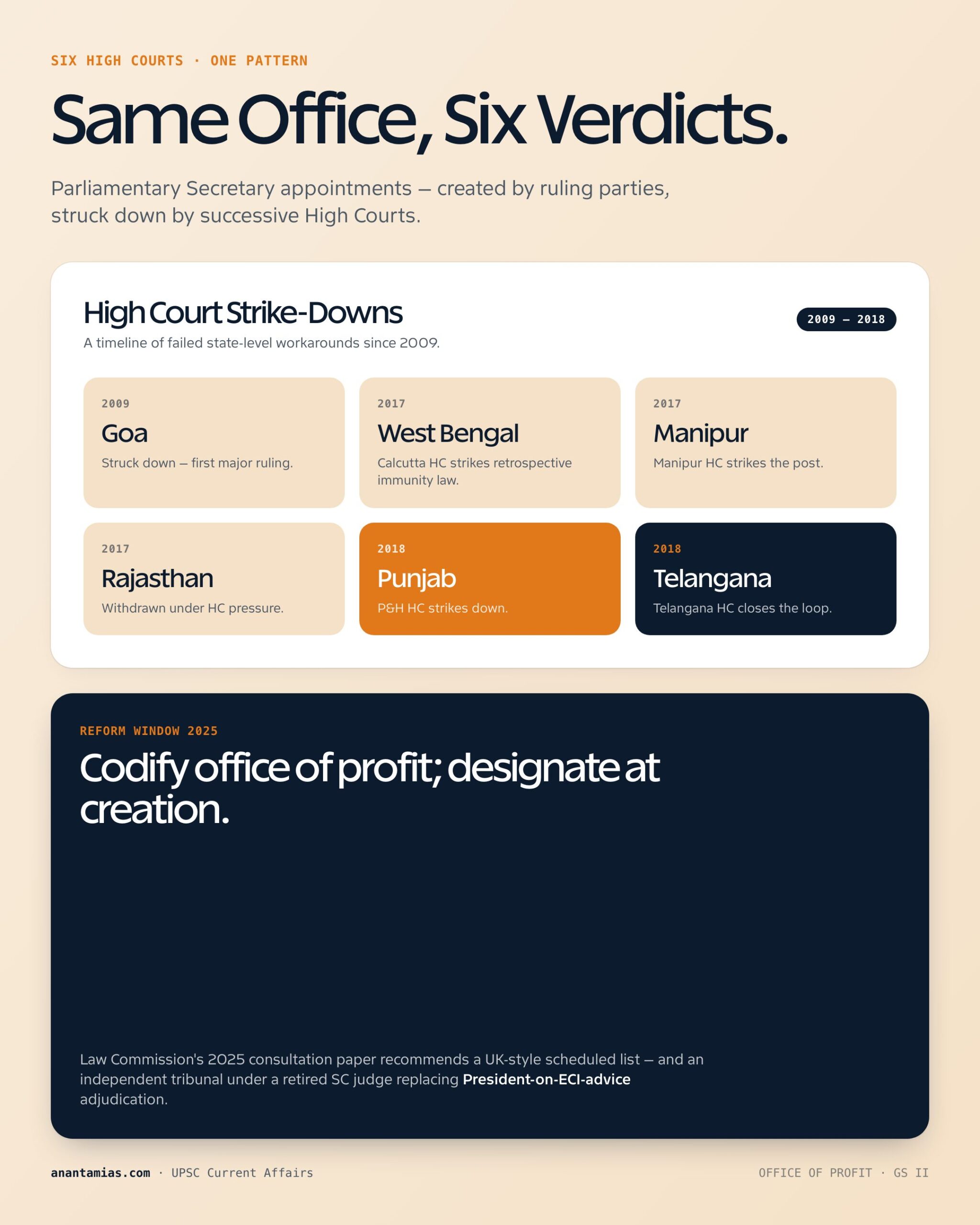
State after state has appointed Parliamentary Secretaries to MLAs, and courts have struck them down:
| State | Year | Outcome |
|---|---|---|
| Punjab | 2018 | Struck down by P&H HC |
| West Bengal | 2017 | Struck down by Calcutta HC |
| Manipur | 2017 | Struck down by Manipur HC |
| Telangana | 2018 | Struck down by Telangana HC |
| Rajasthan | 2017 | Withdrawn |
| Goa | 2009 | Struck down |
Despite this, states continue to revive the post — the doctrine remains contested.
ECI's role in office of profit
Under Article 103 (for MPs) and Article 192 (for MLAs), the President / Governor decides on disqualification. But before deciding, the President / Governor must seek the opinion of the Election Commission of India (ECI) — and shall act according to that opinion.
This makes ECI the de facto adjudicator. ECI conducts a quasi-judicial inquiry, issues notices, hears parties, and submits its opinion.
Advantages of the office of profit doctrine
| Advantage | Explanation |
|---|---|
| Separation of powers | Keeps executive and legislature distinct |
| Independence of MPs/MLAs | Free from executive patronage |
| No conflict of interest | Legislator cannot scrutinise executive while drawing salary from it |
| Accountability to voters | Loyalty to constituency, not government office |
| Curbs corruption | Prevents creation of redundant offices to placate dissident MPs |
Issues with the current framework
- No constitutional definition of "office of profit."
- Frequent statutory exemptions — Parliament adds positions to the 1959 Act selectively.
- Retrospective amendments (2006) raise rule-of-law concerns.
- State-level Parliamentary Secretary posts repeatedly created and struck down.
- Delays in ECI references — disqualification petitions often take 1-2 years.
- Procedural irregularities — AAP MLAs case showed ECI's hearing process can fall short.
- Honorary vs paid offices — distinction often blurry.
- Discretion in statutory exemption — ruling parties expand the exempt list.
Way forward
- Codify a clear, exhaustive definition of office of profit.
- UK practice — the House of Commons Disqualification Act, 1975 schedules every disqualifying office; if not on the schedule, no disqualification. Designate at the time of office creation whether the position is an office of profit.
- Independent adjudication — transfer disqualification decision from President-on-ECI-advice to a tribunal headed by retired SC judge.
- Time-bound ECI inquiry — statutory deadline of 3-6 months.
- Government undertakings distributing or controlling funds should automatically be classified as offices of profit.
- Review the 1959 Act schedule — the Schedule has grown unwieldy.
- Abolish discretionary MPLADS / MLALADS — these have been argued to themselves be a form of patronage.
- Limit Parliamentary Secretary posts — reform required at state level.
Key cases summary
| Case | Year | Holding |
|---|---|---|
| Shibu Soren v. Dayanand Sahay | 2001 | All four Pradyut Bordoloi tests reaffirmed |
| Pradyut Bordoloi v. Swapan Roy | 2001 | Set out structured framework |
| Jaya Bachchan v. UoI | 2006 | "Capable of yielding profit" — actual receipt immaterial |
| Consumer Education and Research Society | 2014 | NAC chairperson controversy |
| AAP MLAs Case | 2018 | Procedural fairness; Delhi HC remand |
| N. Sambasiva Rao | 2019 | Andhra Pradesh political appointments examined |
Recent developments (2024-26)
- State references to ECI — disqualification petitions against MLAs holding chairperson positions in state PSUs continue.
- Parliamentary Secretary in Punjab and HP (2024) — fresh challenges in High Courts.
- Delhi HC ruling on chairperson appointments (2024) — required clear statutory exemption.
- Law Commission's draft consultation paper on Disqualification (2025) — recommended codification of office of profit.
- 18th Lok Sabha — fresh references against MPs holding chairperson roles in trusts and PSUs.
Mains-style answer hook
"The office of profit doctrine, conceived in 1701 to keep the King's servants out of the Commons, remains the most reliable structural check on executive co-option of the legislature. India's framework — Articles 102 and 191, the 1959 Act, and the Pradyut Bordoloi-Jaya Bachchan tests — works in spirit but fails in practice. Recurrent Parliamentary Secretary controversies, retrospective amendments like the 2006 Act, and the procedural lapses in the AAP MLAs case show the law needs codification, an independent adjudicator, and the UK practice of designating offices at creation. The 2025 Law Commission consultation paper provides the reform window; political will is the missing input."
Prelims pointers
- Article 102(1)(a) — disqualification of MPs.
- Article 191(1)(a) — disqualification of MLAs.
- Parliament (Prevention of Disqualification) Act, 1959 — exempts specified offices.
- Article 103 / 192 — President/Governor decides on ECI advice.
- Pradyut Bordoloi (2001) — four-fold test.
- Jaya Bachchan (2006) — "capable of yielding profit"; actual receipt immaterial.
- 2006 Amendment — retrospective; saved Sonia Gandhi.
- AAP MLAs (2018) — Delhi HC remanded for procedural fairness.
FAQ
Are Ministers exempt from office of profit?
Yes — Cabinet, MoS, and Deputy Ministers are exempted by the 1959 Act.
Is the position of Leader of Opposition an office of profit?
No — it is exempted by the 1959 Act and carries the rank of Cabinet Minister.
Who decides on disqualification?
The President (for MPs) or Governor (for MLAs), but they must act on the ECI's opinion.
Related: Parliament, Anti-Defection Law, Election Commission, Concept of Privileges.
Tell Google you want more of this.
Add Anantam IAS as a preferred sourceOne tap, and this site shows up more often in your own Top Stories, AI Overviews and AI Mode. Remove it any time.