Police Ethics and the Use of Force: Proportionality, Crowd Control and Custodial Violence (UPSC Ethics — GS IV)
The police is the one civil service routinely authorised to hurt people, which makes its ethics structurally different from every other post. Almost everything that goes wrong follows from confusing force used to prevent harm with force used to punish.
Every civil service post carries discretion. Only one carries a standing authorisation to hurt people: a revenue officer can ruin a family with a wrong entry in a record of rights, but only a constable can also break a bone.
That is where police ethics has to begin, and it is what most treatments skip on the way to a general appeal for integrity. What is specific here is a licence to inflict harm, exercised by a subordinate officer in situations that unfold in minutes, with nobody to consult and his own safety at stake.
The Moral Position of the Police
The authorisation to use force is the community’s own right of self-defence, lent on conditions.
The force is borrowed, not owned. It belongs to the post, so a constable who slaps a suspect out of irritation has not used a mild version of a legitimate power — he has stepped outside the authorisation altogether.
It is applied retail and unsupervised. Military force moves in formations under orders; police force is applied by individuals deciding alone in seconds, which no supervisory machinery reaches — one reason policing sits apart from the other internal security forces and agencies.
And those on whom force is most often used are least able to complain about it. Someone with a lawyer and a name that opens doors is policed differently — the central problem, not a side effect.
The Four Tests of a Lawful Use of Force
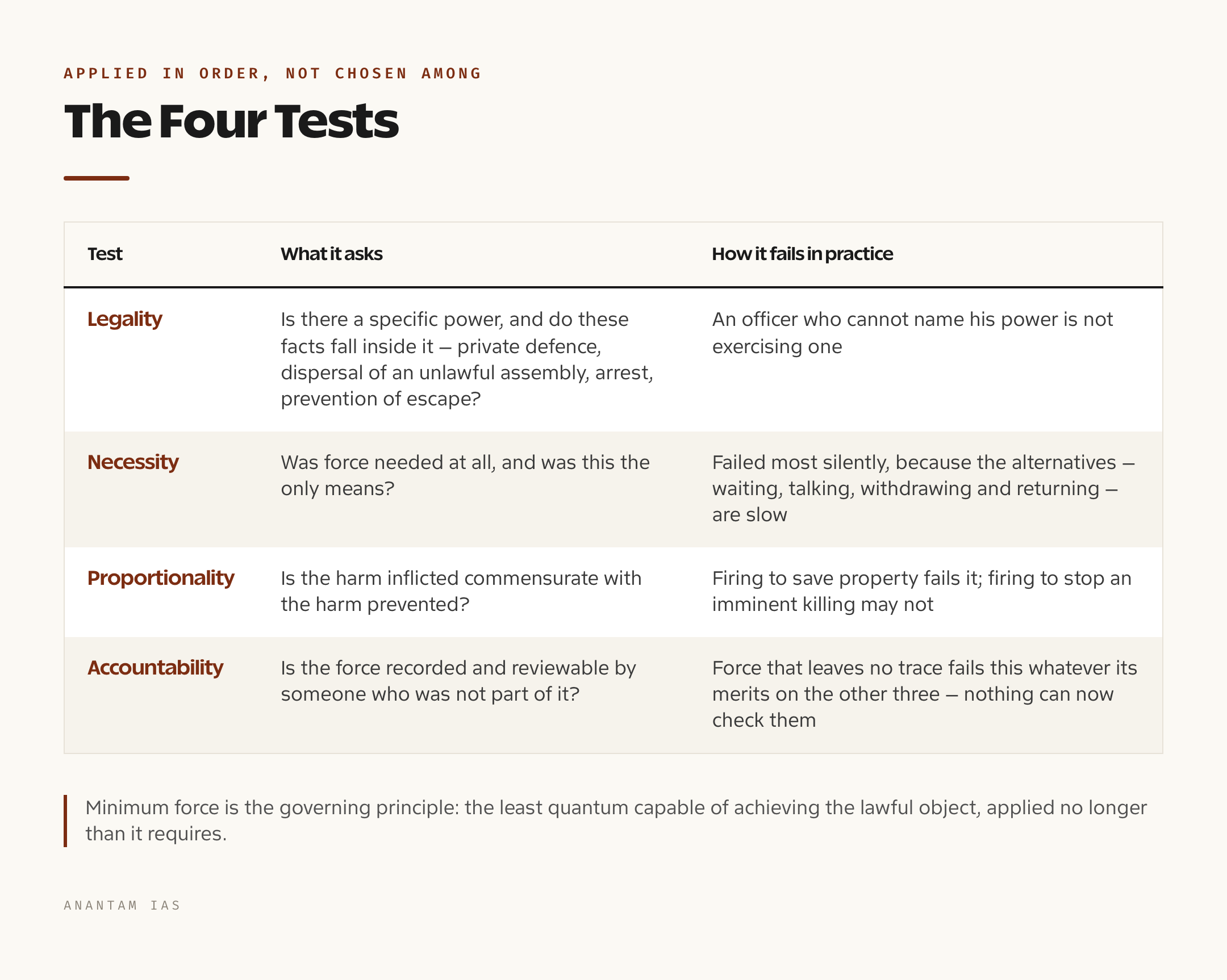
The governing principle is minimum force — the least quantum capable of achieving the lawful object, applied no longer than it requires. Four tests, in order, settle whether a use of force passes.
Legality. Is there a power, and does this situation fall inside it? Private defence, dispersal of an unlawful assembly, arrest, prevention of escape — each is a specific authorisation with conditions. An officer who cannot name his power is not exercising one.
Necessity. Was force needed at all, and was this the only means? This is the test failed most silently, because the alternatives — waiting, talking, withdrawing and returning — are slow.
Proportionality. Is the harm inflicted commensurate with the harm prevented? Firing to save property fails it; firing to stop an imminent killing may not.
Accountability. Is the force recorded and reviewable by someone who was not part of it? Force that leaves no trace fails this test whatever its merits on the other three, because nothing can now check them — the logic set out in accountability and responsibility.

Prevention Versus Punishment
The most useful distinction here is between force used to stop something and force used to punish it. Lawful police force is always the first: when the thing being prevented ends, the authorisation ends with it.
A constable who beats a pickpocket already in custody has not used excessive force towards a legitimate object; he has passed a sentence without a trial.
“Excess” invites an argument about degree, always defensible by the pressure of the moment. Summary punishment names it correctly: provocation does not shrink a usurpation.
Crowd Control and the Graded Ladder
Crowd situations strain the tests hardest, because the officer faces a collective he can neither individuate nor negotiate with. Doctrine answers with a graded ladder whose ethics lie in each rung’s condition.
Warning and time to disperse. A warning that is inaudible, in the wrong language, or followed instantly by action is not a warning. Its purpose is to give those who want to leave a route out, so the route must exist — an order a hemmed-in crowd cannot obey turns dispersal into a beating.
Non-contact means. Water cannon and tear smoke are graded below the lathi as reversible. Tear gas in an enclosed space is not: the canister that clears a street can asphyxiate people in a stairwell, making it a greater use of force than a lathi charge rather than a lesser one.
Lathi charge. Striking below the waist and never at the head is the difference between a reversible injury and a fatal one, and the rule goes once discipline dissolves.
Firing. A bullet cannot be aimed at a collective, only at a person who must individually satisfy the tests. The safeguards follow: an order from the competent authority, minimum rounds, aimed low at identified targets, an immediate count and report, and medical aid to the injured regardless of side — the last skipped most often, and the best indicator of whether force was stopping something or settling a score. The claim from the other side is examined in the ethics of protest.
Custodial Violence: Why It Persists
Custodial violence is not bad character randomly distributed. Four pressures push one way.
Pressure to produce a result. An officer is asked when a case will be solved, not how it is being investigated; detection statistics are the currency of appraisal.
Weak investigative capacity. Without forensics, trained interrogators or time, a confession is the cheapest route to a chargesheet. Torture substitutes for investigation, concentrating where the evidence is thinnest and the suspect least influential.
A belief that some suspects deserve it. Rarely written, constantly said — a moral belief rather than a procedural lapse, sustained by public approval for teaching someone a lesson.
Near-certainty of impunity. The injury occurs in a place controlled by the accused, witnessed by their colleagues, recorded in registers they maintain, investigated by their own force, and prosecuted only with sanction.
What the Law Already Requires
The gap is not in the law. It is between the law and the thana.
The constitutional floor. Article 20(3) protects against compelled self-incrimination from police interrogation onwards, not only in court. Article 21 protects life and liberty against unfair procedure, and is the basis on which the state has been made to pay compensation for custodial death. Article 22 requires grounds of arrest to be communicated and production before a magistrate within twenty-four hours.
Arrest safeguards. D. K. Basu v. State of West Bengal (1997) reduced these to eleven operational requirements: identification of the arresting personnel, an arrest memo attested by a witness with time and date, intimation to a relative of the arrest and place of detention, a diary entry there, injuries recorded at arrest, periodic medical examination by an approved doctor, and documents sent to the magistrate. Cases that later collapse almost always failed at these clerical steps.
Reporting, inquiry and evidence. The National Human Rights Commission, under the Protection of Human Rights Act, 1993, requires the District Magistrate or Superintendent of Police to report every custodial death within twenty-four hours, and such a death attracts a magisterial inquiry rather than a departmental one. A confession to a police officer is separately inadmissible, as is one obtained by threat: the state should not build a case out of what it can extract from a body it controls.
The reform that did not happen. The Law Commission’s 113th Report of 1985 recommended a rebuttable presumption that injuries sustained in police custody were caused by the police; it was never enacted. India signed the UN Convention against Torture in 1997 without ratifying it, and a Prevention of Torture Bill lapsed after 2010.
Encounters and the Case Against the Third Degree
An encounter death is either lawful self-defence or a homicide, and the only way to tell is an investigation the participants do not control. People’s Union for Civil Liberties v. State of Maharashtra (2014) requires an FIR and investigation by an independent agency or another unit under a senior officer, a magisterial inquiry, forensic examination of the weapons, intimation to the NHRC where independence is doubtful, and no out-of-turn promotion or gallantry award until the death is established as lawful — the last of these removing an incentive rather than condemning an act.
The defence of the “third degree” is that it works. A person in pain says whatever stops the pain, which produces false confessions, wrong arrests and prosecutions that fail while the actual offender stays free.
The Institutional Roots
Indian policing was designed by the Police Act of 1861, drafted after 1857 by an administration that wanted a force loyal to the government rather than answerable to the population. Armed, centralised and hierarchical, with no institutional relationship to the people it polices, the design was not a mistake — and the purpose changed while the design did not.
The National Police Commission, reporting in eight volumes between 1977 and 1981, named the operative problem as political control over postings, transfers and case outcomes. In Prakash Singh v. Union of India (2006) the Supreme Court turned it into binding directions: a State Security Commission; selection of the DGP from a panel of the senior-most eligible officers, with a minimum two-year tenure; minimum tenure in key field posts; separation of investigation from law and order; a Police Establishment Board for transfers; and Police Complaints Authorities.
Compliance has been formal. States constituted the bodies while keeping control of their composition, and wrote tenure exceptions wide enough to swallow the rule. The directions remove precisely the power that makes control of the police valuable, and those who gain from insulated policing are diffuse while those who lose are organised — the pattern the Second Administrative Reforms Commission found across ethics in governance.
Four Situations, and What the Duty Is
An illegal oral order to detain. The instruction arrives by telephone and there is no case. Ask for it in writing, which usually ends the matter; an officer who complies has committed wrongful confinement in his own name while the caller has left no trace. Pressure of this kind is worked through in the case studies on political pressure.
A communal flashpoint. The temptation is to act on the arithmetic of the locality. The duty is to police the act, not the identity — whoever throws stones is arrested, in the same manner, and the record shows it.
A powerful accused. The pressure is rarely a threat and usually a suggestion, through an intermediary, that the file become slow. Courage that consists of refusing is exhausted in one posting; courage that documents lasts.
A complainant from a marginalised group. The commonest failure in Indian policing is not violence but non-registration — declining to record a complaint, which requires no force, leaves the complainant with nothing, and touches more people than any of the above.
The Honest Difficulties
The danger is real and the conditions are bad. Officers serve in forces below their own sanctioned strength, on shifts that would be illegal in most occupations, with dated equipment and almost no training after the initial course. Sixteen hours in, outnumbered and unsupervised, an officer is asked to grade proportionality finely — conditions in which almost nobody does it well.
Punishment without capacity will not work. Raising penalties while leaving numbers, training and political interference untouched produces better concealment, not less violence.
Some dilemmas are genuine. An officer facing a crowd that has begun to burn an occupied building must weigh the lives force will endanger against the lives inaction will cost. Treating every use of force as an ethical failure is as unserious as treating none of them that way.
The machinery is weakest where it matters most. Complaints authorities staffed by the governments whose police they examine, and inquiries conducted by colleagues, are thin in practice.
FAQ
What is the principle of minimum force? The least quantum capable of achieving the lawful object, applied only as long as the object requires. It rules out a refusal to use force at all as firmly as force that outlasts its object.
What are the four tests of a lawful use of force? Legality — a power covering the situation; necessity — no non-forcible alternative; proportionality — harm inflicted commensurate with harm prevented; accountability — recorded and reviewable by someone not involved.
Why is beating a person already in custody called a category error? Because lawful police force exists to stop something, and there is nothing left to stop. Force at that stage is punishment, which belongs to a court.
What do the D. K. Basu requirements cover? Identification of the arresting officers, an arrest memo attested by a witness, intimation to a relative, a diary entry at the place of detention, injuries recorded at arrest, periodic medical examination.
Why are convictions for custodial death so rare? The injury occurs in a place controlled by those accused of causing it, recorded in their own registers, witnessed by colleagues, investigated from within the same force, and prosecuted only with sanction.
What do the PUCL guidelines require after an encounter death? An FIR, investigation by an independent agency or a senior officer from another unit, a magisterial inquiry, forensic examination of the weapons, and no out-of-turn promotion until the death is shown lawful.
Practice Questions
Prelims MCQs
- The eleven requirements in D. K. Basu (1997) relate primarily to: (a) Encounter deaths (b) Safeguards at arrest and in detention (c) Dispersal of unlawful assemblies (d) Tenure of the DGP — Answer: (b) arrest memo, intimation to relatives, diary entries, medical examination.
- Which was not a direction in Prakash Singh v. Union of India (2006)? (a) State Security Commission (b) Two-year DGP tenure (c) Separation of investigation from law and order (d) A statutory presumption against police in custodial injury cases — Answer: (d) a 1985 Law Commission recommendation, never enacted.
- Article 20(3) protects a person against: (a) Arrest without warrant (b) Being compelled to be a witness against himself (c) Detention beyond 24 hours (d) Double jeopardy — Answer: (b) operating from police interrogation onwards, not only at trial.
- The NHRC requires a custodial death to be reported by the DM or SP within: (a) 24 hours (b) 48 hours (c) Seven days (d) One month — Answer: (a) with post-mortem, inquest and magisterial inquiry reports following.
- Firing differs from the earlier rungs of the ladder mainly because: (a) It needs a written state order (b) It cannot be aimed at a collective, only at identified individuals (c) It is permitted only after dark (d) It transfers responsibility to the armed forces — Answer: (b) each shot must separately satisfy the tests.
Mains Practice Questions
- “The police is the only civil service routinely authorised to inflict harm.” Examine the implications for its ethics. (150 words)
- Why is summary punishment by police a category error rather than excessive force? (150 words)
- Custodial violence persists despite an elaborate legal framework. Analyse the incentives that sustain it. (250 words)
- Evaluate the graded ladder of force as an ethical device. What safeguards must accompany firing on a crowd? (250 words)
- “Police reform has stalled because the changes remove the power that makes control over the police valuable.” Critically examine with reference to the Prakash Singh directions. (250 words)