Ask who keeps India safe and most people picture the Army. But the soldier on the frontier is rarely the one who answers when a city riot flares, a Maoist ambush hits a forest road, a cyber attack locks a hospital, or a flood swallows a district. That work falls to a sprawling, half-hidden machine of police forces, armed central battalions, spy agencies and coordination cells — a grid that runs from the beat constable in your neighbourhood thana all the way up to a national database that quietly knows your travel itinerary.
And here is the catch that makes the whole thing hard. The single most important fact about Indian internal security is constitutional, not tactical: policing belongs to the states, while the threats it faces — terror financing, cross-border infiltration, organised crime, online radicalisation — pay no attention to state borders. So a national problem is fought by a system designed to be local, propped up by central forces that were never meant to do the local job. Understand that tension and the rest of the grid, with all its strengths and leaks, suddenly makes sense.
The Challenge, Framed
Internal security simply means safety inside the country’s borders — distinct from external defence, which is the Army’s brief against foreign militaries. It covers terrorism, insurgency in the Northeast, Left-Wing Extremism (the Maoist or “Naxal” violence that the government calls LWE), communal and law-and-order flare-ups, organised crime, narcotics, cybercrime and the response to disasters. It’s a GS3 staple precisely because it sits at the crossroads of the Constitution, the economy and technology.
The framing problem starts with the Seventh Schedule of the Constitution, which divides power between the Union and the states across three lists. “Public order” is Entry 1 and “police” is Entry 2 of the State List — meaning the day-to-day job of preventing, detecting, registering and investigating crime is the primary duty of state governments, not Delhi. That federal design is deliberate and democratic; a country this large should not be policed from one capital. But it also means the Centre cannot simply order a uniform standard of policing into existence. It can fund, advise, investigate specific categories of crime and lend its own armed battalions — and that is exactly the workaround the system has grown around.
Why it matters now is a matter of scale and speed. India runs one of the longest and most varied borders in the world, a young and wired population that radicalisers target online, and an economy whose critical infrastructure — airports, ports, power grids, metros — is a soft target. The threats have gone faster and more networked; the institutions guarding against them are still, in large part, organised the way they were decades ago. That gap is the story.
Who Does What
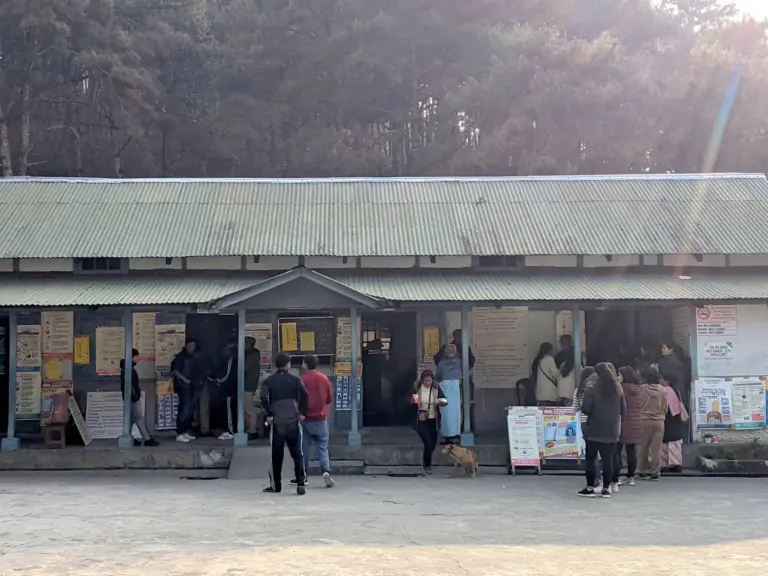
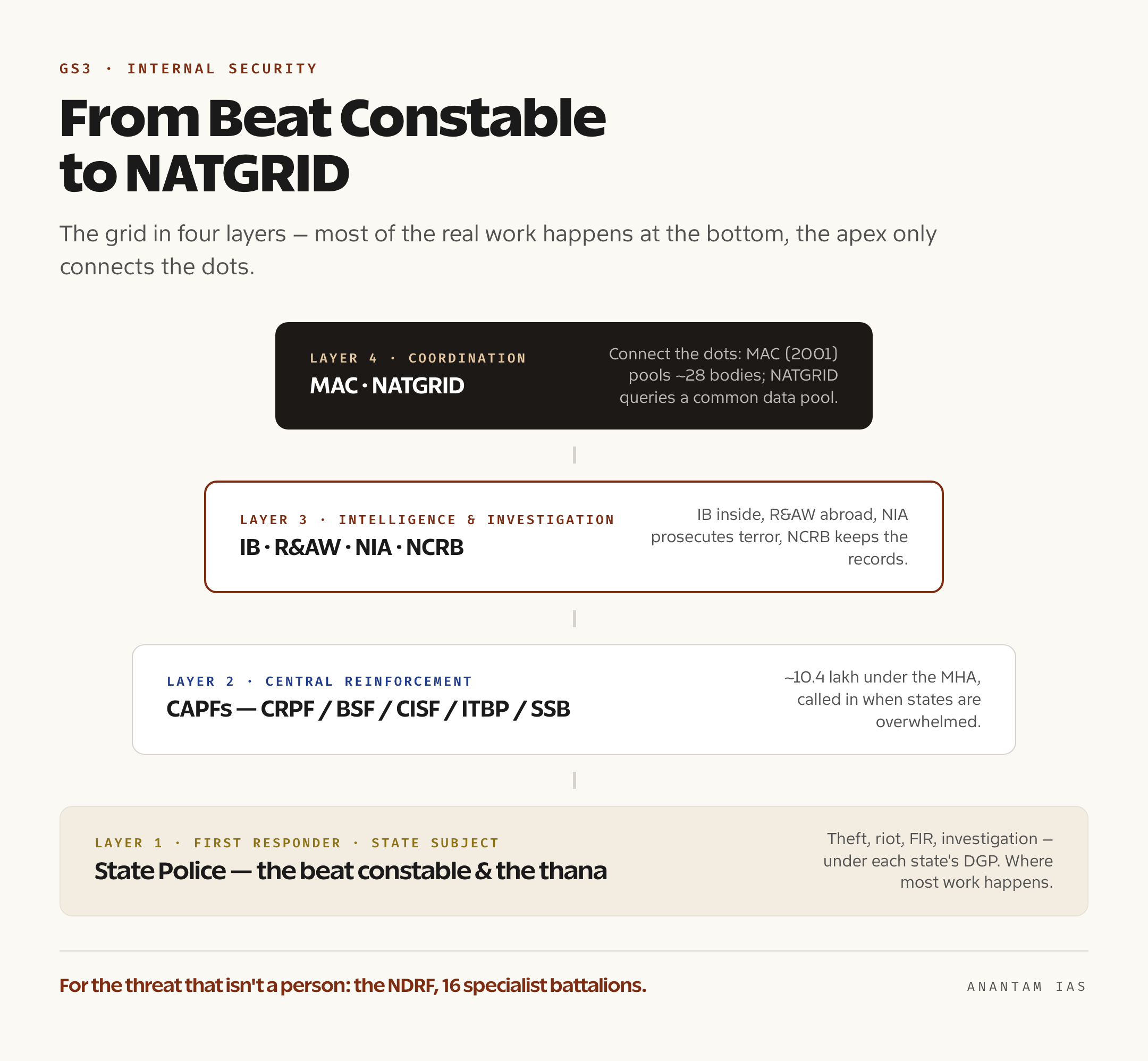
Start at the bottom, because that is where most of the work happens. The state police — your local constabulary under each state’s Director General of Police — is the first responder to almost everything: theft, riot, murder, missing persons, the FIR you file. When a state’s own police are overwhelmed, by a riot it can’t contain or an insurgency it can’t suppress, it calls for central muscle. That muscle is the Central Armed Police Forces.
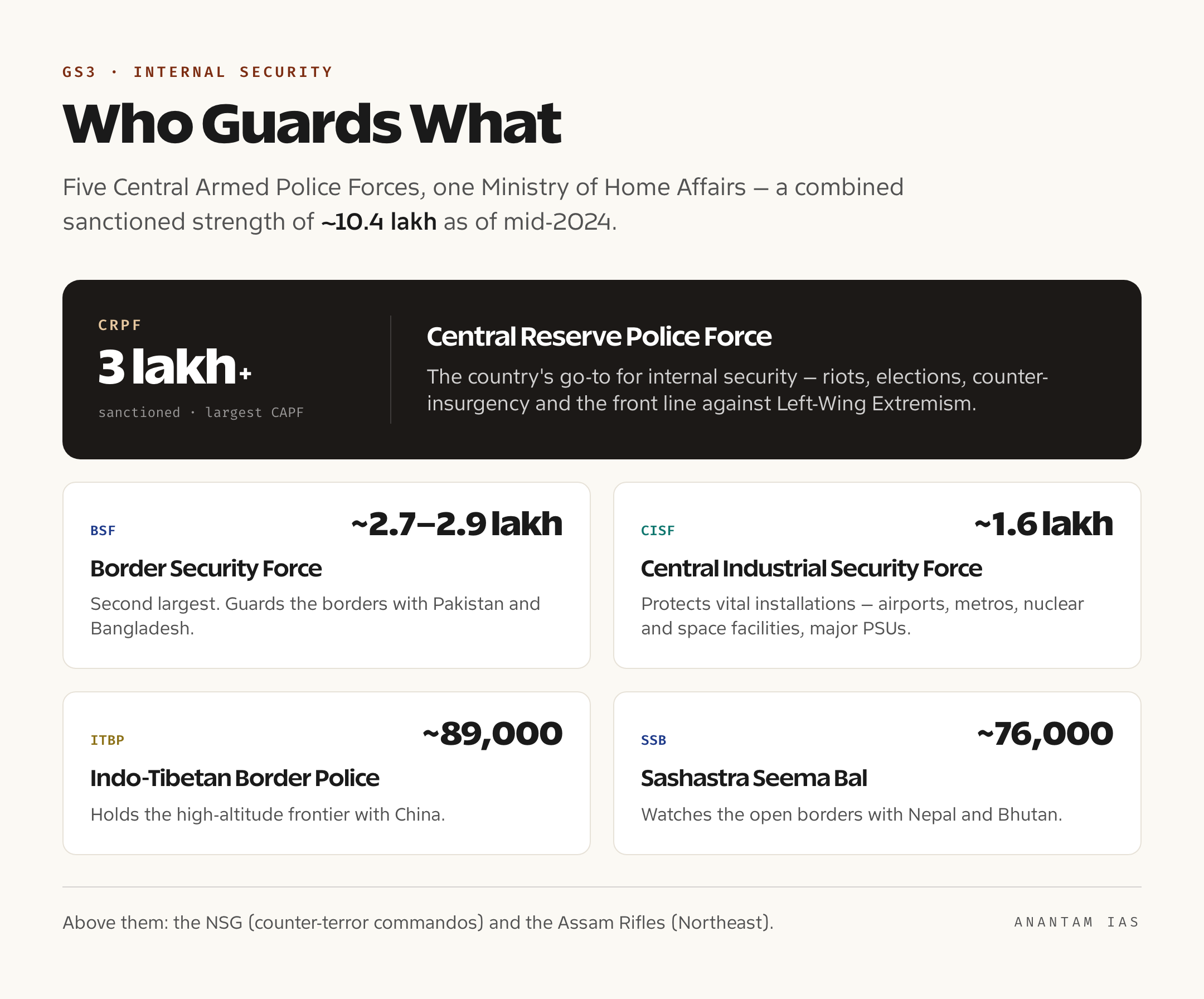
The CAPFs are seven armed forces under the Ministry of Home Affairs, with a combined sanctioned strength of roughly 10.4 lakh personnel as of mid-2024 — making them, taken together, one of the largest uniformed bodies on earth. A word on naming, because examiners love it and the public gets it wrong: these are often loosely called “paramilitary forces,” but the government formally dropped that term in 2011, adopting “Central Armed Police Forces” by circular. In strict usage only the Assam Rifles is treated as a paramilitary force in the older sense. The rest are armed police, not soldiers.
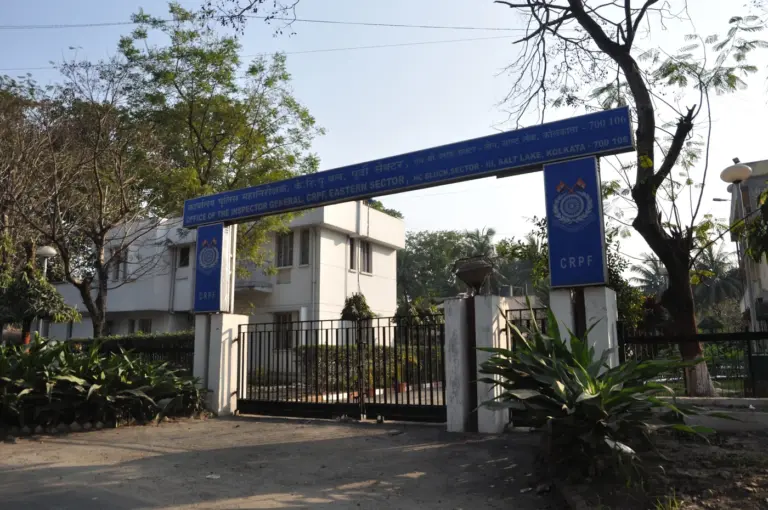
Five forces do the heavy lifting. The Central Reserve Police Force (CRPF) is the largest, with a sanctioned strength north of three lakh, and it is the country’s go-to for internal security — riots, elections, counter-insurgency and the front line against Left-Wing Extremism. The Border Security Force (BSF), the second largest at roughly 2.7 to 2.9 lakh, guards the borders with Pakistan and Bangladesh. The Central Industrial Security Force (CISF), around 1.6 lakh strong, protects vital installations — airports, metros, nuclear and space facilities, major public-sector units. The Indo-Tibetan Border Police (ITBP), about 89,000, holds the high-altitude frontier with China. And the Sashastra Seema Bal (SSB), roughly 76,000, watches the open borders with Nepal and Bhutan. Above them sit the specialists: the National Security Guard (NSG), India’s “Black Cat” counter-terror commandos raised in 1984, and the Assam Rifles, the oldest force, doing border guarding and counter-insurgency in the Northeast.
But forces only act on what they know, and knowing is the job of the intelligence wing. The Intelligence Bureau (IB), under the MHA, is the lead agency for domestic, internal intelligence — the eyes and ears inside the country. Its external counterpart, the Research and Analysis Wing (R&AW), created in 1968 and reporting to the Prime Minister’s Office, handles foreign intelligence; the two are meant to hand off cleanly at the border, though that handoff has historically been where things slip. When a case crosses into terrorism, the National Investigation Agency (NIA) — set up by the NIA Act of 2008 in the shock after the 26/11 Mumbai attacks — takes over investigation and prosecution of “scheduled offences,” a defined list that includes crimes under the anti-terror law. The National Crime Records Bureau (NCRB) keeps the country’s crime statistics and runs the database that ties police stations together.
Then there is the connective tissue, which is where India learnt its hardest lessons. After the Kargil review, the Multi-Agency Centre (MAC) was set up in December 2001 as a 24×7 intelligence-sharing hub run by the IB, pulling in some 28 organisations — R&AW, the armed forces, state police — with Subsidiary MACs in state capitals so a tip-off in one state reaches the others. After 26/11 exposed how agencies sat on information in separate silos, NATGRID — the National Intelligence Grid — was conceived to let designated agencies query a common pool of data: bank and tax records, credit-card use, immigration and travel itineraries. And for the threat that isn’t a person at all, the National Disaster Response Force (NDRF), created under the Disaster Management Act of 2005, fields 16 specialist battalions — staffed on deputation from the CAPFs — for floods, earthquakes and building collapses.
India’s Institutional Response
The institutional response has three layers — law, agencies and money — and it’s worth naming each precisely.
On the legal side, the centrepiece is the Unlawful Activities (Prevention) Act, the UAPA, the principal anti-terror statute. Amended in 2019, it lets the Union government do something significant and contested: designate not just organisations but individual persons as terrorists, without a prior judicial finding, alongside new provisions on cyber-terrorism, terror financing and seizure of property. The same year, the NIA (Amendment) Act widened the agency’s reach to cover human trafficking, counterfeit currency, the sale of prohibited arms and cyber-terrorism, and even gave it jurisdiction over scheduled offences committed by Indians abroad. These laws genuinely sharpened the state’s hand against networked terror — and they are also exactly the provisions civil-liberties groups warn can be turned against dissent, because designating a person a terrorist or jailing them under stringent bail conditions has consequences well before any conviction. Both things are true at once, and a good answer holds both.
On the agency side, the design philosophy since 26/11 has been to stop the silos. MAC and NATGRID exist to make sure that what the IB knows, the NIA can act on, and what a state police special branch picks up doesn’t die in a local file. The logic is sound: most intelligence failures are not failures to collect but failures to connect.
On the money side, the lever the Centre actually controls is funding. The Modernisation of Police Forces (MPF) scheme — an umbrella programme running from 2021-22 to 2025-26 with a total central outlay of about Rs 26,275 crore — channels money to states for weapons, communications, mobility, forensics and technology, with a dedicated sub-scheme of roughly Rs 4,846 crore to help states and union territories modernise. Because the Centre can’t legislate police into shape, it tries to buy improvement instead — a workaround for the federal constraint, and one that has run, under various names, since 1969-70.
Where the System Falls Short
For all that architecture, the grid leaks at the seams, and honesty demands naming the leaks.
The first and largest is simply numbers. India’s police-population ratio sits at roughly 152 personnel per lakh of population, against the benchmark of 222 that the United Nations is often cited as recommending. That’s not a rounding error; it’s a third short. And the gap on paper is worse in practice, because the sanctioned posts themselves go unfilled: vacancies in state police forces have hovered above five lakh for over a decade, a vacancy rate of around 22 percent, with states like Uttar Pradesh and West Bengal among the worst. So the country is under-policed twice over — too few posts, and too many of those empty.
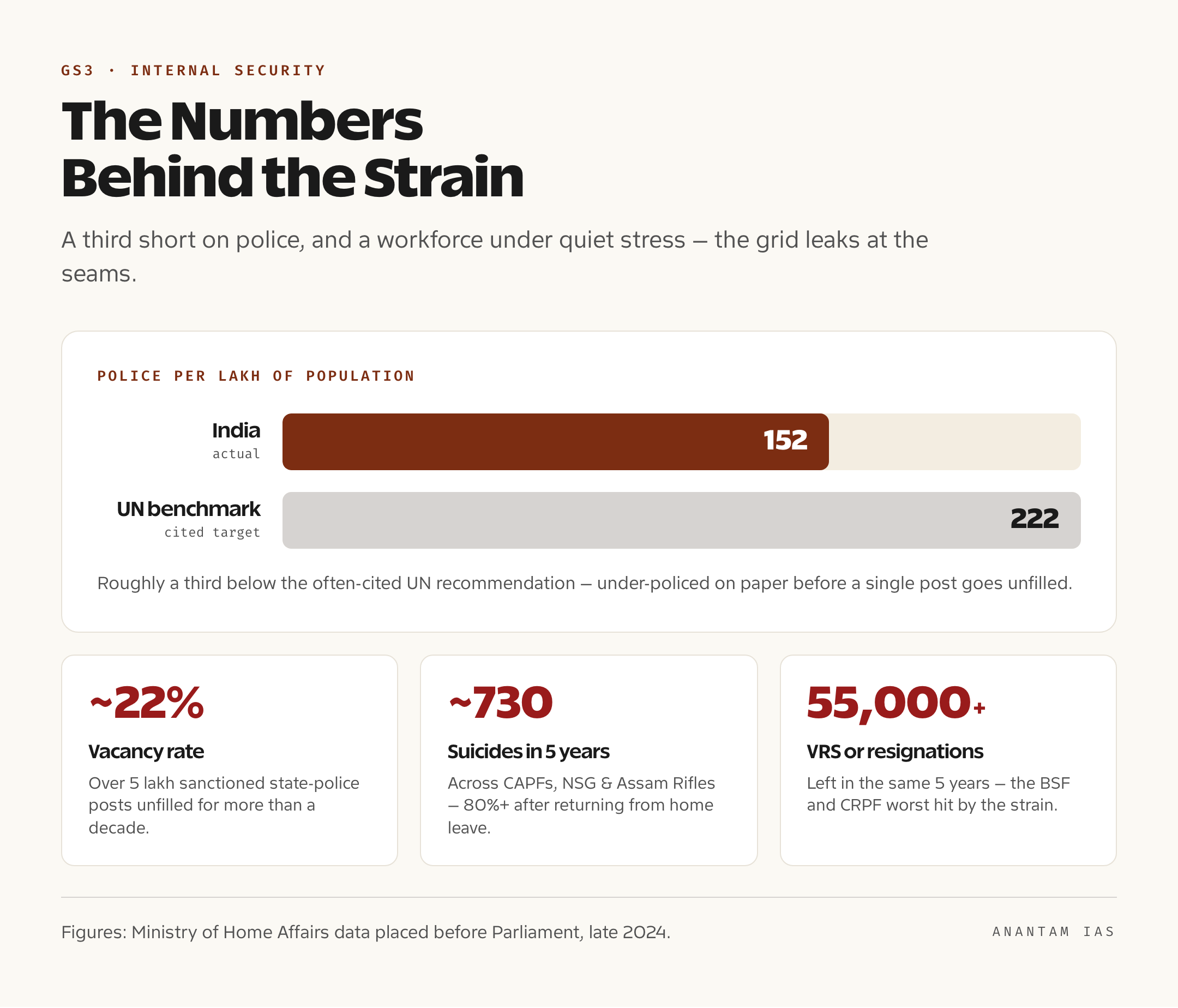
The second leak is over-reliance on the CAPFs. Because state police are thin and reforms have stalled, central battalions get pulled in to do work they were never raised for — long internal-security deployments far from home, election after election, riot after riot. The human cost shows up in grim parliamentary data: the government told Parliament in late 2024 that around 730 personnel across the CAPFs, NSG and Assam Rifles had died by suicide over five years, and that more than 55,000 had taken voluntary retirement or resigned in the same period, the BSF and CRPF worst hit. Officials point to long deployments, family separation and inadequate leave — and note that over 80 percent of those suicides happened after a man returned from home leave, unable to face going back. A force run that hard is a force whose edge is dulling.
The third leak is reform that never lands. In Prakash Singh vs Union of India in 2006, the Supreme Court — ruling on a public-interest petition filed a decade earlier by a former police chief — issued seven binding directives to insulate the police from political interference: a State Security Commission to set policy and act as a buffer, a fixed minimum two-year tenure for the DGP and key field officers, separation of the investigation wing from the law-and-order wing, a Police Establishment Board to handle transfers, and Police Complaints Authorities for accountability. Nearly twenty years on, most states have complied only on paper, passing their own laws that quietly dilute each directive — because a government that can transfer an inconvenient officer overnight is reluctant to give that power up. Investigation and law-and-order are still tangled together in most thanas, which is one reason both crime detection and case pendency stay stubbornly poor. Police remains a State subject, so the Court can direct but cannot enforce, and the Centre cannot legislate over the states’ heads. The federal design that protects democracy also shelters the status quo.
The Way Forward
None of this is unfixable, and the fixes are well understood. The argument is about will, not ideas.
- Fill the ranks and rebalance the load. Close the police-population gap by clearing the five-lakh vacancy backlog before sanctioning glossy new schemes, and free the CAPFs from permanent internal-policing duty by rebuilding state armed police so central forces can return to their core border and counter-terror roles.
- Implement the Prakash Singh directives in spirit, not on paper. Empower the State Security Commissions, give DGPs and field officers genuine fixed tenure, and complete the separation of investigation from law-and-order so detection isn’t crowded out by VIP duty and bandobast.
- Invest in the people, not just the platforms. Fix the CAPF stress crisis with predictable leave, family stations, mental-health support and rational deployment cycles — equipment doesn’t fight, rested and trained personnel do.
- Make coordination real. Move MAC and NATGRID from intelligence-sharing on paper to seamless, secured, real-time data flow with built-in privacy safeguards, so the next failure to connect dots doesn’t cost lives.
- Pursue SMART policing as a standard, not a slogan. The vision articulated for a police that is Strict yet Sensitive, Modern and Mobile, Alert and Accountable, Reliable and Responsive, Techno-savvy and Trained is the right target — but it needs forensics, training academies and digital case management funded through the Modernisation of Police Forces scheme, not just a hashtag.
- Keep rights and security on the same page. Pair tough laws like the UAPA with strong oversight — time-bound trials, working complaints authorities and judicial review — so that security is built on legitimacy and doesn’t trade away the liberty it exists to protect.
For Your Mains Answer
This topic sits squarely in GS Paper 3, under “various security forces and agencies and their mandate” and “linkages between development and spread of extremism” and “role of external state and non-state actors.” It also feeds GS Paper 2 (Centre-state relations, federalism) whenever the question turns on police being a State subject, and it’s strong material for the Essay paper on themes of security, liberty and the state. Treat it as a structure question — examiners reward a candidate who can map the system cleanly and then critique it fairly.
How to Build the Answer
Lead with the federal fact, because it organises everything: police and public order are State subjects under the Seventh Schedule, yet the threats are national. Then map the grid in layers — state police at the base, CAPFs as central reinforcement, intelligence agencies (IB, R&AW, NIA, NCRB) and the coordination bodies (MAC, NATGRID) on top. Move to the institutional response (laws, agencies, the MPF scheme), then to the gaps (numbers, over-reliance, stalled reform), and close with a balanced way forward. That arc — federal frame, map, response, gaps, reform — works for almost any internal-security question.
Common Mistakes to Avoid
Don’t confuse the CAPFs with the Army or call them “paramilitary” without flagging that the term was officially dropped in 2011. Don’t mix up mandates — the BSF is borders, the CRPF is internal security, the CISF is installations; reversing them is an easy way to lose marks. Don’t list agencies with no argument tying them together. And don’t write a one-sided answer: an internal-security answer that names tough laws without naming the rights concern, or names rights without acknowledging the genuine threat, reads as ideology, not analysis.
A Compact Answer Spine
Police is a State subject (Seventh Schedule) but threats are national → state police as first responder → CAPFs (CRPF largest, BSF, CISF, ITBP, SSB) as central reinforcement → intelligence and investigation (IB, R&AW, NIA, NCRB) → coordination (MAC, NATGRID) and disaster response (NDRF) → laws (UAPA 2019, NIA Act) and the Modernisation of Police Forces scheme → gaps (152 vs 222 police-population ratio, ~22% vacancies, CAPF stress, stalled Prakash Singh reforms) → way forward (fill ranks, implement reforms, SMART policing, real coordination, rights safeguards).
Diagram or Flowchart Idea
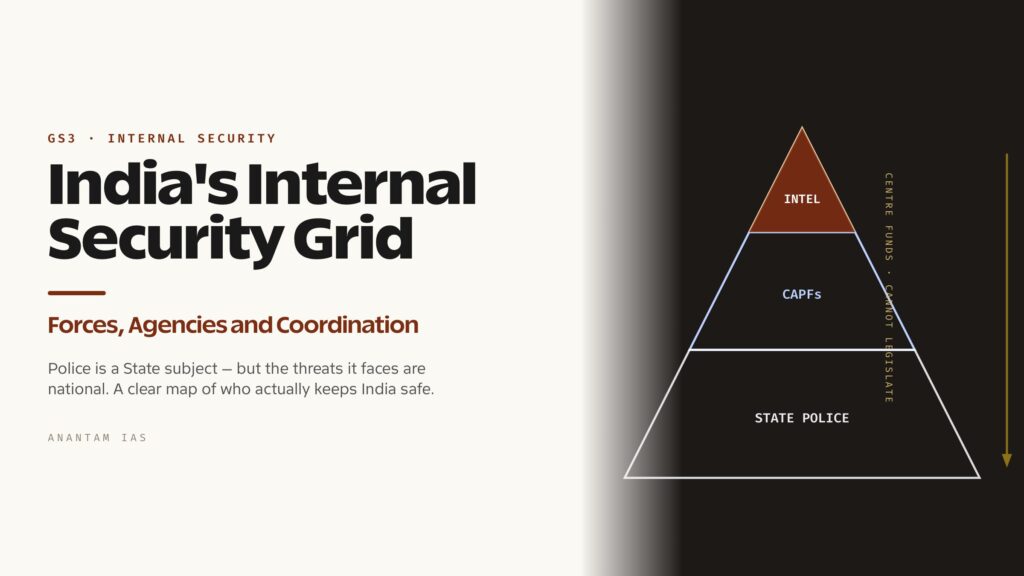
Draw a pyramid. The wide base is “State Police — first responder (State subject).” The middle band is “CAPFs — central reinforcement (CRPF / BSF / CISF / ITBP / SSB).” The apex is “Intelligence and Coordination — IB, R&AW, NIA, MAC, NATGRID.” Run an arrow down the side labelled “Centre funds via MPF scheme; cannot legislate (federal limit).” A clean pyramid like this signals you understand the architecture, not just the acronyms.
The Rights-and-Security Balance Angle
The mature point, worth a line in your conclusion, is that strong security and civil liberties are not opponents — security without legitimacy is brittle. The UAPA’s power to designate individuals as terrorists strengthens the state’s hand and worries rights groups, and both concerns are real. Say that security measures earn public trust — and with it, the public’s cooperation with intelligence — only when paired with oversight and due process. That distinction is what separates a top answer from a competent one.
How to Use Data Without Overclaiming
Anchor with a few sturdy numbers and attribute them: the police-population ratio of about 152 against the cited UN benchmark of 222; vacancies above five lakh; the MPF outlay of roughly Rs 26,275 crore; the LWE footprint shrinking from 126 districts in 2013 to 38 by 2024. Use approximations honestly (“around,” “roughly”) rather than false precision, and don’t claim a single ratio settles a complex argument. Naming the source in your phrasing — “Ministry of Home Affairs data,” “the Prakash Singh judgment” — reads as someone who has read, not memorised.
FAQ
What are the Central Armed Police Forces, and are they the same as the Army? No. The CAPFs are seven armed police forces under the Ministry of Home Affairs — CRPF, BSF, CISF, ITBP, SSB, plus the NSG and Assam Rifles — with a combined sanctioned strength of about 10.4 lakh. They handle internal security and border guarding, not war against foreign militaries, which is the Army’s job under the Ministry of Defence. They were once loosely called “paramilitary,” but the government formally dropped that label in 2011.
Why is internal security so hard to manage in India? Because of a constitutional split. Under the Seventh Schedule, police and public order are State subjects, so day-to-day policing is the states’ responsibility — but terrorism, cyber threats and organised crime cross state and national borders. The Centre can fund, investigate specific crimes and lend its own forces, but it can’t impose a uniform standard of policing. A national problem is being fought through a deliberately local system.
What did the Prakash Singh judgment of 2006 actually order? The Supreme Court issued seven binding directives to insulate the police from political interference: a State Security Commission, fixed two-year tenures for the DGP and key field officers, separation of investigation from law-and-order duties, a Police Establishment Board for transfers, Police Complaints Authorities for accountability, and a National Security Commission at the Centre. Most states have complied only on paper, passing diluted versions, because police remains a State subject the Court cannot directly enforce.
What’s the difference between MAC and NATGRID? Both fix the same weakness — agencies not sharing what they know — but in different ways. The Multi-Agency Centre, set up in 2001 and run by the Intelligence Bureau, is a 24×7 hub where some 28 organisations pool and discuss intelligence inputs. NATGRID, conceived after the 2008 Mumbai attacks, is a technology platform that lets designated agencies query a common pool of data such as bank, tax, travel and immigration records. One is a coordination forum; the other is a searchable database.
Tell Google you want more of this.
Add Anantam IAS as a preferred sourceOne tap, and this site shows up more often in your own Top Stories, AI Overviews and AI Mode. Remove it any time.