Private Member’s Bill in India: Procedure, History and Why So Few Pass
A complete guide to the Private Member's Bill in India: who qualifies as a private member, the Friday rule, the ballot system, the Category A and B classification, and why only 14 PMBs have ever become law.
Indian parliamentary procedure recognises a category of legislation that almost never becomes law but matters more than the success rate suggests. The Private Member’s Bill is a piece of proposed legislation introduced by a Member of Parliament who is not a Minister. Any MP who does not hold a portfolio in the Council of Ministers, including MPs from the ruling party, qualifies as a private member. The Bill is the procedural device by which an individual legislator can put an idea, a grievance, or a policy proposal on Parliament’s agenda without waiting for the government to act.
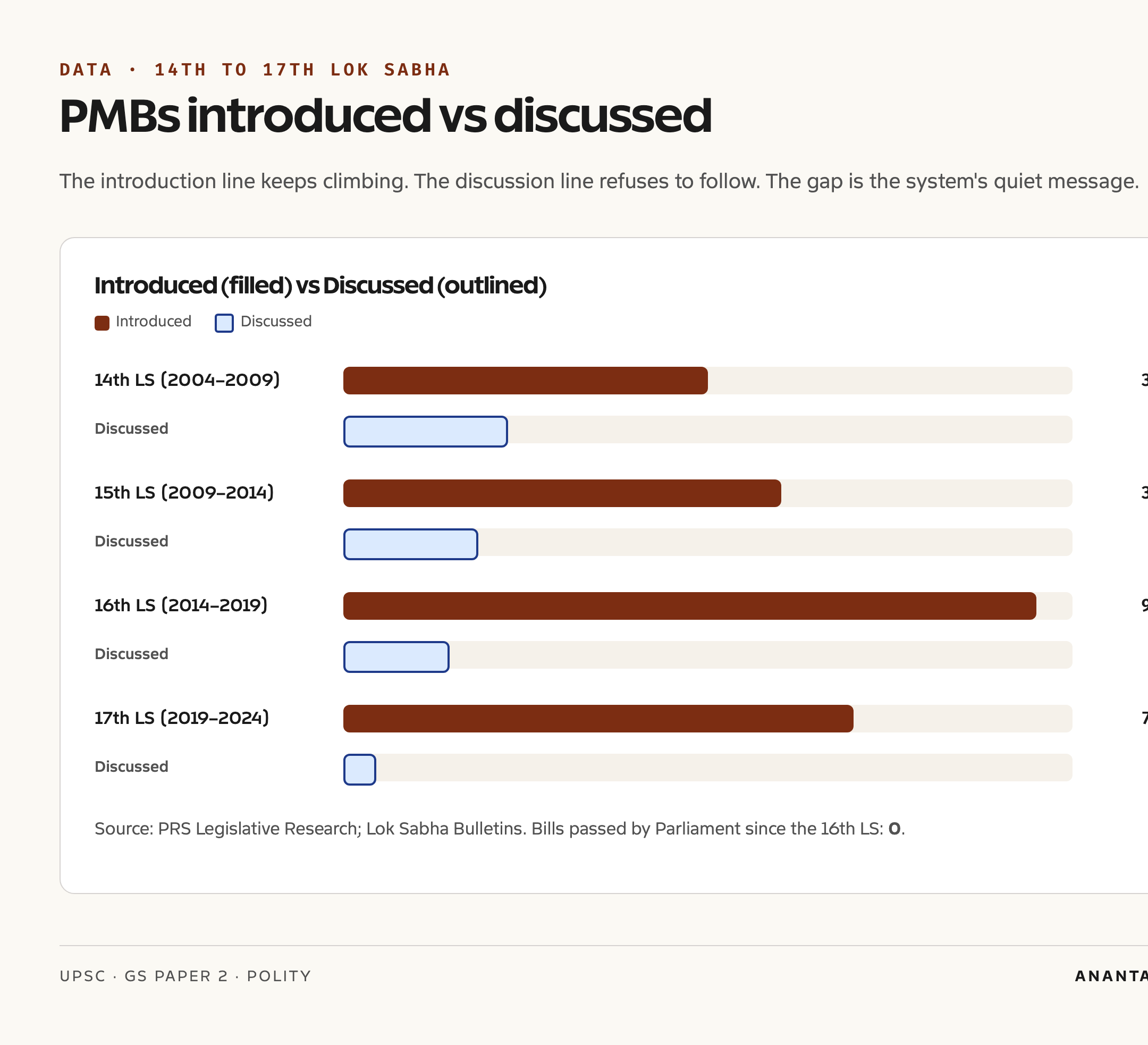
The arithmetic of the Private Member’s Bill is humbling. Since 1952, only fourteen such Bills have been passed by Parliament and become law. The last successful Private Member’s Bill was the Supreme Court (Enlargement of Criminal Appellate Jurisdiction) Bill of 1970. No Private Member’s Bill has reached the statute book in the fifty-five years since. The seventeenth Lok Sabha, between 2019 and 2024, saw over seven hundred Private Member’s Bills introduced. According to PRS Legislative Research, only two were actually discussed in the Lok Sabha. The gap between introduction and debate has widened steadily over the past four parliamentary terms.
This guide walks through the constitutional and procedural framework of the Private Member’s Bill, the differences from a government Bill, the history of successful and influential PMBs, the structural reasons why so few survive the floor, and the prelims and mains pointers an aspirant should carry into the examination hall.
Quick Facts on Private Member’s Bills
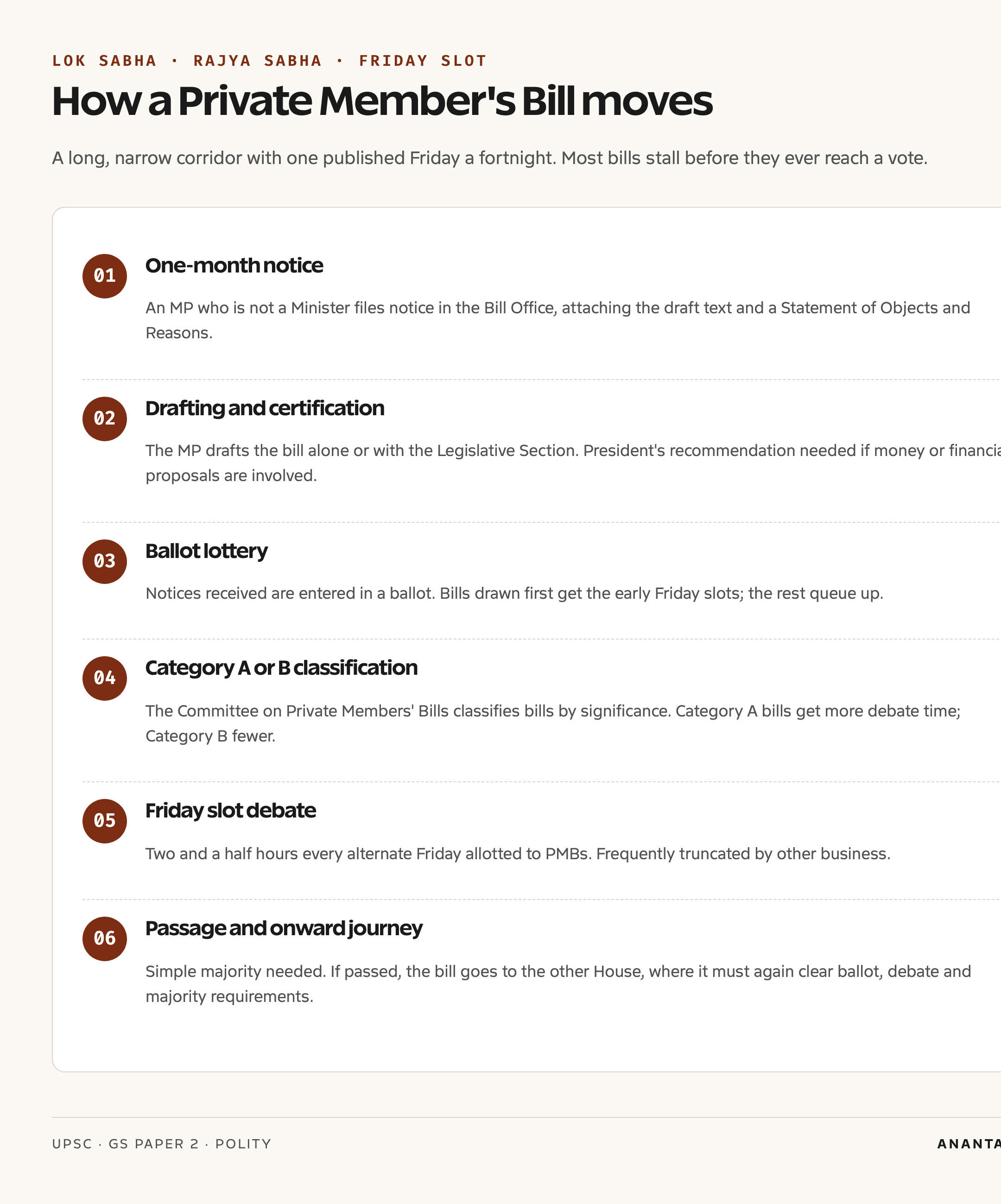
A Private Member is any Member of Parliament who is not a Minister. The notice period for introducing a Private Member’s Bill is one month, against seven days for a government Bill. The Bill is drafted by the member, without the support of the Law Ministry that drafts government legislation. Admissibility is decided by the Speaker in the Lok Sabha or the Chairman in the Rajya Sabha. Private Member’s Bills are taken up only on Fridays in the Lok Sabha, generally during the last two and a half hours of the sitting. A ballot system determines which Bills are taken up for discussion when more Bills compete for limited time. The Committee on Private Members’ Bills and Resolutions in the Lok Sabha classifies admitted Bills into Category A and Category B, with only Category A getting priority. Since 1952, only fourteen Private Member’s Bills have been passed by Parliament. The last successful one was the Supreme Court (Enlargement of Criminal Appellate Jurisdiction) Bill, 1970. Over seven hundred PMBs were introduced in the seventeenth Lok Sabha; only two were discussed in the House.
What a Private Member’s Bill Is
A Private Member’s Bill is a Bill introduced by an MP who is not a Minister. The introducing member takes personal responsibility for drafting the text, justifying the legislation in the floor of the House, and shepherding it through any subsequent stages. The Bill can be on any subject within Parliament’s legislative competence, with a few exceptions for money Bills, which can only be introduced by a Minister and only in the Lok Sabha. The objective of allowing private members to introduce Bills is to ensure that legislative initiative does not rest exclusively with the executive.
The constitutional logic is simple. Parliament is not just the executive in legislative form. Individual legislators have the right to bring policy ideas, draft them as Bills, and demand parliamentary attention. The historical experience of British, American, and Indian parliamentary practice has produced procedural mechanisms that allow private members to do this without disrupting the government’s legislative business. The trade-off is that the procedural protections also limit the floor time available, and the limit has tightened steadily as government legislative loads have increased.
Background and Historical Context
The British House of Commons developed the Private Member’s Bill mechanism over centuries. In its mature form, it allowed any MP to introduce legislation on a topic of personal or constituency interest, subject to a procedural framework that protected the government’s primary control over legislative time. Indian parliamentary practice inherited the framework after Independence and adapted it to the conditions of the Indian House. The Rules of Procedure and Conduct of Business in the Lok Sabha and the Rajya Sabha set out the operational details.
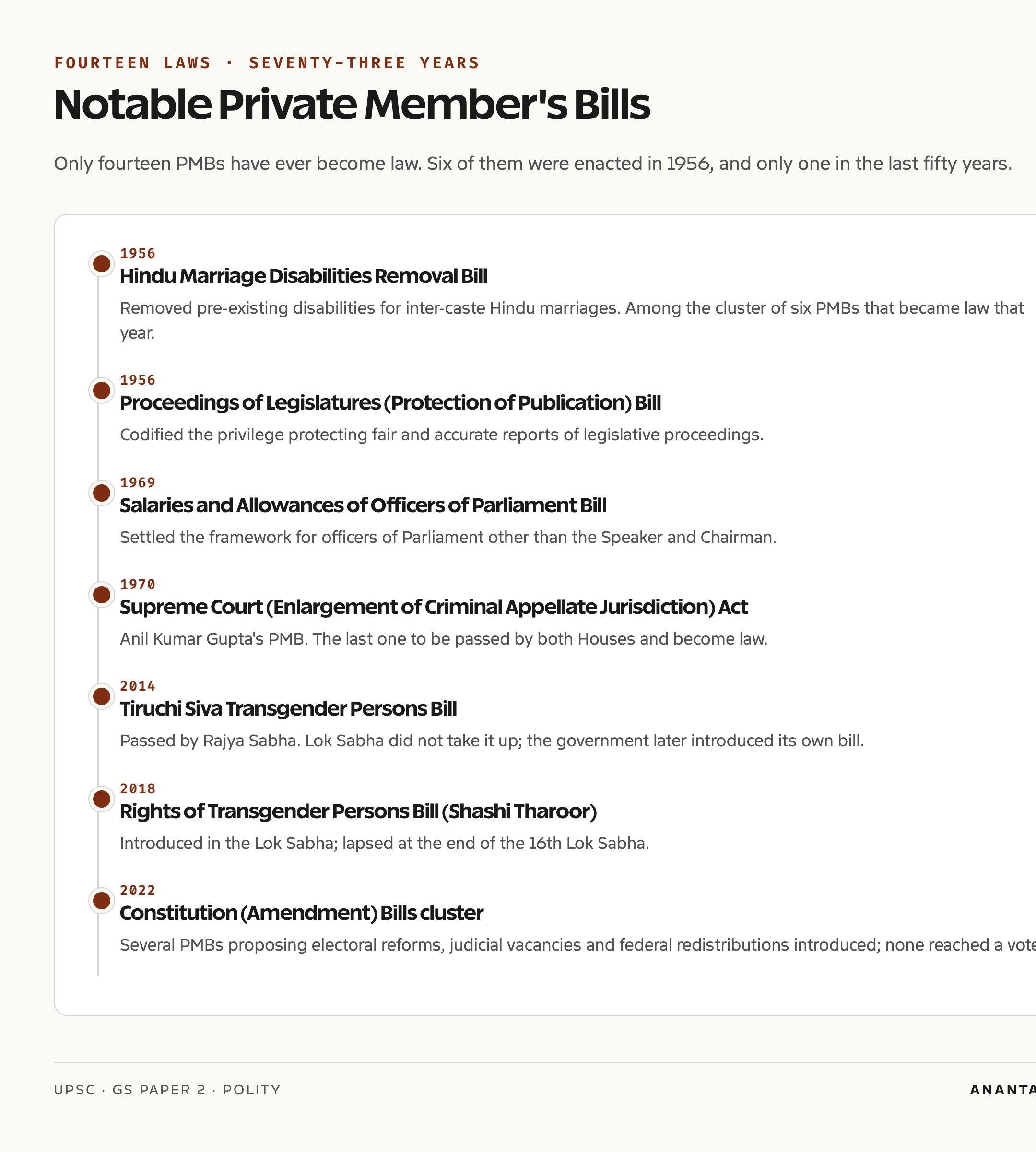
The first decade of the Indian Parliament, from 1952 to 1962, saw the most active phase of Private Member’s Bill engagement. Several PMBs were taken up for sustained debate, and a handful made it to the statute book. The Hindu Marriage Disabilities Removal Bill, 1956, the Salaries and Allowances of Officers of Parliament Bill, 1969, and the Supreme Court (Enlargement of Criminal Appellate Jurisdiction) Bill, 1970, are among the fourteen PMBs that became law. The 1970 Bill, which expanded the Supreme Court’s appellate jurisdiction in criminal matters, was the last to clear both Houses and receive presidential assent.
After 1970, the success rate fell to zero and stayed there. Several factors contributed. The Indira Gandhi years saw a strong executive that pushed government legislation through with less floor time for private members. The post-1991 reform years saw a heavy government legislative agenda on economic liberalisation. The recent decades have seen smaller actual sitting days and longer suspensions and disruptions, leaving even less time for the optional Friday slot. For a wider view of how Parliament’s institutional architecture has evolved, see our explainers on Lok Sabha vs Rajya Sabha and parliamentary committees in India.
Procedure for Introducing a Private Member’s Bill
The procedure runs through several stages, each governed by the Rules of Procedure and Conduct of Business in the relevant House. The first stage is notice. The member must give at least one month’s notice to the Secretariat of the House before introducing the Bill, against seven days for a government Bill. The longer notice period reflects the absence of pre-introduction departmental scrutiny that government Bills receive.
The second stage is drafting. Unlike a government Bill, which is drafted by the Legislative Department of the Ministry of Law and Justice in consultation with the relevant administrative ministry, a Private Member’s Bill is drafted by the member personally or with such assistance as the member can arrange. Some MPs use parliamentary research support services or external legal expertise; others draft on their own. The drafting standard varies considerably, and many PMBs are returned for technical reasons before they can be admitted.
The third stage is admissibility. The Speaker of the Lok Sabha or the Chairman of the Rajya Sabha decides whether the Bill can be admitted, based on whether it falls within Parliament’s legislative competence, whether it complies with rules of procedure, and whether it duplicates pending or recently disposed government legislation. Once admitted, the Bill enters the queue for ballot selection.
The fourth stage is the ballot. Because hundreds of PMBs are admitted in any given Lok Sabha and only Friday afternoons are available for discussion, a lottery determines the order in which Bills are taken up. This is the famous “ballot system” of the Indian Parliament. The fifth stage is discussion on the floor of the House, restricted to the last two and a half hours of a Friday sitting. Government Bills can be discussed any day; Private Member’s Bills are discussed only on Fridays. The sixth stage is voting and, if the Bill is passed, transmission to the other House for similar consideration.
The Friday Rule and the Ballot System
The Friday rule is the structural constraint that shapes the entire Private Member’s Bill ecosystem. Lok Sabha rules reserve the last two and a half hours of every Friday during a session for Private Members’ business. If Friday is not a sitting day or if Private Members’ business is suspended for any reason, the time is lost. Across a full parliamentary year of about seventy sitting days, the available Friday time is at most twenty to twenty-five hours, often substantially less.
The ballot system distributes that scarce time among hundreds of competing Bills. A draw of lots decides which Bills get the slot. The Committee on Private Members’ Bills and Resolutions then classifies the selected Bills into Category A and Category B. Category A Bills are treated as urgent and given priority. Category B Bills are scheduled if time permits. In practice, only Category A Bills get any meaningful floor time, and even most Category A Bills do not complete the full legislative process within a single Lok Sabha. When a Lok Sabha dissolves, all pending Private Member’s Bills lapse, unlike Bills before Rajya Sabha which survive across Lok Sabha terms because the Rajya Sabha is a permanent body.
Public Bill vs Private Member’s Bill
The two categories of legislation differ at every procedural stage. Government Bills, also called Public Bills, are introduced by Ministers. Private Member’s Bills are introduced by any MP who is not a Minister. Government Bills require seven days’ notice; Private Member’s Bills require one month’s notice. Government Bills are drafted by the Law Ministry; Private Member’s Bills are drafted by the member. Government Bills can be discussed on any sitting day; Private Member’s Bills are discussed only on Fridays.
The most consequential difference is political. Defeat of a government Bill in the Lok Sabha can lead to the resignation of the government, because it implies a loss of confidence in the executive. Defeat of a Private Member’s Bill has no impact on government stability. The threshold for opposing or amending a Private Member’s Bill is therefore lower, but the threshold for actually passing one is also higher because the Bill lacks the institutional weight of executive backing.
Significance of Private Member’s Bills
Despite the low success rate, Private Member’s Bills serve three useful functions. The first is policy signalling. A PMB on a topic that the government has not taken up forces the issue onto the parliamentary record. Even if the Bill is not passed, it creates a documented demand for legislation and contributes to the public conversation. The second is pathfinding. The Transgender Persons (Protection of Rights) Bill, 2014, introduced by Tiruchi Siva of the DMK in the Rajya Sabha and passed by that House, is the most cited modern example. The Bill never became law, but it forced the government to draft and introduce its own legislation on the same subject, which became the Transgender Persons (Protection of Rights) Act, 2019.
The third function is constituency representation. A Private Member’s Bill on a regional or community-specific issue allows a legislator to demonstrate substantive engagement with constituents’ concerns even when the Bill itself does not pass. The fourteen successful PMBs since 1952 cover a range of subjects, from family law reform to court jurisdiction to officer salaries, and several were significant in their day. The procedural mechanism is therefore not entirely ornamental, even if the success rate looks unflattering.
Why It Matters
The institutional vitality of Parliament depends on the space available for individual legislators to act outside the executive’s legislative agenda. Private Member’s Bills are one of the few procedural mechanisms that preserve that space. Their decline is therefore a symptom of a broader trend in which Parliament’s legislative function is increasingly dominated by government-led legislation, with limited room for back-bench initiative.
The decline also affects the quality of legislative deliberation. A House that spends almost all its time on government Bills loses the procedural muscle to think through alternative legislative ideas. The Private Member’s Bill mechanism, even when it does not produce statute, produces deliberation, draft texts, and policy ideas that can be picked up later. The shrinking of Friday slots and the falling number of PMBs actually discussed reduce that deliberative output.
For a wider view of the deliberative architecture of Indian Parliament, see our pieces on parliamentary committees in India and the broader Indian judiciary interface with legislative reform.
Comparative Look
The British House of Commons reserves thirteen Fridays in each session for Private Members’ Bills. The selection is by ballot, similar to the Indian system. Recent decades have seen an active stream of successful PMBs in the United Kingdom, including legislation on climate change reporting, abortion law reform, and assisted dying. The British success rate is much higher than the Indian, partly because British parliamentary culture has retained the convention of allowing serious PMBs to proceed without procedural blocking.
The United States Congress operates differently. Any member can introduce a Bill, and the distinction between government Bills and private member Bills does not exist in the same procedural form. Committee chairmanship and floor scheduling are the principal levers that decide which Bills proceed. The result is a system where individual member initiatives have a higher routine likelihood of progress than in India, though the political conditions of advancing controversial legislation are no easier.
Challenges and Reform Options
Three reform proposals are commonly discussed. The first is the protection of Friday time. A rule that prevents Private Members’ business from being routinely set aside for government legislation would preserve the procedural floor time. The second is the modernisation of drafting support. Parliament could provide structured drafting support to members who wish to introduce a serious PMB, without compromising the principle that the member retains ownership of the Bill. The third is post-introduction processing. Pending PMBs could be referred to relevant Standing Committees for examination, even if the floor schedule does not permit full discussion. Committee scrutiny would convert a dead PMB into a useful policy report.
The deeper question is the cultural one. A Parliament that values back-bench initiative will protect Friday time and treat Private Member’s Bills as a serious instrument of policy thinking. A Parliament that treats them as ceremonial will let them lapse without engagement. The recent trend has been toward the second pattern. Reversing it requires both procedural reform and a shift in parliamentary practice.
Prelims Pointers
The notice period for a Private Member’s Bill is one month, against seven days for a government Bill. PMBs are discussed only on Fridays in the Lok Sabha, in the last two and a half hours of the sitting. Admissibility is decided by the Speaker or the Chairman of the relevant House. Bills are taken up by ballot. Admitted Bills are classified into Category A and Category B by the Committee on Private Members’ Bills and Resolutions, and only Category A gets priority. Since 1952, only fourteen PMBs have been passed by Parliament. The last successful PMB became the Supreme Court (Enlargement of Criminal Appellate Jurisdiction) Act, 1970. The Transgender Persons (Protection of Rights) Bill, 2014, by Tiruchi Siva, was passed by the Rajya Sabha but lapsed; it forced the government to enact a parallel statute in 2019.
A common trap statement: “A Private Member’s Bill defeated in the Lok Sabha leads to the resignation of the government.” This is incorrect. PMB defeat has no implication for government stability. Another trap: “A Minister can introduce a Private Member’s Bill.” This is incorrect; a Minister can only introduce a Public Bill.
Mains Practice Questions
- The Private Member’s Bill is a constitutional mechanism designed to preserve back-bench initiative in legislative work. Discuss the procedural framework and assess the institutional health of the mechanism in contemporary Indian Parliament. (GS Paper 2, 250 words)
- Why has the success rate of Private Member’s Bills in India fallen to zero since 1970? Examine the structural and political reasons. (GS Paper 2, 150 words)
- Compare the Private Member’s Bill mechanism in the Indian Parliament with the equivalent procedures in the British House of Commons. (GS Paper 2, 150 words)
- Examine the role of Private Member’s Bills in policy signalling and pathfinding, with reference to the Transgender Persons (Protection of Rights) Bill, 2014, of Tiruchi Siva. (GS Paper 2, 250 words)
Way Forward
A serious revival of the Private Member’s Bill mechanism in Indian Parliament would require three concurrent changes. The first is the reliable preservation of Friday time, with a rule that the slot cannot be set aside without explicit House approval. The second is structured drafting support, perhaps through an enhanced Lok Sabha and Rajya Sabha Secretariat unit or through institutional partnerships with parliamentary research bodies, while keeping ownership of the Bill with the member. The third is a committee-referral mechanism for pending PMBs, so that the policy work invested in drafting does not vanish when the Lok Sabha dissolves.
For aspirants, the Private Member’s Bill story is a useful case study in how institutional design and political practice interact. The constitutional and procedural architecture is intact. The political practice has hollowed out the procedural protection. Reform is more about cultural commitment than legal change. The same theme recurs across many areas of Indian governance, from judicial reforms in India to deliberative practice in centre-state forums.
Frequently Asked Questions
Who is a u0022Private Memberu0022 in the Indian Parliament?
A Private Member is any Member of Parliament who does not hold a position in the Council of Ministers. This includes MPs from the ruling party who do not have a ministerial portfolio. Members of the opposition, independents, and ruling-party back-benchers all qualify as private members for procedural purposes. The category exists to distinguish individual legislative initiatives from government legislation.
What is the notice period for introducing a Private Member’s Bill?
A Private Member must give at least one month’s notice to the Secretariat of the relevant House before introducing the Bill. This is significantly longer than the seven-day notice required for a government Bill. The longer period reflects the absence of pre-introduction departmental scrutiny that government Bills receive.
Why are Private Member’s Bills discussed only on Fridays?
The Rules of Procedure and Conduct of Business in the Lok Sabha reserve the last two and a half hours of every Friday during a session for Private Members’ business. The Friday rule allocates a structured slot for back-bench initiatives without disrupting the government’s primary control over legislative time. If Friday is not a sitting day or if Private Members’ business is suspended, that time is lost.
What is the ballot system for Private Member’s Bills?
Because hundreds of PMBs are admitted in any given Lok Sabha and only Friday afternoons are available for discussion, a lottery decides the order in which Bills are taken up. This draw of lots is the ballot system. After the ballot, the Committee on Private Members’ Bills and Resolutions classifies the Bills into Category A and Category B, with only Category A Bills getting priority floor time.
How many Private Member’s Bills have actually become law in India?
Since the first Lok Sabha in 1952, only fourteen Private Member’s Bills have been passed by Parliament and received presidential assent. The last successful one was the Supreme Court (Enlargement of Criminal Appellate Jurisdiction) Bill, 1970, which expanded the appellate jurisdiction of the Supreme Court in criminal matters. No PMB has become law in the fifty-five years since.
Can a Minister introduce a Private Member’s Bill?
No. A Minister can only introduce a Public Bill, also called a government Bill. The categorical distinction is what gives the Private Member’s Bill mechanism its identity. A Minister who has a policy idea uses the government Bill route, with Law Ministry drafting support and Cabinet approval.
Does the defeat of a Private Member’s Bill have any impact on the government?
No. Unlike a government Bill, defeat of a Private Member’s Bill has no implication for the stability of the government. The Bill belongs to the individual member, not to the executive, and rejection is a vote on the proposal rather than on confidence in the government.
Why did Tiruchi Siva’s Transgender Persons (Protection of Rights) Bill, 2014, matter even though it did not become law?
Tiruchi Siva’s Bill was introduced in the Rajya Sabha in 2014 and was passed by that House, becoming the first PMB to be passed by either House since 1972. The Lok Sabha did not take it up, and the Bill eventually lapsed. But the Rajya Sabha passage forced the government to draft and introduce its own legislation, which became the Transgender Persons (Protection of Rights) Act, 2019. The case is the standard modern example of a PMB working as a pathfinder for legislation.
What happens to a Private Member’s Bill when the Lok Sabha dissolves?
A Private Member’s Bill pending before the Lok Sabha lapses when the Lok Sabha dissolves. A Bill pending before the Rajya Sabha does not lapse, because the Rajya Sabha is a permanent body. This is the same lapsing rule that applies to government Bills, but its impact is sharper for PMBs because the longer queues and the limited Friday time mean fewer Bills complete the full legislative process within a single Lok Sabha term.
What does Category A and Category B mean for Private Member’s Bills?
After admitted Private Member’s Bills are selected through the ballot, the Committee on Private Members’ Bills and Resolutions in the Lok Sabha classifies them into two categories. Category A Bills are treated as urgent and given priority for discussion. Category B Bills are scheduled only if time permits. In practice, only Category A Bills receive meaningful floor time, and even then most do not complete the full legislative process. The classification is the procedural chokepoint that separates Bills that get serious House attention from those that do not.