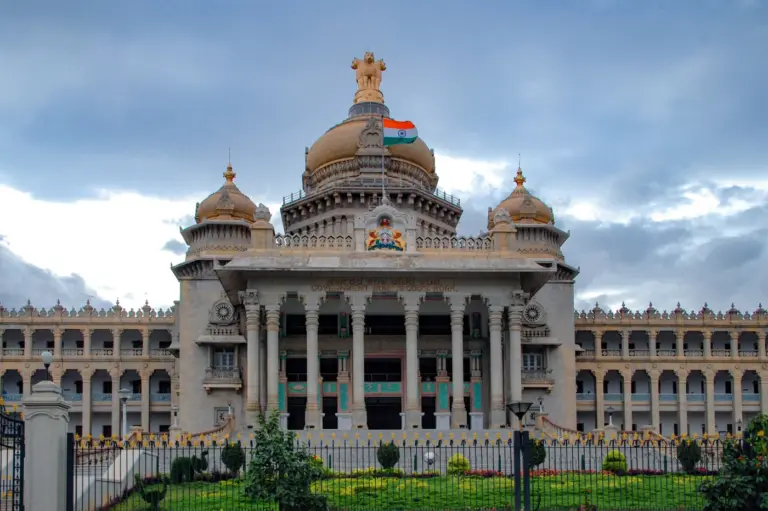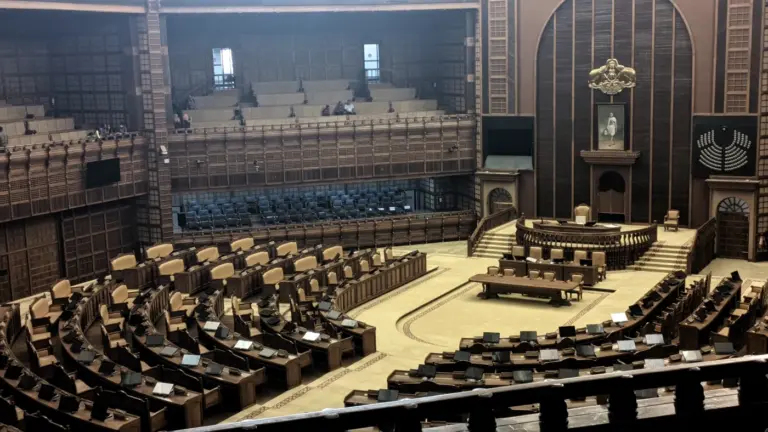

Parliamentary Committees are the deliberative engine of the Indian Parliament. Because the full House cannot examine every Bill, policy or expenditure in detail, Parliament delegates much of its technical scrutiny to smaller, specialised committees. These committees examine Bills, scrutinise demands for grants, audit public expenditure and probe policy issues — with evidence from experts, stakeholders, and the public. For UPSC, they appear in GS-II (Parliament and State Legislatures) and sometimes in Prelims (names, composition, ratios).
Why Parliamentary Committees matter
Parliament performs four functions: lawmaking, executive oversight, financial scrutiny, and representation. The time constraint of House sittings — Lok Sabha averages around 60-80 sittings a year — makes thorough scrutiny on the floor impossible. Committees compensate by:
- Detailed examination of Bills — legal, technical, financial, and policy dimensions.
- Oversight of executive actions — ensuring accountability.
- Financial scrutiny — demands for grants, past expenditure outcomes.
- Public participation — open to expert and public evidence.
- Expertise — members specialise in a sector over successive Lok Sabhas.
- Consensus-building — closed-door, non-televised debates allow cross-party agreement.
Constitutional and statutory basis
- Article 105 — powers, privileges and immunities of Parliament and its Members.
- Articles 118, 208 — power of each House to regulate its own procedure, including Committee creation.
- Rules of Procedure and Conduct of Business of Lok Sabha and Rajya Sabha — operationalise committee functioning.
Types of Parliamentary Committees
Committees are broadly classified as Standing Committees (permanent or annual) and Ad Hoc Committees (for a specific task).
Departmentally Related Standing Committees (DRSCs)
Introduced in 1993, DRSCs scrutinise Ministries' activities and Bills.
- Number: 24 DRSCs (16 serviced by Lok Sabha secretariat, 8 by Rajya Sabha).
- Composition: 31 members each — 21 from Lok Sabha and 10 from Rajya Sabha.
- Tenure: One year.
- Chair: Nominated by Speaker/Chairman.
- Functions: Examine Demands for Grants; Bills referred to them; Annual Reports; long-term policy documents.
Financial Committees
| Committee | Members | Tenure | Selection |
|---|---|---|---|
| Public Accounts Committee (PAC) | 22 (15 LS + 7 RS) | 1 year | Elected by both Houses |
| Estimates Committee | 30 (all Lok Sabha) | 1 year | Elected by Lok Sabha |
| Committee on Public Undertakings (COPU) | 22 (15 LS + 7 RS) | 1 year | Elected by both Houses |
Convention: PAC is chaired by a member of the Opposition, usually the leader; the Finance Minister cannot be a member of PAC.
Administrative Committees
| Committee | Function |
|---|---|
| Business Advisory Committee | Allocates time to Bills and other business |
| Committee on Private Members' Bills and Resolutions | Examines private members' Bills |
| Committee on Government Assurances | Scrutinises assurances given by Ministers |
| Rules Committee | Considers procedure |
| Committee of Privileges | Examines breaches of privilege |
| Committee on Ethics | Oversees ethical conduct of MPs |
| General Purposes Committee | Residual matters |
| House Committee / Library Committee | Administrative |
Accountability Committees
- Committee on Subordinate Legislation — examines whether rules made under delegated legislation conform to parent Acts.
- Committee on Petitions — receives and processes citizens' petitions.
- Committee on Government Assurances — tracks assurances given in the House.
Committees on the Welfare of Groups
- Committee on Welfare of SCs and STs
- Committee on Empowerment of Women
Ad Hoc Committees
Created for a specific task — the most important being:
- Select Committees — examine a specific Bill (one-House).
- Joint Parliamentary Committees (JPCs) — inquire into specific matters (for example, 2G, Bofors, VVIP helicopter, Personal Data Protection Bill).
Functioning — how DRSCs work
- Meet during sessions and inter-session periods.
- Examine Demands for Grants after the Budget; table reports before the House votes on DGs.
- Take evidence from expert witnesses, Ministry officials, and the public.
- Submit reports; the government submits Action Taken Reports (ATRs) within a stipulated period.
- Reports are recommendatory; not binding.
Scale of work (illustrative): In the 16th Lok Sabha, DRSCs held 2,038 sittings and submitted 1,111 reports. On average, one report per 1.8 sittings.
Issues with Parliamentary Committees
- Declining Bill referrals — PRS data shows only about 25% of Bills were referred to Committees in the 17th Lok Sabha, down from 71% in the 15th and 60% in the 16th.
- Low attendance — average DRSC attendance hovers around ~50%, compared to House attendance of ~84%.
- Thin staffing — Committees have minimal research support; the Parliament Secretariat provides administrative help but no specialist advisors (unlike the UK, US, Canada).
- Limited expertise — no compulsory induction of subject experts; expert evidence is discretionary.
- Deadlines missed — DRSC reports on Demands for Grants sometimes come after DGs are voted, defeating the purpose.
- Opaque functioning — meetings are in camera; public cannot access deliberations.
- Action Taken Reports — acceptance rates vary and recommendations are often diluted.
- Opposition chairperson convention under stress — PAC's opposition-chair convention has been questioned by ruling benches.
Latest developments (2024-26)
Updated context: The 17th Lok Sabha (2019-24) referred a particularly low share of Bills to Committees; the 18th Lok Sabha has seen renewed calls for strengthening committee scrutiny.
- 17th Lok Sabha data (PRS Legislative Research): About 16% of Bills referred to committees; major laws like the three new criminal codes (BNS, BNSS, BSA) were passed after committee consideration.
- 18th Lok Sabha reconstitution (2024-25) — DRSCs and PAC reconstituted; the Wakf (Amendment) Bill, 2024 referred to a JPC.
- One Nation One Election JPC (2024) — a Joint Parliamentary Committee was constituted to examine the Constitution (129th Amendment) Bill and Union Territories Laws (Amendment) Bill.
- Parliamentary Rules revision — Speaker's committees have discussed adopting time-bound referral norms.
- Pranab Mukherjee Foundation / IIPA / PRS discussions (2024-25) — proposals for full-time research staff, specialist advisors and mandatory public consultation.
Reform pathway
- Mandatory referral — every substantive Bill should go to a DRSC or Select Committee.
- Specialist advisors — permit each DRSC to retain economists, lawyers, and sector specialists.
- Public consultation — mandatory invitation of written evidence for all Bills.
- Technology — publish draft reports, testimony, and calendars online.
- Attendance norms — minimum attendance requirement for MPs.
- Timely tabling — reports on Demands for Grants before voting.
- Action Taken Reports — statutory time-bound response from Ministries.
Comparative perspective
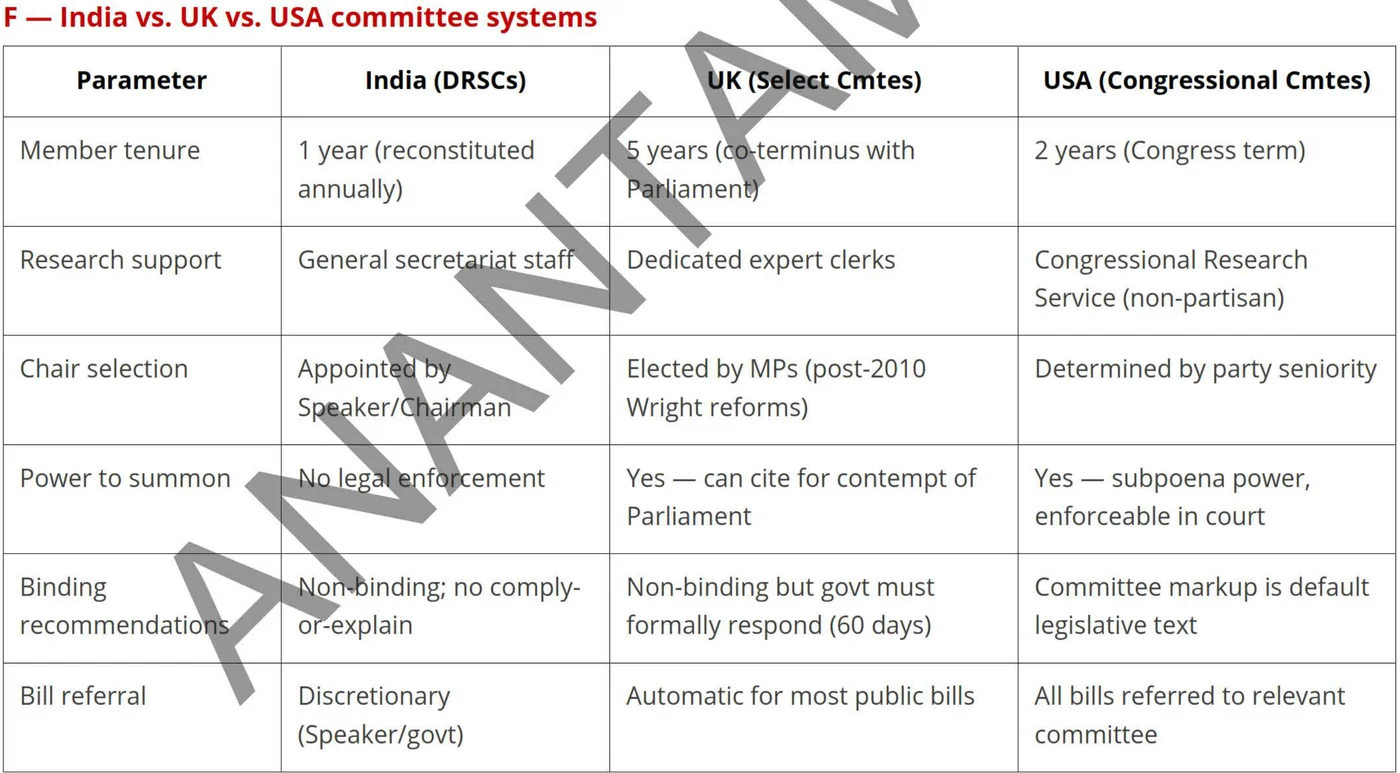
- United Kingdom — Select Committees shadow each department; Members have access to specialist advisors; hearings are often televised. The National Audit Office supports PAC.
- United States — Powerful standing committees and sub-committees; subpoena power; full-time professional staff; committee chairs have substantial agenda-setting authority.
- Canada — Standing Committees routinely call expert evidence; research support from Library of Parliament.
- India — In-camera functioning; limited research; smaller subject pool; Presiding Officer's discretion on Bill referral.
India's DRSC model is functionally closest to the US model but operationally closer to the UK — without the research muscle of either.
Case studies: when committees work (and when they don't)
Committee that worked: Personal Data Protection Bill (2019) — referred to a Joint Parliamentary Committee which took evidence from civil society, technology experts, and government. The committee's 542-page report flagged serious concerns; the Bill was eventually withdrawn and replaced with the simpler DPDP Act, 2023.
Committee that was bypassed: Farm Laws (2020) — the three farm laws were passed without committee scrutiny amid protests in Parliament. A year-long farmers' movement followed, ending with their repeal in November 2021 — a lesson in the cost of skipping committees.
Committee that clarified: RTI Bill (2005) — DRSC-reviewed; many strengthening amendments came from the committee, producing one of the world's stronger transparency laws.
Committee that delayed meaningfully: New Criminal Codes (2023) — the Standing Committee's report shaped several provisions of the BNS, BNSS, and BSA; operational since 1 July 2024.
Analysis
Committees are Parliament's "deliberative chamber". When they work, they deliver landmark law (GST, RTI, Companies Act, Personal Data Protection examination). When bypassed, legislation suffers — the three farm laws of 2020 were not referred to a committee and had to be repealed. The question for Indian democracy is whether the 18th Lok Sabha will restore committee scrutiny as a default.
UPSC Relevance
GS-II mapping: Parliament and State Legislatures — structure, functioning, conduct of business, powers and privileges; Pressure groups and associations; Accountability mechanisms.
Prelims pointers:
- DRSCs created in 1993; currently 24 in number.
- DRSC composition: 21 LS + 10 RS = 31 members.
- PAC: 22 members (15 LS + 7 RS); chaired by Opposition MP.
- Estimates Committee: 30 members, only Lok Sabha.
- COPU: 22 members (15 LS + 7 RS).
- Finance Minister cannot be a member of PAC.
- Article 118 & 208 — procedural autonomy of the Houses.
- Reports are recommendatory, not binding.
Mains angles:
- "Parliamentary Committees are the eyes and ears of the Indian Parliament." Examine their role and suggest reforms.
- Discuss the reasons behind the declining number of Bills referred to Parliamentary Committees and its implications for legislative quality.
Related: Parliament of India, Anti-Defection Law, Role of Speaker.
Tell Google you want more of this.
Add Anantam IAS as a preferred sourceOne tap, and this site shows up more often in your own Top Stories, AI Overviews and AI Mode. Remove it any time.