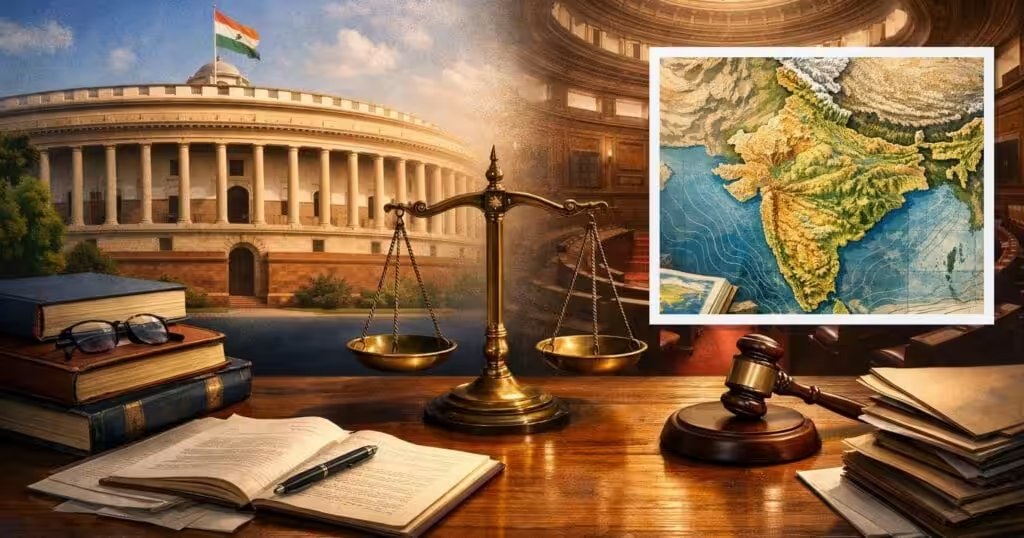
India's Parliament consists of two houses — the Lok Sabha (House of the People) and the Rajya Sabha (Council of States) — along with the President. This bicameral system balances popular representation with federal representation. The Lok Sabha represents the people directly through elections, while the Rajya Sabha represents the states. Understanding their composition, powers, and relationship is fundamental to UPSC Polity preparation.
Constitutional Basis
Article 79 establishes Parliament — consisting of the President, Rajya Sabha, and Lok Sabha. The Constitution envisions a system where:
- Lok Sabha reflects the democratic principle — elected directly by the people
- Rajya Sabha reflects the federal principle — represents states and union territories
- The President is part of Parliament but doesn't sit in either house
The framers adopted the British Westminster model with modifications. Unlike the British House of Lords, the Rajya Sabha is an elected body with real legislative powers.
Composition
Lok Sabha
- Maximum strength: 552 members (Article 81)
- Up to 530 from states
- Up to 20 from Union Territories
- 2 nominated by the President from the Anglo-Indian community (removed by 104th Amendment, 2020 — provision expired in January 2020)
- Current effective strength: 543 elected members
- Election: Direct election by universal adult franchise using the First Past the Post (FPTP) system
- Eligibility: Indian citizen, 25 years of age, other qualifications prescribed by Parliament
- Term: 5 years (can be dissolved earlier; extended during Emergency)
Rajya Sabha
- Maximum strength: 250 members (Article 80)
- Up to 238 elected by state and UT legislative assemblies
- 12 nominated by the President for expertise in literature, science, art, and social service
- Current effective strength: 245 (233 elected + 12 nominated)
- Election: Indirect election — elected by members of state legislative assemblies using Single Transferable Vote (STV) with proportional representation
- Eligibility: Indian citizen, 30 years of age, other qualifications prescribed by Parliament
- Term: Permanent body — not subject to dissolution; members serve 6-year terms; one-third retire every 2 years
Composition Comparison
| Parameter | Lok Sabha | Rajya Sabha |
|---|---|---|
| Constitutional article | Article 81 | Article 80 |
| Maximum members | 552 | 250 |
| Current strength | 543 | 245 |
| Election method | Direct (FPTP) | Indirect (STV/proportional) |
| Nominated members | 2 (Anglo-Indian — now lapsed) | 12 (by President) |
| Minimum age | 25 years | 30 years |
| Term | 5 years | 6 years (1/3 retire every 2 years) |
| Dissolution | Can be dissolved | Permanent body |
Presiding Officers
Lok Sabha
- Speaker: Elected from among Lok Sabha members; presides over sessions; casts deciding vote in case of tie; decides whether a bill is a Money Bill; maintains order and decorum
- Deputy Speaker: Acts when Speaker is absent
- The Speaker doesn't vacate office when Lok Sabha is dissolved — continues until the new Lok Sabha's first sitting
Rajya Sabha
- Chairman: The Vice President of India is the ex-officio Chairman (Article 64)
- Deputy Chairman: Elected from among Rajya Sabha members
- The Chairman can be removed by a resolution passed by a majority of all Rajya Sabha members (effective majority) — with 14 days' notice
| Role | Lok Sabha | Rajya Sabha |
|---|---|---|
| Presiding officer | Speaker (elected from members) | Vice President (ex-officio Chairman) |
| Deputy | Deputy Speaker | Deputy Chairman |
| Removal | Resolution of Lok Sabha (effective majority) | Resolution of Rajya Sabha (effective majority) |
| Voting | Doesn't vote in first instance; casting vote in tie | Same |
Legislative Powers
Both houses participate in ordinary legislation equally — a bill must pass both houses in identical form to become law. However, there are important exceptions.
Ordinary Bills
- Can be introduced in either house
- Must be passed by both houses
- If there's a disagreement, the President can summon a Joint Sitting under Article 108
- In a Joint Sitting, the Lok Sabha's larger numbers give it an effective advantage
- Joint Sittings have occurred only three times: Dowry Prohibition Bill (1961), Banking Service Commission Bill (1978), and POTA (2002)
Money Bills (Article 110)
Money Bills can only be introduced in Lok Sabha — this is the most significant power asymmetry between the two houses.
- The Speaker certifies whether a bill is a Money Bill — this decision is final
- After Lok Sabha passes a Money Bill, it's sent to Rajya Sabha
- Rajya Sabha must return it within 14 days with recommendations
- Lok Sabha may accept or reject Rajya Sabha's recommendations
- If Rajya Sabha doesn't return it within 14 days, the bill is deemed passed
- No Joint Sitting for Money Bills — Lok Sabha's will prevails
Financial Bills
Financial Bill (Type I) — Article 117(1): Contains provisions of a Money Bill and other provisions. Treated like an ordinary bill for passage but can only be introduced in Lok Sabha.
Financial Bill (Type II) — Article 117(3): Involves expenditure from Consolidated Fund. Can be introduced in either house; treated as ordinary bill.
Constitutional Amendment Bills (Article 368)
- Can be introduced in either house
- Must be passed by each house separately with a special majority (majority of total membership + 2/3 of members present and voting)
- No Joint Sitting — if one house rejects, the amendment fails
- Both houses have equal power in constitutional amendments
Special Powers
Powers Exclusive to Lok Sabha
| Power | Provision |
|---|---|
| Money Bills | Can only be introduced and effectively passed by Lok Sabha (Article 110) |
| Union Budget | Demands for Grants are voted only by Lok Sabha |
| No-confidence motion | Only Lok Sabha can remove the Council of Ministers (Article 75) |
| Cut motions | Only Lok Sabha can reduce budget demands |
Powers Exclusive to Rajya Sabha
| Power | Provision |
|---|---|
| Article 249 | Can pass a resolution (by 2/3 majority) enabling Parliament to legislate on State List subjects — valid for 1 year |
| Article 312 | Can pass a resolution (by 2/3 majority) to create new All India Services |
Equal Powers
- Ordinary legislation (subject to Joint Sitting provision)
- Constitutional amendments
- Election and impeachment of the President
- Removal of Vice President (resolution must originate in Rajya Sabha, agreed by Lok Sabha)
- Removal of judges of Supreme Court and High Courts
- Approval of Emergency proclamations (Articles 352, 356, 360)
- Approval of ordinances
Rajya Sabha: Permanent House
The Rajya Sabha is a continuing chamber — it doesn't dissolve. One-third of members retire every two years, ensuring continuity.
This permanence serves important purposes:
- Provides legislative continuity when Lok Sabha is dissolved
- Ensures experienced members remain in the legislature
- Pending bills in Rajya Sabha don't lapse on Lok Sabha dissolution (only Rajya Sabha pending bills in Lok Sabha lapse)
Council of Ministers and Lok Sabha
The Council of Ministers is collectively responsible to Lok Sabha (Article 75). This means:
- Only Lok Sabha can pass a no-confidence motion against the government
- The PM must maintain majority in Lok Sabha to remain in office
- Ministers can be from either house but must be members of Parliament
- A minister who is not a member must become one within 6 months
This makes Lok Sabha the more powerful house in the parliamentary system — the government's survival depends on it.
Representation and Federalism
Lok Sabha: Population-Based
Seats are distributed among states based on population. Larger states have more seats:
- Uttar Pradesh: 80 seats (largest)
- Sikkim: 1 seat
- Delimitation based on 2001 Census (frozen by the 84th Amendment until post-2026 Census)
Rajya Sabha: State-Based (But Not Equal)
Unlike the US Senate (where each state gets 2 senators regardless of population), Rajya Sabha seats are allocated roughly proportional to state population:
- Uttar Pradesh: 31 seats (largest)
- Small states: 1 seat each (Tripura, Meghalaya, etc.)
- Union Territories: Only Delhi and Puducherry have Rajya Sabha representation
This means Rajya Sabha doesn't fully serve the federal function of equal state representation — a point of criticism.
Domicile Requirement
Until 2003, Rajya Sabha members had to be residents of the state they represented. The Representation of the People (Amendment) Act, 2003 removed this requirement — allowing candidates to contest from any state. Critics argue this has weakened the federal character of Rajya Sabha, as national leaders are now "parachuted" into Rajya Sabha from states they have no connection with.
Key Differences: Summary Table
| Parameter | Lok Sabha | Rajya Sabha |
|---|---|---|
| Nature | Lower House / House of People | Upper House / Council of States |
| Represents | People (democratic principle) | States (federal principle) |
| Members elected by | Citizens directly | State legislature members |
| Term | 5 years (dissoluble) | 6 years (permanent; 1/3 retire biannually) |
| Money Bills | Exclusive power | Can only recommend (14 days) |
| No-confidence motion | Yes | No |
| Budget vote | Yes (Demands for Grants) | Can only discuss |
| Joint Sitting | Advantage due to larger size | Disadvantage |
| New All India Services | No exclusive power | Can authorise (Article 312) |
| State List legislation | No exclusive power | Can authorise (Article 249) |
| Constitutional amendments | Equal | Equal |
| Impeachment of President | Equal | Equal |
Joint Sitting (Article 108)
A Joint Sitting is summoned by the President when:
- A bill is passed by one house and rejected by the other
- The houses disagree on amendments
- More than 6 months pass without the second house passing the bill
The Speaker of Lok Sabha presides over the Joint Sitting. Since Lok Sabha has roughly twice the membership of Rajya Sabha, it effectively dominates joint sittings.
Note: Joint Sitting doesn't apply to Money Bills or Constitutional Amendment Bills.
Frequently Asked Questions
Which house is more powerful — Lok Sabha or Rajya Sabha?
Lok Sabha is more powerful in most respects. It exclusively controls Money Bills, the Union Budget (Demands for Grants), and no-confidence motions against the government. The Council of Ministers is responsible only to Lok Sabha. In Joint Sittings, Lok Sabha's larger membership gives it dominance. However, Rajya Sabha has unique powers under Articles 249 and 312 and equal power in constitutional amendments.
Can Rajya Sabha reject a Money Bill?
Rajya Sabha cannot reject a Money Bill. It can only make recommendations within 14 days of receiving the bill. Lok Sabha may accept or reject these recommendations. If Rajya Sabha doesn't return the bill within 14 days, it is deemed passed by both houses. The Speaker's certification of a bill as a Money Bill is final and cannot be questioned in court.
What is the difference between a Money Bill and a Financial Bill?
A Money Bill (Article 110) deals exclusively with taxation, borrowing, Consolidated Fund expenditure, or related matters. Only Lok Sabha can pass it. A Financial Bill Type I (Article 117(1)) contains Money Bill provisions plus other provisions — introduced only in Lok Sabha but passes like an ordinary bill. A Financial Bill Type II involves Consolidated Fund expenditure and can be introduced in either house.
Why is Rajya Sabha called a permanent house?
Rajya Sabha is permanent because it doesn't dissolve — unlike Lok Sabha, which can be dissolved before completing its 5-year term. Instead, one-third of Rajya Sabha members retire every 2 years and new members are elected. This ensures continuous legislative functioning and institutional memory even during elections or political transitions affecting Lok Sabha.
What is the role of nominated members in Rajya Sabha?
The President nominates 12 members to Rajya Sabha from persons with special knowledge or practical experience in literature, science, art, and social service (Article 80(3)). This ensures Parliament benefits from expertise that might not enter through electoral politics. Nominated members can vote on all matters except the election of the President. They can join a political party within 6 months of nomination.
Tell Google you want more of this.
Add Anantam IAS as a preferred sourceOne tap, and this site shows up more often in your own Top Stories, AI Overviews and AI Mode. Remove it any time.