Rani Laxmibai of Jhansi: Manikarnika Who Became the Face of 1857
Rani Laxmibai of Jhansi (1828-1858) led the 1857 revolt from Jhansi, refused the Doctrine of Lapse, allied with Tantia Tope, and died fighting at Gwalior. UPSC notes on her life, military campaigns, and legacy.
Rani Laxmibai of Jhansi is the most recognised woman warrior in modern Indian memory. She was twenty-nine years old when the 1857 revolt reached her city. She had already lost a husband, an infant son, and a kingdom to the East India Company’s Doctrine of Lapse. By the time British troops marched on Jhansi in March 1858, she had organised a defence, trained her own women’s regiment, and turned a small Bundelkhand state into one of the most stubborn nodes of the Great Revolt. Three months later she died in battle at Gwalior, sabre in hand, dressed as a soldier.
This article reads Rani Laxmibai with a UPSC History lens. It walks through her early life as Manikarnika Tambe, her marriage to Raja Gangadhar Rao, the legal trap that the Doctrine of Lapse set for Jhansi, her command during the 1857 uprising, her alliance with Tantia Tope and Rao Sahib, the final campaign at Gwalior, and the literary afterlife that made “Khub ladi mardani” a household line.
Quick Facts
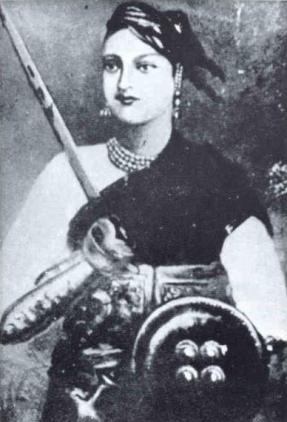
- Birth name: Manikarnika Tambe (called “Manu” at home)
- Born: November 19, 1828, at Varanasi (some sources cite 1835; 1828 is the academically accepted date)
- Father: Moropant Tambe, an advisor at the Peshwa’s court in Bithur
- Mother: Bhagirathi Sapre
- Husband: Raja Gangadhar Rao Newalkar of Jhansi
- Marriage: May 1842; she took the name Lakshmibai
- Biological son: Damodar Rao, born 1851, died within four months
- Adopted son: Anand Rao, renamed Damodar Rao, adopted on November 20, 1853
- Kingdom: Jhansi state in Bundelkhand
- Annexation: March 1854 under Lord Dalhousie’s Doctrine of Lapse
- Death: June 18, 1858, at Kotah-ki-Serai near Gwalior
- Famous epitaph: “Khub ladi mardani woh to Jhansi wali Rani thi” — Subhadra Kumari Chauhan, 1930
Early Life: Manikarnika at the Peshwa’s Court
Manikarnika was born in Varanasi to a Marathi Karhade Brahmin family. Her father Moropant Tambe served at the court of the deposed Peshwa Baji Rao II at Bithur, near Kanpur. Her mother died when she was four. She grew up at Bithur alongside Nana Sahib and Rao Sahib, the Peshwa’s adopted heirs, and Tantia Tope, who would later become her closest military ally.
The Bithur upbringing matters for one reason. Manikarnika did not have a conventional zenana childhood. She learned horsemanship, swordsmanship, archery, and the use of firearms. She rode and shot well enough that British observers later commented on her seat and her aim. The Peshwa’s court at Bithur was politically humiliated but militarily literate, and the girl who would become Rani Laxmibai absorbed that culture early.
In May 1842, at about fourteen, she was married to Raja Gangadhar Rao Newalkar, the much older ruler of Jhansi. As per court custom she received a new name, Lakshmibai, and moved to the Jhansi fort. Jhansi was a small but strategically placed Maratha state in Bundelkhand, holding a stone fort on a granite outcrop that dominated the surrounding plains.
The Doctrine of Lapse and the Annexation of Jhansi
Rani Laxmibai’s political career is impossible to read without the Doctrine of Lapse. The doctrine was formalised by Governor-General Lord Dalhousie between 1848 and 1856. It held that any Hindu princely state under British paramountcy whose ruler died without a natural male heir would “lapse” to the East India Company. Adopted heirs, which Hindu law and custom recognised without question, were not accepted.
In 1851 Rani Laxmibai gave birth to a son, Damodar Rao. The child died within four months. On November 20, 1853, with the raja gravely ill, the couple formally adopted a relative’s son, also named Damodar Rao, in the presence of British political officers. Raja Gangadhar Rao died the next day. The adoption was witnessed and the will explicitly asked the Company to recognise the boy and to allow the queen to rule as regent.
The Company refused. In March 1854 Dalhousie’s government annexed Jhansi. The queen was offered a pension of Rs 60,000 per year and told to leave the fort. Her recorded response — “Mera Jhansi nahin doongi” — became, with later embellishment, the most famous one-line refusal of the colonial age.
For three years between 1854 and 1857, Rani Laxmibai lived in the city palace, pursued legal petitions through her London advocate John Lang, and quietly maintained a small armed retinue. Every petition was rejected.
The Revolt of 1857: Jhansi at the Storm Centre
The 1857 revolt reached Jhansi on June 5, 1857. Sepoys of the 12th Bengal Native Infantry mutinied, killed British officers and civilians at the Star Fort, and within a few days the British presence in Jhansi was finished. The exact role of Rani Laxmibai during the killings of June 1857 is the most contested question in her biography. British investigators later accused her of complicity. Contemporary Indian and modern academic readings, including those that rely on her own letters to Major Erskine, the Commissioner at Saugor, hold that she was not in control of the mutinous sepoys and that she pleaded with them to spare lives.
What is undisputed is what happened next. With the Company collapsed across north India, Rani Laxmibai assumed administrative control of Jhansi by August 1857. She raised levies, repaired the fort, organised a women’s volunteer corps that included her companions Jhalkari Bai, Sundar and Mundar, and minted coins in her own name. She also fought off rival claimants — the rajas of Datia and Orchha tried to annex Jhansi while the British were absent, and her troops repulsed them.
For nine months Jhansi was a self-governed kingdom under a twenty-nine-year-old queen.
The Siege of Jhansi, March 1858
In March 1858 General Sir Hugh Rose marched the Central India Field Force on Jhansi. The siege began on March 23, 1858. British heavy guns took up position on the rocky outcrops around the fort. Rani Laxmibai had perhaps 11,000 troops inside, many of them sepoys from the 1857 mutiny who had taken refuge in Jhansi.
Tantia Tope marched a relief force of about 20,000 men from Kalpi to break the siege. On April 1, 1858, the relief force engaged Rose’s troops at the Betwa river. Rose, in a decision that became a textbook British counter-insurgency move, split his army, held the siege with one wing, and routed Tantia Tope with the other.
Rose’s troops stormed the city on April 3, 1858, though the fort itself held out. House-to-house fighting raged through the lower city for two more days. On the night of April 4-5, Rani Laxmibai broke out of the fort on horseback, with her adopted son tied to her back, and rode through the British cordon to Kalpi. The escape is the single most celebrated episode of her life and the source of every later poem and painting.
Kalpi, Gwalior, and the Final Battle
At Kalpi, Rani Laxmibai joined Tantia Tope, Rao Sahib (the Peshwa’s nephew), and the Nawab of Banda. The Kalpi council in May 1858 took a strategic gamble. With British forces closing in, the rebels marched on Gwalior, which was still held by Maharaja Jayajirao Scindia, a British ally. The Gwalior army defected, Scindia fled, and the rebels captured the great hill fort and its treasury on June 1, 1858.
For about two weeks Gwalior was a rebel capital. The Peshwa was symbolically reinstated. Coins were struck. But Sir Hugh Rose marched again, and on June 17 and 18, 1858, his force engaged the rebels at Kotah-ki-Serai, on the eastern approaches to Gwalior. Rani Laxmibai led a cavalry unit on June 18, was wounded by a sabre cut and a gunshot, and died on the field. Different accounts place her death at a roadside hut, at a mango tree, or on horseback. Her body was cremated to prevent its capture.
She was twenty-nine.
Why Rani Laxmibai Matters for UPSC
For UPSC History, Rani Laxmibai sits at the intersection of three syllabus themes.
Princely States and Subsidiary Alliance
She is the cleanest case study of how the Doctrine of Lapse worked in practice. Awadh, Satara, Jaitpur, Sambalpur, Nagpur, and Jhansi between them illustrate every variation. Jhansi adds the dimension of a recognised adoption being overruled, which is what makes the case legally striking.
The 1857 Revolt
Rani Laxmibai is one of three named civil leaders of the revolt who actually died fighting, the others being Tantia Tope and Kunwar Singh. Read alongside Begum Hazrat Mahal of Awadh, she shows that the 1857 revolt was not a sepoy mutiny alone but a civil rebellion in which dispossessed rulers, especially those displaced by annexation, supplied much of the leadership.
Women in the Freedom Struggle
She is the earliest figure in the standard NCERT canon of women warriors, but she is not the first. Rani Velu Nachiyar of Sivagangai defeated the British in 1780, and Kittur Rani Chennamma of Karnataka fought a war over an identical Doctrine of Lapse case in 1824, more than three decades before Jhansi.
Jhalkari Bai and the Women’s Regiment
Rani Laxmibai’s military household included a unit of women soldiers. The most documented figure is Jhalkari Bai, a Koli woman from Bhojla village who resembled the queen physically and served as both bodyguard and decoy. On April 4, 1858, during the siege, Jhalkari Bai is said to have dressed as the queen, ridden out to draw British fire, and bought time for the actual breakout. She was captured and, in some accounts, executed.
The historiography of Jhalkari Bai matters for one reason. Dalit and OBC histories in the Hindi belt have, since the 1990s, foregrounded Jhalkari Bai as a parallel heroine of 1857. UPSC essay papers in recent years have asked about subaltern perspectives in the national movement, and Jhalkari Bai is the cleanest example next to her queen.
Literary and Cultural Afterlife
Rani Laxmibai’s afterlife in print is almost as important as her life. The Marathi historian Vishnu Bhatt Godse, who was in Jhansi during the siege, left an eyewitness account in Majha Pravas. The Hindi poet Subhadra Kumari Chauhan published Jhansi ki Rani in 1930. The opening line — “Sinhasan hil uthe rajvanshon ne bhrukuti tani thi, budhe Bharat mein aayi phir se nayi jawani thi” — and the refrain “Khub ladi mardani woh to Jhansi wali Rani thi” entered the school syllabus by the 1950s and have stayed there.
In 2019 the film Manikarnika: The Queen of Jhansi brought the story to a new generation. The Indian Army’s ‘Rani of Jhansi Regiment’, raised in 1943 by Subhas Chandra Bose‘s Indian National Army at Singapore, took her name directly.
Comparative Frame: Four Queens in Revolt
| Queen | Year of armed resistance | Adversary | Outcome |
|---|---|---|---|
| Rani Velu Nachiyar | 1780 | East India Company | Reclaimed Sivagangai |
| Kittur Rani Chennamma | 1824 | East India Company | Captured, died in prison |
| Rani Laxmibai | 1857-58 | East India Company | Killed in action at Gwalior |
| Begum Hazrat Mahal | 1857-59 | East India Company | Retreat to Nepal |
Read together, these four campaigns span seventy-nine years, three regions, and three confessional traditions, and they recast the period 1780-1858 as a long arc of Indian queens resisting Company expansion.
For independent India, the line of women political leaders descends through a different track — figures like Sucheta Kripalani, the first woman Chief Minister of any Indian state — but the imaginative legitimacy of women in public command runs back to the Rani of Jhansi.
Frequently Asked Questions
Was Rani Laxmibai’s birth name really Manikarnika?
Yes. She was born Manikarnika Tambe in 1828 at Varanasi, in a Marathi Karhade Brahmin family. The name comes from the Manikarnika Ghat at Varanasi. She was called u0022Manuu0022 at home. The name Lakshmibai was given at her marriage to Raja Gangadhar Rao Newalkar in May 1842.
Why was Jhansi annexed under the Doctrine of Lapse?
Raja Gangadhar Rao died in November 1853 without a surviving natural son. The couple’s biological son Damodar Rao had died in infancy in 1851. The day before his death, the raja formally adopted Anand Rao, renamed Damodar Rao, in the presence of British political officers, and asked the Company to recognise the boy as heir with the queen as regent. Lord Dalhousie’s government refused to recognise the adoption and annexed Jhansi in March 1854.
Did Rani Laxmibai actually say u0022Mera Jhansi nahin doongiu0022?
The line is documented in early Marathi and Hindi accounts and has been repeated in every major biography since. Whether she said exactly these words on a specific date is not provable from British archival sources. The legal record shows that she opposed the annexation through formal petitions in 1854-1856, including through John Lang in London. The phrase captures the documented stance even if the specific wording is folkloric.
How did Rani Laxmibai die?
She died in battle on June 18, 1858, at Kotah-ki-Serai near Gwalior, fighting troops of Sir Hugh Rose’s Central India Field Force. She received a sabre cut and a gunshot wound. Different eyewitnesses place her death in different specific locations near the battlefield. Her body was cremated immediately by her remaining troops to prevent capture.
What was the Rani of Jhansi Regiment in the INA?
Subhas Chandra Bose raised an all-woman combat unit of the Indian National Army in Singapore in July 1943 and named it the Rani of Jhansi Regiment. Captain Lakshmi Sahgal commanded the unit, which recruited mostly Tamil women from Southeast Asia. The unit saw service on the Burma front in 1944-45.
Who was Jhalkari Bai?
Jhalkari Bai was a Koli (some sources Kori) woman from Bhojla village near Jhansi who served in Rani Laxmibai’s women’s regiment. She physically resembled the queen and served as a decoy during the siege of Jhansi in April 1858. She is commemorated in modern Dalit historiography of 1857 and on a 2001 Indian postage stamp.
What is Rani Laxmibai’s place in the UPSC syllabus?
She appears in GS Paper I Modern Indian History under the Doctrine of Lapse, the Revolt of 1857, and women in the freedom struggle. She is also relevant to GS Paper IV ethics case discussions on duty, leadership, and the resistance of dispossession. Optional History candidates need her in some depth as a case study of princely state annexation.
Where can I see Rani Laxmibai’s fort today?
The Jhansi fort still stands on its granite outcrop above Jhansi city in Uttar Pradesh. Major structures including the Kadak Bijli cannon, the Ganesh Mandir, the Panch Mahal, and the breach point where Rose’s troops entered in April 1858 are preserved. The Archaeological Survey of India maintains the fort as a centrally protected monument.