Rhynchostylis retusa: Foxtail Orchid — State Flower of Assam and Arunachal Pradesh
Rhynchostylis retusa, popularly called the foxtail orchid, is the state flower of Assam — known as Kopou Phul and central to the Bihu festival. Found across South and Southeast Asia.
Rhynchostylis retusa, commonly called the Foxtail Orchid, is a fragrant epiphytic orchid that hangs in long pinkish-purple sprays from the trunks of tall trees across South and Southeast Asia. It is the state flower of both Assam and Arunachal Pradesh. In Assam it is known as Kopou Phul and is closely associated with Rongali Bihu, the spring festival that marks the Assamese new year — young women weave Kopou Phul sprays into their hair when performing the Bihu dance, and the orchid has become a powerful symbol of Assamese cultural identity. In Arunachal Pradesh too, the state government’s Department of Information & Public Relations officially lists Foxtail Orchid (Rhynchostylis retusa) as the state flower. The species is not endemic to Northeast India — its natural range extends across South and Southeast Asia (Kew POWO records it from southern China to tropical Asia).
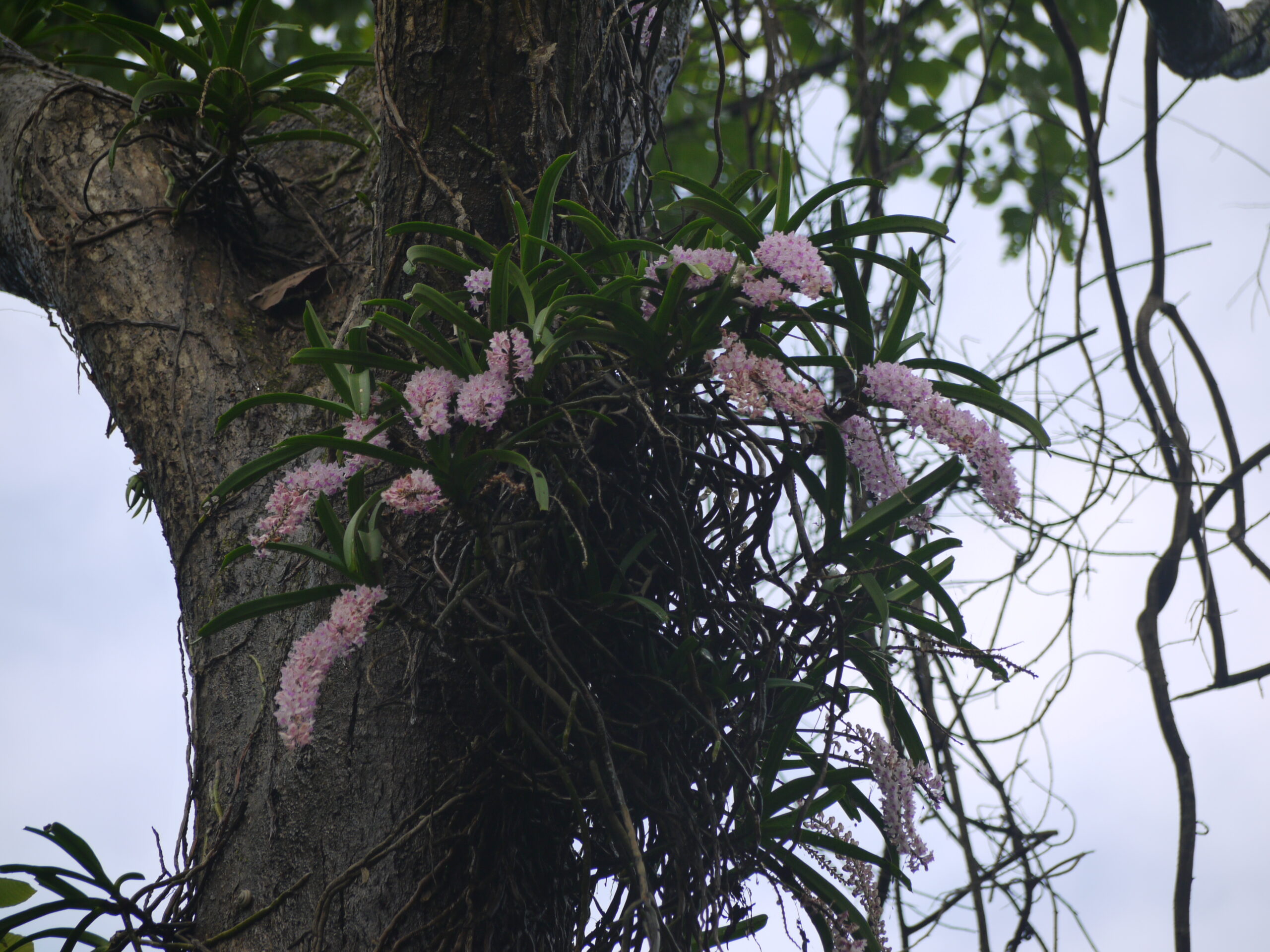
To resolve textbook confusion: Rhynchostylis retusa is the official state flower of both Assam and Arunachal Pradesh. Some sources lean on Assam because of Kopou Phul’s strong Bihu association, but Arunachal Pradesh also officially lists Foxtail Orchid as its state flower (see the Arunachal DIPR “About State” page). The earlier hedge about “Arunachal’s state flower is some other species” was inaccurate and has been corrected.
Taxonomy and Botanical Identity
Rhynchostylis retusa belongs to the family Orchidaceae, subfamily Epidendroideae, tribe Vandeae. The genus Rhynchostylis contains only four species, all native to tropical Asia, with Rhynchostylis retusa being the most widespread.
Scientific Classification
- Kingdom: Plantae
- Order: Asparagales
- Family: Orchidaceae
- Genus: Rhynchostylis
- Species: R. retusa (L.) Blume
Common Names
- Foxtail orchid (English) — because the densely packed flower spike resembles a fox’s brush tail
- Kopou Phul / Kopou-phul (Assamese)
- Draupadi Mala (Hindi)
- Seethamudi (Tamil)
- Samjirei (Manipuri)
- Foxtail Orchid / Common Foxtail Orchid / Blunt Rhynchostylis (English)
Morphology and Habit
Rhynchostylis retusa is a monopodial epiphyte — it grows attached to other plants (without parasitising them) and produces a single, upright stem that elongates from the apex. Plants can live for decades on the same host tree.
Roots
Thick, fleshy aerial roots with velamen tissue (a sponge-like layer that absorbs rainwater and atmospheric moisture). The roots also photosynthesise — the inner cortex contains chloroplasts visible as green flecks.
Leaves
Long, leathery, strap-shaped, arranged in two ranks (distichous). Mid-rib pronounced, leaf-tip slightly bilobed (hence retusa, Latin for “blunt”).
Flowers
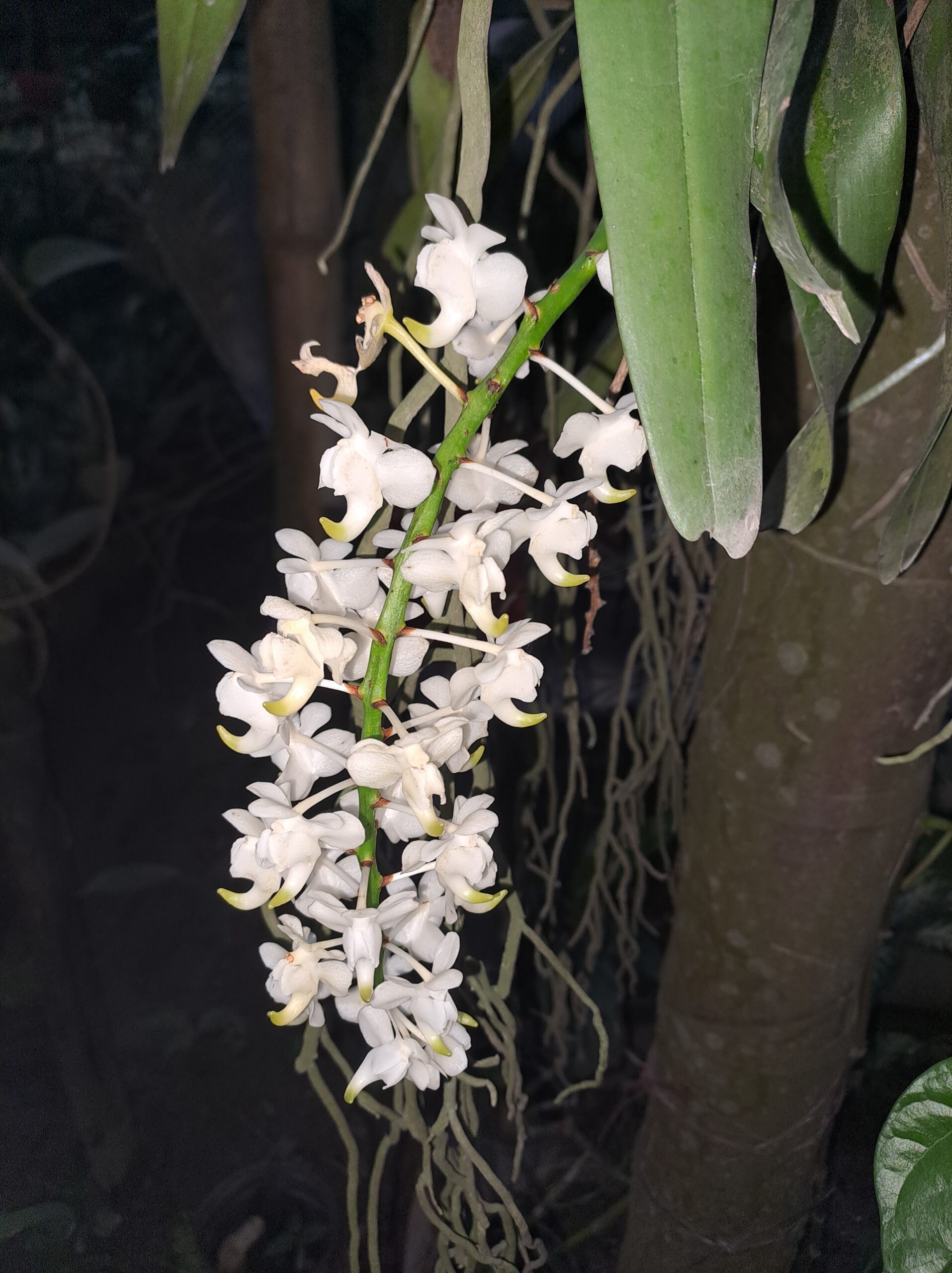
The species’ signature feature is the long, drooping flower spike — up to 60 cm — that emerges from the leaf axil between April and June. Each spike packs 100-200 small, deeply scented flowers in pinkish-purple with darker spots. The lip (labellum) is curved upward, providing a landing platform for pollinators. Individual flowers last about 8-10 days; a full spike stays in display for over a month.
Pollination
In the wild, Rhynchostylis retusa is pollinated by bees and small butterflies attracted by the strong fragrance, which is most intense at dawn.
Distribution
Rhynchostylis retusa is widely distributed across:
- Northeast India — Assam, Arunachal Pradesh, Meghalaya, Nagaland, Manipur, Mizoram, Tripura
- Eastern Himalayan foothills — Bhutan, Sikkim, eastern Nepal
- Western Ghats — patches in Kerala, Karnataka and Maharashtra
- Indo-Burma — Myanmar, Thailand, Laos, Vietnam, Cambodia
- Indonesia (Sumatra, Java, Borneo), Malaysia, Philippines, Sri Lanka
In India, the orchid is most abundant in the wet tropical forests of Assam and the Eastern Himalayas. It is a flagship of the Indo-Burma biodiversity hotspot — see our pillar on biodiversity hotspots of India.
Habitat
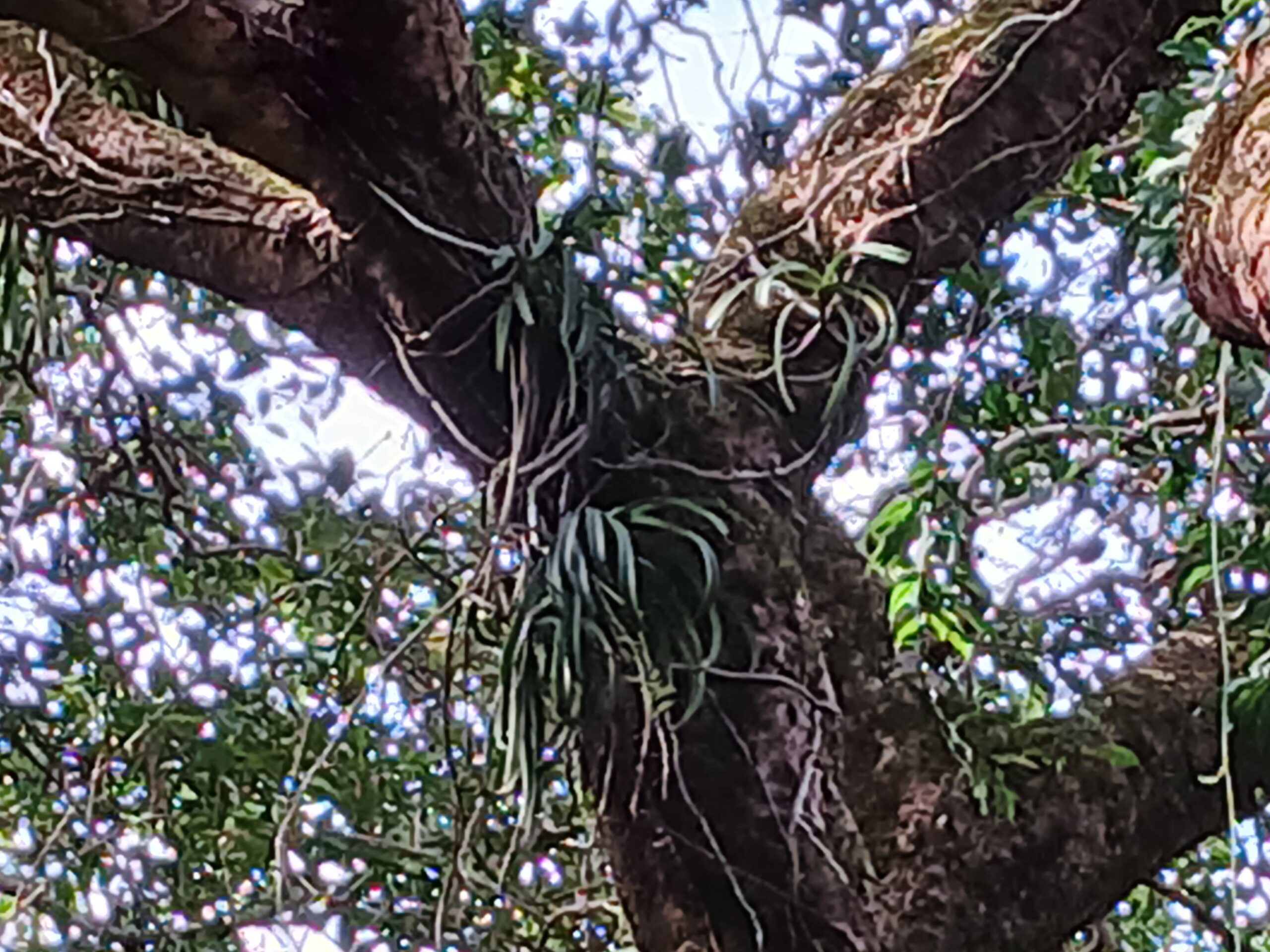
Rhynchostylis retusa grows on the trunks and branches of large deciduous and semi-evergreen trees — favourites include sal (Shorea robusta), siris (Albizia), mango (Mangifera indica) and various figs. It prefers altitudes below 1,000 metres, dappled light, and high humidity. The Brahmaputra valley, with its high humidity and forest fragments, is an ideal habitat — which is why Assam treats Rhynchostylis retusa as its botanical mascot.
Cultural Significance
Kopou Phul and Bihu
Rongali Bihu (also called Bohag Bihu) marks the Assamese new year and the onset of the agricultural season. It falls in mid-April, the very week Rhynchostylis retusa blooms most abundantly. Young women weave Kopou Phul sprays into their hair as they dance the Bihu Naas. The flower has become synonymous with the festival.
In 2003 Assam officially declared Rhynchostylis retusa the state flower. Its image appears on Assamese stamps, tourism logos, and even on the official livery of state government departments.
Religious Uses
Rhynchostylis retusa is offered at temples in eastern and northeastern India during spring festivals. In southern India the orchid is called Seetha Pushpam and is said in folk traditions to have been worn by Sita.
References in Assamese Songs and Bihu Culture
The blossom is referenced in Assamese poet Jyoti Prasad Agarwala‘s songs and Bihu lyrics, which contribute to its cultural canon.
Conservation Status
The IUCN has not assessed Rhynchostylis retusa globally, but it is listed in CITES Appendix II like all orchids — meaning international trade is regulated. In India, the orchid is protected under the Wildlife (Protection) Act, 1972, Schedule VI (which covers specified plants).
Threats
- Over-collection for the horticultural trade — wild plants are stripped from forest trees for sale at flower markets in Guwahati, Kolkata and Bangkok
- Habitat loss as forests are converted to tea plantations and settlements
- Climate stress — rising temperatures and shifting rainfall change the moisture regime
- Host-tree felling — older deciduous trees that anchor large epiphyte communities are increasingly rare
Conservation Initiatives
The Botanical Survey of India, the Orchid Research and Development Centre at Tipi (Arunachal), and ICAR-NRC Orchids at Sikkim run ex situ conservation through tissue culture and seed banking. The Kaziranga and Manas landscapes (and other wildlife sanctuaries) protect significant wild populations.
Cultivation
Rhynchostylis retusa is cultivated commercially as a cut flower and as a potted ornamental in Thailand, the Philippines and northeast India. It is grown:
- On wooden slabs or in baskets (never in solid pots — roots need air)
- With sphagnum moss or coconut husk as substrate
- Under 50-60 per cent shade
- At 25-30 C with high humidity
- Watered daily in summer and weekly in winter
- Fed dilute orchid fertiliser fortnightly
A mature plant in optimal conditions produces 2-3 long flower spikes annually.
Pharmacological and Ethnobotanical Notes
Tribal medicine in Assam and Arunachal Pradesh uses Rhynchostylis retusa extracts for wound healing, kidney complaints, and as a tonic. Modern phytochemical studies have isolated phenolic compounds and flavonoids with antioxidant activity, though clinical use is not established.
State Flowers of India — A Quick Look
| State | State Flower |
|---|---|
| Assam | Rhynchostylis retusa (Kopou Phul / foxtail orchid) |
| Arunachal Pradesh | Foxtail orchid (popularly used; official notification often cites Rhynchostylis retusa as well, but Arunachal’s current MoEFCC listing is Rhynchostylis retusa) |
| Sikkim | Noble dendrobium (Dendrobium nobile) |
| Meghalaya | Lady’s Slipper Orchid (Paphiopedilum insigne) |
| Karnataka | Lotus |
| Tamil Nadu | Glory lily (Gloriosa superba) |
| Kerala | Kanikonna (Cassia fistula) |
For the complete state-by-state list, see our guide to the state flowers of India.
For UPSC Prelims, the safest formulation is: Rhynchostylis retusa (Foxtail Orchid) is the state flower of both Assam and Arunachal Pradesh. Choose this in any MCQ that pits the two states against each other.
Sources & References
- Department of Information & Public Relations, Government of Arunachal Pradesh — “About State” (lists State Flower: Foxtail Orchid / Rhynchostylis retusa)
- Plants of the World Online (POWO), Royal Botanic Gardens, Kew — Rhynchostylis retusa (L.) Blume (accepted species, native range across South and Southeast Asia)
- India Biodiversity Portal — Rhynchostylis retusa (L.) Blume (common names, distribution, ecology)
- IndiaCode — Wildlife (Protection) Act, 1972, Schedule VI (the canonical list of Schedule VI plants; Rhynchostylis retusa is not currently included)
- DGFT — CITES Appendix listing for Orchidaceae spp. (Appendix II coverage, with species in Appendix I where stricter rules apply)
- Assam Forest Department technical bulletins on regional orchid flora (for flowering-window data)
Frequently Asked Questions
What is Rhynchostylis retusa?
Rhynchostylis retusa is a fragrant epiphytic orchid native to South and Southeast Asia. It is famous for its long pinkish-purple flower spikes that resemble a fox’s tail.
Is Rhynchostylis retusa the state flower of Assam or Arunachal Pradesh?
Rhynchostylis retusa is the state flower of both Assam and Arunachal Pradesh. In Assam it is called Kopou Phul and is culturally tied to Rongali Bihu. The Arunachal Pradesh government's Department of Information & Public Relations also officially lists Foxtail Orchid (Rhynchostylis retusa) as its state flower.
Why is Rhynchostylis retusa called the foxtail orchid?
Because its long, drooping flower spike packed with 100-200 tiny flowers resembles a fox’s bushy tail.
When does Rhynchostylis retusa bloom?
It blooms between April and June, peaking in mid-April — which coincides with the Assamese spring festival Rongali Bihu.
Where is Rhynchostylis retusa found in the wild?
It is found in the wet tropical forests of northeast India, the Eastern Himalayan foothills, parts of the Western Ghats, and across Southeast Asia from Myanmar to Indonesia and the Philippines.
Is Rhynchostylis retusa endangered?
It is not formally listed as endangered by IUCN, but it is under CITES Appendix II and protected by India’s Wildlife Protection Act. Wild populations face heavy collection pressure for the horticultural trade.
What is Kopou Phul?
Kopou Phul is the Assamese name for Rhynchostylis retusa. Women wear it in their hair during Bihu dances, making it a cultural emblem of Assam.
How is Rhynchostylis retusa pollinated?
In the wild, Rhynchostylis retusa is pollinated mainly by bees and small butterflies attracted by its strong, sweet fragrance which is most intense in the early morning.