Most aspirants try to mug up state flowers as a flat list of 28 names, get tripped up by the fact that three different states share the same flower, and then blank out in the exam anyway. The trick is not memory. It is knowing which ones repeat, which ones are genuinely famous, and which states have no officially notified flower at all, so you stop wasting revision time on the obvious and lock in the ones examiners actually pick.
Here is the full state and union-territory-wise list first, with both the common name and the botanical name, because a botanical name in the options is the single most common way this topic is set. After the table, we will teach the handful that carry real weight.
The complete list of state flowers of India
Every state and union territory that has notified a floral emblem is in the table below, with the botanical name that usually appears in the tougher options. Two states, Assam and Chhattisgarh, have no officially notified state flower, and one union territory, Dadra and Nagar Haveli and Daman and Diu, does not either. That absence is itself examinable, so those rows are marked rather than filled with a guess.
| State / UT | State Flower (common name) | Botanical name |
|---|---|---|
| Andhra Pradesh | Jasmine | Jasminum officinale |
| Arunachal Pradesh | Foxtail orchid | Rhynchostylis retusa |
| Assam | No officially notified state flower | Not applicable |
| Bihar | Kachnar | Bauhinia variegata |
| Chhattisgarh | No officially notified state flower | Not applicable |
| Goa | Red jasmine (Frangipani) | Plumeria rubra |
| Gujarat | Marigold | Tagetes erecta |
| Haryana | Lotus | Nelumbo nucifera |
| Himachal Pradesh | Pink rhododendron | Rhododendron campanulatum |
| Jharkhand | Palash | Butea monosperma |
| Karnataka | Lotus | Nelumbo nucifera |
| Kerala | Golden Shower (Kani Konna) | Cassia fistula |
| Madhya Pradesh | Palash | Butea monosperma |
| Maharashtra | Jarul (Tamhan) | Lagerstroemia speciosa |
| Manipur | Siroi lily | Lilium mackliniae |
| Meghalaya | Lady’s slipper orchid | Paphiopedilum insigne |
| Mizoram | Red vanda | Renanthera imschootiana |
| Nagaland | Rhododendron | Rhododendron arboreum |
| Odisha | Ashoka | Saraca asoca |
| Punjab | Sword lily (Gladiolus) | Gladiolus grandiflorus |
| Rajasthan | Rohira | Tecomella undulata |
| Sikkim | Noble orchid | Cymbidium goeringii |
| Tamil Nadu | Flame lily (Glory lily) | Gloriosa superba |
| Telangana | Tanner’s cassia (Tangedu) | Senna auriculata |
| Tripura | Nageswar | Mesua ferrea |
| Uttar Pradesh | Palash | Butea monosperma |
| Uttarakhand | Brahma Kamal | Saussurea obvallata |
| West Bengal | Night-flowering jasmine (Shiuli) | Nyctanthes arbor-tristis |
| Andaman and Nicobar Islands | Andaman Pyinma | Lagerstroemia hypoleuca |
| Chandigarh | Palash | Butea monosperma |
| Dadra and Nagar Haveli and Daman and Diu | No officially notified state flower | Not applicable |
| Delhi | Alfalfa | Medicago sativa |
| Jammu and Kashmir | Common rhododendron | Rhododendron ponticum |
| Ladakh | Himalayan blue poppy | Meconopsis aculeata |
| Lakshadweep | Neelakurinji | Strobilanthes kunthiana |
| Puducherry | Cannonball flower | Couroupita guianensis |
One honest caveat the copy-paste lists skip: these emblems are not published in a single central gazette, so different reference sites disagree on a few states, especially Andhra Pradesh, Madhya Pradesh, and Sikkim. Where sources clash, the table above follows the most widely cited botanical designation. If a question hinges on a contested state, it is almost always one of the famous, well-settled flowers below, not a disputed one.
The duplicates that catch people out
The fastest way to lose a mark here is to assume every state has a unique flower. Several do not, and the repeats are the favourite trap.
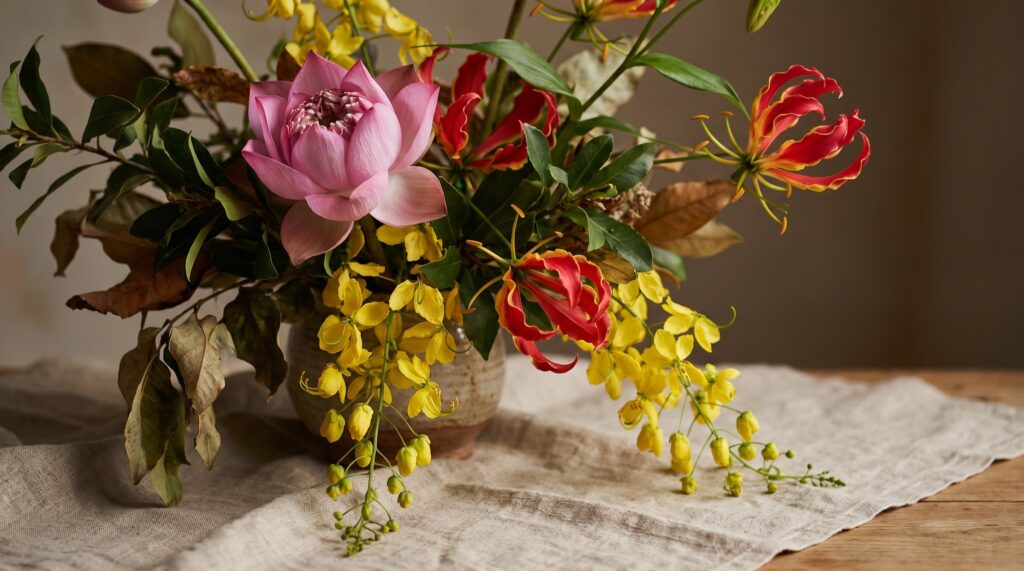
The Lotus (*Nelumbo nucifera*) is the flower most likely to confuse you, because it is the national flower of India and also the state flower of both Haryana and Karnataka. So if an option says “the lotus is the state flower of X,” it can be correct for two different states at once. Read the stem carefully. You can go deeper on why the lotus was chosen as the national emblem in our note on the national symbols of India, and there is a dedicated explainer on the lotus as the national flower if you want the botany and the symbolism in one place.
The bigger repeat is Palash, the flame of the forest (*Butea monosperma*). It is the state flower of four places: Jharkhand, Madhya Pradesh, Uttar Pradesh, and the union territory of Chandigarh. That is the single most valuable fact on this page, because a “which of these does NOT have Palash as its state flower” question is exactly the kind examiners like. Palash blooms a fierce orange-red across north and central India in spring, which is why so many states in that belt claim it.
So before you memorise anything else, fix these two: lotus for Haryana and Karnataka, and Palash for the four. Get those and you have already covered the most set-worthy part of the topic.
The famous ones worth knowing in depth
A handful of state flowers show up again and again because they are botanically special, culturally loaded, or ecologically threatened. Learn the story behind each, and you will not need to rote-revise them.
Brahma Kamal (*Saussurea obvallata*), Uttarakhand. This is not the aquatic lotus its name suggests. It is a high-altitude herb that grows above 3,000 metres in the Himalayas, blooms only at night for a short window in the monsoon, and is offered at shrines like Kedarnath and the Valley of Flowers. The “Kamal” in the name is devotional, not botanical, which is exactly the misdirection a question uses. Remember it as the Himalayan night-bloomer, not a water lily.
Foxtail orchid (*Rhynchostylis retusa*), Arunachal Pradesh. Here is the confusion worth its own paragraph. The foxtail orchid, known as Kopou phul in Assam, is culturally inseparable from Assamese identity and the Bihu festival, so it is very widely quoted as “Assam’s state flower.” But Assam has no officially notified state flower. The foxtail orchid is the officially designated state flower of Arunachal Pradesh. If an option pairs it with Assam, the safe answer treats Assam as having no notified emblem and Arunachal Pradesh as the correct holder. This one trips up almost everyone, so slow down on it.
Golden Shower or Kani Konna (*Cassia fistula*), Kerala. The bright yellow cascade that flowers around Vishu, the Malayali new year, where the blooms form the ceremonial *Vishukkani*. It is also the flower on the coat of arms of Thailand, a favourite trivia twist. Tie it to Kerala and to Vishu and it will stick.
Flame lily, also called Glory lily (*Gloriosa superba*), Tamil Nadu. A striking red-and-yellow climber whose petals curl back like a flame. Every part of the plant is poisonous, and it is the source of colchicine, a compound used in gout treatment, which is why it matters beyond symbolism. Tamil Nadu adopted it as Kaanthal. Do not confuse it with the ordinary garden lily.
Siroi lily (*Lilium mackliniae*), Manipur. A pinkish-white lily found almost nowhere on earth except the Shirui (Siroi) hills of Ukhrul district in Manipur. Its extreme endemism is the point: it is a textbook example of a species restricted to a single tiny habitat, which is why conservation notes cite it. Pair it with Manipur and with “endemic.”
Red vanda (*Renanthera imschootiana*), Mizoram. A brilliant red orchid that is genuinely endangered and protected, listed in the appendices of the CITES convention that regulates trade in threatened species. When environment questions want a state flower that is also a conservation concern, this is usually the one.
Notice the pattern in the northeast: orchids dominate, because that region is one of the richest orchid habitats in the world. Arunachal Pradesh, Meghalaya, Mizoram, and Sikkim all picked orchids, and that clustering is easier to remember than four separate facts. You can slot this into your wider biodiversity of India revision, since the northeast is a recognised biodiversity hotspot.
How state symbols are notified and why they matter
There is no single constitutional article or central law that declares state flowers. Unlike the national symbols, which the Government of India adopted through specific decisions, a state flower is chosen by the individual state government, usually on the advice of its forest or environment department, and announced through a state notification or a cabinet decision. That is precisely why the lists vary and why some states, like Assam and Chhattisgarh, simply have not formalised one.
The taxonomic backbone comes from the Botanical Survey of India, the country’s apex plant-taxonomy body established in 1890, which maintains the authoritative record of India’s flora. When you see a botanical name in an exam option, that name traces back to this kind of formal taxonomy, not to a folk name.
So why bother with symbols at all? Two reasons that go beyond trivia. First, the choice is almost always an act of conservation signalling: states pick species that are native, endemic, or under threat, which pushes them onto protection lists and into local pride. The Siroi lily and the red vanda are state flowers precisely because they are rare. Second, these emblems anchor cultural identity, from Kerala’s Vishukkani to Assam’s Bihu, linking a plant to a festival and a people. That environment-and-culture overlap is why a flower can appear in a geography question, an environment question, or a culture question, and it is worth filing under all three in your environment notes. The same logic runs through the state animals of India, which are set the exact same way and are worth revising in the same sitting.
How to study and remember this
Do not memorise 36 rows. Cluster them, and you cut the load by more than half.
Group one, the repeats: lotus for Haryana and Karnataka, and Palash for Jharkhand, Madhya Pradesh, Uttar Pradesh, and Chandigarh. If you know only these, you have covered the highest-probability questions.
Group two, the northeast orchids: Arunachal (foxtail), Meghalaya (lady’s slipper), Mizoram (red vanda), Sikkim (noble orchid). One theme, four states.
Group three, the famous named specials: Brahma Kamal for Uttarakhand, Siroi lily for Manipur, Golden Shower for Kerala, Flame lily for Tamil Nadu. These have stories, so anchor each to its festival, habitat, or use rather than a bare name.
Group four, the strategic blanks: Assam, Chhattisgarh, and Dadra and Nagar Haveli and Daman and Diu have no notified flower. Knowing the absence is worth as much as knowing a name.
Revise botanical names only for the specials and the repeats, because that is where the harder options come from. For a first-timer, that is the whole secret: you do not need every scientific name, you need the eight or nine that carry weight and the four blanks. Build a one-page table of just those, and let the rest come from the full list above only in your final revision.
Frequently Asked Questions
Which flower is the state flower of the most Indian states?
Palash, the flame of the forest (*Butea monosperma*), holds the record. It is the state flower of Jharkhand, Madhya Pradesh, Uttar Pradesh, and the union territory of Chandigarh, four places in all.
Is the lotus a state flower or the national flower?
Both. The lotus (*Nelumbo nucifera*) is the national flower of India, and it is separately the state flower of Haryana and Karnataka. That dual status is a common source of confusion in objective questions.
What is the state flower of Assam?
Assam has no officially notified state flower. The foxtail orchid (Kopou phul) is deeply associated with Assamese culture and the Bihu festival, but it is the officially designated state flower of Arunachal Pradesh, not Assam.
Which states or union territories have no state flower?
Among states, Assam and Chhattisgarh have no officially notified state flower. Among union territories, Dadra and Nagar Haveli and Daman and Diu has none notified.
What is the state flower of Uttarakhand?
The Brahma Kamal (*Saussurea obvallata*), a high-altitude Himalayan herb that blooms at night during the monsoon and is offered at Himalayan shrines. Despite the name, it is not the aquatic lotus.
Why do so many northeastern states have orchids as their state flower?
Because the northeast is one of the richest orchid habitats on earth. Arunachal Pradesh, Meghalaya, Mizoram, and Sikkim all chose orchids, reflecting the region’s status as a biodiversity hotspot.
Who decides a state flower in India?
The individual state government decides, usually on the advice of its forest or environment department, and announces it through a state notification. There is no single central law, which is why the lists occasionally differ across sources.
Practice Questions
1. The flower Palash (*Butea monosperma*) is the state flower of all of the following EXCEPT:
a) Jharkhand
b) Uttar Pradesh
c) Madhya Pradesh
d) Bihar
Answer: d) Bihar (Bihar’s state flower is the Kachnar; Palash belongs to Jharkhand, Madhya Pradesh, Uttar Pradesh, and Chandigarh.)
2. The Brahma Kamal, state flower of Uttarakhand, is botanically:
a) *Nelumbo nucifera*
b) *Saussurea obvallata*
c) *Cassia fistula*
d) *Gloriosa superba*
Answer: b) *Saussurea obvallata* (It is a Himalayan herb, not an aquatic lotus.)
3. Which of the following pairs is correctly matched?
a) Manipur: Siroi lily
b) Kerala: Marigold
c) Tamil Nadu: Lotus
d) Rajasthan: Palash
Answer: a) Manipur: Siroi lily (*Lilium mackliniae*, endemic to the Shirui hills.)
4. The foxtail orchid (*Rhynchostylis retusa*) is the officially notified state flower of:
a) Assam
b) Arunachal Pradesh
c) Nagaland
d) Meghalaya
Answer: b) Arunachal Pradesh (Assam, though culturally linked to it, has no notified state flower.)
5. Which state flower is the botanical source of colchicine, used to treat gout?
a) Golden Shower of Kerala
b) Ashoka of Odisha
c) Flame lily of Tamil Nadu
d) Rohira of Rajasthan
Answer: c) Flame lily of Tamil Nadu (*Gloriosa superba*, whose parts are poisonous and yield colchicine.)
Mains-style questions
1. State symbols such as flowers and animals are often chosen for endemic or threatened species. Discuss how these emblems can support biodiversity conservation and local ecological awareness in India. 2. “There is no central law governing state flowers in India, unlike national symbols.” Examine the constitutional and administrative reasons for this difference. 3. The northeastern states of India disproportionately choose orchids as their floral emblems. Analyse what this reveals about the region’s biogeography and conservation priorities. 4. Cultural festivals in India are frequently tied to particular flowering species. Discuss with examples how such associations reflect the interface of ecology and cultural identity. 5. Evaluate the role of the Botanical Survey of India in documenting and classifying the country’s plant diversity, and its relevance to conservation policy.
State flowers look like a rote list, but the topic rewards structure, not memory. Master the two duplicates, the northeast orchid cluster, the four famous specials, and the strategic blanks, and you have covered the part that is actually set, while the copy-paste crowd is still trying to memorise all thirty-six rows. That is the difference between collecting the list and understanding it.
Tell Google you want more of this.
Add Anantam IAS as a preferred sourceOne tap, and this site shows up more often in your own Top Stories, AI Overviews and AI Mode. Remove it any time.