Salient Features of Indian Society: UPSC Indian Society Guide
UPSC GS-I guide on the salient features of Indian society — diversity, value system, modern-yet-traditional character, caste, joint family, religiosity, tribal continuum with 2024-26 data.
Indian society is one of the oldest continuous civilisations in the world, home to over 1.43 billion people (UN World Population Prospects 2024) — now the most populous country on the planet. What makes it distinctive is not just scale but the simultaneous coexistence of diversity and unity, tradition and modernity, ascriptive identity and democratic citizenship. For UPSC GS-I (Indian Society) and Essay aspirants, mastering the salient features of Indian society is the foundational chapter — every other theme (caste, communalism, gender, urbanisation, secularism) sits on top of these structural traits.
This guide consolidates the seven salient features that anchor the syllabus — diversity, value system, modern-yet-traditional, caste, joint family, religiosity, and the tribal continuum — and links each to constitutional anchors, sociological theory, and 2024-26 data.
What "Salient Features" Means in the UPSC Syllabus
The GS-I syllabus opens with: "Salient features of Indian Society, Diversity of India." The phrase signals enduring structural characteristics — features that have persisted through colonial rule, Partition, the Green Revolution, liberalisation, and digitalisation. They are simultaneously continuities (caste, family, religiosity) and transformations (urbanisation, individualism, gender renegotiation).
Sociological Lens
- Émile Durkheim distinguished mechanical solidarity (likeness-based, traditional) from organic solidarity (interdependence-based, modern). India displays both at once — a hallmark of what M.N. Srinivas called the "vertical and horizontal solidarities" of Indian society.
- Max Weber described India as a society of status groups (caste) rather than purely class — though that is now contested in urban India.
- Louis Dumont (Homo Hierarchicus, 1966) framed Indian society around hierarchy and the pure–impure axis, a thesis later challenged by Dipankar Gupta and Andre Beteille.
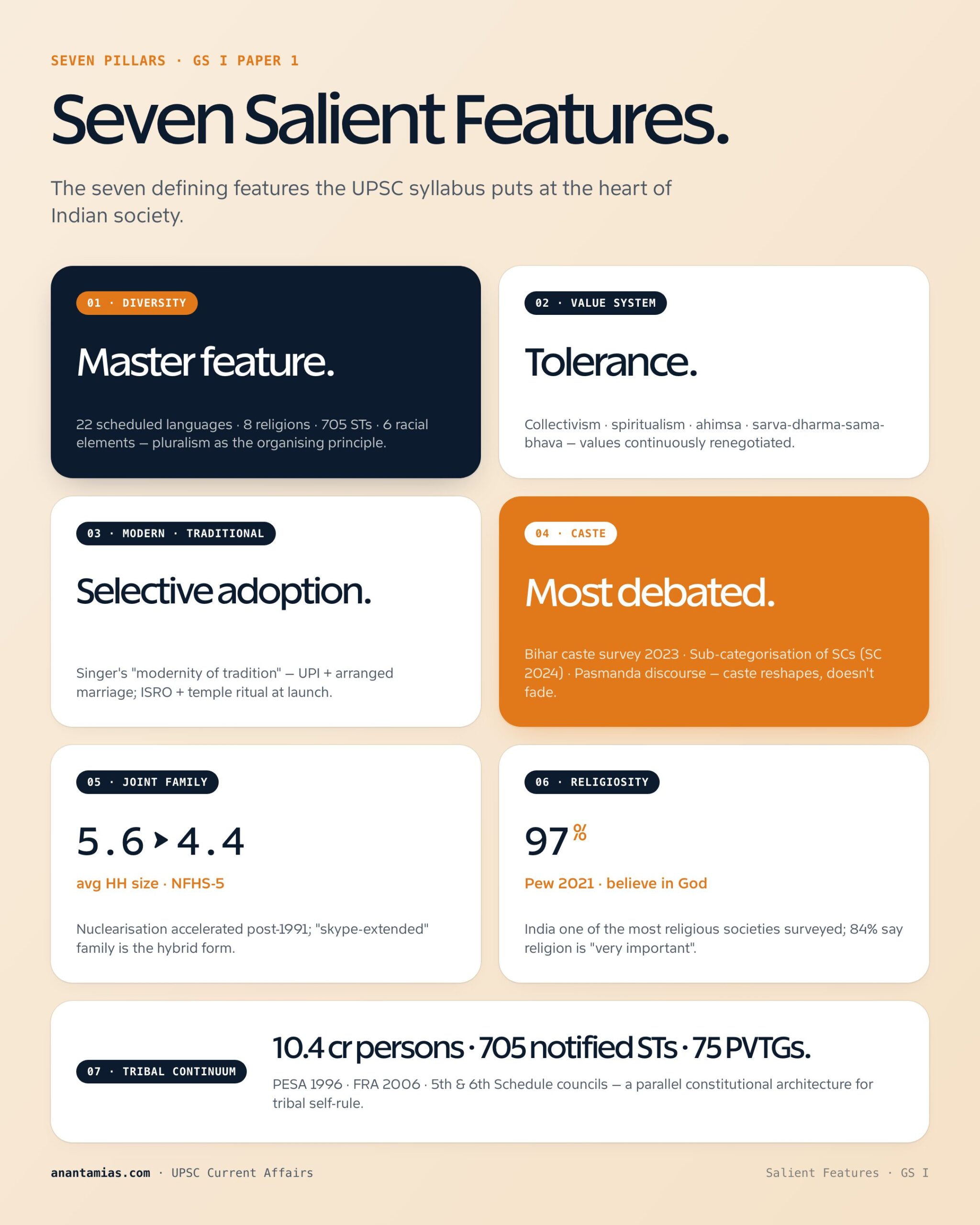
The Seven Salient Features at a Glance
| # | Feature | Core Idea | Contemporary Tension |
|---|---|---|---|
| 1 | Diversity | Linguistic, religious, racial, regional, caste pluralism | Communalism, regionalism, identity politics |
| 2 | Value System | Tolerance, collectivism, respect for elders, spiritualism | Hate speech, individualism, secular drift |
| 3 | Modern yet Traditional | Coexistence of rituals with smartphones, IVF with arranged marriage | Selective modernisation, "sanskritised modernity" |
| 4 | Caste | Hereditary, endogamous, hierarchical groups | Caste mobilisation, sub-quota debates, caste census 2025 |
| 5 | Joint Family | Multi-generational, patrilineal household | Nuclearisation, elderly care crisis |
| 6 | Religiosity | Pervasive role of religion in life-cycle, festivals, politics | Communalism vs. principled secularism |
| 7 | Tribal Continuum | 8.6% Adivasi population; PVTGs; forest-based livelihoods | Displacement, Forest Rights Act, PESA implementation |
1. Diversity: The Master Feature
India's diversity is horizontal (across regions, religions, languages) and vertical (within each — sects, sub-castes, dialects).
Dimensions of Diversity
- Linguistic: 22 scheduled languages, 121 mother tongues with >10,000 speakers, 270 with >10,000 speakers (Census 2011). The Eighth Schedule anchors linguistic federalism.
- Religious: Hindu (79.8%), Muslim (14.2%), Christian (2.3%), Sikh (1.7%), Buddhist (0.7%), Jain (0.4%) — Census 2011.
- Racial: Negrito, Proto-Australoid, Mongoloid, Mediterranean, Western Brachycephal, Nordic — B.S. Guha's classification (now contested by population genetics).
- Caste: Over 4,000 jatis; 1,234 SC, 705 ST notified communities (Ministry of Social Justice).
- Regional: Six physiographic zones; cultural macro-regions (North, South, East, West, Northeast, Central).
Constitutional Anchors
- Preamble: "Unity and integrity of the Nation."
- Article 29: Protection of interests of minorities.
- Article 350-A/B: Mother-tongue instruction; Special Officer for linguistic minorities.
- Eighth Schedule: 22 official languages.
The Indian formula is "Unity in Diversity" — coined as a political slogan but rooted in Jawaharlal Nehru's Discovery of India (1946): "Some kind of a dream of unity has occupied the mind of India since the dawn of civilisation."
2. Value System: Tolerance, Collectivism, Spiritualism
Traditional Indian values include tolerance (Ashoka's edicts, Akbar's Sulh-i-Kul, Hindu syncretism), collectivism (community over individual), respect for elders, religiosity, spiritualism (moksha, dharma), and patriarchy (a value reproduced through socialisation, not always celebrated).
Why These Values Persisted
- Tolerant rulers (Ashoka to Akbar) and the syncretistic nature of Hinduism and Sufism.
- Family socialisation transmitted patriarchy, gerontocracy, and gendered division of labour.
- The jajmani system of caste created functional interdependence across communities, sustaining caste as ideology.
- An agrarian economy valued land — joint families prevented land fragmentation.
Where Values Are Shifting (2024-26 Signals)
- Hate speech and communal violence: India ranks 161/180 in World Press Freedom Index 2024 — partly reflecting communal polarisation.
- Civil marriages on the rise: Special Marriage Act registrations grew significantly in metros — secular drift.
- Gender renegotiation: Female labour-force participation rose from 23.3% (2017-18) to 41.7% (PLFS 2023-24) — a structural shift.
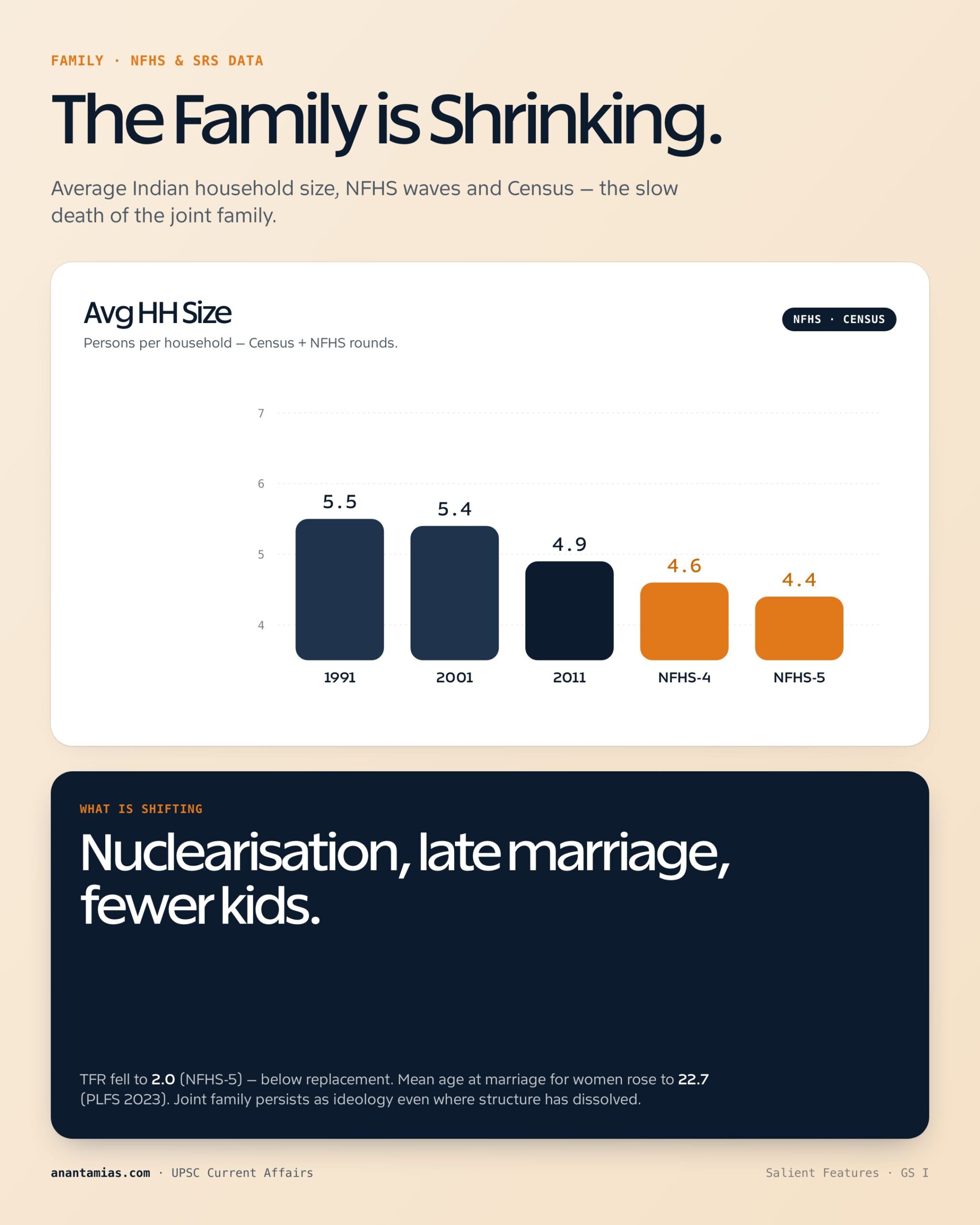
- Individualism: Median household size fell from 4.8 (Census 2001) to 4.4 (NFHS-5, 2019-21); nuclear-household share now ~52%.
3. Modern Yet Traditional: Selective Modernisation
India did not modernise by replacing tradition — it layered modernity onto tradition. Yogendra Singh called this "modernisation of tradition and traditionalisation of modernity." M.N. Srinivas's concepts of Sanskritisation, Westernisation, and Secularisation capture this layered change.
Examples of Coexistence
- IVF clinics that consult astrologers for "muhurat".
- Arranged marriages on Shaadi.com with biometric KYC.
- Smart cities with temple chariots blocking traffic on festival days.
- Online Ganga aarti livestreams with UPI donations.
This is closer to multiple modernities (S.N. Eisenstadt) than to a Western linear modernisation thesis.
4. Caste: The Most Debated Feature
Caste is hereditary, endogamous, hierarchical, and segmental (G.S. Ghurye's six features). The 2024-26 syllabus must engage with:
- The Bihar Caste Survey (2023) that triggered demands for a national caste census — included in Census 2027 (delayed from 2021).
- Sub-quota classification within SCs — State of Punjab v. Davinder Singh (2024) Supreme Court 7-judge verdict allowed states to sub-classify SCs.
- The EWS reservation (103rd Amendment, upheld in 2022) opening the door to economic criteria within reservations.
- Persistent caste atrocities: 57,582 SC/ST atrocity cases in 2022 (NCRB Crime in India 2022).
5. Joint Family: Persistence and Decline
The patriarchal joint family (multi-generational, common kitchen, common property) was the Indian unit of production, consumption, and socialisation. Iravati Karve's classic typology (joint, nuclear, supplemented nuclear) still frames the discussion.
NFHS-5 (2019-21) Snapshot
- Mean household size: 4.4 (down from 5.5 in NFHS-1).
- Share of nuclear families: ~52%.
- Yet functional jointness persists: pooled remittances, weekly video calls, joint property, marriage networks.
A.M. Shah's distinction between household composition (one kitchen) and family (kinship network) is critical — Indians live in nuclear households but operate in joint families.
6. Religiosity
India is among the most religious countries in the world — Pew Research Center 2021 found 97% of Indians believe in God, and 79% say religion is "very important." Religiosity organises life-cycle rituals, festivals, food, dress, and personal laws.
Constitutional Framework
- Articles 25-28: Freedom of religion.
- Article 44: Uniform Civil Code (DPSP) — Uttarakhand became the first state to operationalise a state-level UCC in 2024-25.
- Article 290-A: Public funding for certain religious institutions (Travancore-Cochin).
7. Tribal Continuum
India has 104.3 million Scheduled Tribes (8.6%) — Census 2011. 705 STs are notified, including 75 Particularly Vulnerable Tribal Groups (PVTGs) under the PM-JANMAN scheme (launched November 2023, ₹24,104 crore outlay).
Distinct Features of Tribal Society
- Territorial continuity in forests, hills, and frontier regions.
- Distinct language families — Austric (Munda, Khasi), Dravidian (Gond), Tibeto-Burman (Naga, Mizo).
- Customary law, clan exogamy, community land.
- Constitutional protection: Fifth and Sixth Schedules, PESA 1996, Forest Rights Act 2006.
Sociological Perspectives on Indian Society
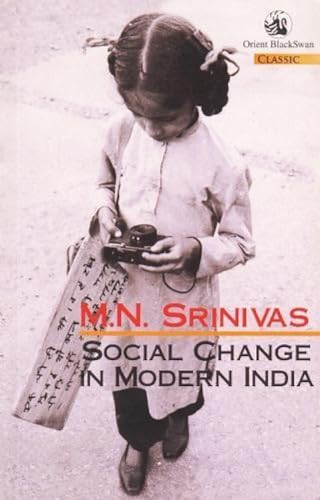
Social Change in Modern India — M.N. Srinivas (Orient BlackSwan)
- 196 pages, Orient BlackSwan, revised edition
- Sanskritisation, Westernisation and secularisation, in the words that coined them
- The source every Indian Society answer borrows from
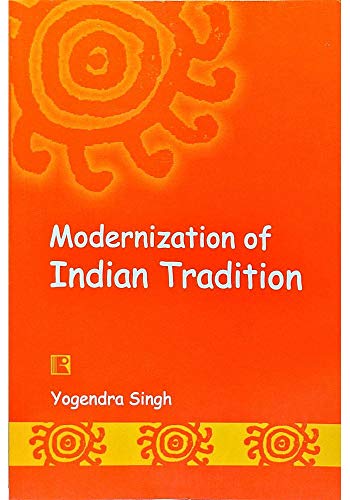
Modernization of Indian Tradition — Yogendra Singh (Rawat)
- 280 pages, the Rawat classic
- Tradition and modernity as a single process, not a contest
- The framework behind the 'modern yet traditional' feature of Indian society
| Thinker | Key Concept | Application to India |
|---|---|---|
| G.S. Ghurye | Six features of caste | Endogamy, hierarchy, hereditary occupation |
| M.N. Srinivas | Sanskritisation, Dominant caste | Mobility within caste system; Lingayats, Patidars, Marathas |
| Louis Dumont | Homo Hierarchicus | Pure-impure axis; contested today |
| Andre Beteille | Caste, class, power | Disjunction in modern Tanjore village |
| Yogendra Singh | Modernisation of tradition | Layered, non-linear change |
| Dipankar Gupta | Hierarchies of difference | Caste as identity, not just hierarchy |
| A.M. Shah | Household vs. family | Nuclear household, joint family |
Government Initiatives Reinforcing Plural Society
- National Foundation for Communal Harmony (1992).
- PM-JANMAN for PVTGs (2023, ₹24,104 crore).
- Eklavya Model Residential Schools (EMRS) — 728 sanctioned for tribal children.
- Mission Vatsalya and Mission Shakti for child and women welfare (2022).
- Poshan 2.0, PMMVY 2.0, Beti Bachao Beti Padhao — feature 2.0 (2025).
- Special Marriage Act & Foreign Marriage Act — secular marriage routes.
- PESA 1996 and Forest Rights Act 2006 — tribal self-governance.
Data Snapshot (2024-26)
| Indicator | Value | Source |
|---|---|---|
| Population | 1.43 billion | UN WPP 2024 |
| Female LFPR (15+) | 41.7% | PLFS 2023-24 |
| Mean household size | 4.4 | NFHS-5 |
| SC/ST atrocity cases | 57,582 | NCRB 2022 |
| ST share | 8.6% | Census 2011 |
| Religious composition | 79.8% Hindu, 14.2% Muslim | Census 2011 |
| Languages (scheduled) | 22 | Eighth Schedule |
| World Hunger Index | 105/127 | GHI 2024 |
| Global Gender Gap | 129/146 | WEF GGGR 2024 |
Challenges to the Salient Features
- Communalism and majoritarianism eroding the tolerance value.
- Caste hardening through politicisation even as untouchability legally weakens.
- Gendered violence: 4,45,256 crimes against women in 2022 (NCRB).
- Tribal displacement: Estimates suggest 50+ million displaced by development since 1947.
- Linguistic marginalisation: 196 endangered Indian languages (UNESCO).
- Generational gap: Between digital-native youth and gerontocratic family norms.
Way Forward
- Constitutional patriotism (Habermas, applied to India by Rajeev Bhargava) as the unifying thread.
- Fraternity — the under-used third pillar of the Preamble — as a sociological project.
- Strengthen principled distance in secularism (Bhargava's framework).
- Caste census + disaggregated data for evidence-based affirmative action.
- Operationalise PESA and FRA in letter and spirit.
- Mainstream gender and disability lenses in welfare design.
Mains Hook
"Indian society's distinctiveness lies not in the absence of contradictions but in its institutionalised capacity to absorb them." Discuss with reference to the salient features of Indian society. (GS-I, 250 words, 15 marks)
Prelims Pointers
- Eighth Schedule: 22 languages; latest addition — Bodo, Dogri, Maithili, Santhali (2003, 92nd Amendment).
- PVTG: 75 groups; PM-JANMAN scheme launched November 2023.
- Article 29 vs. 30: 29 protects all minorities (cultural); 30 gives religious/linguistic minorities right to establish institutions.
- Census 2027: First caste-enumerated census since 1931.
- NFHS-5 mean household size: 4.4.
- SC/ST atrocity: NCRB Crime in India 2022 — 57,582 cases.
- UCC operationalisation: Uttarakhand, 2025.
- Female LFPR: 41.7% (PLFS 2023-24).
The salient features of Indian society are not static descriptors — they are dynamic structural traits that the Constitution channels, the polity contests, and the economy reshapes. Mastering them means seeing India as both continuity and change.
For a worked reading routine, use the guide for the source you have chosen: