Searching for a Ram Ahuja Indian society book can lead you to several different titles. Indian Social System, Society in India, Social Problems in India and the Hindi Bhartiya Samaj aren’t names you should treat as interchangeable. Check the title before buying or following somebody else’s chapter plan.
Use Ahuja as a selective source for understanding social relationships and change. If you’re beginning GS1, build the foundation with NCERT first. If you’ve already chosen Sociology optional, use the relevant Ahuja chapter to deepen a specific syllabus topic, then practice explaining it in an answer.
Which Ram Ahuja Book Do You Need?
The reliable buying decision starts with the publisher’s title and contents. A search result labeled ‘Indian society’ doesn’t identify one particular English edition.
- Rawat lists Indian Social System by Ram Ahuja, ISBN 9788170331971. Its contents include family, kinship, marriage, caste and social change.
- Rawat separately lists Bhartiya Samaj: Indian Society in Hindi, ISBN 9788170336396. Its contents include stratification, institutions, rural and urban society and modernization.
- Social Problems in India is another title. A listing for that book shouldn’t be used as evidence about the contents or edition of Indian Social System.
Use the Rawat Indian Social System listing to identify the English book and its contents. Hindi readers can check the separate Bhartiya Samaj listing. The publication dates attached to these listings also make an important point: a useful explanation of a concept isn’t automatically a current statistical source.
I wouldn’t buy multiple Ahuja titles at the start. Identify the gap you need to fill. A chapter on family relationships and a chapter on a social problem may answer different questions, even when they mention the same institution.
What to Read Selectively
Organize reading around a question you’re trying to answer. A theme-to-task map is more useful than a copied list of chapter numbers, especially when editions differ.
| Theme | Question to Carry Into Reading | What to Produce |
|---|---|---|
| Family and kinship | Which relationships, duties and support arrangements matter? | A relationship-and-function diagram |
| Marriage | How do social expectations shape an institution? | A distinction between norms, practices and law |
| Caste and stratification | How are status and access organized? | A concept, mechanism and example note |
| Social change | What changes, what persists and why? | A continuity-and-change comparison |
| Modernization | Which institutions adapt when conditions change? | A causal chain with a qualification |
The salient features of Indian society guide supplies a broader GS1 frame. Sociology candidates should keep their optional preparation guide beside the book so that selective reading doesn’t become an unplanned second syllabus.
A Worked Family Study Session
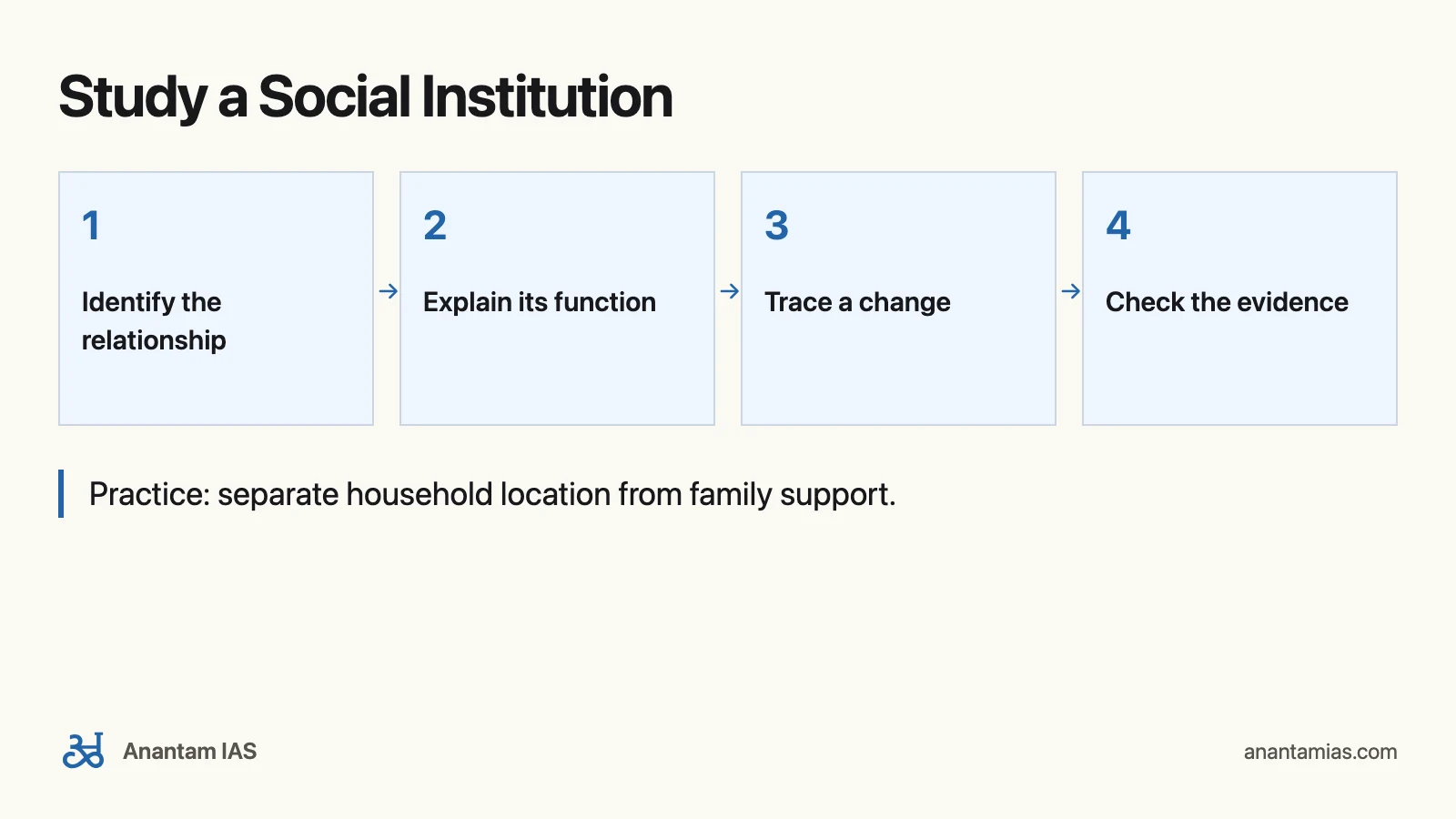
Consider this original practice question: ‘How can migration change family support without ending family relationships?’ It asks you to separate living arrangements from the functions a family performs.
Read a relevant section on the family system. Close the book and write a first answer. If your answer says only ‘migration causes nuclear families,’ you’ve named a possible change without explaining the relationship.
Build the explanation in stages:
- Define the observation. In the hypothetical example, an adult moves to another city for work. The household’s location changes.
- Identify the affected function. Daily care, shared expenses or childcare may need a new arrangement. Choose one function rather than listing everything.
- Trace the adaptation. The family might arrange remittances, visits or paid care. These are possible responses in the example, not a claim about every migrant household.
- State the boundary. Living separately doesn’t establish that kinship support has disappeared. You need evidence about relationships and responsibilities.
Your note now has an observation, a mechanism, an example and a qualification. That is an answer you can develop. A page copied from the textbook wouldn’t have made the distinction for you.
A Reading Routine You Can Repeat
Try a 4-week cycle if you can give this resource several focused sessions each week. Reduce the number of themes if you’re using it alongside a full optional course.
- Week 1: identify the exact book, map relevant syllabus themes and read family or kinship. Produce one worked explanation.
- Week 2: read caste and stratification selectively. Explain how a concept differs from its everyday use.
- Week 3: read social change and modernization. Build a continuity-and-change note for one institution.
- Week 4: revisit your weakest explanations and write answers using your own notes. Add contemporary evidence only where it serves the argument.
A session should end with something you can reconstruct without the book. If you can’t explain the term, reread the relevant passage. If you can explain it but can’t apply it, work on an example. Those are different weaknesses and don’t need the same repair.
Updating Older Material
Keep the book’s conceptual explanation separate from contemporary facts. Before using a statistic, record its year, source, population and definition. A figure about households can’t automatically answer a question about individuals, and a historical survey isn’t a current estimate.
The same care applies to legal references. Check the current official text before making a claim about an entitlement, restriction or procedure. Use the book to understand the social question; use an appropriate current source to establish the present fact.
Start with one theme you repeatedly struggle to explain. Read it, reconstruct the mechanism and write an original example. Buy another source only when you can name the question your present source leaves unanswered.
Frequently Asked Questions
Which Ram Ahuja book is called Indian Society?
Search listings use the phrase loosely. Rawat lists Indian Social System in English and Bhartiya Samaj: Indian Society in Hindi as distinct titles. Identify the title and ISBN before using a reading plan.
Is Social Problems in India the same book?
No. It is a separate title. Do not transfer its contents, edition or chapter numbers to Indian Social System.
Should a GS1 beginner start with Ahuja?
Start with the relevant NCERT foundation. Add a selected Ahuja chapter when you can identify a concept or institution that needs a deeper explanation.
Can I use older chapters in an answer?
Use a conceptual explanation after checking its meaning, but verify statistics, legal references and contemporary examples against appropriate current sources.
Do I need to copy every chapter?
No. Write the relationship, mechanism and qualification you struggled to explain, then test them with an original example.
Tell Google you want more of this.
Add Anantam IAS as a preferred sourceOne tap, and this site shows up more often in your own Top Stories, AI Overviews and AI Mode. Remove it any time.