
The best Indian society books for UPSC are the ones you can turn into explanations of social processes. Start GS1 with the relevant NCERT sociology texts and your syllabus. Add one reference only when you can identify a concept or theme that needs more depth.
A Sociology optional booklist serves a different task. Don’t import it wholesale into GS1. For GS1, you need a clear concept, a relevant Indian example and a reasoned answer. More books won’t repair notes that contain headings but no explanation.
The Core Indian Society Reading Stack
Keep the stack small and give each source a job. Use the official NCERT textbook portal to check the title, language and contents of the copy you download.
| Source | Main Job | When to Use It |
|---|---|---|
| NCERT Indian Society | Build a foundation in the structures and diversity of Indian society | First pass and concept repair |
| NCERT Social Change and Development in India | Understand processes of change and development | Read alongside relevant syllabus themes |
| A selected Ram Ahuja title | Deepen a specific institution or social-problem discussion | After you can name the gap |
| Current official reports and published issue notes | Supply dated evidence and contemporary context | After the concept is clear |
Verify these titles in the portal rather than assuming that a downloaded bundle matches the current official texts. Where book editions or rationalized contents differ, use a topic map and the actual contents page. Don’t depend on a stranger’s chapter-number list.
The NCERT reading guide covers the wider foundation. Here the question is how to select and use sources for Indian society, rather than how to collect every school textbook.
Which Reference Should You Add?
Add a reference when it answers a question your foundation source leaves unresolved. Ram Ahuja’s Indian Social System, for example, has a publisher-listed contents map covering family, kinship, caste and social change. Social Problems in India is a separate title, not another name for the same volume.
You can examine the Rawat Indian Social System contents before choosing it. Hindi readers should check the publisher’s separate Bhartiya Samaj listing and its contents rather than assume that the language editions have matching chapter numbers.
Use these selection tests:
- Concept gap: can the sample help you explain the term in your own words?
- Application gap: does the discussion show a relationship or mechanism you need to understand?
- Coverage gap: does the contents page actually include the syllabus theme you’re studying?
- Revision cost: can you add the useful explanation to your present notes without creating another complete notebook?
You can decide to keep using your current source. Replacing a book is worthwhile only when the replacement addresses a specific failure.
A Worked Urbanization Note
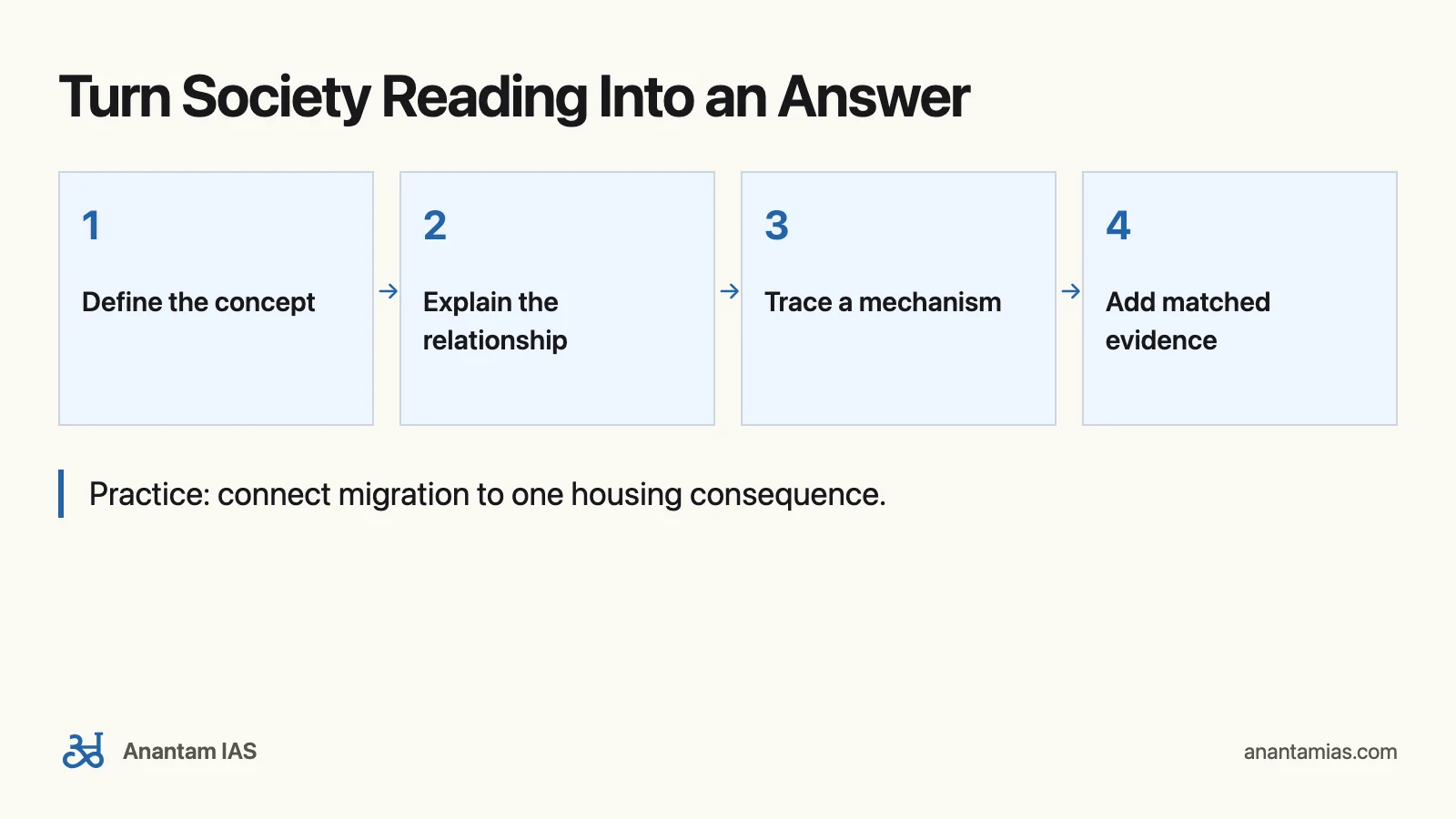
Use this original practice prompt: ‘How can migration affect housing and family support in a city?’ The aim is to connect a social process to consequences, not to insert an unsourced population figure.
Imagine a worker moving from a village to a city. This is a hypothetical example, not a claim about the typical migrant. A useful note needs the intermediate links:
- Process: the person’s place of work and residence changes.
- Constraint: income, rental conditions or location may limit the housing options available in the example.
- Household decision: the worker might move alone, share accommodation or bring family members. The arrangement changes which support is available nearby.
- Consequence: commuting, care or access to services may become a problem. Choose a consequence you can explain rather than listing every possible difficulty.
- Evidence need: identify what a survey would have to measure before you could generalize this explanation.
Your note now distinguishes a plausible mechanism from an established pattern. When you later add a statistic, record the source year and the group being measured. A city-wide total and a finding about a particular migrant group aren’t interchangeable.
Read the urbanization guide for a fuller issue discussion. Use the book to explain the mechanism and the issue guide to add relevant context. Copying both into one long note loses the purpose of having two sources.
Build Notes That Answer a Question
Give each syllabus theme one working sheet. Start with the question, then build the note in a consistent order:
- Concept: define the idea in ordinary language, retaining the correct term.
- Relationship: explain which actors or institutions are connected.
- Mechanism: show how one change can affect another.
- Example: use a verified case or a clearly labeled hypothetical illustration.
- Evidence: add a dated fact only if it supports the explanation.
- Qualification: state the condition under which your argument may not apply.
The salient features of Indian society guide provides an overview for locating these themes. Your sheet should solve a smaller problem than the overview does.
A Six-Week Reading and Practice Plan
Use this sequence at a pace that leaves room for your other subjects. The weeks define a route through themes, not a guarantee of syllabus completion.
- Week 1: map the syllabus and read the foundation material on social structure and diversity.
- Week 2: work on family, kinship and gender. Write one relationship-based explanation.
- Week 3: study stratification and inequality. Separate the concept from the statistic used to illustrate it.
- Week 4: study rural-urban change and migration. Build a causal chain with a qualification.
- Week 5: read social change and development selectively. Add a reference passage only where the NCERT explanation leaves a gap.
- Week 6: write and review answers from your own sheets. Reread weak concepts instead of restarting every book.
Keep contemporary examples current, but don’t let daily reading constantly expand your source list. Pick one theme, one foundation source and one question you can answer after studying it. That is enough to begin.
Frequently Asked Questions
What should a GS1 beginner read first?
Start with relevant NCERT sociology texts and your syllabus. Add one reference only when you can identify the theme or concept that needs greater depth.
Can I use a Sociology optional booklist?
Its purpose and depth differ. Do not adopt the whole list for GS1; choose sources according to the task and your specific gaps.
Do I need several Ram Ahuja books?
Not at the start. Check the exact titles and contents, then add the source that fills a defined concept or application gap.
Where are the official NCERT PDFs?
Use NCERT’s official textbook portal and check title, language and contents. A third-party bundle is not evidence that you have the current official copy.
How do I combine a book with current evidence?
Explain the mechanism first. Add a dated, relevant figure or case with its source and measured group. Do not use a statistic as a substitute for explaining the relationship.
Tell Google you want more of this.
Add Anantam IAS as a preferred sourceOne tap, and this site shows up more often in your own Top Stories, AI Overviews and AI Mode. Remove it any time.