SCO Summit 2025: Tianjin Declaration, Modi’s Visit, and India’s Stance
SCO Summit 2025 in Tianjin: 25th Heads of State Council, Tianjin Declaration, Modi's first China visit in seven years, expansion, and India's position explained for UPSC.
The SCO Summit 2025 was the 25th meeting of the Council of Heads of State of the Shanghai Cooperation Organisation, held in Tianjin, China, from 31 August to 1 September 2025. It was the largest summit in the bloc’s history and the fifth time China hosted the heads of state meeting. Prime Minister Narendra Modi attended in person, his first visit to China in seven years, and the Tianjin Declaration was adopted along with 23 other documents covering everything from terrorism to the SCO Development Strategy 2035.
For India, the SCO Summit 2025 was a careful diplomatic balancing act. New Delhi had to defend its position on cross-border terrorism after the April 2025 Pahalgam attack, reset working contact with Beijing after the long post-Galwan freeze, signal continued partnership with Moscow, and avoid getting boxed into a China-led alternative order. The fact that India accepted the Tianjin Declaration, which explicitly condemned the Pahalgam attack, suggests the diplomatic outcome was usable, if not transformative.
This explainer walks through what the SCO is, why the Tianjin meeting mattered, what the SCO Summit 2025 declaration contained, where India pushed and where it held back, and what UPSC aspirants need to remember about the bloc’s expansion, structure, and India’s evolving stance.
Quick Facts on SCO Summit 2025
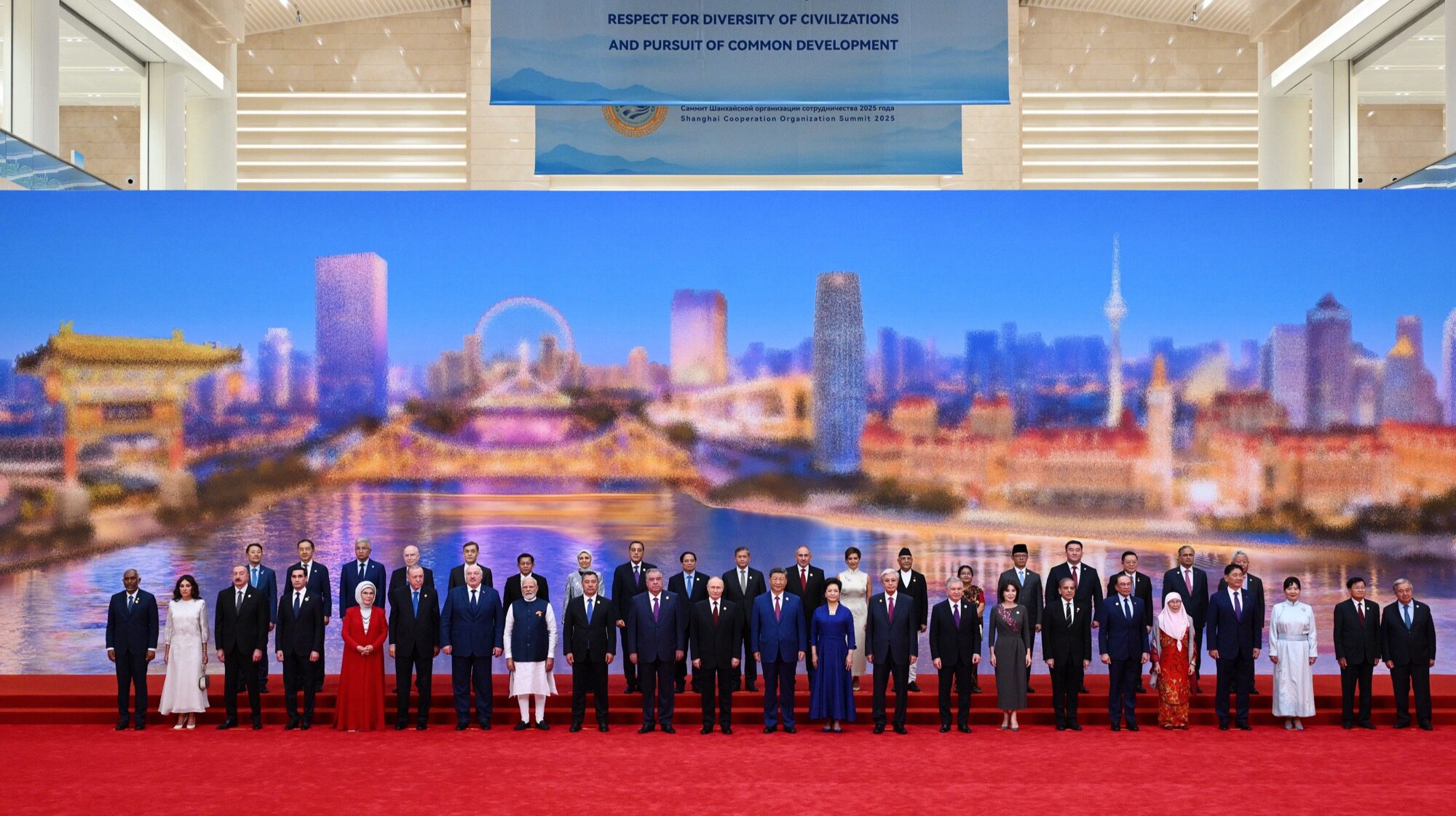
- Edition. 25th Council of Heads of State meeting.
- Host city. Tianjin, China, at the Meijiang International Convention and Exhibition Center.
- Dates. 31 August to 1 September 2025.
- India’s representation. Prime Minister Narendra Modi attended in person; first visit to China since 2018.
- Documents adopted. 24 in total, including the Tianjin Declaration and the SCO Development Strategy until 2035.
- Members in 2025. China, Russia, Kazakhstan, Kyrgyzstan, Tajikistan, Uzbekistan, India, Pakistan, Iran (joined 2023), Belarus (joined 2024).
- Observers. Afghanistan, Mongolia.
- Dialogue partners. 14 states including Türkiye, Saudi Arabia, Egypt, UAE, Qatar, Sri Lanka, Nepal, Cambodia, Bahrain, Kuwait, Maldives, Myanmar, Armenia, Azerbaijan.
- Next chair. Kyrgyzstan, for the 2025 to 2026 cycle.
What Is the SCO and Why It Matters
The Shanghai Cooperation Organisation is a Eurasian political, economic, and security bloc founded in 2001 in Shanghai by China, Russia, Kazakhstan, Kyrgyzstan, Tajikistan, and Uzbekistan. It grew out of the Shanghai Five, a confidence-building mechanism started in 1996 to settle Soviet-era border disputes between China and four post-Soviet Central Asian neighbours.
The bloc’s working agenda is built on what insiders call the three evils: terrorism, separatism, and extremism. The Regional Anti-Terrorist Structure (RATS), headquartered in Tashkent, coordinates intelligence sharing and joint counter-terror exercises. The SCO also runs a Business Council, an Interbank Consortium, and ministerial tracks on culture, agriculture, energy, and digital cooperation.
India joined as a full member in 2017 alongside Pakistan. Iran was admitted as the ninth member in 2023, and Belarus became the tenth in July 2024. With the addition of Belarus, the SCO now covers about 24 percent of global land area, 42 percent of the world’s population, and roughly a quarter of global GDP in purchasing power parity terms. That demographic and geographic weight is exactly why the SCO Summit 2025 attracted attention well beyond the member states.
The Road to Tianjin
The Tianjin summit was preceded by months of preparatory ministerial meetings in 2025. The SCO Council of Foreign Ministers met in Tianjin in July 2025, where External Affairs Minister S. Jaishankar represented India. Defence ministers met in June, and there were heads of government, transport, energy, and security council secretary meetings spread across the year.
China assumed the rotating chairmanship in July 2024 from Kazakhstan, which had hosted the 2024 Astana summit. China’s theme for its presidency was building a closer SCO community with a shared future, framed as a deepening of the Shanghai Spirit. That framing carried straight into the SCO Summit 2025 documents.
The Tianjin summit’s symbolic weight was amplified by the parallel staging of the SCO Plus format, which included observer and dialogue partner states, and by a separate military parade in Beijing on 3 September marking the 80th anniversary of the end of World War II. Modi did not attend the parade but was present for the SCO heads of state programme.
Modi’s First China Visit in Seven Years
Prime Minister Modi’s attendance at the SCO Summit 2025 was the headline takeaway from an Indian perspective. His last visit to China was in June 2018 for the Qingdao SCO summit. The intervening years included the 2020 Galwan Valley clash, the long military standoff in Eastern Ladakh, the Brahmaputra River boundary mechanism disruptions, and a near complete freeze in high-level political contact.
Modi met Chinese President Xi Jinping on 31 August on the sidelines of the SCO Summit 2025. The two leaders had previously met at the BRICS summit in Kazan in October 2024, which had produced the disengagement and patrolling understandings at Demchok and Depsang. The Tianjin meeting was framed as the next step in stabilising the relationship.
Modi also held bilateral meetings with Russian President Vladimir Putin and several Central Asian leaders. The Modi-Putin meeting carried particular weight given the ongoing Russia-Ukraine war, sustained Western pressure on India’s Russian oil imports, and the planned Putin visit to India in December 2025.
The Tianjin Declaration Explained
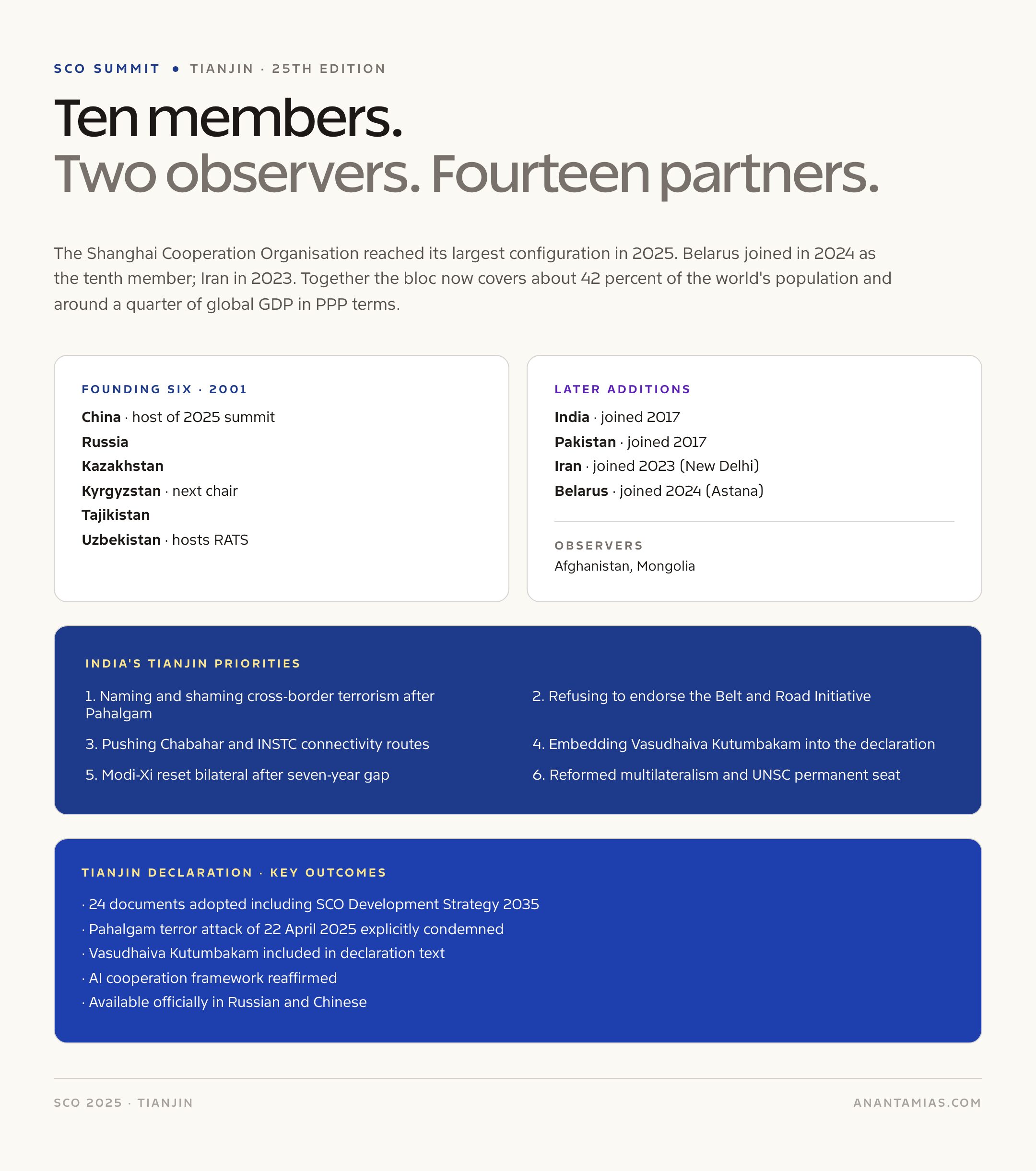
The Tianjin Declaration is the political outcome document of the SCO Summit 2025. It was adopted by all ten members and runs to several thousand words covering global governance, multilateralism, regional security, economic cooperation, and the SCO’s institutional development.
Three points in the declaration deserve special attention from an Indian perspective.
First, the declaration explicitly condemned the 22 April 2025 Pahalgam terror attack in Jammu and Kashmir, which killed 26 civilians. The declaration called for the perpetrators and sponsors to be brought to justice. It was the first time an SCO declaration named Pahalgam by reference. The declaration also condemned the March 2025 Jaffar Express hijacking and the May 2025 Khuzdar school bus bombing in Pakistan, framing terrorism as a shared regional concern rather than picking sides.
Second, the declaration incorporated India’s civilisational concept of Vasudhaiva Kutumbakam, translated as one earth, one family, one future. This was a notable diplomatic win for New Delhi because it embedded an Indian phrase into a China-hosted SCO document. The phrase had already been adopted in India’s G20 presidency theme in 2023 and now sits in the SCO’s reference vocabulary.
Third, the declaration laid out the SCO Development Strategy until 2035. The strategy commits members to deeper cooperation on artificial intelligence, the digital economy, green development, energy security, and connectivity. Where members disagree, like on the Belt and Road Initiative, the declaration uses careful language that India can sign without endorsing the BRI directly.
India’s Stance at the SCO Summit 2025
India’s stance at the SCO Summit 2025 followed three threads that have run through New Delhi’s engagement with the bloc since 2017. The first is counter-terrorism. India used the platform to push for naming and shaming of state sponsors of terror, without accepting any definition that would dilute its position on Pakistan. The Pahalgam condemnation in the declaration was a direct outcome.
The second thread is strategic autonomy. India refused to endorse the Belt and Road Initiative in the declaration, a position it has held since 2017 because BRI passes through Pakistan-occupied Kashmir via the China-Pakistan Economic Corridor. The Tianjin Declaration’s connectivity language was crafted to allow India to sign without backing the CPEC route.
The third thread is connectivity through Central Asia on India’s own terms. New Delhi has pushed the Chabahar port route and the International North-South Transport Corridor (INSTC) as alternatives to Pakistan-based overland trade. Modi’s bilateral meetings with the Central Asian heads of state in Tianjin reinforced the Chabahar and INSTC pitches.
India’s positioning on the global order was also visible. Modi reiterated the call for reformed multilateralism and a more representative United Nations Security Council, themes consistent with India’s G20 and IBSA messaging. New Delhi also flagged its concerns about cross-border data flows and the misuse of artificial intelligence, two areas where the SCO Development Strategy 2035 had concrete language.
SCO Expansion: Iran and Belarus
The SCO Summit 2025 was the first heads of state meeting with the bloc at its full ten-member size after Belarus joined in July 2024. Iran joined as the ninth member at the 2023 New Delhi summit, hosted by India during its rotating chairmanship.
The Iran admission added significant geopolitical weight. Iran shares borders with Pakistan and Afghanistan, controls Chabahar port leased to India, and is a major energy producer. Iran’s membership also gave the bloc a Persian Gulf footprint for the first time.
Belarus’s admission in 2024 extended the SCO into Eastern Europe. Belarus is a close ally of Russia, hosts Russian tactical nuclear weapons since 2023, and shares borders with three NATO and EU states. The Belarus accession was politically sensitive for India because of the Russia-Belarus alignment in the Ukraine war, but New Delhi raised no objection.
The 14 dialogue partners add another layer. Saudi Arabia, UAE, Qatar, Egypt, and Türkiye joined as dialogue partners between 2022 and 2024, giving the SCO a West Asian profile that did not exist a decade ago. Sri Lanka, Nepal, Cambodia, and Myanmar add South and Southeast Asian depth, while Armenia and Azerbaijan extend into the South Caucasus.
Comparing the Tianjin Summit with Prior Editions
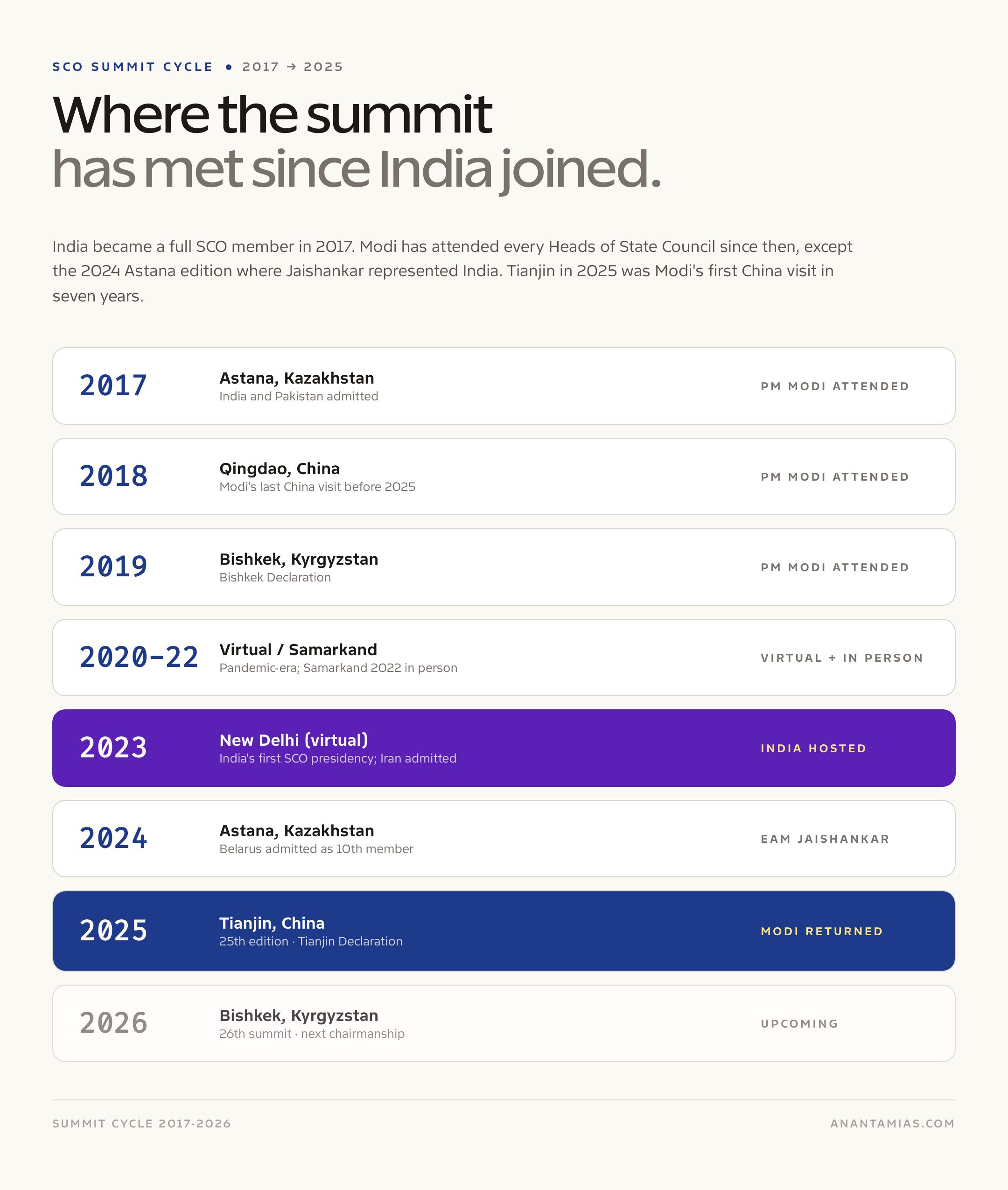
A short comparison helps place the SCO Summit 2025 in context.
| Year | Host | City | India’s Representation | Key Outcome |
|---|---|---|---|---|
| 2017 | Kazakhstan | Astana | PM Modi | India and Pakistan admitted as full members |
| 2018 | China | Qingdao | PM Modi | Qingdao Declaration; first summit with India and Pakistan as members |
| 2019 | Kyrgyzstan | Bishkek | PM Modi | Bishkek Declaration |
| 2020 | Russia | Moscow (virtual) | PM Modi (virtual) | Pandemic-era virtual summit |
| 2021 | Tajikistan | Dushanbe | PM Modi (virtual) | Memorandum on Iran’s accession process |
| 2022 | Uzbekistan | Samarkand | PM Modi | Samarkand Declaration; Iran process advanced |
| 2023 | India | New Delhi (virtual) | PM Modi hosted | New Delhi Declaration; Iran admitted as 9th member |
| 2024 | Kazakhstan | Astana | EAM Jaishankar | Belarus formally admitted; PM Modi did not attend |
| 2025 | China | Tianjin | PM Modi | Tianjin Declaration; SCO Development Strategy 2035; Pahalgam condemned |
The 2023 New Delhi summit hosted by India was held in virtual format, a deliberate choice that limited the optics of welcoming Pakistan’s leadership to India. The 2024 Astana summit was the first heads of state meeting Modi skipped since becoming Prime Minister, sending Jaishankar instead. The decision to attend the SCO Summit 2025 in person reversed that trend and signalled a measured reopening with China.
SCO Institutional Architecture
The SCO operates through several permanent and rotating bodies. UPSC questions often test the names and locations.
- Council of Heads of State. Top decision-making body, meets annually. The SCO Summit 2025 was this body’s 25th meeting.
- Council of Heads of Government. Meets annually to approve the budget and economic programmes.
- Council of Foreign Ministers. Prepares the heads of state meeting.
- Secretariat. Headquartered in Beijing. The Secretary-General serves a three-year term on rotation.
- Regional Anti-Terrorist Structure (RATS). Headquartered in Tashkent, Uzbekistan. Coordinates counter-terror intelligence and joint exercises.
- Working languages. Russian and Chinese.
The rotating chairmanship moves between members each year. Kyrgyzstan takes over from China for the 2025 to 2026 cycle, with the 26th summit expected in Bishkek.
What the SCO Summit 2025 Did Not Deliver
For all the symbolic weight, the SCO Summit 2025 had its limits. The Tianjin Declaration is available in Russian and Chinese as the official versions; an English version was not formally released. That technical detail matters because India and Pakistan are the bloc’s only English-language members, and the absence of an English text complicates domestic political messaging.
The summit also did not resolve the deeper India-China structural questions. Border demarcation along the Line of Actual Control remains pending. The trade deficit, which has widened past USD 100 billion annually, was not addressed in any binding outcome. The Brahmaputra River hydrological data sharing has not fully resumed. The Modi-Xi bilateral was a stabilisation meeting, not a reset.
On terrorism, the Pahalgam condemnation was significant, but the declaration did not name Pakistan-based groups or sponsors. The condemnation of attacks in Pakistan in the same paragraph created an equivalence India would not have written on its own. The diplomatic compromise was visible in the text.
Prelims and Mains Pointers for UPSC
For UPSC Prelims:
- Founded 2001 in Shanghai by 6 members; evolved from Shanghai Five (1996).
- 10 members in 2025; observers Afghanistan and Mongolia.
- Iran joined 2023 at New Delhi summit hosted by India.
- Belarus joined 2024 at Astana summit.
- RATS headquartered in Tashkent; Secretariat in Beijing.
- Working languages: Russian and Chinese.
- 2025 Tianjin summit hosted by China; 25th edition.
- India hosted the 2023 summit in virtual format.
For UPSC Mains GS-II (International Relations):
- Analyse India’s balancing act in the SCO between strategic autonomy and engagement with the China-Russia axis.
- Discuss how the SCO Summit 2025’s Tianjin Declaration handled the question of cross-border terrorism after Pahalgam.
- Evaluate the implications of SCO expansion (Iran, Belarus) for India’s neighbourhood policy.
- Compare India’s positioning in the SCO with its Quad and Indo-Pacific commitments and broader India foreign policy architecture.
How SCO Fits in India’s Wider Foreign Policy
India’s SCO engagement sits within a larger multi-alignment strategy. New Delhi simultaneously holds memberships in the Quad with the United States, Japan, and Australia; the BRICS grouping; the G20; the Indian Ocean Rim Association; and several mini-laterals like the I2U2 with Israel, the UAE, and the United States.
The SCO is India’s primary platform for sustained contact with the Central Asian republics, which sit outside the Quad and BRICS architectures. It is also the only multilateral forum where India and Pakistan are formal members of the same security and political bloc, a situation that constrains how blunt either capital can be in the declarations.
Modi’s Tianjin visit also has to be read against the broader India-China relations reset that began in October 2024, and the deepening India-Russia relations that continue to shape New Delhi’s energy and defence sourcing.
Conclusion
The SCO Summit 2025 in Tianjin produced more headlines than hard deliverables, but the headlines were real. Modi’s first China visit in seven years restarted political contact at the highest level. The Tianjin Declaration named the Pahalgam attack. India pushed Vasudhaiva Kutumbakam into a Chinese-hosted document. New Delhi kept its distance from the BRI. And the bloc settled into its new ten-member configuration with a 2035 strategy that India can shape from the inside.
For UPSC aspirants, the SCO Summit 2025 is a clean case study in how India practises strategic autonomy inside a multilateral platform where it has limited drafting leverage. Remember the date, the city, the declaration name, the development strategy 2035, the Pahalgam reference, and the fact that this was the largest SCO summit on record. Those are the prelim and mains anchors that will carry through any related question.
Frequently Asked Questions
When and where was the SCO Summit 2025 held?
The SCO Summit 2025 was held in Tianjin, China, from 31 August to 1 September 2025. It was the 25th meeting of the Council of Heads of State and the fifth time China hosted the heads of state summit.
Did Prime Minister Modi attend the SCO Summit 2025?
Yes. Prime Minister Narendra Modi attended in person, his first visit to China since the 2018 Qingdao SCO summit. He held bilateral meetings with President Xi Jinping, President Putin, and several Central Asian leaders on the sidelines.
What is the Tianjin Declaration?
The Tianjin Declaration is the political outcome document of the SCO Summit 2025. It was adopted by all ten members, condemned the Pahalgam terror attack, embedded India’s Vasudhaiva Kutumbakam concept, and launched the SCO Development Strategy until 2035.
How many members does the SCO have in 2025?
The SCO has ten full members in 2025: China, Russia, Kazakhstan, Kyrgyzstan, Tajikistan, Uzbekistan, India, Pakistan, Iran (joined 2023), and Belarus (joined 2024). Afghanistan and Mongolia are observers, and there are 14 dialogue partners.
What is RATS in the SCO context?
RATS is the Regional Anti-Terrorist Structure of the SCO, headquartered in Tashkent, Uzbekistan. It coordinates counter-terror intelligence sharing, joint exercises, and a database of designated terrorist organisations among member states.
Why did India refuse to endorse the Belt and Road Initiative at the SCO?
India has refused to endorse the BRI in every SCO declaration since joining in 2017 because the China-Pakistan Economic Corridor, a flagship BRI project, passes through Pakistan-occupied Kashmir, which India claims as sovereign territory.
Who will host the next SCO Summit?
Kyrgyzstan holds the SCO chairmanship for 2025 to 2026 and will host the 26th heads of state summit. Bishkek hosted the bloc once before, in 2019.