India-Russia ties are framed as a Special and Privileged Strategic Partnership — the only such bilateral label India uses. The relationship survived the Soviet collapse, the 1998 nuclear tests, sanctions regimes, and now the Russia-Ukraine war. It is neither an alliance nor a transactional relationship — it is a hedge against over-dependence on any single pole, especially in defence, energy and Eurasian access. For UPSC GS II, India-Russia tests the concept of strategic autonomy, the trade-off between discounted Russian oil and Western pressure, and the quiet Russia-China drift India must manage.
Historical context
The Indo-Soviet relationship solidified after the 1971 Treaty of Peace, Friendship and Cooperation — which gave India diplomatic cover in the Bangladesh war. Moscow was the principal supplier of tanks, fighters, submarines and nuclear reactors through the Cold War. Post-1991, relations dipped; the 2000 Declaration on Strategic Partnership and the 2010 upgrade to Special and Privileged Strategic Partnership restored the trajectory. Since 2022, the Russia-Ukraine war has reshaped the relationship's economic balance — and introduced new risks.
Areas of cooperation
Defence
India remains Russia's largest arms client historically, though diversifying. Key platforms:
| Platform | Status |
|---|---|
| S-400 Triumf | 3 of 5 squadrons delivered; remaining delayed by Ukraine war |
| Su-30MKI / MiG-29 | Backbone of IAF; upgrades ongoing |
| T-90 Bhishma / T-72 | Indian Army main tanks |
| INS Vikramaditya, Talwar-class frigates | Navy |
| BrahMos | Indo-Russian JV — now exported to Philippines |
| AK-203 | Joint production at Amethi |
India’s imports from Russia have declined 37% over the past decade; the defence import basket is shifting toward France, Israel, the US and indigenous production under Make in India.
Energy
- Russia became India's largest crude oil supplier post-2022 — at one point accounting for over 40% of imports.
- Kudankulam Nuclear Power Plant — six VVER-1000 reactor units with Russian technology (two operational, more under construction).
- Coking coal supply agreements; Rosneft's stake in Nayara Energy.
Trade
- Bilateral trade surged from USD 10 billion pre-2022 to USD 65.7 billion in FY24 — driven almost entirely by Indian oil imports.
- India's exports to Russia remain around USD 3 billion, creating a major trade imbalance.
- Rupee-rouble trade mechanism faces unutilised rupee surpluses in Russia.
- India-EAEU FTA negotiations continue.
Connectivity
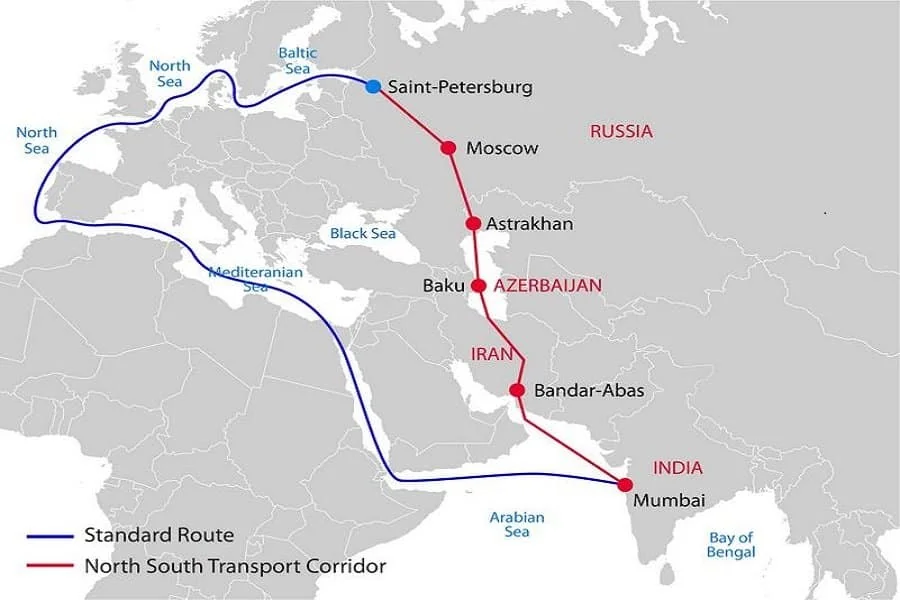
- International North-South Transport Corridor (INSTC) — revived by the war; first Russian coal shipments reached India via INSTC in 2024.
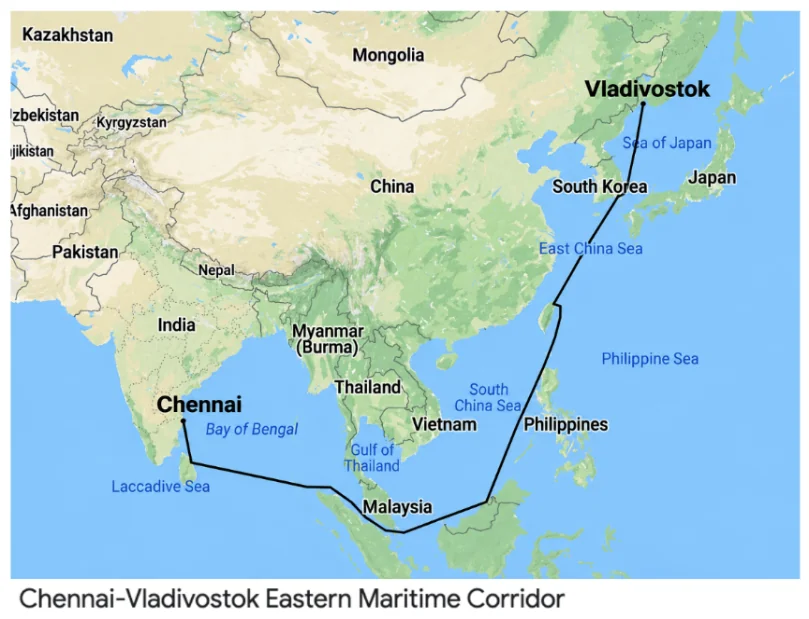
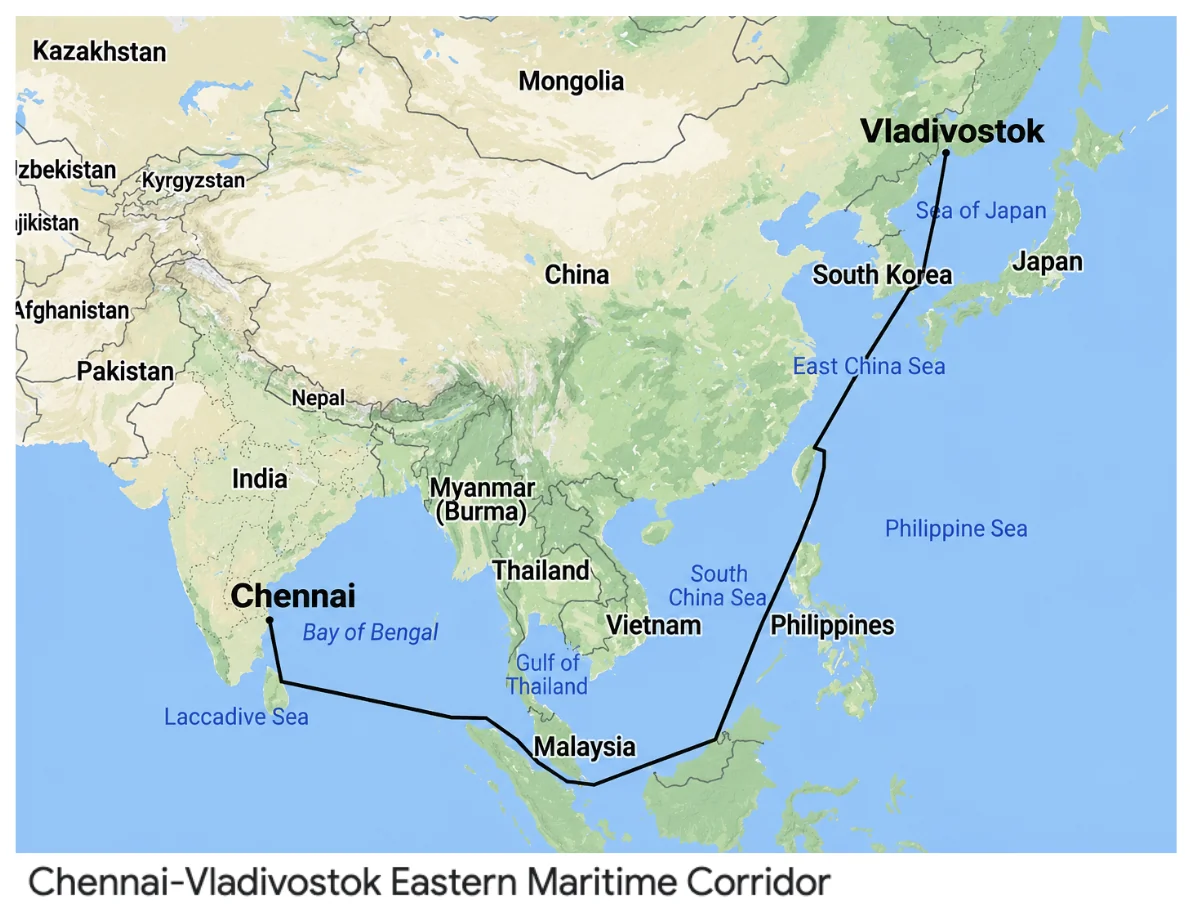
- Chennai-Vladivostok Eastern Maritime Corridor — cuts shipping time significantly.
- Northern Sea Route potential.
Space
ISRO-Roscosmos cooperation on the Gaganyaan human spaceflight programme, planetary exploration, and satellite navigation.
Multilateral
- BRICS (Russia chaired 2024) and SCO (India chaired 2023).
- Russia supports India's permanent UNSC seat.
- Coordination in the G20 where Moscow is partially isolated.
Key issues
Changing defence pattern
- Ukraine war has delayed spare parts and new platforms.
- CAATSA risk from the US has been managed but remains a background threat.
- India's defence indigenisation lowers long-term dependence.
Trade imbalance
High oil figures mask an imbalance: India earns little foreign exchange from Russia beyond a limited pharma and engineering export basket. Sanctions complicate financial settlement — SWIFT exclusion forces rupee, yuan and UAE dirham workarounds.
Russia-China drift
- Anti-American convergence; vision of multipolarity.
- China is Russia's largest oil buyer (now exceeding India in some quarters).
- Russia echoes Chinese positioning on the Indo-Pacific (calling Quad an "Asian NATO").
- 77% of China's arms imports during 2016-2020 came from Russia — defence tech flows that eventually affect India.
India's task: prevent Russia from becoming a Chinese junior partner, without overreacting.
Indo-Pacific divergence
Russia views the Indo-Pacific concept sceptically. This limits Russia as a partner for India's maritime strategy.
Central Asia and Afghanistan
- Russia is distracted; Central Asia drifts toward China via Shanghai Cooperation Organization and Belt and Road.
- Both engage the Taliban pragmatically, though on slightly different terms.
Points of friction
- India's sympathetic neutrality on Ukraine creates Western pressure without Russian gratitude.
- Sanctions risk for Indian banks processing Russia-linked payments.
- Declining share of Russian defence equipment in new Indian procurement.
- Russia's arms and oil flows to China complicate Delhi's calculus.
Latest developments (2024-26)
- PM Modi's Moscow visit (July 2024) — Russia's highest civilian honour (Order of Saint Andrew the Apostle) conferred on PM Modi; trade target of USD 100 billion by 2030 endorsed.
- Modi's Kyiv visit (August 2024) — first Indian PM to visit Ukraine; balanced positioning affirmed.
- BRICS Summit, Kazan (October 2024) — Modi-Xi bilateral on the sidelines; BRICS expansion deliverables; Modi-Putin bilateral.
- G20 Rio (2024) — India held the line on Russia-Ukraine consensus language.
- India's G20 Presidency (2023) secured the New Delhi Declaration despite deep divides on Ukraine.
- Red Sea crisis (2024) rerouted shipping; INSTC became more relevant.
- AI Action Summit (Paris, 2025) — India and Russia aligned on AI sovereignty concerns.
- Operation Sindhu Thakur style evacuation frameworks drawn on from Operation Ganga (2022 Ukraine lessons).
- Russia-Ukraine update: Trump administration's shifted posture in 2025 eased some Western pressure on India's Russia trade.
- S-400 remaining squadron delivery timeline renegotiated to 2026-27.
- BrahMos to Philippines deliveries on track; Indonesia and Vietnam in talks.
Way forward
- Diversify defence supply while keeping Russia as a key partner for legacy platforms and co-production.
- Rebalance trade — explore pharma, textiles, engineering goods, agri exports via INSTC.
- Finalise India-EAEU FTA and Bilateral Investment Treaty.
- INSTC and Chennai-Vladivostok — move from announcements to volume.
- Manage Russia-China dynamic — through quiet diplomacy, Central Asia engagement, SCO activism.
Russian oil purchases: the FY23-FY25 story
Post-February 2022, India became one of Russia's two largest oil customers (alongside China):
- FY22 Russian share: under 2%.
- FY23 Russian share: around 19% and rising.
- FY24 Russian share: peaked above 40% in some months; averaged ~35%.
- Price discounts: initially USD 15-30/barrel; narrowed to USD 3-5/barrel by late 2024.
- G7 price cap (USD 60/barrel): India largely complied by using non-G7 tankers, insurers.
- Refined product exports to Europe — India emerged as a major supplier of diesel and gasoline.
This trade helped India stabilise inflation during 2022-24 while supporting Russian revenue — the diplomatic balancing act that defined post-invasion policy.
Chennai-Vladivostok Corridor
The Eastern Maritime Corridor — announced in 2019 — links Chennai and Vladivostok by sea, cutting travel time to about 24 days versus 40 days via the Suez. By 2024, pilot cargo runs were operational. The corridor matters because it gives India access to Russia's Far East, a region Moscow is increasingly opening to Asian partners to offset Western sanctions. Russian LNG, coal, timber, and fertilisers are viable cargoes; India's pharma, tea, engineering, and agri-products flow the other way.
Nuclear energy partnership
Six VVER-1000 reactors at Kudankulam form the bedrock. Units 1 and 2 are operational; 3-6 under construction. A second site (Kudankulam 7-8 discussions, plus a new site planned) is under negotiation. India-Russia civil nuclear cooperation predates the 2008 NSG waiver and operates under a specific bilateral framework.
Eurasia and Central Asia
India's Connect Central Asia policy and the India-Central Asia Summit (virtual, 2022) align partially with Russia's traditional sphere. With Russia distracted, Central Asia increasingly looks to China. India's INSTC push and Chabahar operation partially offset this.
UPSC Relevance
India-Russia is tested in GS II (bilateral relations, multilateralism), GS III (energy security). Prelims has asked about S-400, BrahMos, Kudankulam, INSTC, CAATSA. Mains prompts centre on strategic autonomy, Russia-China drift, and the energy-defence nexus. Essay angles: "Old friends in a new world."
Practice question (Mains): The Russia-Ukraine war has tested India's strategic autonomy more than any crisis since 1971. Evaluate how India has managed the triangle of Russia, the West, and its own interests. (250 words)
Tell Google you want more of this.
Add Anantam IAS as a preferred sourceOne tap, and this site shows up more often in your own Top Stories, AI Overviews and AI Mode. Remove it any time.