SIPRI on India: Defence Spending, Arms Imports, and the Numbers Behind the Strategic Picture
A complete UPSC GS-III explainer on the latest SIPRI data for India. Covers world military spending of US$ 2,887 billion in 2025, India as the fifth-largest spender at US$ 92.1 billion, India as the second-largest arms importer, the supplier mix dominated by Russia, France, and Israel, and the policy lessons for self-reliance under the Atmanirbhar Bharat programme.
The Stockholm International Peace Research Institute, known by its acronym SIPRI, is the most cited independent source on global military expenditure, arms transfers, and security trends. Every spring SIPRI releases its annual review of military spending and its rolling five-year window of arms transfers. The 2025 release covers calendar-year 2024 spending and the 2020 to 2024 transfer window, and it carries some of the largest year-on-year shifts in two decades. India sits inside almost every top-ten list in that release. The data are dense, the rankings are revealing, and the policy implications are direct.
This article unpacks the SIPRI 2025 numbers for India one step at a time. It walks through global military expenditure, India’s spending and rank, the share of GDP devoted to defence, the arms import picture and India’s place in it, the supplier mix, the export ranking, and the policy levers India has been pulling to alter the trajectory. The aim is to leave the reader with both the raw numbers for prelims and the analytical framing for mains.
Who SIPRI Is and Why the Numbers Matter
SIPRI was set up in 1966 to mark Sweden’s 150 years of unbroken peace. It is funded mainly by the Swedish parliament and operates as an independent international institute headquartered in Stockholm. Its three flagship databases are the Military Expenditure Database, the Arms Transfers Database, and the Multilateral Peace Operations Database. The methodology is transparent. Spending data come from official budgets and supplementary appropriations, adjusted to a common definition that captures pay, pensions, equipment, R&D, military construction, and military aid. Arms transfer data are tracked using a Trend Indicator Value, or TIV, that converts heterogeneous weapons into a common measure of military resources rather than financial value.
Government, defence industry, and policy researchers across the world use SIPRI data as the baseline for comparative analysis. National defence ministries occasionally dispute specific figures, but SIPRI’s methodology is the closest thing to an industry standard that exists.
World Military Expenditure 2025
The headline number from SIPRI’s 2026 reporting is US$ 2,887 billion. That is the total world military expenditure in calendar-year 2025, a real-terms increase of 2.9 percent over 2024. It is a record nominal figure and the steepest real-terms year-on-year increase in decades. The drivers are well known. The Russia-Ukraine war is in its fourth year. Several European NATO members have crossed or approached the 2 percent of GDP defence spending target. China continues a long, steady build-up. The United States remains the dominant single spender. Middle Eastern spending has risen sharply. African spending has grown off a small base.
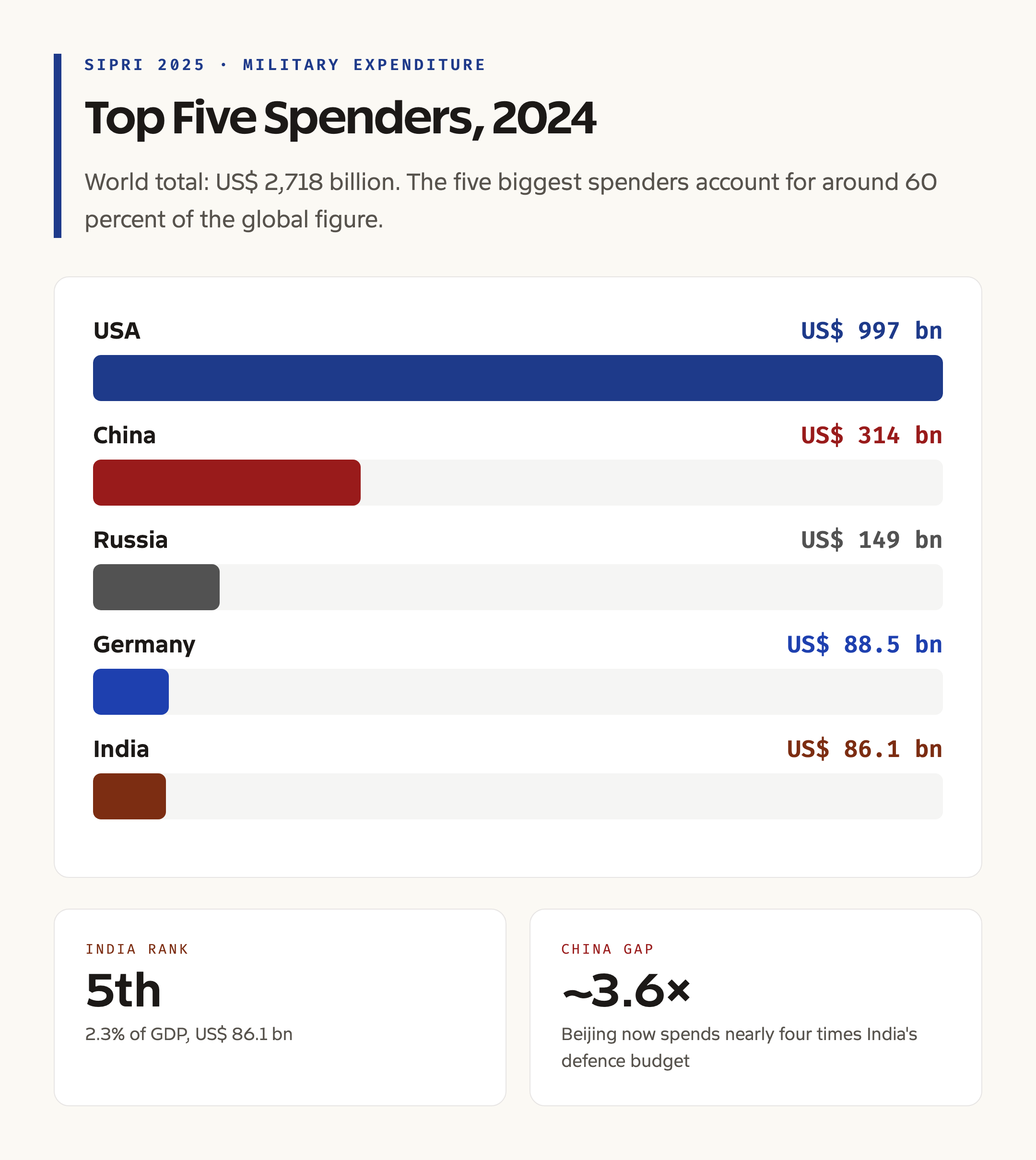
The top three spenders — the United States, China and Russia — account for US$ 1,480 billion between them, about 51 percent of the world total. India is fifth with US$ 92.1 billion, an increase of 8.9 percent on the year. The regional split is where the story sits: US spending fell, while Europe rose 14 percent and Asia and Oceania rose 8.1 percent. For Indian readers the gap with China is the number that matters — Beijing still spends several times what New Delhi does, and the ratio has widened steadily over a decade.
India’s Defence Burden
The military burden, defined as defence expenditure as a percentage of GDP, is the standard measure of how much of a country’s economic capacity is devoted to defence. India’s burden in 2024 was 2.3 percent of GDP. That is roughly the level it has held for two decades. It is below NATO’s 2 percent target, in the sense that it sits very close to that threshold, and it is far below the burden carried by the world’s heaviest spenders.
Three countries top the burden list: Ukraine at about 34 percent of GDP, a wartime extreme; Israel at 8.8 percent, reflecting the post-October 2023 mobilisation; and Algeria at 8.0 percent. The United States carries about 3.4 percent of GDP. Russia carries about 7 percent in 2024 by SIPRI’s adjustment. China’s officially reported burden is around 1.7 percent, though SIPRI’s adjusted figure is somewhat higher. India’s 2.3 percent reflects a deliberate political settlement, in which the Indian state has historically prioritised welfare and development spending while keeping defence at a level deemed sufficient for the threat environment.
India as the Second-Largest Arms Importer
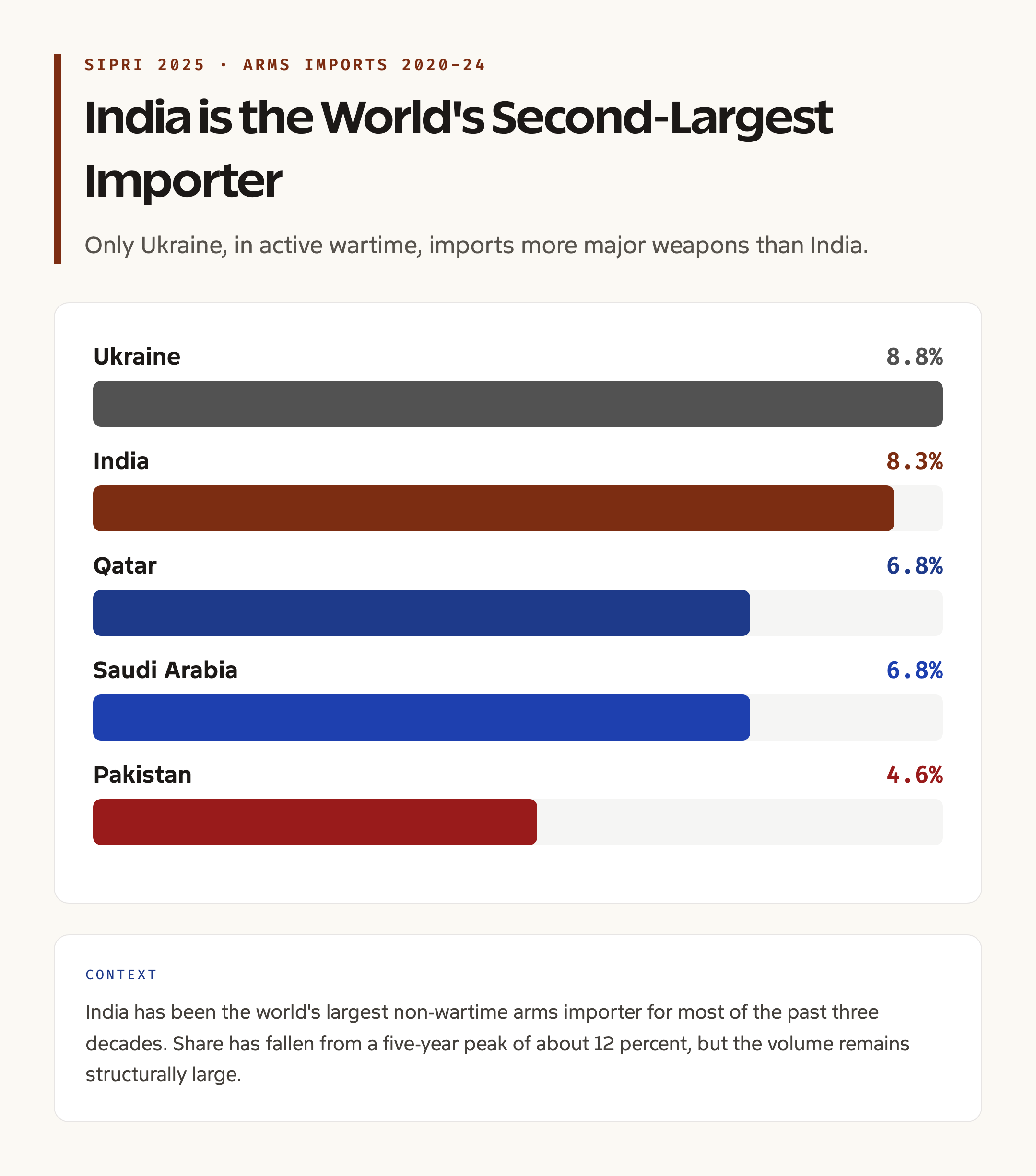
The arms transfer picture is more striking than the spending picture. SIPRI’s 2020 to 2024 window shows India as the second-largest importer of major weapons in the world, capturing 8.3 percent of global imports. Only Ukraine, in active wartime, imported more, at 8.8 percent. Behind India are Qatar at 6.8 percent, Saudi Arabia at 6.8 percent, and Pakistan at 4.6 percent. The Indian share is large in absolute terms because India is one of the very few countries that sustains a multi-service military across air, sea, land, missile, and space domains.
The structural takeaway is that India has been the world’s largest non-wartime arms importer for most of the past three decades. Even though India’s total share has fallen from a previous five-year window peak of about 12 percent, the country still buys more major weapons systems abroad than any other peacetime economy.
India’s Supplier Mix
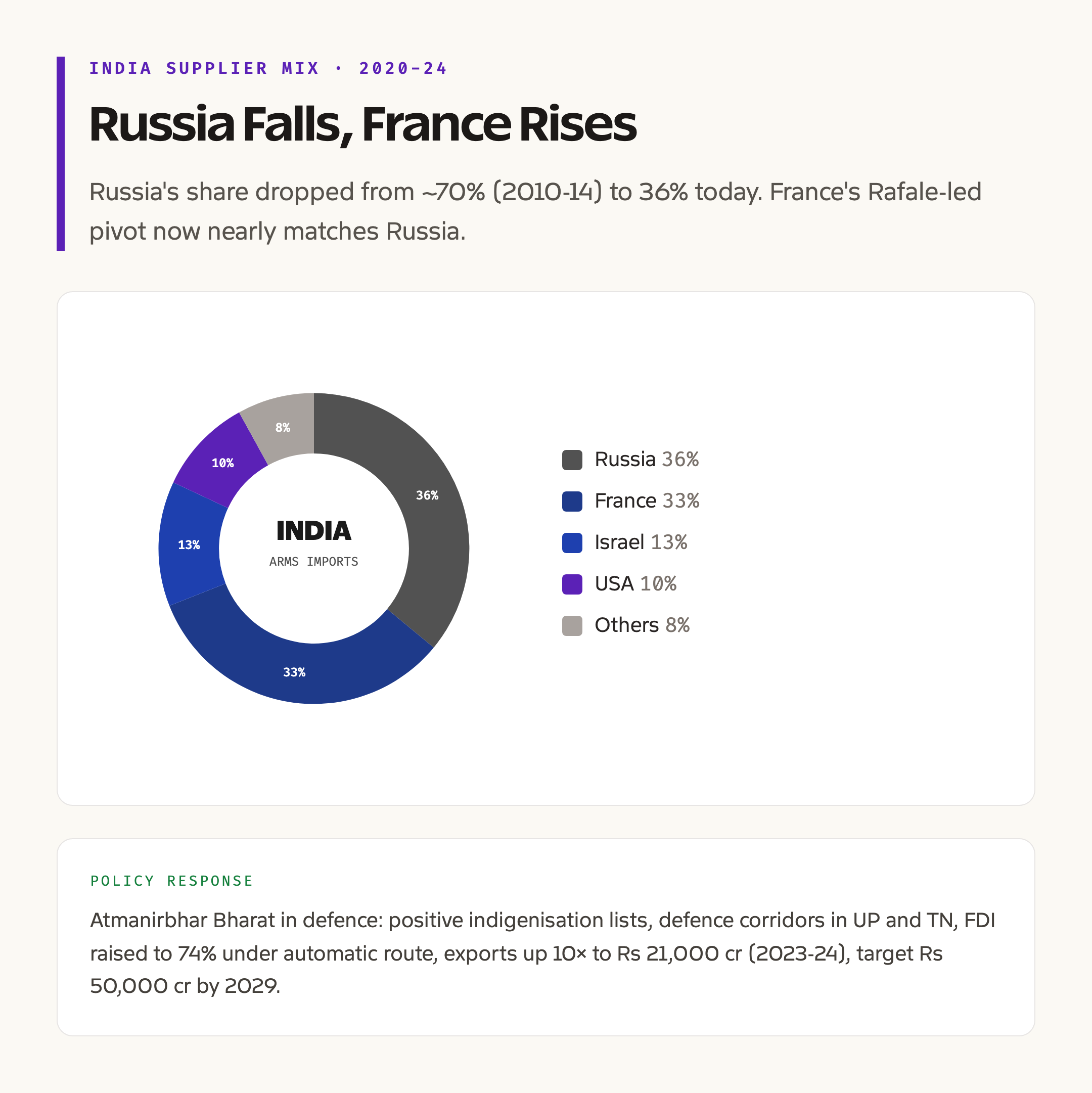
The composition of India’s arms imports is the most analytically interesting dimension of the data. Russia remains the largest single supplier of major Indian weapons systems, with 36 percent of India’s import volume in the 2020 to 2024 window. France is second with 33 percent, a sharp rise driven by Rafale fighter deliveries, Scorpène submarine programmes, and several follow-on contracts. Israel is third with 13 percent, reflecting decades of cooperation in radars, missiles, drones, and electronic warfare. The United States is a smaller but growing supplier through helicopters, transport aircraft, surveillance platforms, and select munitions.
The shift away from Russian dependence is the headline story. In the 2010 to 2014 window, Russia accounted for nearly 70 percent of India’s arms imports. By 2020 to 2024, that share is just over a third. The Ukraine war has constrained Russian production and delivery schedules, accelerating diversification that was already underway. France and Israel have absorbed much of the displaced share.
India as an Arms Exporter
India is now an arms exporter, though still a small one. SIPRI’s data place India in the 20th to 25th rank globally as a supplier, with around 0.2 percent of global exports. The trajectory is what matters. Indian defence exports have grown roughly tenfold over a decade, from a base of around Rs 1,500 crore in 2014-15 to over Rs 21,000 crore in 2023-24, and the government’s stated target is Rs 50,000 crore by 2029. The flagship export items include the BrahMos cruise missile to the Philippines, Pinaka rocket systems, Akash missile systems, offshore patrol vessels, and a wide range of components, ammunition, and small arms. For the strategic picture on indigenous platforms, see the article on the BrahMos missile family and on the Agni family.
The top three global exporters in the 2020 to 2024 window are the United States with about 43 percent of global exports, France with about 9.6 percent, and Russia with about 7.8 percent. Russia’s slide from second to third place is the most consequential change at the top of the league table since SIPRI began tracking. China sits at fourth with around 5.9 percent.
The Policy Backdrop: Atmanirbhar Bharat in Defence
India has spent the past decade trying to move down the import league table and up the export league table. The instruments are several and overlapping. The Defence Acquisition Procedure now prioritises indigenously designed, developed, and manufactured procurement in its category hierarchy. The positive indigenisation lists, periodically revised by the Department of Defence Production, ban imports of specified items beyond a phased timeline, forcing the services to procure domestically. Defence corridors in Uttar Pradesh and Tamil Nadu pool industrial infrastructure for private and public sector defence manufacturers.
The Strategic Partnership model brings private firms into major platform programmes alongside public-sector defence undertakings. The opening of foreign direct investment in defence to 74 percent under the automatic route, and 100 percent under the government route, has attracted some joint-venture activity. The Innovations for Defence Excellence programme, run by the Defence Innovation Organisation, channels start-up capital into specific operational problems. Each instrument moves the needle by some small amount, and the cumulative effect is visible in the export numbers and in the increasing share of capital procurement going to Indian vendors.
What the Numbers Do Not Tell You
SIPRI captures the visible, conventional defence economy. It does not capture, or captures imperfectly, several adjacent variables that matter strategically. Cyber capability and electronic warfare capacity are partly invisible to the database. Space-based reconnaissance and military communications, which India has expanded sharply through the defence space agency and dedicated satellites, are imperfectly tracked. The acquisition of dual-use technology through civilian channels is by definition outside the arms transfer net.
Force structure quality is also a separate question. A country can spend less and field a more capable force if its training, logistics, doctrine, and force management are better. SIPRI does not measure those qualitative dimensions. The data are an input to strategic analysis, not the analysis itself.
What India Should Take From SIPRI 2025
Three lessons follow. First, the absolute spending gap with China continues to widen, and the gap is now large enough that India cannot match it dollar for dollar. The implication is that asymmetric advantages in specific domains, including missile capability, undersea warfare, electronic warfare, and information operations, matter more than headline spending parity. Second, the diversification of arms suppliers is real but partial. France and Israel cannot fully substitute for the volume Russia once provided, and the resilience of the supply chain depends on stronger indigenous capacity. Third, the export trajectory shows that the policy levers are working, but the base is small and competition in the global arms market is intense.
The relevant overlaps with broader UPSC GS-III topics are direct. Internal security depends on a defence industrial base capable of replenishing combat losses without import bottlenecks. Border management is increasingly equipment-intensive, with sensors, surveillance drones, and counter-drone systems shaping the frontier. The shift from a buyer to a partial seller is one of the few structural moves India has made in the global security order in the past decade.
Prelims and Mains Pointers
For prelims, the key facts are world military expenditure of US$ 2,887 billion in 2025, India’s rank of fifth at US$ 92.1 billion, India’s military burden of 2.3 percent of GDP, India’s second place among arms importers at 8.3 percent of global share, and India’s main suppliers being Russia, France, and Israel. Top exporters are the United States, France, and Russia in that order. SIPRI is headquartered in Stockholm.
For mains, the analytical questions cluster around defence self-reliance, the implications of supplier diversification, the limits of headline spending as a measure of capability, and the export pivot under Atmanirbhar Bharat. SIPRI is one of the most cited inputs into Indian strategic policy debate, and a working command of the 2025 numbers is the price of entry to that debate.