Smog: Causes, Health Impact, Smog Towers and Delhi AQI 2024 (UPSC)
UPSC guide to smog — sulfurous vs photochemical, Delhi NCR winter smog, GRAP, smog towers, anti-smog guns, India's NCAP and 2024–26 AQI updates.
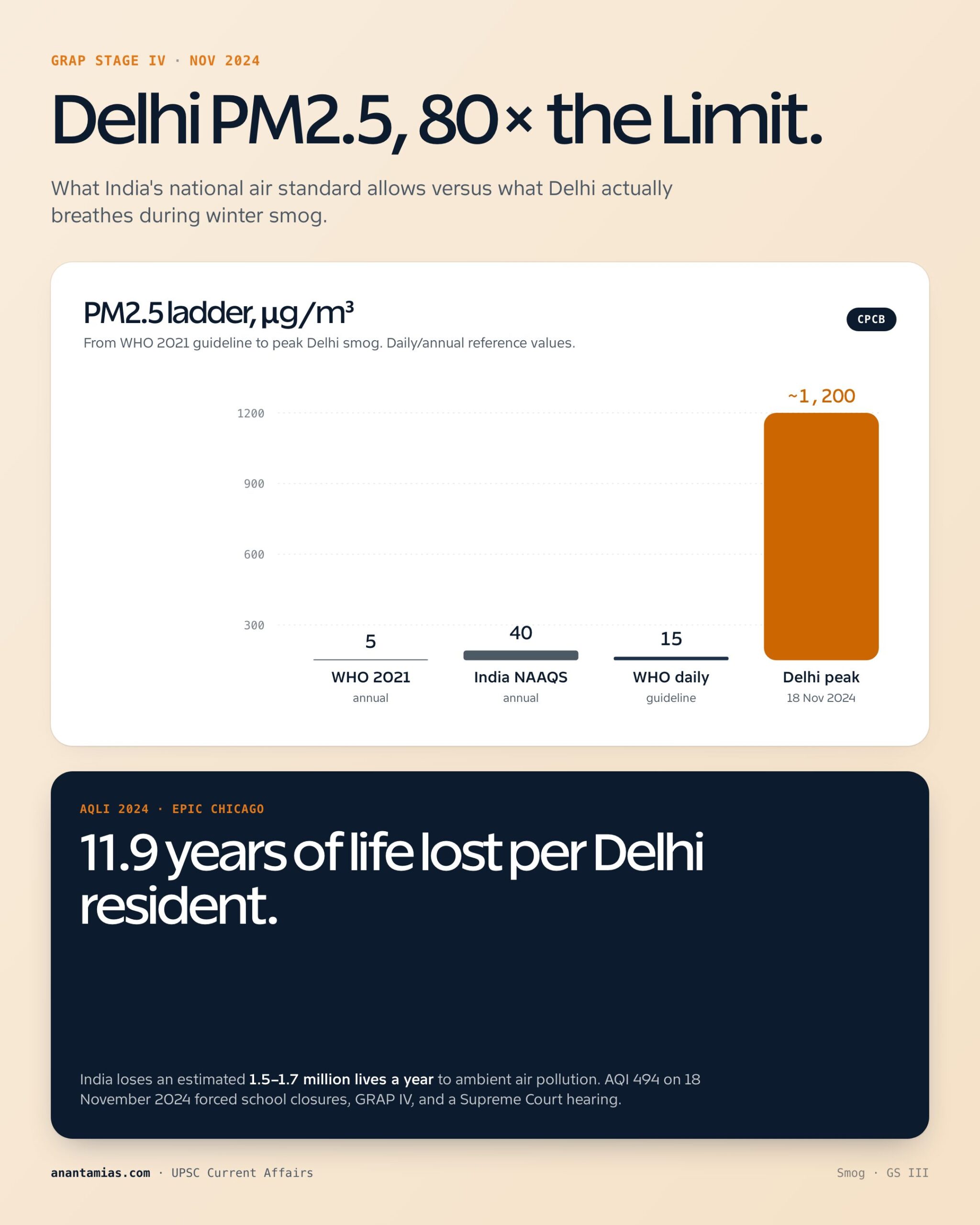
On 18 November 2024, Delhi's Air Quality Index (AQI) hit 494 — barely below the maximum of 500 — and PM2.5 concentrations crossed 80 times the WHO daily safe limit of 15 µg/m³. Schools shut. Construction halted. The Supreme Court, sitting suo motu, summoned officials and observed that "every passing day, more people get sick".
What Delhi lived through was smog — a thick blanket of toxic air that settles over the National Capital Region every winter and many other Indian cities for weeks at a time. It is no longer a visual nuisance. The Lancet Commission attributes 1.67 million premature deaths in India (2019) to air pollution; subsequent State of Global Air reports (2022, 2024) confirm air pollution is now the single largest mortality risk factor in the country.
This guide explains what smog is, how it forms, why Delhi-NCR is uniquely vulnerable, what the government has done, what works (and what does not — looking at you, smog towers), and where India's air policy stands in 2024–26.
What is Smog?
The word smog is a portmanteau of smoke + fog, coined for London's coal-driven air pollution in the early 20th century. It refers to a visible, harmful mixture of gases and particulates in the lower atmosphere that reduces visibility and damages health.
Two Types of Smog
| Type | Sulfurous (London-type) | Photochemical (Los Angeles-type) |
|---|---|---|
| Climate | Cold, humid winters | Warm, sunny weather |
| Source | Coal burning, SO2 | Vehicle exhaust, NOx + VOCs |
| Key chemicals | SO2, soot, particulates | Ozone, PAN, NO2 |
| Colour | Greyish, smoky | Brownish, hazy |
| Visibility | Heavy | Hazy, glare |
| Famous case | London Smog 1952 (~12,000 deaths) | LA smog post-WWII |
Indian smog — particularly Delhi's winter smog — is a hybrid — sulfurous in chemistry (high PM, SO2 from coal and biomass) but with strong photochemical contributions from vehicles and industries.
Components of Smog
- Particulate matter — PM10 and especially PM2.5 (deepest health risk).
- Sulphur dioxide (SO2) — coal combustion.
- Nitrogen oxides (NOx) — vehicles, power plants.
- Volatile organic compounds (VOCs) — solvents, vehicle exhaust.
- Ozone (O3) — secondary pollutant from NOx + VOCs + sunlight.
- Carbon monoxide (CO) — incomplete combustion.
- Polycyclic aromatic hydrocarbons (PAHs) and heavy metals — biomass and waste burning.
Causes of Smog (with Indian Context)
Vehicular Emissions
Delhi has over 13 million registered vehicles. Despite BS-VI norms (April 2020), the sheer volume drives a constant baseline of NOx, CO and PM. Diesel two-wheelers and older trucks are particularly polluting.
Stubble Burning
Punjab and Haryana farmers burn crop residue (paddy stubble) between mid-October and mid-November to prepare fields for wheat. CREAMS satellite data, NASA's MODIS and Punjab Remote Sensing Centre track fires daily. Stubble burning typically contributes 20–35% of Delhi's PM2.5 during peak burning weeks.
Coal-Based Thermal Power Plants
NCR has 11 thermal plants within a 300 km radius. Despite the 2015 emission norms (deadline extended multiple times to 2026–27), flue-gas desulphurisation (FGD) retrofitting remains incomplete.
Construction Dust
Roughly 30% of Delhi's PM10 in winter comes from construction and road dust.
Industrial Emissions
Brick kilns, foundries and small industries in NCR emit a steady stream of SO2 and PM.
Biomass Burning (Domestic)
Cooking with biomass and open fires for warmth in winter.
Diwali Firecrackers
Short-duration spike with PM2.5 doubling in 24 hours despite "green cracker" rules.
Meteorology
The villain that converts emissions into smog:
- Temperature inversion — cold dense air trapped under warm air.
- Low wind speed in winter (3–5 km/h vs 8–12 km/h in summer).
- Boundary layer compression — pollutants concentrated in a thin layer.
- Western Disturbances can either flush pollutants or worsen humidity-driven smog.
Impacts of Smog
Health
| Organ system | Impact |
|---|---|
| Respiratory | Asthma, bronchitis, COPD, lung cancer |
| Cardiovascular | Heart attacks, strokes, hypertension |
| Neurological | Dementia, cognitive decline (recent evidence) |
| Reproductive | Low birth weight, premature birth |
| Eyes/skin | Irritation, dermatitis |
ICMR-INDIAB and Lancet estimate India loses roughly 1.5–1.7 million lives a year to ambient air pollution. Life expectancy in Delhi is reduced by 11.9 years (AQLI 2024).
Economic
- 3% of GDP loss annually estimated by World Bank (2013, replicated in subsequent studies).
- School closures, work loss, healthcare costs.
- Tourism and aviation disruption — visibility-driven flight diversions.
Ecological
- Damage to crops — ozone alone reduces wheat yields by 5–15%.
- Acid rain effects on forests and water bodies.
- Reduced photosynthesis in urban trees.
Visibility and Safety
- Road, rail and air accidents during fog-smog episodes.
- Train delays of 100+ trains daily during peak smog days.
Engineering Responses
Smog Towers
A smog tower is a large vertical air-purification structure with industrial-grade filters.
- Connaught Place smog tower (Delhi) — commissioned August 2021, 24 metres tall, 1,200 fans, HEPA H14 filters removing PM2.5 down to 0.3 µm. Designed to deliver 1,000 m³ of clean air per second.
- Anand Vihar smog tower — commissioned 2021.
- Performance verdict: studies by CSIR-NEERI and IIT-Bombay (2022–24) found no significant improvement in ambient AQI beyond a small radius. The Supreme Court Committee called them "costly experiments with limited utility" in 2023. Most are now offline.
Anti-Smog Guns
Cannon-shaped vehicles that spray atomised water droplets into the air to settle dust and particulates.
- Used by Delhi government and CPCB during high pollution episodes.
- Mandatory at construction sites > 5,000 sq m under GRAP Stage III.
- Effective for dust/PM10 only — no effect on gaseous pollutants or PM2.5 from combustion.
Mechanical Sweepers
Replace dry sweeping that re-suspends dust. CPCB recommends water-spray equipped vacuum sweepers.
India's Policy Framework
Air (Prevention and Control of Pollution) Act, 1981
The principal statute. Establishes Central and State Pollution Control Boards (CPCB / SPCBs).
National Ambient Air Quality Standards (NAAQS, 2009)
Sets standards for 12 pollutants. Far less stringent than WHO 2021 guidelines.
National Clean Air Programme (NCAP, 2019)
- Targeted 20–30% reduction in PM concentrations by 2024 (later revised to 40% by 2026 for PM10).
- Covers 131 non-attainment cities.
- Funded under 15th Finance Commission with ~Rs 19,711 crore for million-plus cities (2020-26).
- Cities below targets penalised; ones meeting them rewarded.
Graded Response Action Plan (GRAP)
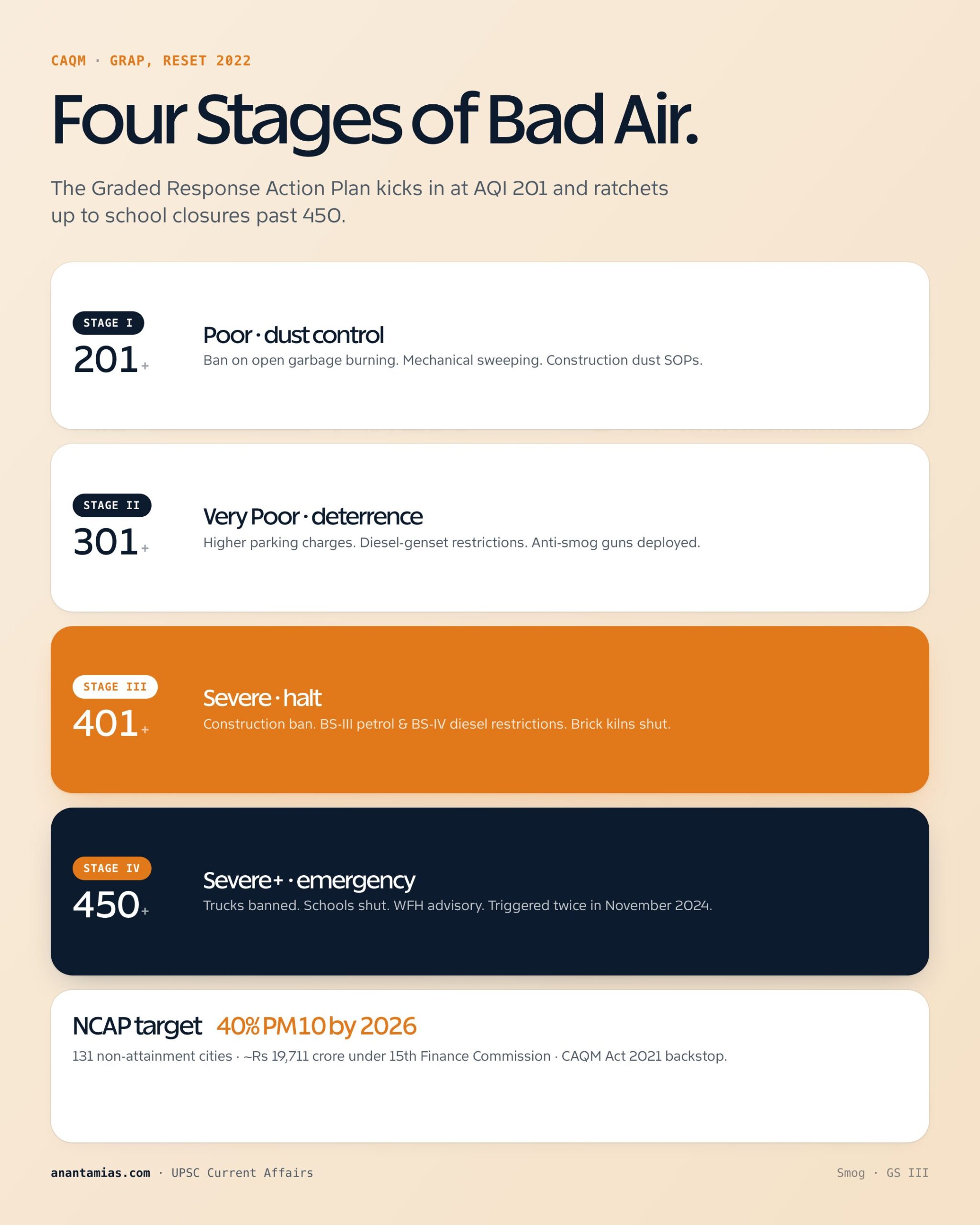
For Delhi-NCR. Triggered by CAQM (Commission for Air Quality Management) based on AQI:
- Stage I (AQI 201–300, Poor) — dust control, ban on garbage burning.
- Stage II (301–400, Very Poor) — parking fees up, mech sweeping.
- Stage III (401–450, Severe) — construction bans, BS-III/IV diesel restrictions.
- Stage IV (>450, Severe+) — truck entry ban, school closures, work-from-home advisories.
GRAP was overhauled in October 2022 to be triggered by forecasts, not actual readings.
Commission for Air Quality Management Act, 2021
Replaced EPCA. CAQM has statutory powers to issue directions across NCR + adjoining states.
BS-VI Norms (April 2020)
Equivalent to Euro 6. Sharp drop in NOx, PM, particulate number from new vehicles.
Bharat Stage Emission Norms
Tightened progressively. BS-VI Stage II (RDE compliance) effective from April 2023.
Pradhan Mantri Ujjwala Yojana (2016)
Provides LPG to households — reduces biomass smoke. Phase II (2021) extended.
Faster Adoption and Manufacturing of Electric Vehicles (FAME II)
EV push to cut vehicular emissions.
Ex-Situ Stubble Management
- Pusa decomposer — Punjab and Haryana subsidies.
- Happy Seeder, Super Straw Management System (SMS) — paddy residue management machinery.
- Bio-CNG plants at Karnal and Sangrur.
Recent Developments (2024–26)
- November 2024 smog crisis — Delhi AQI crossed 494, prompting Supreme Court intervention; GRAP IV invoked twice.
- AQLI 2024 Report (EPIC, University of Chicago) — air pollution costs Delhiites 11.9 years of life expectancy, the highest globally.
- State of Global Air 2024 (HEI) — air pollution overtook tobacco as the second leading global mortality risk.
- Supreme Court order (Oct 2024) — directed Punjab, Haryana, UP and Delhi governments on stubble burning; threatened contempt for non-compliance.
- WHO 2021 air quality guidelines revision — tightened PM2.5 annual limit to 5 µg/m³ (India's NAAQS still 40 µg/m³).
- NCAP target revised to 40% PM10 reduction by 2026.
- Delhi 2025 winter — early November saw 9 consecutive days of Severe AQI; school closures and WFH for grade 1–10.
- Coal plant FGD deadline extended by CPCB to December 2027 for some plants.
- CAQM 2024 directions — banned plying of BS-III petrol and BS-IV diesel vehicles in NCR during GRAP IV.
- Pusa-2090 stubble decomposer rollout expanded; Punjab announced subsidy of Rs 8,000 per tonne for stubble baling (2024).
- Green Crackers mandate enforced from Diwali 2024; AQI spike still observed.
Way Forward
- Airshed approach — manage NCR airshed as one unit, beyond city boundaries.
- Tighten NAAQS to align with WHO 2021 (interim target 1: 35 µg/m³ PM2.5 annual).
- Penalise non-attainment cities under NCAP with mandatory plans.
- Accelerate EV adoption — 100% public transport electrification by 2030.
- Mandatory FGD for all coal plants by 2027 — no further deadline extensions.
- Decentralised stubble management — incentivise paddy diversification.
- Construction code with mandatory anti-pollution measures.
- Investment in clean fuels — green hydrogen, ethanol blending.
- Public health surveillance — track air-pollution-attributable illnesses.
- Right to Clean Air — judicial articulation as a Fundamental Right under Article 21.
- Focus on PM2.5 reduction, not visible smog — invisible particles do most damage.
- Citizen science with low-cost monitors to expand coverage.
Mains Hook
"Delhi's annual smog is no longer a seasonal nuisance but a public-health emergency. Critically examine the effectiveness of GRAP and NCAP and suggest a roadmap to clean air." — GS III
"Smog towers and anti-smog guns are symbolic responses to a structural problem. Discuss with reference to India's air pollution governance." — GS III
Prelims Pointers
- Smog = smoke + fog; coined for London's coal-driven pollution.
- Two types: sulfurous (London-type) and photochemical (Los Angeles-type).
- Photochemical smog: ozone + PAN from NOx + VOCs + sunlight.
- PM2.5 is the most harmful component of smog — penetrates deep into lungs and bloodstream.
- WHO 2021 Air Quality Guidelines: PM2.5 annual 5 µg/m³; India's NAAQS: 40 µg/m³.
- NCAP launched 2019; target revised to 40% PM10 reduction by 2026.
- GRAP is implemented by CAQM, formed under the CAQM Act 2021.
- GRAP Stage IV triggered when AQI > 450.
- Connaught Place smog tower commissioned August 2021; 24 m tall; HEPA H14 filters.
- Anti-smog guns — atomised water droplets; effective only for PM10/dust.
- Pusa decomposer — bio-decomposer for paddy stubble, developed by IARI.
- AQLI 2024: Delhi residents lose 11.9 years of life expectancy.
- Air Act 1981 establishes CPCB and SPCBs.
- BS-VI norms in force since April 2020.
Conclusion
Delhi's smog is not weather. It is a policy failure compounded over decades — too many vehicles, too much coal, too little stubble management, and too little political will to fix any of it permanently. Smog towers and anti-smog guns are the urban planning equivalent of treating cancer with cough syrup. What India needs is an airshed-wide, science-driven, multi-state, all-season plan with hard targets, funded enforcement, and a clear admission that clean air is a fundamental right, not a winter wishlist item.