Standing Committee Reports — Role, Functioning, Recent Reports (UPSC Polity)
UPSC guide to Parliamentary Standing Committee reports: DRSCs, electoral reform, common electoral roll, Aadhaar linking, BNS series, and 2024-26 key recommendations.
Parliamentary Standing Committees are the most important institutional mechanism for legislative scrutiny in India. Where the floor of Parliament has 543 voices and 55 days a year, a Standing Committee has 31 members and works year-round. Their reports are the most considered policy work that emerges from the legislative branch — and yet they are some of the most under-utilised. Bills referred to committees dropped from 71% in the 15th Lok Sabha (2009-14) to just 25% in the 17th Lok Sabha (2019-24). Major laws — the three farm laws, the Bharatiya Nyaya Sanhita series, the Forest Conservation Amendment 2023 — passed with limited or rushed committee scrutiny.
For UPSC, Standing Committee reports are dual-purpose: they are factual material for Mains GS-II (legislature, accountability) and policy depth for GS-III (economy, social sectors). The recent Sushil Kumar Modi Committee report on Election Process Reform (2023) and the Bharatiya Nyaya Sanhita Standing Committee report (2023) are particularly examination-relevant.
This guide explains what Standing Committees are, how DRSCs work, summarises the Sushil Modi Committee report on Election Process Reform in detail (the seed extract for this article), and surveys other major 2024-26 reports.
What are Standing Committees?
Standing Committees are permanent parliamentary committees that exist to provide continuous scrutiny of executive functioning. They sit through the year, even when Parliament is not in session.
Three categories
- Departmentally Related Standing Committees (DRSCs) — 24 committees covering all ministries.
- Financial Committees — Public Accounts Committee, Estimates Committee, Public Undertakings Committee.
- House-keeping Committees — Business Advisory, Privileges, Ethics, Rules, Library, House.
DRSC structure
- 24 committees since 2004 restructuring.
- 16 serviced by Lok Sabha; 8 by Rajya Sabha.
- 31 members each — 21 from Lok Sabha + 10 from Rajya Sabha.
- Term: one year.
- Each ministry allocated to a DRSC.
- Chairperson appointed by Speaker (LS DRSCs) or Chairman (RS DRSCs).
Functions of Standing Committees
| Function | Detail |
|---|---|
| Examination of bills | Bills referred by Speaker/Chairman; clause-by-clause scrutiny |
| Demands for Grants | Examination of budgetary allocation to ministries |
| Annual reports | Review of ministry's annual report |
| National policies | Examination of policy documents referred |
| Stakeholder consultation | Inviting depositions from civil society, experts, industry |
| Report submission | Tabled in Parliament; government responds via Action Taken Report |
Sushil Kumar Modi Committee — Election Process Reform (2023)
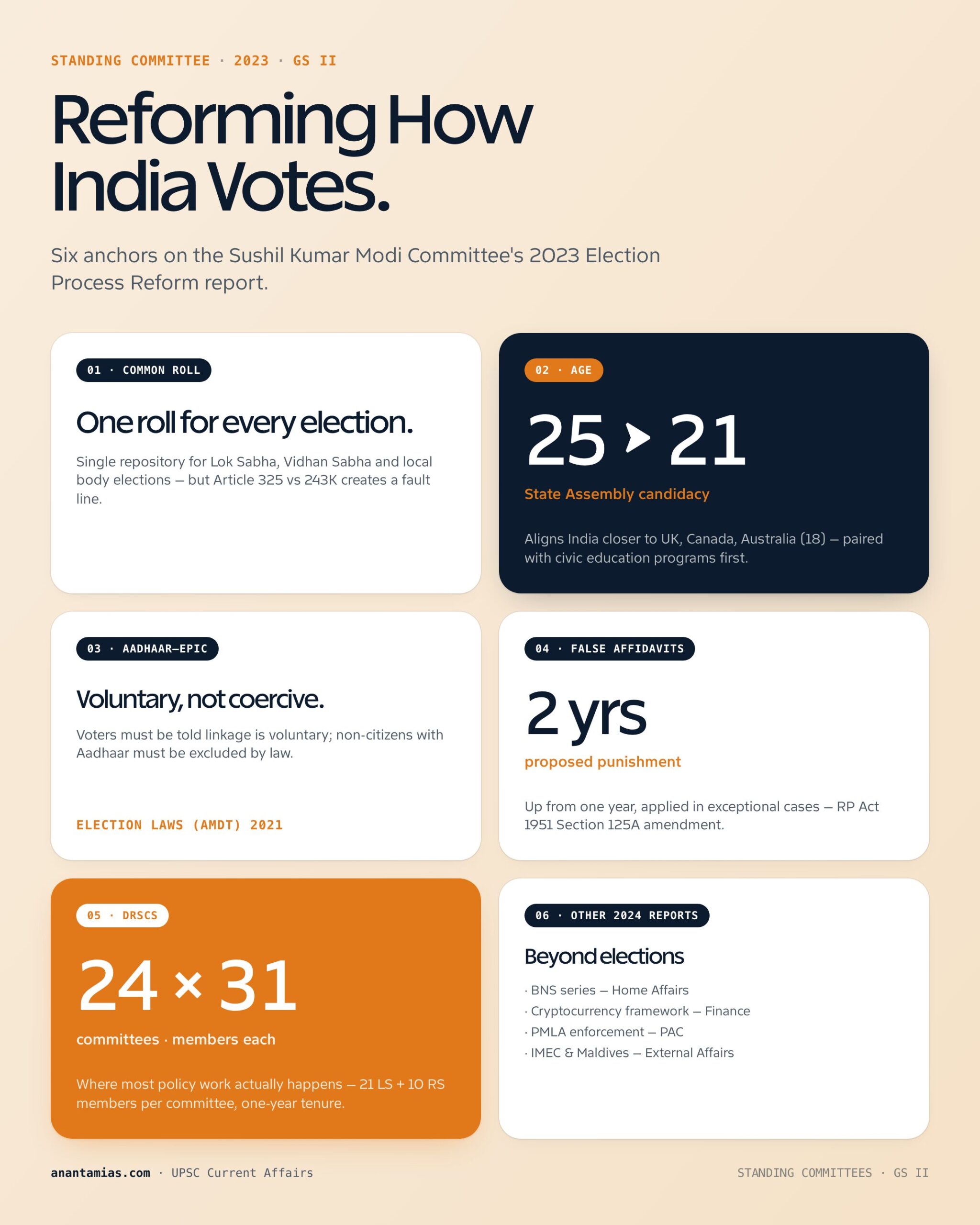
The Standing Committee on Personnel, Public Grievances, Law and Justice, chaired by Mr. Sushil Kumar Modi, submitted its report on "Specific Aspects of Election Process and their Reform" in 2023. This is one of the most detailed recent committee reports on electoral reform, covering common electoral roll, age of contesting elections, Aadhaar linking, and false declarations.
Common Electoral Roll
Proposal: Establish a centralised repository of voter information that can be used for Lok Sabha, Vidhan Sabha, and local body (panchayat, municipality) elections.
Benefits:
- Streamlines resources — single roll instead of two (one for Parliament/Assembly, another for local bodies).
- Minimises duplication of efforts in roll preparation.
- Reduces expenses — currently states and ECI separately conduct revision.
- Eliminates discrepancies between different electoral rolls.
Issues identified by the Committee:
- Legal framework and constitutional regulations — Article 325 mandates a single general electoral roll for parliamentary and assembly elections; local body elections are managed by State Election Commissions under Articles 243K and 243ZA.
- Impact on state powers — local body elections are state subject. Common roll could be seen as encroachment.
- Delimitation of local wards — done by state governments and SECs; needs harmonisation.
- Constitutional separation — Article 325 vs Article 243K creates potential conflict.
Recommendations:
- ECI should carefully consider constitutional provisions before implementing.
- Assess potential consequences as Article 325 mandates separate electoral rolls for Parliament and state legislatures, and a single general electoral roll for each constituency.
- Explore voluntary adoption by states first.
- Undertake pilot in willing states.
Age of Contesting Elections
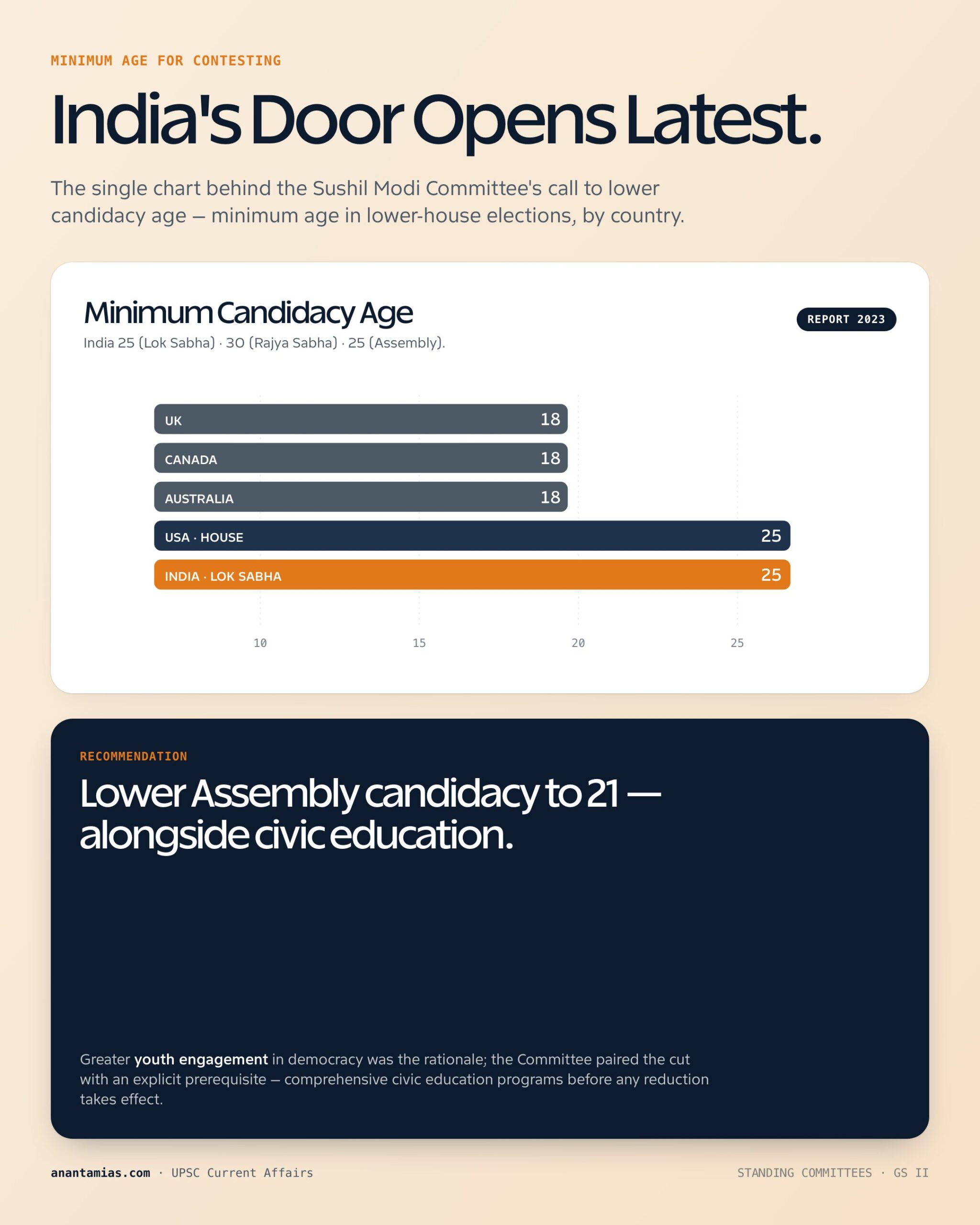
Observation: The Committee noted that lowering the minimum age for candidacy would allow greater youth engagement in democratic processes.
International examples:
| Country | Minimum age (lower house) |
|---|---|
| United Kingdom | 18 |
| Canada | 18 |
| Australia | 18 |
| USA (House of Representatives) | 25 |
| India (Lok Sabha) | 25 |
| India (Rajya Sabha) | 30 |
| India (State Assembly) | 25 |
Recommendations:
- Reduce the minimum age requirement for State Assembly elections — possibly to 21.
- Prioritise comprehensive civic education programs for youth political engagement before any reduction.
- Review the experience of countries with lower thresholds.
Aadhaar Linking
Issue: The Election Laws (Amendment) Act, 2021 enabled voluntary linking of Aadhaar with EPIC (Voter ID).
Transparency: The Committee emphasised that citizens should be informed about voluntary Aadhaar linkage — they should understand:
- It is voluntary, not mandatory.
- Their EPIC will not be cancelled if they don't link.
- The data protection framework that applies.
Concerns:
- Aadhaar of non-citizens linked with EPIC — Aadhaar can be issued to residents who are not citizens; this could lead to non-citizens being mistakenly retained on the electoral roll.
- Privacy concerns post-Puttaswamy.
Recommendations:
- Establish legal provisions to ensure non-citizens are not included in the Common Electoral Roll.
- Strengthen verification of citizenship before final inclusion.
- Aadhaar linking should remain genuinely voluntary; no coercive demand at booth.
False Declarations
Observation: Accurate voter information — and accurate candidate information — is crucial for free and fair elections. False affidavits by candidates undermine voter choice.
Recommendations:
- Set up a verification process for affidavits filed by candidates.
- Involve all stakeholders in regulation-making for election affidavits — political parties, civil society, ECI.
- Amend the Representation of the People Act, 1951, to define and penalise false declarations more rigorously.
- Increase punishment for false declarations to up to 2 years' imprisonment and a fine, applied only in exceptional cases.
- Continue current practice of judicial review under Section 125A of the RP Act.
Other major Standing Committee reports (2023-26)
Standing Committee on Home Affairs — Bharatiya Nyaya Sanhita series (2023)
- Examined the BNS, BNSS, BSA replacing IPC, CrPC, Indian Evidence Act.
- Recommendations on community service, mob lynching, marital rape exception, victim compensation.
- Many opposition members suspended during deliberation; final report had limited dissent.
- Government accepted some recommendations (e.g., community service definition); rejected others (marital rape).
Standing Committee on Finance — Cryptocurrency framework (2024)
- Examined regulation of crypto-assets and digital tokens.
- Recommended specific tax framework, KYC norms, and a central regulator.
- Aligned with the G20 Crypto Framework (under India's 2023 Presidency).
Standing Committee on External Affairs — IMEC and India-Maldives (2024)
- Reviewed India-Middle East-Europe Economic Corridor (IMEC).
- Examined India-Maldives bilateral after President Muizzu's stance.
- Recommended diplomatic outreach and infrastructure investment.
PAC report on PMLA enforcement (2024)
- Examined ED's conviction rate (only 1.5% of registered cases).
- Asked Finance Ministry for tighter procedural safeguards.
- Recommended quarterly review by PAC.
Joint Parliamentary Committee on Waqf (Amendment) Bill (2024-25)
- Examined the Waqf (Amendment) Bill, 2024.
- Public consultations across states.
- Submitted report February 2025.
JPC on One Nation One Election (2024-26)
- Examining Constitutional Amendment Bills 129 and 130.
- Held detailed deliberations with state governments, ECI, constitutional experts.
Standing Committee on Rural Development — MGNREGS reforms (2024)
- Recommended raising wages to align with state minimum wage.
- Recommended better real-time monitoring.
Standing Committee on Education — National Education Policy implementation (2024)
- Reviewed NEP 2020 implementation gaps.
- Asked for state-wise progress dashboard.
Issues with Standing Committee functioning
- Declining bill referrals — 25% in 17th LS.
- Yearly tenure — prevents specialisation.
- Low attendance — average 30-40%.
- Lack of expert staff — UK has dedicated specialist advisers; India has minimal.
- Action Taken Reports — government often responds vaguely; no statutory binding effect.
- Reports tabled late — sometimes after the bill has been passed.
- No live broadcast — limited public awareness.
- No power to compel ATR within deadline — government can sit on it.
Reform agenda
| Reform | Detail |
|---|---|
| Mandatory bill referral | UK model — all non-money bills to committees |
| Tenure extension | 2-3 years for specialisation |
| Sector specialists | 5-6 expert staff per DRSC |
| Statutory ATR deadline | 6 months from report tabling |
| Parliamentary Budget Office | Like US CBO; non-partisan analysis |
| Live select hearings | UK select committee model |
| Committees on Constitutional Amendment Bills | NCRWC recommendation |
| Chairperson rotation | More opposition chairmanships |
Mains-style answer hook
"Standing Committee reports are the unread treasures of Indian parliamentary governance. The Sushil Modi Committee on Election Process Reform (2023), the Home Affairs Committee on the new criminal codes, and the PAC report on PMLA enforcement together offer a more rigorous policy critique than the floor of Parliament can produce in its present truncated calendar. Yet only a quarter of bills in the 17th Lok Sabha were referred to committees. The reform agenda is clear — mandatory referral, expert staff, longer tenures, statutory ATR deadlines — and overdue. The 18th Lok Sabha's early signs of reviving committee referrals offer a corrective opportunity."
Prelims pointers
- DRSCs — 24 committees; 31 members each (21 LS + 10 RS); yearly tenure.
- PAC — 1921; 22 members; chairman from Opposition (since 1967 convention).
- Estimates Committee — 1950; 30 members all from LS.
- Public Undertakings Committee — 1964; 22 members.
- Bills referred — 71% (15th LS) → 25% (17th LS).
- Sushil Modi Committee (2023) — Election Process Reform report.
- Article 325 — single general electoral roll for parliamentary and assembly.
- Article 243K, 243ZA — State Election Commissions for local bodies.
- RP Act, 1951 — Section 125A — false declarations.
FAQ
Are Standing Committee recommendations binding?
No. They are advisory. The government is expected to file an Action Taken Report explaining acceptance or rejection.
Can the public depose before a Standing Committee?
Yes — committees frequently invite experts, civil society, industry, and even government officials.
What did the Sushil Modi Committee recommend on common electoral roll?
ECI should consider constitutional provisions (Article 325) carefully; assess impact on state powers; explore voluntary adoption.
Is Aadhaar-EPIC linking mandatory?
No — it is voluntary under the Election Laws (Amendment) Act, 2021. Citizens must be informed of this.
Related: Parliamentary Committees, Parliament, Election Commission, Anti-Defection Law.