The Giant African Snail: Invasive Species, Impact, and India’s Biodiversity Threat
A complete UPSC GS-III guide to the Giant African Snail. Covers its biology, why it is one of the world's worst invasive alien species, agricultural and ecological damage, public health implications, and management strategies in India.
The Giant African Snail is a fist-sized terrestrial mollusc that originated in the humid forests of East Africa and has since travelled, often as an unwanted hitchhiker, to almost every warm continent on the planet. The IUCN ranks it among the hundred worst invasive alien species in the world, and once it settles in a new place it eats its way through more than five hundred plant species, breeds at a pace that defeats most control efforts, and acts as an intermediate host for parasites that can infect human beings.
For a UPSC aspirant, the snail is more than a pest. It is a textbook case study in how a single species can illustrate the entire framework of biological invasion, the gaps in India’s quarantine regime, and the difficulty of writing environmental law for organisms that do not respect district boundaries. Questions on invasive species have become a regular feature in prelims, and the topic now overlaps with biodiversity, agriculture, and public health.
Quick Facts on the Giant African Snail
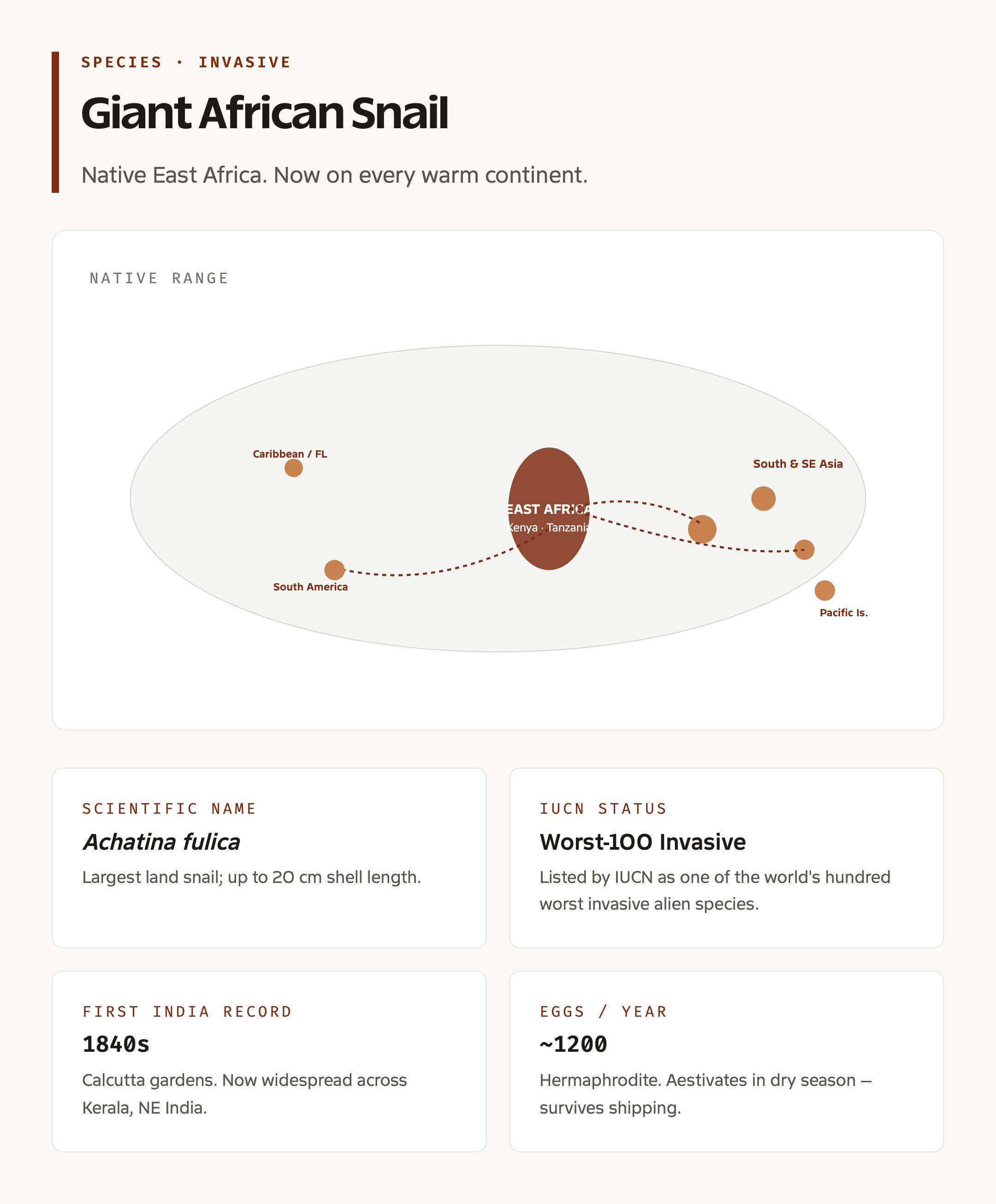
The Giant African Snail’s scientific name is Achatina fulica, and it is native to the coastal regions of Kenya and Tanzania in East Africa. The shell of an adult snail is conical, brown with darker stripes, and can grow to nearly twenty centimetres in length, which makes it one of the largest land snails on Earth. A single individual is hermaphrodite, lays up to twelve hundred eggs in a year, and can live for five to ten years in favorable conditions.
In India, the species was first reported from the gardens of Calcutta in the 1840s. It has since spread to Kerala, Karnataka, Tamil Nadu, the North-East, and pockets of central India. The Ministry of Environment, Forest and Climate Change lists it as an invasive alien species under its national framework on biological invasions, and it is regularly cited in agricultural advisories issued by the ICAR.
What the Giant African Snail Actually Is
The snail is a gastropod mollusc, which puts it in the same broad zoological group as the garden slug, the conch, and the octopus. It is air-breathing, has a single muscular foot, and carries a calcium-rich shell that protects it from predators and from drying out. During the dry season it seals the shell with a thin layer of mucus and aestivates, sometimes for months, which is exactly the trait that lets it survive shipping containers and travel as cargo.
Background and Historical Context
The story of how a single mollusc became a global pest is also a short history of colonial trade. In the early nineteenth century the snail was deliberately moved from East Africa to Mauritius, then to Madagascar, then to the Indian subcontinent, often by collectors who admired its size and by traders who saw it as a cheap source of protein. By the 1930s it had reached South-East Asia, by the 1940s the Pacific islands, and by the 1960s Hawaii and parts of South America.
Each new introduction followed the same pattern. The snail arrived as a curiosity, escaped or was released, found a warm climate with no natural predators, and exploded into vast populations within a decade. In Florida the United States Department of Agriculture has run two separate eradication campaigns, one in the 1960s and one in the 2010s, each costing tens of millions of dollars. India has never attempted a national eradication. Instead, it has relied on patchy state-level advisories and on the diligence of individual farmers, which is one reason the snail keeps showing up in fresh districts after every monsoon.
The Convention on Biological Diversity, to which India is a signatory, requires parties to prevent the introduction of, control, or eradicate alien species that threaten ecosystems. The provisions of the Biological Diversity Act, 2002 and the broader environmental laws in India framework give the Centre the legal hook to act, but enforcement on the ground remains thin.
Why the Giant African Snail Is Classified as Invasive
An invasive alien species is a non-native organism that establishes a self-sustaining population outside its natural range and causes measurable harm to native biodiversity, the economy, or human health. The Giant African Snail meets all three tests. It is non-native almost everywhere outside East Africa. It establishes wherever rainfall and warmth allow. And it causes harm at every level of the test.
The snail is a generalist herbivore, which means it does not specialize on a single plant family. It feeds on tender shoots, ripening fruit, ornamental flowers, and even tree bark when softer food runs out. In tropical agriculture it has been recorded damaging papaya, banana, cabbage, cocoa, beans, and ornamental nursery stock. The damage is rarely the kind of total destruction that a locust swarm leaves behind. It is slower, harder to attribute, and often blamed on weather or other pests until populations are already too large to control.
Detailed Analysis of the Threefold Impact
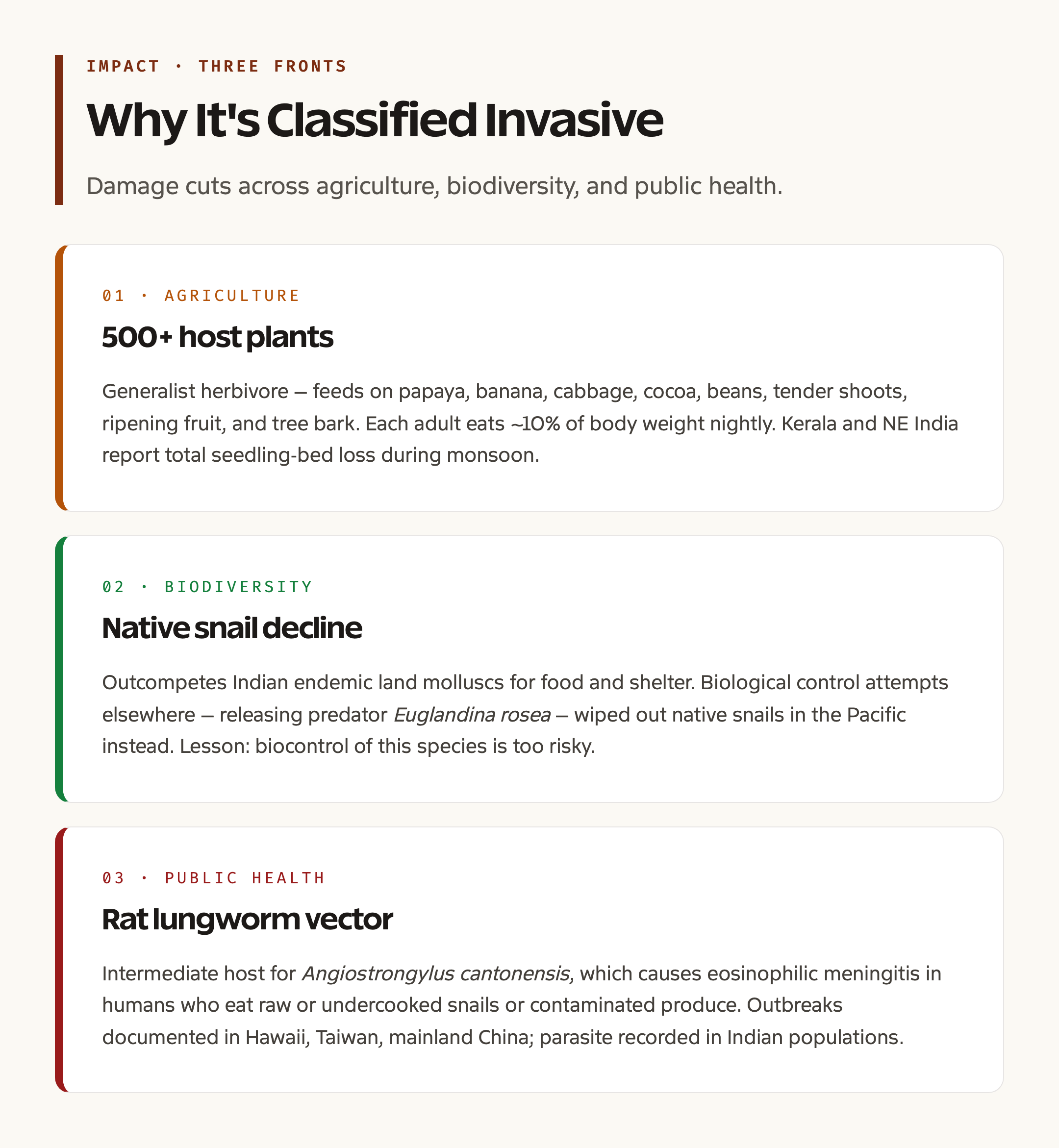
Begin with agriculture. A breeding pair of snails can produce several thousand offspring in two years, and each adult eats around ten percent of its body weight every night. Multiply that across a hectare of vegetable gardens or a nursery and you get a measurable yield loss. Farmers in Kerala and the North-East have reported the loss of entire seedling beds during the southwest monsoon, when high humidity allows the snail to remain active even during the day.
The biodiversity impact is harder to see but more durable. The snail competes with native land molluscs for food and shelter, and several Indian endemic snails have shown population declines in areas where Achatina fulica has become abundant. The introduced predator Euglandina rosea, which was released in some Pacific islands to control the African snail, ended up wiping out native land snails instead, which is why biological control of this species is now considered too risky to attempt.
The public health dimension is the one that turns a garden nuisance into a notifiable problem. The snail is an intermediate host for the rat lungworm parasite Angiostrongylus cantonensis, which causes a form of eosinophilic meningitis in humans who eat raw or undercooked snail flesh, contaminated vegetables, or salad rinsed in untreated water. Outbreaks of this parasite have been documented in Hawaii, Taiwan, and parts of mainland China, and the parasite has been recorded in Indian snail populations as well.
Comparative Look: Major Invasive Species in India
India’s invasive species inventory is wider than most aspirants realize. The most quoted examples in standard answer-writing include the following.
| Species | Type | Primary Impact |
|---|---|---|
| Lantana camara | Shrub | Replaces native forest understory and reduces fodder availability |
| Water hyacinth (Eichhornia crassipes) | Aquatic plant | Chokes water bodies and depletes dissolved oxygen |
| Giant African Snail (Achatina fulica) | Mollusc | Crop damage, native snail decline, parasite vector |
| Parthenium hysterophorus | Weed | Skin allergy in humans, soil chemistry alteration |
| African Catfish (Clarias gariepinus) | Fish | Predates and outcompetes native fish |
| Prosopis juliflora | Tree | Alters arid grassland ecosystems and lowers groundwater |
Read this table together with biodiversity in India for the broader picture. Each entry on this list illustrates a different pathway of introduction: lantana came in through colonial gardens, water hyacinth through ornamental ponds, the African snail through trade and curiosity, parthenium through contaminated wheat shipments, and Prosopis through deliberate plantation drives meant to control desertification. The lesson is that there is no single regulatory tool that can address all of them at once.
Challenges in Controlling the Giant African Snail
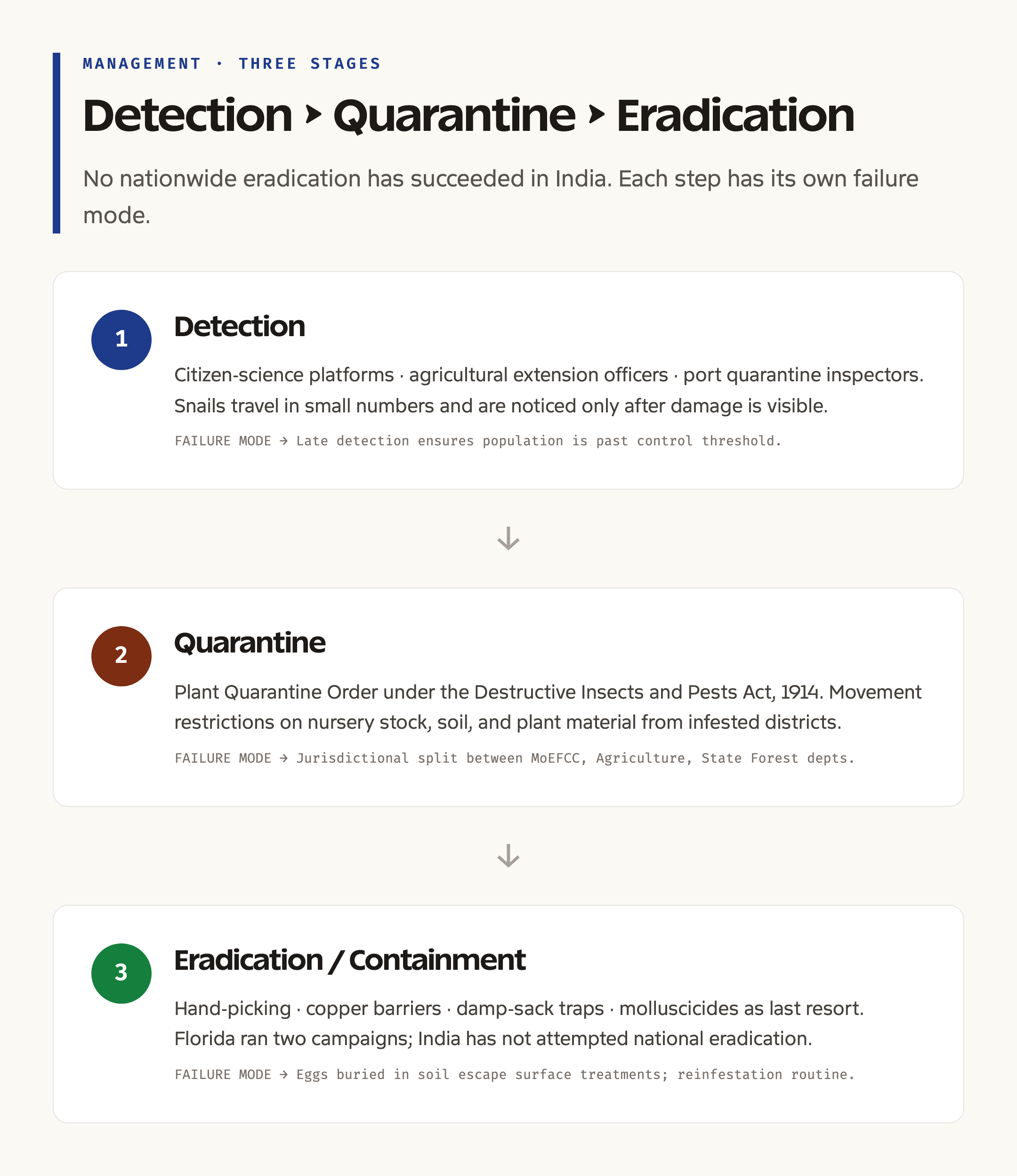
The first challenge is detection. Snails travel in small numbers and are usually noticed only after the population has crossed a threshold of visible damage. By that stage, eradication is impossible and the goal shifts to containment. The second challenge is biological. Hand-picking, the most common control method, is labor-intensive and rarely reaches eggs that are buried in soil. Chemical molluscicides like metaldehyde work but they also kill native snails and beneficial soil fauna, and they are unsuitable for organic farms.
A third challenge is institutional. Plant quarantine in India falls under the Department of Agriculture and Cooperation, while wildlife and biodiversity issues fall under the Ministry of Environment, Forest and Climate Change. A snail at a port is a quarantine matter, the same snail in a forest is a wildlife matter, and the same snail eating cabbage in a backyard is a state agriculture matter. The boundaries between these jurisdictions slow down responses and create gaps.
The final challenge is awareness. Many farmers and gardeners still see the snail as a curiosity and even as a pet, particularly in urban areas. Without sustained public education, every generation of new gardeners restarts the cycle of accidental release.
Prelims Pointers
The Giant African Snail is native to East Africa, scientifically named Achatina fulica, and listed by the IUCN among the world’s hundred worst invasive species. It is a gastropod mollusc, hermaphrodite, and capable of laying over a thousand eggs in a year. In India it was first recorded in Calcutta in the 1840s, and it now has a confirmed presence in Kerala, Karnataka, Tamil Nadu, and the North-East.
The Convention on Biological Diversity recognizes invasive alien species as a major driver of biodiversity loss. The Biological Diversity Act, 2002 and the Wild Life (Protection) Act, 1972, read together with the Plant Quarantine Order under the Destructive Insects and Pests Act, 1914, form the patchwork legal framework available against the species. Aspirants should also remember that promotion of vegetarianism is not a recognized threat to biodiversity, while habitat fragmentation, global warming, and invasive species are.
Mains Questions on Invasive Species
Discuss the threats posed by invasive alien species to India’s biodiversity, with reference to the Giant African Snail. Suggest a framework for early detection and response. Compare the regulatory provisions for invasive species under the Biological Diversity Act, 2002 with international obligations under the Convention on Biological Diversity. Examine the link between trade liberalization, climate change, and the spread of invasive alien species in tropical countries.
A good answer would frame the snail as a microcosm of three larger problems: the porous nature of biosecurity in a globalized economy, the institutional fragmentation of environmental governance, and the slow pace at which scientific evidence translates into farmer-level action. Reference to the broader wildlife protection regime helps anchor the answer.
Way Forward
A workable approach has four parts. The first is a national early-warning network that connects state agriculture extension officers, customs and quarantine inspectors, and citizen-science platforms so that fresh sightings can be mapped in real time. The second is a single nodal authority on invasive species, modelled on the National Invasive Species Council of New Zealand, with a clear mandate that cuts across agriculture, environment, and forestry.
The third is research investment in safe biological control. Native predators and parasites of the snail in its East African range have been studied by international research groups, and Indian institutes such as the ICAR and the Zoological Survey of India can collaborate to assess whether any of those agents could be released safely. The fourth is sustained public education, especially in school curricula, so that the next generation of gardeners and farmers does not repeat the mistakes of the last two centuries.
Frequently Asked Questions
Is the Giant African Snail dangerous to humans?
The snail itself is not aggressive, but it can carry the rat lungworm parasite, which causes a form of eosinophilic meningitis in people who consume raw or undercooked snail flesh or contaminated produce. Washing vegetables thoroughly and avoiding direct skin contact with the snail’s mucus is the standard precaution.
Why is it called the world’s worst invasive species?
The IUCN includes it in its list of the hundred worst invasive alien species because of the combined evidence of its wide host range, fast reproduction, ability to survive transport in dormant form, and documented harm to agriculture, biodiversity, and human health.
Where in India is the snail most widespread?
The species is well established in Kerala, parts of Karnataka and Tamil Nadu, the North-Eastern states, the Andaman and Nicobar Islands, and pockets of central and eastern India. Fresh sightings continue to be reported after each monsoon.
Can the Giant African Snail be eaten?
In some parts of West Africa it is consumed as a traditional protein source after thorough cooking, but in India it is not part of any mainstream cuisine and consumption is discouraged because of the parasite risk and uncertain heavy-metal contamination.
How is the snail different from native Indian land snails?
Native Indian land snails are typically much smaller, rarely larger than a thumbnail, and most species do not aggregate in the dense numbers seen with Achatina fulica. The exotic species is also distinguished by its conical brown shell with darker bands.
Is there a legal ban on keeping the Giant African Snail as a pet in India?
There is no nationwide pet ban, but several states have issued advisories against trade and release, and the Plant Quarantine Order restricts its import. Releasing the snail into the wild can attract liability under environmental law.
How does climate change affect the snail’s spread?
Warmer winters and longer monsoon seasons extend the active period of the snail and allow it to colonize regions that were previously too dry or too cold, including parts of north India that were historically marginal habitat.
What can a farmer do to protect a small plot from the snail?
Hand-picking at dawn or after rainfall, removal of crop debris that provides shelter, copper-based barriers around seedling beds, and trapping with damp sacks placed overnight are the most reliable low-input methods. Chemical molluscicides should be a last resort and only as per state agriculture department advisories.