Uranium Enrichment Explained: From Yellowcake to Reactor and Weapon Grade
A complete UPSC GS-III explainer on uranium enrichment. Covers the U-235 and U-238 isotopes, why enrichment is needed for reactors and weapons, the gas-centrifuge and gaseous-diffusion methods, India's enrichment programme at Rattehalli, and IAEA safeguards.
Uranium enrichment is the process of increasing the proportion of uranium-235, the fissile isotope, in a sample of uranium so that the metal can sustain a chain reaction in a power reactor or in a nuclear weapon. Natural uranium pulled out of the ground contains only about 0.7 percent U-235, with the rest dominated by U-238, an isotope that does not split easily under thermal neutrons. Most reactors and every nuclear weapon need a higher U-235 fraction than nature provides.
Enrichment is the most technically demanding step in the nuclear fuel cycle. Separating two isotopes of the same element is fundamentally a physics problem, because chemistry treats both isotopes identically. The trick is to exploit the slight mass difference, U-235 is roughly 1.3 percent lighter than U-238, in a centrifuge, a gas-diffusion membrane, or a tuned laser. Each method needs many stages cascaded in series to deliver a useful fraction.
For UPSC GS-III, uranium enrichment sits at the heart of India’s nuclear energy programme, the country’s civil-liability framework, and the international export-control regimes that govern dual-use technology. This guide explains the physics, the engineering, the levels of enrichment, India’s domestic capability, and the safeguards regime that governs the global trade.
Quick Facts on Uranium Enrichment
Natural uranium contains about 0.7 percent U-235 and 99.3 percent U-238. U-235 is the fissile isotope. It splits readily on absorbing a slow neutron and releases more neutrons that can sustain a chain reaction. U-238 is fertile rather than fissile, it can absorb a neutron and become plutonium-239 over time, but it cannot itself drive a thermal reactor.
Enrichment is measured in two units. Percent U-235 is the obvious one. Separative work units, SWU, measure the effort needed to produce a given quantity of enriched uranium from a given quantity of feed. SWU is the international currency of enrichment trade. A typical 1,000-megawatt light-water reactor needs roughly 100,000 SWU per year of fuel.
Enrichment uses uranium in the form of uranium hexafluoride, UF6, a colourless solid that turns into a gas at modest temperatures. The gaseous form is what allows centrifuges and diffusion membranes to separate the isotopes. After enrichment, UF6 is converted back into uranium dioxide, UO2, and pressed into fuel pellets.
The international regulator for civilian enrichment is the International Atomic Energy Agency, IAEA. India’s civilian enrichment, when it occurs under the 2008 separation plan, falls under IAEA safeguards. India’s military enrichment does not, because India is not a signatory to the Nuclear Non-Proliferation Treaty.
Why Enrichment Is Needed
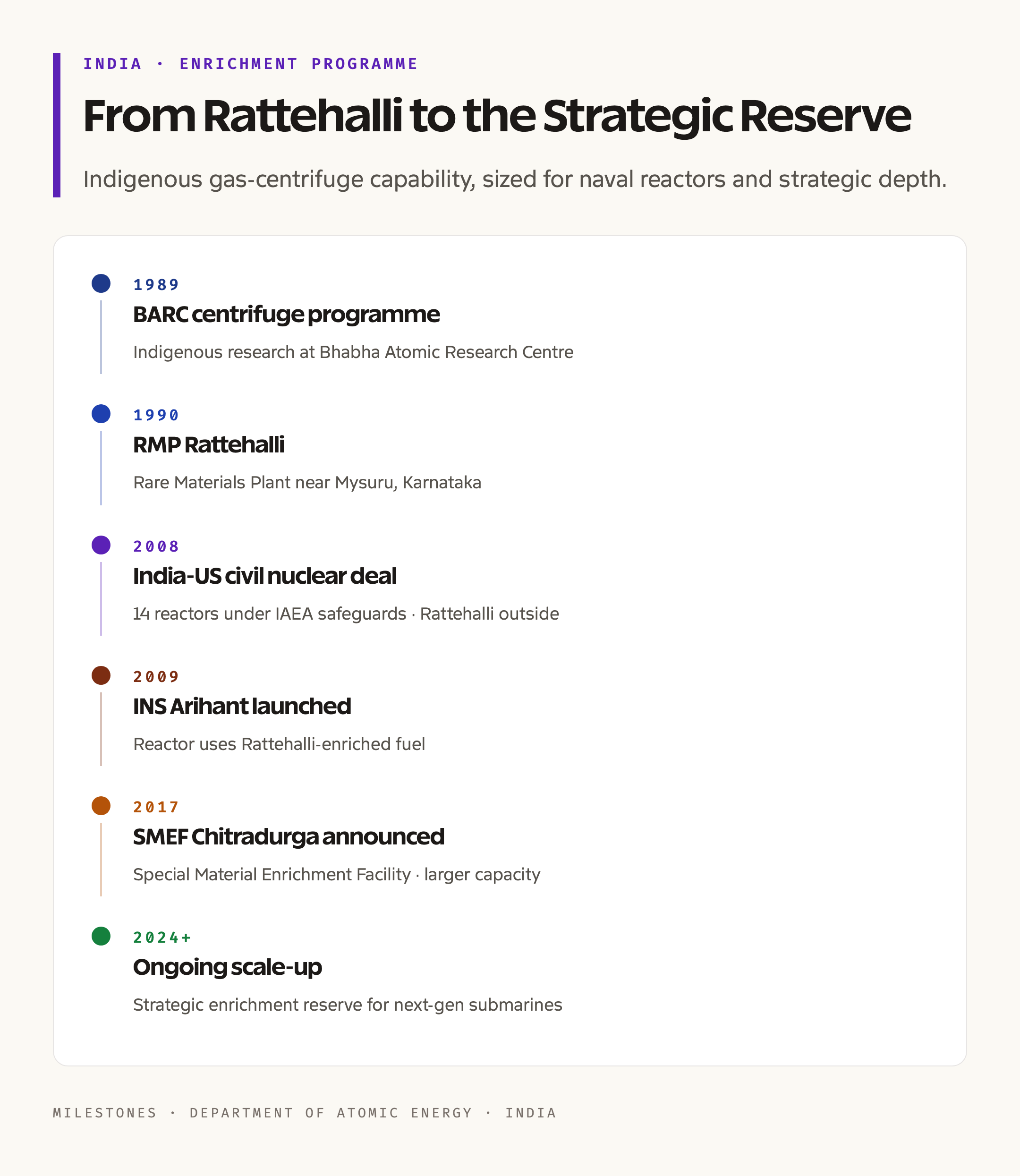
Most modern reactors are light-water reactors, LWRs, which use ordinary water as both coolant and neutron moderator. Ordinary water absorbs neutrons too readily for a chain reaction in natural uranium, so LWRs need fuel enriched to between 3 and 5 percent U-235. This is called low-enriched uranium, LEU.
Some advanced and small modular reactor designs use high-assay low-enriched uranium, HALEU, with U-235 fractions between 5 and 20 percent. HALEU is not common in commercial use yet, but it is what most fourth-generation reactor concepts assume.
Naval propulsion reactors used in submarines and aircraft carriers usually use higher enrichment levels, sometimes well above 20 percent, to keep the reactor compact and to extend the time between refuellings. Research reactors at universities and national labs often use HALEU as well.
Nuclear weapons require highly enriched uranium, HEU, defined as 20 percent or more U-235. Weapons-grade HEU is typically 90 percent or above. The Hiroshima bomb used roughly 64 kilograms of HEU at about 80 percent enrichment.
India’s pressurised heavy-water reactors, PHWRs, are the exception to this story. They use heavy water, deuterium oxide, as the moderator. Heavy water absorbs far fewer neutrons than ordinary water, so PHWRs can run on natural unenriched uranium with no enrichment at all. This is the engineering reason India built a heavy-water-based civilian programme rather than an LWR-based one. It was a pragmatic response to international restrictions on enrichment technology.
How a Gas Centrifuge Works
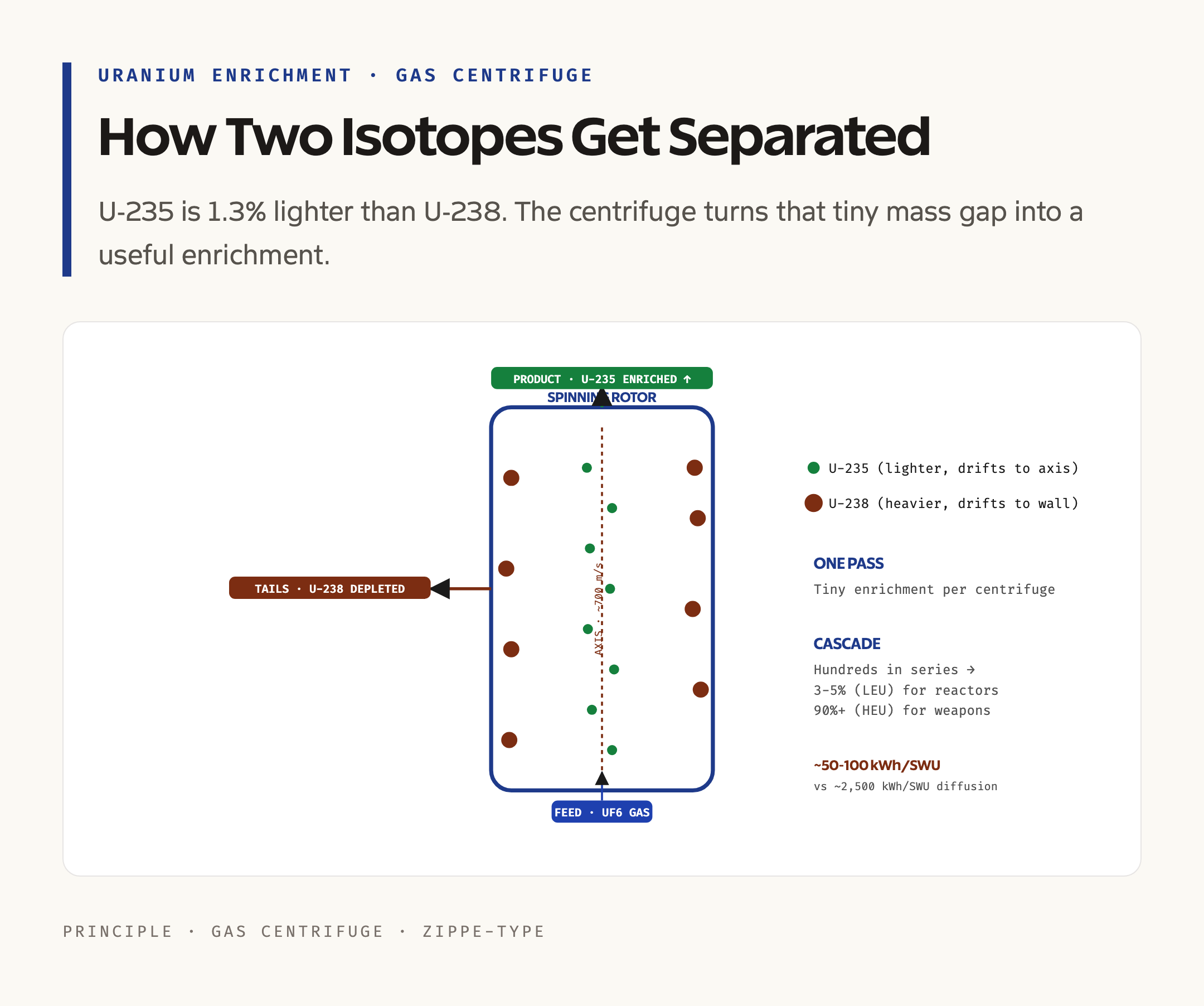
The gas centrifuge is by far the most common modern method. A vertical cylinder, the rotor, spins at very high speed inside a sealed casing. UF6 gas is fed in. The lighter U-235-bearing molecules drift slightly closer to the axis, and the heavier U-238-bearing molecules drift slightly closer to the wall. A counter-current circulation along the length of the rotor amplifies the small radial separation into a useful axial separation.
Each centrifuge produces only a small enrichment in one pass. To go from 0.7 percent to 4 percent for power-reactor fuel, the gas is fed through hundreds or thousands of centrifuges in series, called a cascade. The output of one centrifuge is the input of the next.
Modern centrifuges spin at supersonic speeds and are made from carbon-fibre composites or specialised maraging steel. The bearings, the rotor balance, and the materials science are the difficult parts. The country that masters them runs an efficient enrichment programme. The country that does not, does not.
The gas centrifuge replaced gaseous diffusion as the dominant method in the 1970s and 1980s because it consumes far less electricity per SWU. A centrifuge plant uses roughly 50 to 100 kilowatt-hours per SWU. A diffusion plant used about 2,500 kilowatt-hours per SWU. The energy economics alone closed every diffusion plant in the West by 2013.
Other Methods of Enrichment
Gaseous diffusion was the original industrial method, used at Oak Ridge in the United States during the Manhattan Project and in scaled-up plants for civilian fuel through the 1990s. UF6 gas is forced through porous nickel barriers, and the lighter molecules pass slightly faster. The method works but is hugely energy intensive.
Aerodynamic separation, the helikon and Becker nozzle methods, was developed in South Africa and Germany. The methods exploit pressure differences in curved gas streams. They are more energy efficient than diffusion but less efficient than centrifuges. South Africa used them to build its nuclear weapons before dismantling the programme.
Laser enrichment, sometimes called atomic vapour laser isotope separation, AVLIS, or molecular laser isotope separation, MLIS, uses tuned lasers to selectively ionise U-235 atoms or molecules so they can be electrically separated. The Australian SILEX process, licensed to GLE in the United States, is the only modern laser method that has reached commercial demonstration.
Calutron electromagnetic separation, where ionised UF6 is bent through a magnetic field, was the first method ever used at scale. It is energy-intensive and is now largely a historical curiosity, although Iraq used it in its weapons programme in the 1980s and Iran briefly experimented with it.
India’s Enrichment Programme
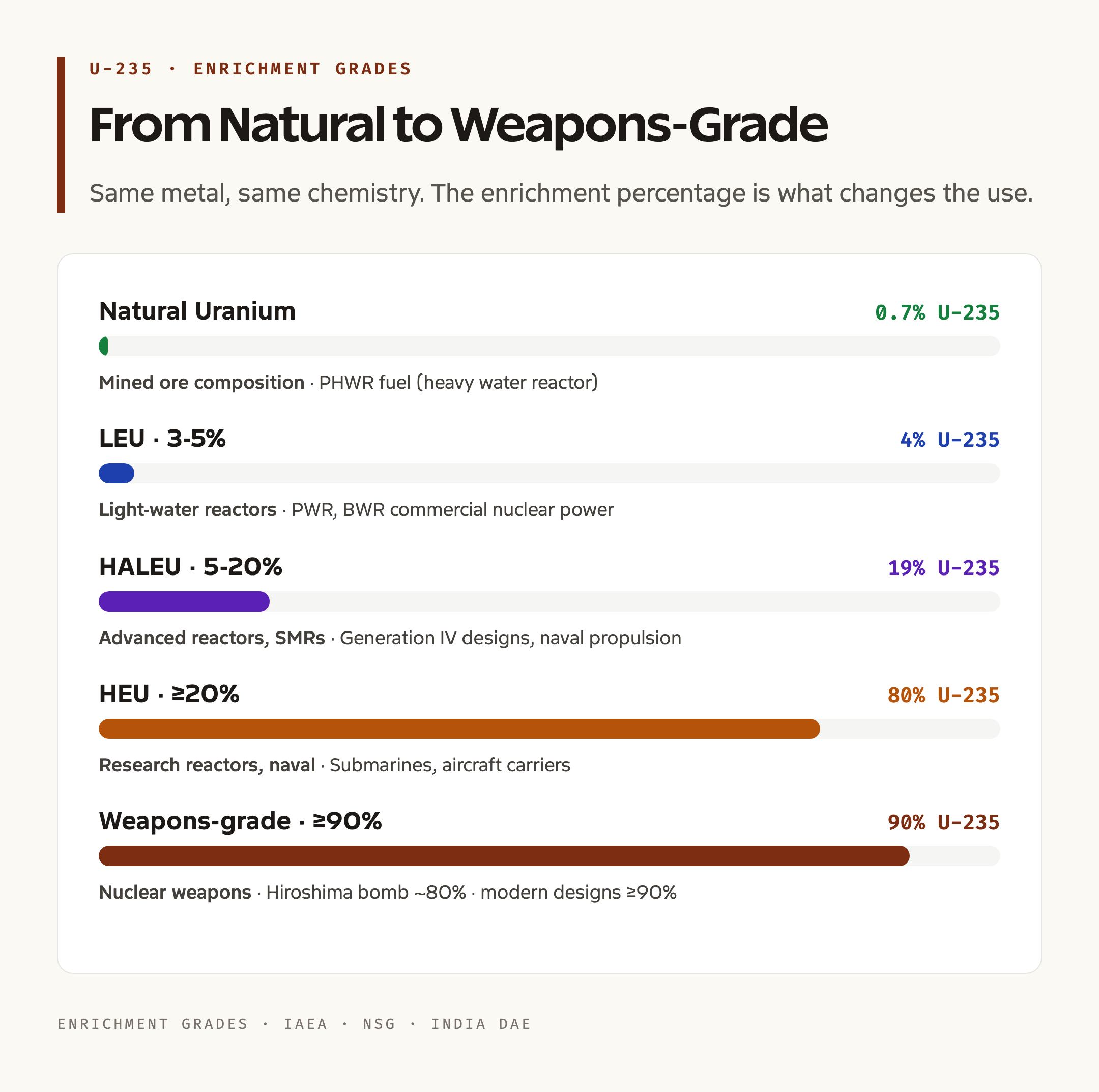
India operates an enrichment plant at Rattehalli, near Mysuru in Karnataka. The plant is run by the Department of Atomic Energy and produces uranium for the country’s nuclear-powered submarines and for the Indian Naval reactor programme. The Rattehalli plant uses gas-centrifuge technology developed indigenously through the Bhabha Atomic Research Centre, BARC, and the Indira Gandhi Centre for Atomic Research, IGCAR.
A Special Material Enrichment Facility, SMEF, has been announced for Chitradurga in Karnataka with a much larger projected capacity. The new facility is intended to support the next generation of indigenous naval reactors and a strategic enrichment reserve.
India’s civilian power programme does not currently need enrichment. The 22 operational PHWRs run on natural uranium, and the imported LWRs at Kudankulam are fuelled by Russia under a supply agreement. The new fleet of 700-megawatt PHWRs being built at Kakrapar, Rawatbhata, Gorakhpur, and Mahi Banswara also runs on natural uranium.
The civilian-military separation is important. After the India-US civil nuclear deal in 2008, India placed 14 of its civilian reactors and associated facilities under IAEA safeguards in stages. Rattehalli and SMEF are not on that list. They remain in the strategic reserve and are not subject to international inspection.
Multilateral Export Controls
Enrichment technology is among the most tightly controlled categories in the world. The Nuclear Suppliers Group, NSG, the Missile Technology Control Regime, the Wassenaar Arrangement, and the Australia Group between them cover almost every dual-use technology that a national enrichment programme would need.
India is a member of the Missile Technology Control Regime, MTCR, the Australia Group, and the Wassenaar Arrangement. India is not a member of the NSG, the most directly relevant body, although the country has applied for membership and continues to negotiate with member states.
The 2008 NSG waiver allowed India to import civilian nuclear technology and uranium fuel for its safeguarded reactors despite not being a Non-Proliferation Treaty signatory. The waiver did not extend to enrichment or reprocessing technology, which remain off limits to India under most supplier agreements.
Safeguards and Non-Proliferation
The IAEA, headquartered in Vienna, runs the international safeguards regime. Member states declare their nuclear materials and facilities, and IAEA inspectors verify the declarations through on-site inspections, environmental sampling, and remote monitoring. Surveillance cameras, tamper-evident seals, and material accountancy logs are the day-to-day tools.
India operates an item-specific safeguards agreement with the IAEA covering its declared civilian facilities. The Additional Protocol, which extends safeguards to suspected undeclared activities, is in force in many states but is not signed by India.
Enrichment-related proliferation risks have driven much of the international system. The A Q Khan network from Pakistan supplied centrifuge technology to North Korea, Libya, and Iran. The Iranian programme, partially constrained by the 2015 Joint Comprehensive Plan of Action and the snapback debates of 2025, remains the central case study in modern enrichment diplomacy.
Why Uranium Enrichment Matters for UPSC GS-III
GS-III asks candidates to engage with technology that has both civilian and security implications. Uranium enrichment is the textbook example. It powers reactors, it powers weapons, and the dividing line is set by enrichment percentage rather than by any chemical or visible difference in the metal.
The cleanest UPSC framing is to layer the topic. The science layer, what U-235 is and why isotope separation is hard. The technology layer, what a centrifuge does and how cascades work. The policy layer, why enrichment is so tightly controlled and how India navigates the export regimes. The strategic layer, how Rattehalli and SMEF fit into India’s nuclear deterrent and naval posture. Linking enrichment to uranium mining in India and the wider nuclear energy programme rounds out the answer.
Frequently Asked Questions
What is uranium enrichment?
Uranium enrichment is the process of increasing the proportion of uranium-235 in a uranium sample so that the metal can sustain a chain reaction. Natural uranium contains only about 0.7 percent U-235. Reactor fuel needs 3 to 5 percent. Weapons-grade uranium is 90 percent or higher.
Why does enrichment need uranium hexafluoride gas?
UF6 is the only stable uranium compound that becomes a gas at modest temperatures, around 56 degrees Celsius at atmospheric pressure. Gas-phase separation methods, especially the centrifuge, only work on a gas. Solid uranium and uranium dioxide cannot be enriched by these methods, so the metal is converted to UF6 first and converted back after enrichment.
What is the difference between LEU, HALEU, and HEU?
LEU, low-enriched uranium, contains less than 20 percent U-235 and includes commercial reactor fuel at 3 to 5 percent. HALEU, high-assay low-enriched uranium, sits between 5 and 20 percent and is used for some advanced and small modular reactors. HEU, highly enriched uranium, is 20 percent or above. Weapons-grade HEU is typically 90 percent or higher.
Where does India enrich uranium?
India operates a uranium-enrichment plant at Rattehalli, near Mysuru in Karnataka, using gas-centrifuge technology. A larger Special Material Enrichment Facility has been announced for Chitradurga in Karnataka. India’s enrichment supports the indigenous naval reactor programme and is outside IAEA safeguards.
Why do PHWRs not need enrichment?
Pressurised heavy-water reactors use heavy water, deuterium oxide, as the moderator. Heavy water absorbs far fewer neutrons than ordinary water, which lets a chain reaction proceed even with natural unenriched uranium. India’s domestic civilian power programme is built around PHWRs precisely because international restrictions on enrichment made an LWR-based programme impractical in the 1960s and 1970s.
Who regulates uranium enrichment internationally?
The International Atomic Energy Agency runs the safeguards regime that verifies declared civilian enrichment. The Nuclear Suppliers Group restricts trade in enrichment technology. The Non-Proliferation Treaty is the legal framework. India is outside the NPT but has facility-specific safeguards arrangements with the IAEA covering its declared civilian reactors.