World Wildlife Day: Date, Themes, CITES, India’s Conservation
World Wildlife Day explained: 3 March CITES signing, UN 2013 resolution, annual themes, India's WPA 1972, Project Tiger, IUCN Red List for UPSC.
World Wildlife Day is observed every year on 3 March to celebrate wild fauna and flora and raise awareness about their conservation. The date commemorates the signing of the Convention on International Trade in Endangered Species of Wild Fauna and Flora (CITES) on 3 March 1973 in Washington, D.C. The United Nations General Assembly proclaimed the day through Resolution 68/205 on 20 December 2013, on a proposal from Thailand during CITES CoP16. The Secretariat of CITES, in collaboration with other UN bodies, facilitates the global observance.
Why 3 March — The CITES Connection
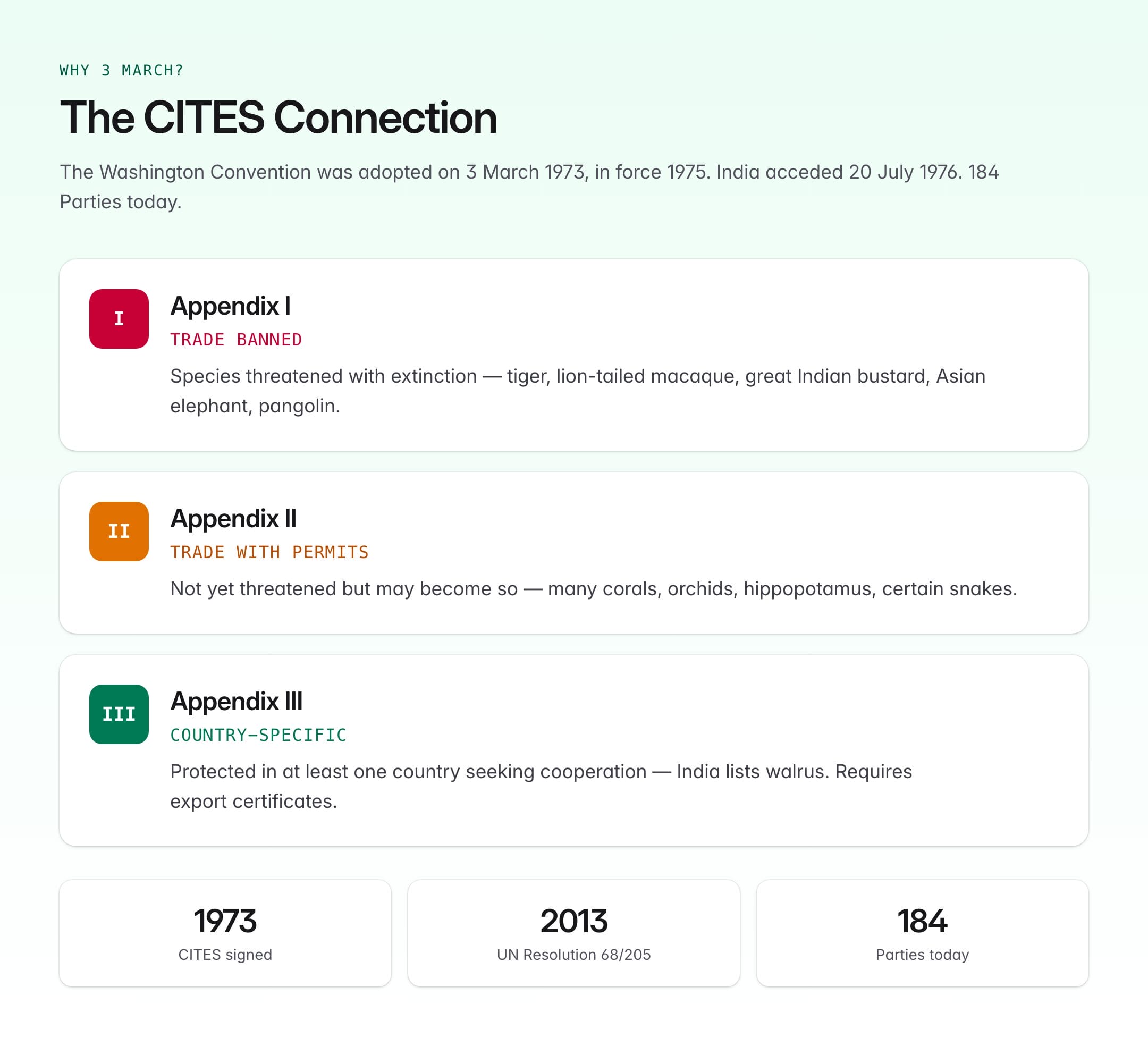
CITES, also called the Washington Convention, was adopted on 3 March 1973 and entered into force on 1 July 1975. It is one of the oldest and largest multilateral environmental agreements, with 184 Parties as of 2025. India became a Party on 20 July 1976.
CITES regulates international trade in listed species through three Appendices:
| Appendix | Content | Trade Rule |
|---|---|---|
| I | Species threatened with extinction (e.g., tiger, lion-tailed macaque, great Indian bustard, Asian elephant, pangolin) | Trade banned except in exceptional non-commercial circumstances |
| II | Species not yet threatened but may become so without trade regulation (e.g., many corals, orchids, hippopotamus, some snakes) | Trade permitted with export permits and non-detriment findings |
| III | Species protected in at least one country seeking international cooperation (e.g., India listed walrus — country-specific submissions) | Trade requires export certificates |
Species transfers between appendices are decided at the Conference of the Parties (CoP) held every 2–3 years. India has hosted CoP3 (1981 New Delhi).
Annual Themes (Selected Years)
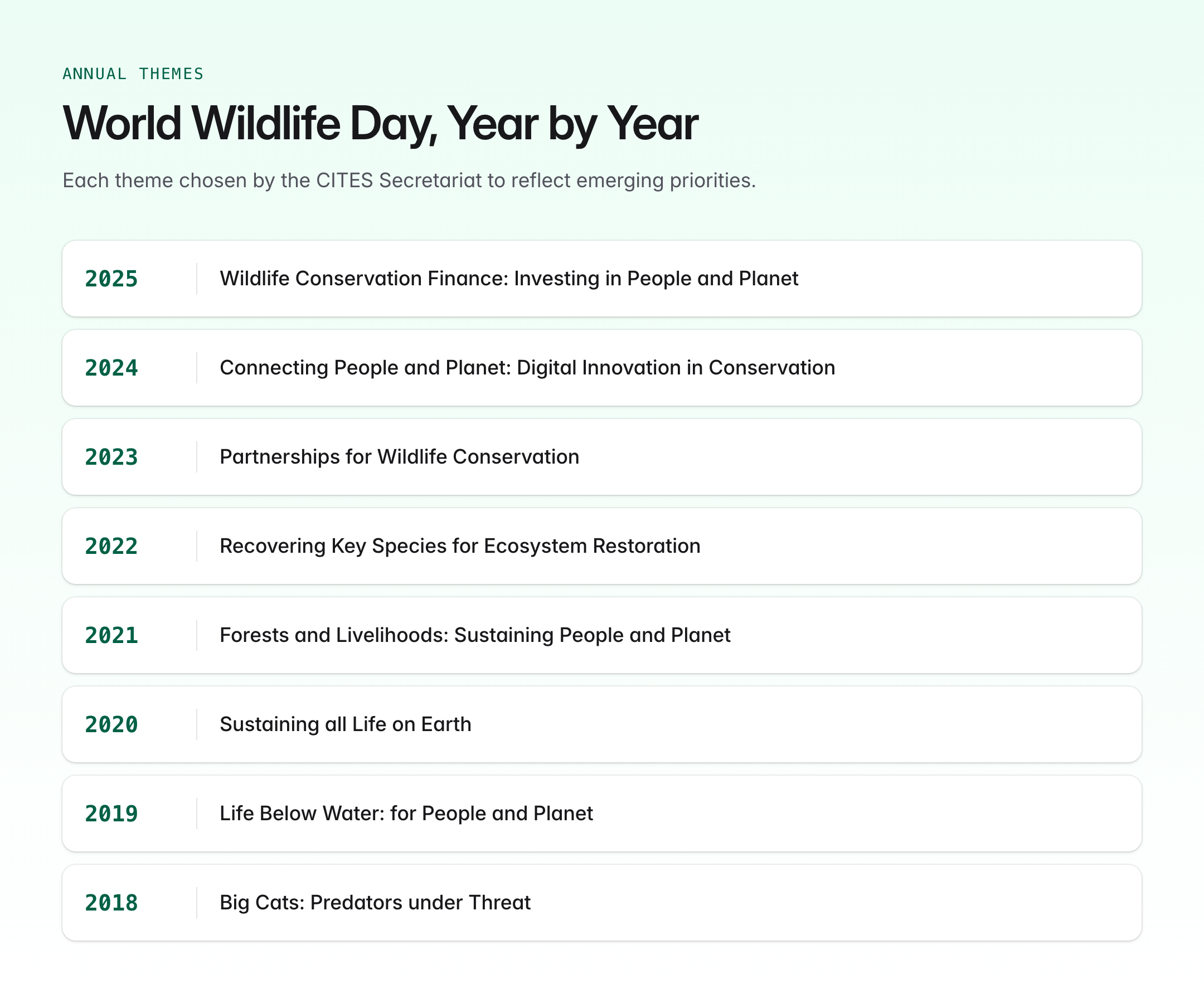
Each year the day has a theme, chosen by the CITES Secretariat and UN partners to reflect emerging conservation priorities.
| Year | Theme |
|---|---|
| 2014 | Wildlife Crime is Serious — Let's Get Serious about Wildlife Crime |
| 2016 | The Future of Wildlife is in our Hands |
| 2017 | Listen to the Young Voices |
| 2018 | Big Cats: Predators under Threat |
| 2019 | Life Below Water: for People and Planet |
| 2020 | Sustaining all Life on Earth |
| 2021 | Forests and Livelihoods: Sustaining People and Planet |
| 2022 | Recovering Key Species for Ecosystem Restoration |
| 2023 | Partnerships for Wildlife Conservation |
| 2024 | Connecting People and Planet: Exploring Digital Innovation in Wildlife Conservation |
| 2025 | Wildlife Conservation Finance: Investing in People and Planet |
India's Wildlife Legislation
India protects its wildlife through a layered legal framework anchored in Article 48A (Directive Principles) and Article 51A(g) (Fundamental Duties) of the Constitution, operationalised through several statutes.
Wildlife (Protection) Act, 1972 (WPA)
Enacted on 9 September 1972, the WPA is India's principal wildlife law. Its core features:
- Six Schedules (Schedules I–IV for animals, V for vermin, VI for plants) — after 2022 amendment, restructured to four Schedules (I for highest protection, II for other protected species, III for CITES listed species, IV for plants).
- Protected Area categories: National Parks, Wildlife Sanctuaries, Conservation Reserves (added 2003), Community Reserves (2003).
- National Board for Wildlife (NBWL) chaired by the Prime Minister.
- State Boards for Wildlife chaired by Chief Ministers.
- Central Zoo Authority, National Tiger Conservation Authority (NTCA), Wildlife Crime Control Bureau (WCCB) as statutory bodies.
- Penalties: imprisonment up to 7 years and fines for Schedule I offences.
Other Key Laws
| Law | Year | Domain |
|---|---|---|
| Indian Forest Act | 1927 | Reserved, Protected, Village forests |
| Forest (Conservation) Act | 1980 | Diversion of forest land |
| Environment (Protection) Act | 1986 | Umbrella environment law |
| Biological Diversity Act | 2002 | Access, benefit-sharing, NBA |
| Scheduled Tribes and Other Traditional Forest Dwellers (Recognition of Forest Rights) Act | 2006 | Community forest rights |
| Wildlife (Protection) Amendment Act | 2022 | CITES alignment, schedule restructuring |
Flagship Conservation Programmes
Project Tiger (1973)
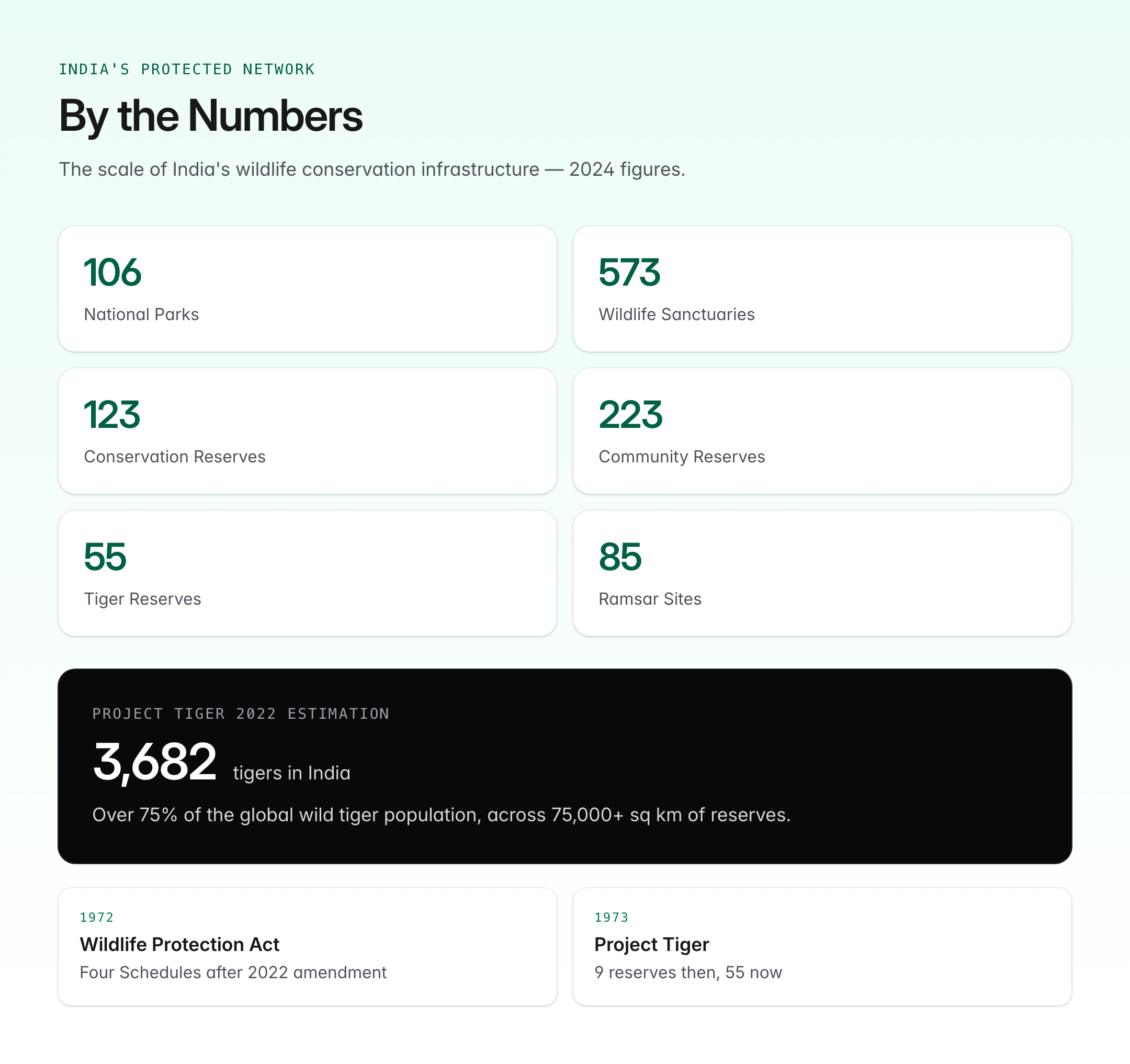
Launched on 1 April 1973 with 9 tiger reserves covering 14,000 sq km. As of 2024, India has 55 tiger reserves covering over 75,000 sq km and harbours around 3,682 tigers (All India Tiger Estimation 2022, report released 2023) — over 75% of the global wild tiger population. The National Tiger Conservation Authority (NTCA) was made statutory in 2006.
Project Elephant (1992)
Launched in February 1992 to protect Asian elephants (Elephas maximus), their habitats and migration corridors. India hosts around 29,964 elephants (2017 census) across 33 Elephant Reserves. The Monitoring of Illegal Killing of Elephants (MIKE) programme runs under CITES.
Other Species-Specific Initiatives
- Project Lion (2020) — Asiatic lion in Gir landscape.
- Project Dolphin (2020) — Gangetic and marine dolphins.
- Project Cheetah (2022) — reintroduction at Kuno National Park.
- Vulture Action Plan 2020–25 — Gyps species recovery.
- Sea Turtle Conservation Project — Olive Ridley, leatherback.
- Great Indian Bustard Recovery Programme — Desert National Park.
- Species Recovery Programme — 22 critically endangered species under CSS-IDWH.
Protected Area Network (India)
As of 2024–25:
- 106 National Parks
- 573 Wildlife Sanctuaries
- 123 Conservation Reserves
- 223 Community Reserves
- Total Protected Area: approximately 1,73,629 sq km (~5.28% of India's geographical area)
- 18 Biosphere Reserves (12 recognised under UNESCO-MAB)
- 85 Ramsar Sites (Wetlands of International Importance) as of 2024
- 43 Tiger Reserves (Core + Buffer) under Project Tiger (55 declared as of 2024)
IUCN Red List and Indian Species
The IUCN Red List of Threatened Species is the world's most comprehensive inventory of conservation status. Categories:
| Category | Meaning |
|---|---|
| Extinct (EX) | No surviving individuals |
| Extinct in the Wild (EW) | Survives only in captivity |
| Critically Endangered (CR) | Extremely high risk of extinction |
| Endangered (EN) | High risk of extinction |
| Vulnerable (VU) | Facing significant threats |
| Near Threatened (NT) | Close to qualifying for VU |
| Least Concern (LC) | Widespread and abundant |
| Data Deficient (DD) | Insufficient data |
| Not Evaluated (NE) | Not yet assessed |
Selected Indian species and Red List status (2024):
| Species | Status |
|---|---|
| Great Indian bustard | Critically Endangered |
| Gharial | Critically Endangered |
| Bengal florican | Critically Endangered |
| Pygmy hog | Endangered |
| Lion-tailed macaque | Endangered |
| Asian elephant | Endangered |
| Snow leopard | Vulnerable |
| Bengal tiger | Endangered |
| Sloth bear | Vulnerable |
| Nilgiri tahr | Endangered |
| Hangul (Kashmir stag) | Critically Endangered |
International Wildlife Governance
| Instrument | Year | India's Status |
|---|---|---|
| CITES | 1973 / in force 1975 | Party since 1976 |
| Convention on Biological Diversity (CBD) | 1992 | Party since 1994; COP 11 hosted in Hyderabad 2012 |
| Ramsar Convention on Wetlands | 1971 | Party since 1982 |
| Convention on Migratory Species (CMS, Bonn) | 1979 | Party since 1983; COP 13 hosted 2020 at Gandhinagar |
| World Heritage Convention (UNESCO) | 1972 | Party since 1977 |
| UNCCD | 1994 | Party since 1996 |
Contemporary Concerns
- Wildlife crime — illegal trade in pangolins, tigers, elephants, sea cucumbers, red sanders; WCCB's role.
- Human–wildlife conflict — leopards, elephants, nilgai, wild boar; compensation and coexistence frameworks.
- Climate change — range shifts, coral bleaching, Himalayan fauna.
- Infrastructure and habitat fragmentation — linear projects cutting corridors.
- Zoonotic disease risks — One Health approach post-COVID.
UPSC Relevance
Prelims: Date (3 March), year of CITES signing (1973), India's accession (1976), UN resolution year (2013), CITES appendices contents, WPA year (1972) and 2022 amendment, Project Tiger (1973) and Project Elephant (1992), number of tiger reserves, Ramsar sites count, IUCN categories.
GS-III (Environment): Wildlife conservation laws, protected area network, flagship projects, international conventions, species recovery programmes. Typical question: "Discuss the effectiveness of India's Wildlife (Protection) Act, 1972 in light of emerging conservation challenges."
GS-II (Governance): Role of statutory bodies — NBWL, NTCA, WCCB, Central Zoo Authority.
Essay: Themes like "humans and nature," "biodiversity as a public good," "science and conservation."
Interview: Expect questions comparing Project Cheetah with Project Tiger, India's stand at CITES CoPs on pangolin/shark listings, and human–elephant conflict policy.
Use 3 March as an annual anchor to update your UPSC notes on wildlife — species listings shift, themes change, laws evolve. Treat World Wildlife Day not as a one-line factoid but as a calendar cue to refresh a core Prelims-Mains topic.