In 2025, a Central Zoo Authority (CZA) review made a quiet but consequential admission. India’s flagship conservation breeding programme for the Alpine musk deer had, for years, been running with the wrong species. The deer in Indian zoos labelled and bred as Alpine musk deer were actually Himalayan musk deer, a closely related but distinct species. Decades of breeding records, gene-pool planning, and conservation reporting had been built on a misidentification.
This is a teaching case for UPSC. It sits at the intersection of statutory bodies, the Wildlife (Protection) Act, 1972, conservation science, taxonomy, and institutional accountability. The CZA itself is a high-frequency prelims topic, and the deer mix-up adds a recent-current-affairs angle that mains questions on conservation governance and species recovery may build on. This guide covers both layers: the institution and the controversy.
Quick Facts
- Body: Central Zoo Authority (CZA)
- Created under: Wildlife (Protection) Act, 1972
- Nature: Statutory body
- Nodal ministry: Ministry of Environment, Forest and Climate Change (MoEFCC)
- Chairperson: Minister of Environment, Forest and Climate Change
- Vice-Chairperson: Appointed by the Central Government
- Members: Up to 10 (experts in wildlife biology and zoo management)
- Member-Secretary: Ex-officio, Director (Member-Secretary), MoEFCC
- Headquarters: New Delhi
- 2025 controversy: Conservation breeding programme for the Alpine musk deer was actually running with Himalayan musk deer specimens
- Web: cza.nic.in
What is the Central Zoo Authority?
The Central Zoo Authority is the statutory regulator for all zoos in India. Created in 1992 through an amendment to the Wildlife (Protection) Act, 1972, it brings every recognised zoo, large or small, public or private, under a common standard for animal welfare, husbandry, enclosure design, veterinary care, and conservation breeding. Before the CZA, zoo standards were uneven. Some Indian zoos were excellent, others were neglectful and operated as little more than menageries.
The CZA’s mandate is regulatory, advisory, and developmental. It recognises zoos and grants them accreditation, conducts periodic evaluations, approves animal exchange programmes within India and across borders, controls captive breeding programmes for endangered species, and advises the central government on zoo policy and legislation. It also coordinates with the Wildlife Protection Act framework and with international standards like those of the World Association of Zoos and Aquariums.
Composition and Structure
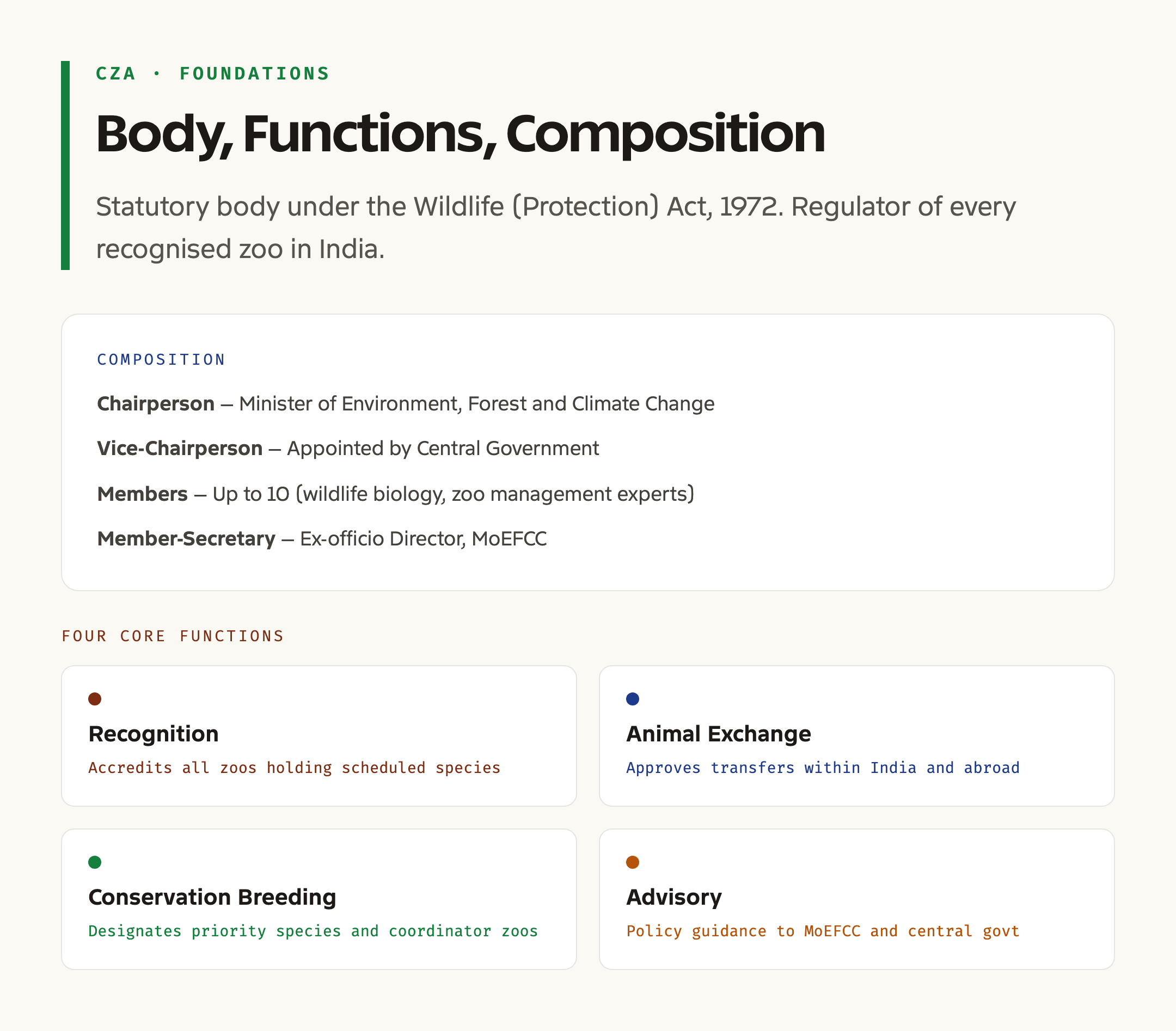
The CZA’s composition reflects a deliberate balance between political accountability and technical expertise. The Minister of Environment, Forest and Climate Change chairs the Authority, ensuring high-level political ownership. A Vice-Chairperson is appointed by the central government to handle day-to-day strategic guidance. Up to ten members include experts in wildlife biology, zoo management, veterinary science, and conservation, often drawn from institutions like the Wildlife Institute of India and Indian veterinary universities.
The Member-Secretary, an ex-officio Director within MoEFCC, serves as the Authority’s chief executive and runs the secretariat in New Delhi. This structure, codified under the Wildlife (Protection) Act, allows the CZA to issue legally binding directions to zoos. Failure to comply can result in derecognition, which effectively shuts a zoo down because no recognised zoo can legally hold scheduled wildlife species without CZA recognition.
Functions of the CZA
The CZA performs four broad classes of functions, each with distinct legal and operational implications.
- Recognition and accreditation: Every zoo in India that holds scheduled wildlife must be recognised by the CZA. Recognition is renewed periodically based on evaluation visits and compliance reports. This function is the lever the CZA uses to enforce welfare standards.
- Approval of animal exchanges: Movement of scheduled animals between zoos, whether within India or across international borders, requires CZA approval. This includes loans for breeding, exchange of surplus animals, and inter-zoo transfers for genetic management.
- Conservation breeding programmes: The CZA designates priority species for captive breeding and identifies coordinator zoos. These programmes are supposed to produce genetically robust populations that can support reintroduction or supplement wild populations of endangered species.
- Advisory: Advising the central government on zoo policy, legislation, master planning, and standards. The CZA’s National Zoo Policy framework guides how new zoos are conceived and how existing ones evolve.
The Musk Deer Mix-Up: What Happened
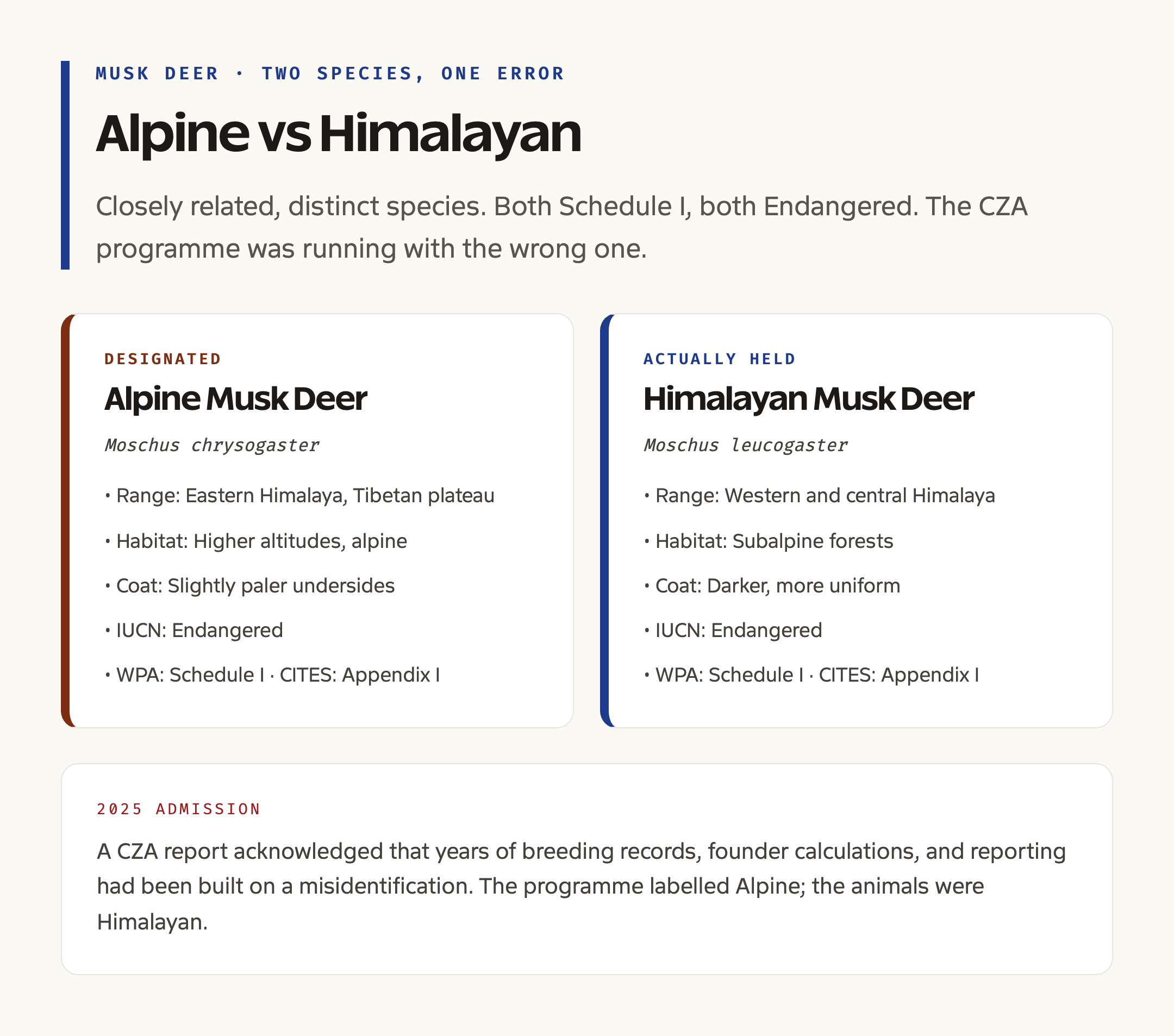
The musk deer is one of the world’s most poached small mammals because the male carries a musk pod whose secretions are valuable in traditional medicine and perfumery. India hosts at least two musk deer species. The Himalayan musk deer is found in the western and central Himalaya. The Alpine musk deer is more eastern, with stronger affinities to higher Tibetan-plateau habitats.
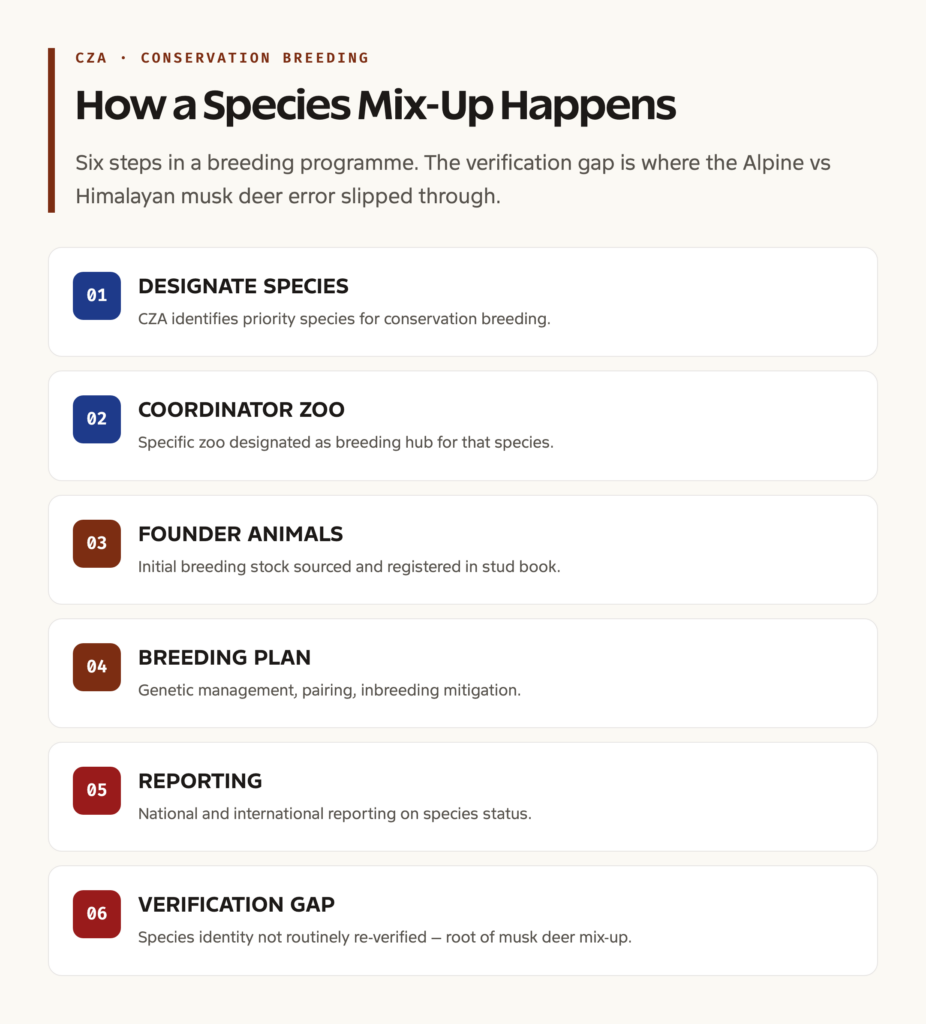
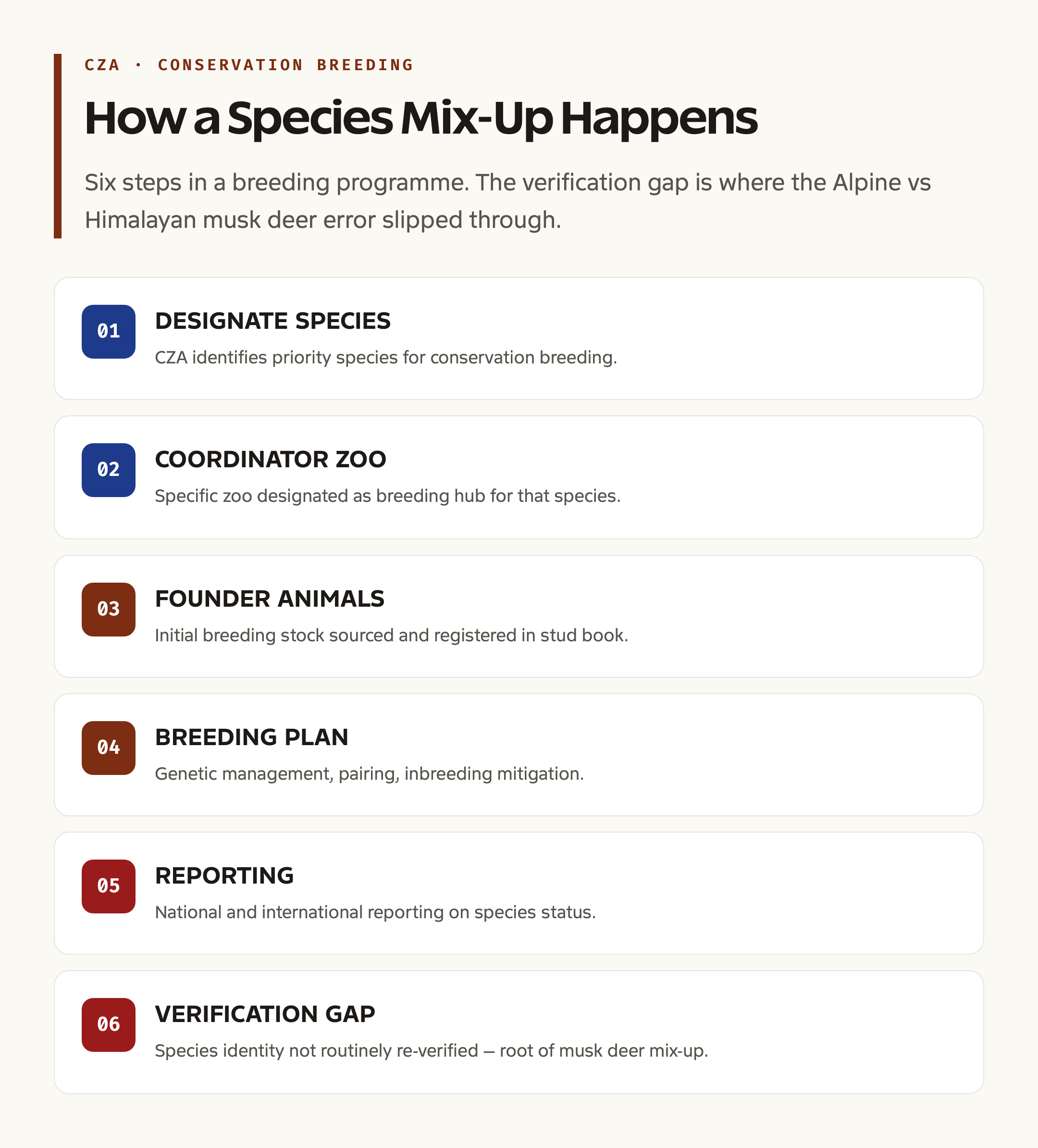
The CZA had designated the Alpine musk deer as a priority species and identified a coordinator zoo for its captive breeding. Stud-book records, breeding plans, and progress reports were all maintained for the Alpine musk deer. In 2025, a fresh taxonomic review and field-comparative study revealed that the deer actually held in the breeding facility were Himalayan musk deer, not Alpine. Years of investment, scientific reporting, and policy positioning had been based on a misidentification at the species level.
Why the Mix-Up Matters
The mix-up matters at three levels. First, scientifically, the Alpine and Himalayan musk deer are distinct species with different evolutionary lineages, distinct habitat preferences, and different conservation statuses. Treating Himalayan musk deer as Alpine musk deer means the genetic management plan, founder calculation, and inbreeding mitigation strategies were all built on the wrong baseline.
Second, the situation has policy consequences. India’s reporting under the Convention on Biological Diversity and to other international bodies on the conservation status of the Alpine musk deer was affected. Resources allocated to Alpine breeding were actually maintaining Himalayan stocks. Third, it raises governance questions. How could a coordinator zoo, the Wildlife Institute of India, the State Forest Department, and the CZA itself collectively miss the species identity for years? The honest answer is that taxonomic verification was not built into routine inspection and audit cycles.
Alpine vs Himalayan Musk Deer
| Feature | Alpine Musk Deer | Himalayan Musk Deer |
|---|---|---|
| Scientific name | Moschus chrysogaster | Moschus leucogaster |
| Range | Eastern Himalaya, Tibetan plateau | Western and central Himalaya |
| Coat | Slightly paler, lighter undersides | Darker, more uniform |
| Habitat preference | Higher altitudes, alpine and subalpine | Subalpine forests, slightly lower |
| IUCN status | Endangered | Endangered |
| Indian presence | Limited, mostly in Arunachal Pradesh and beyond | Widespread in Uttarakhand, Himachal, J&K |
For UPSC, remember that both species are listed in Schedule I of the Wildlife (Protection) Act and on Appendix I of CITES, the highest level of international trade protection.
Comparative: CZA and Other Statutory Bodies under WPA
The CZA is one of several statutory bodies created under the Wildlife (Protection) Act, 1972. Each has a distinct mandate.
- National Tiger Conservation Authority (NTCA): Tiger reserves and Project Tiger.
- Wildlife Crime Control Bureau (WCCB): Wildlife crime investigation, enforcement.
- National Board for Wildlife (NBWL): Apex advisory on wildlife policy, with the Prime Minister as chair.
- Central Zoo Authority (CZA): Zoo regulation and conservation breeding.
The CZA is unique because it works primarily through ex-situ conservation. NTCA and NBWL focus on in-situ habitat. CZA focuses on captive populations, breeding, and the welfare standards that govern those animals. Conservation breeding is the bridge: animals bred in captivity may eventually be released to support wild populations, as has happened with the Gangetic dolphin and certain species in Indian protected areas.
Challenges and Critiques
Even before the musk deer episode, the CZA faced challenges. India has hundreds of recognised zoos with hugely variable budgets and staff capacity. Some state zoos struggle to meet basic welfare standards even after multiple inspections. Conservation breeding has been criticised for over-emphasising charismatic species while neglecting less-studied ones. The CZA has limited field enforcement capacity and depends on state forest departments for ground inspections.
The musk deer case adds an institutional learning point. Scientific verification, including periodic genetic and morphometric audits of captive populations, must become standard. Conservation breeding cannot rely on assumptions inherited from the founders’ generation. Veterinary and curatorial training must include taxonomic skills, and partnerships with academic institutions for periodic species verification need formal protocols. Otherwise, similar errors elsewhere in the system are entirely possible.
Prelims Pointers
- The Central Zoo Authority is a statutory body created under the Wildlife (Protection) Act, 1972 (added by amendment in 1992).
- The nodal ministry is MoEFCC.
- The Chairperson is the Minister of Environment, Forest and Climate Change.
- It can have up to 10 members (experts in wildlife biology and zoo management) plus a Vice-Chairperson and an ex-officio Member-Secretary.
- Its functions include recognising zoos, approving animal exchanges, controlling conservation breeding of endangered species, and advising the government on zoo policy.
- The CZA secretariat is in New Delhi.
- Alpine musk deer (Moschus chrysogaster) and Himalayan musk deer (Moschus leucogaster) are distinct species, both Schedule I under WPA, both CITES Appendix I, both Endangered (IUCN).
- In 2025, the CZA acknowledged that its conservation breeding programme for the Alpine musk deer was actually maintaining Himalayan musk deer specimens.
Mains Angles
- GS-III, Environment: Discuss the role of statutory regulators in wildlife conservation, with the Central Zoo Authority as a case study. What lessons does the musk deer mix-up offer for conservation breeding governance?
- GS-II, Governance: Examine the institutional architecture of the Wildlife Protection Act, 1972, including CZA, NTCA, NBWL, and WCCB. How should they coordinate?
- GS-III, Science and Technology: Analyse the role of taxonomy, genetic verification, and scientific audit in modern conservation programmes. Why is species identification still a frontier issue?
- GS-II, Accountability: Use the musk deer episode to discuss how statutory bodies can build error-correction mechanisms without losing operational continuity.
- Essay: “An institution that cannot identify its mistakes cannot recover from them.” Examine in the context of Indian conservation governance.
Way Forward
The musk deer case is recoverable, not catastrophic. The first step is full transparency: a public CZA report on what happened, when it was identified, and what the immediate corrective actions are. The second step is a system-wide species verification audit across all CZA conservation breeding programmes, ideally completed within twelve months and reviewed by an independent scientific committee.
The third step is to embed taxonomic verification, including periodic genetic sampling, into the CZA’s routine inspection cycle. The fourth is to invest in zoo curator training so that frontline staff are equipped to spot species-level discrepancies. Finally, the CZA should publish breeding programme outcomes openly, so external scientists can flag concerns early. The episode is not a failure of intent. It is a failure of audit. Audit can be fixed. Done well, the lesson here can strengthen, rather than undermine, India’s conservation breeding regime.
Frequently Asked Questions
What is the Central Zoo Authority?
The Central Zoo Authority (CZA) is the statutory body that regulates zoos in India. It was created under the Wildlife (Protection) Act, 1972, by amendment in 1992, and operates under the Ministry of Environment, Forest and Climate Change.
Under which law was the CZA created?
The CZA was created under the Wildlife (Protection) Act, 1972, through an amendment introduced in 1992. It is therefore a statutory body, not a constitutional or executive body.
Who chairs the Central Zoo Authority?
The Minister of Environment, Forest and Climate Change is the ex-officio Chairperson of the CZA. A Vice-Chairperson is appointed by the central government.
How many members does the CZA have?
The CZA can have up to ten members, drawn from wildlife biology, zoo management, veterinary science, and conservation. Plus a Chairperson, Vice-Chairperson, and a Member-Secretary who is the ex-officio Director within MoEFCC.
What does the CZA do?
The CZA recognises and accredits zoos, approves animal exchange programmes between Indian and foreign zoos, controls conservation breeding programmes for endangered species, and advises the central government on zoo policy, legislation, and standards.
What is the CZA musk deer controversy?
In 2025, a Central Zoo Authority review revealed that the conservation breeding programme designated for the Alpine musk deer was actually being conducted with Himalayan musk deer specimens. The two are closely related but taxonomically distinct species.
How are Alpine and Himalayan musk deer different?
The Alpine musk deer (Moschus chrysogaster) is found in the eastern Himalaya and Tibetan plateau, while the Himalayan musk deer (Moschus leucogaster) is found in the western and central Himalaya. They differ in coat colour, habitat preference, and genetic lineage.
Why does the mix-up matter?
It matters because conservation breeding is supposed to maintain genetically representative populations of a specific species. Treating one species as another invalidates the breeding plan, distorts national reporting on species status, and misallocates conservation resources.
Are both musk deer species protected in India?
Yes. Both species are listed under Schedule I of the Wildlife (Protection) Act, 1972, the highest level of domestic protection. They are also listed on Appendix I of CITES and classified as Endangered by the IUCN.
Where is the CZA’s official information available?
Official information is available on the Central Zoo Authority website at cza.nic.in. The site hosts the National Zoo Policy, recognition lists, conservation breeding programme details, and annual reports.
Tell Google you want more of this.
Add Anantam IAS as a preferred sourceOne tap, and this site shows up more often in your own Top Stories, AI Overviews and AI Mode. Remove it any time.