

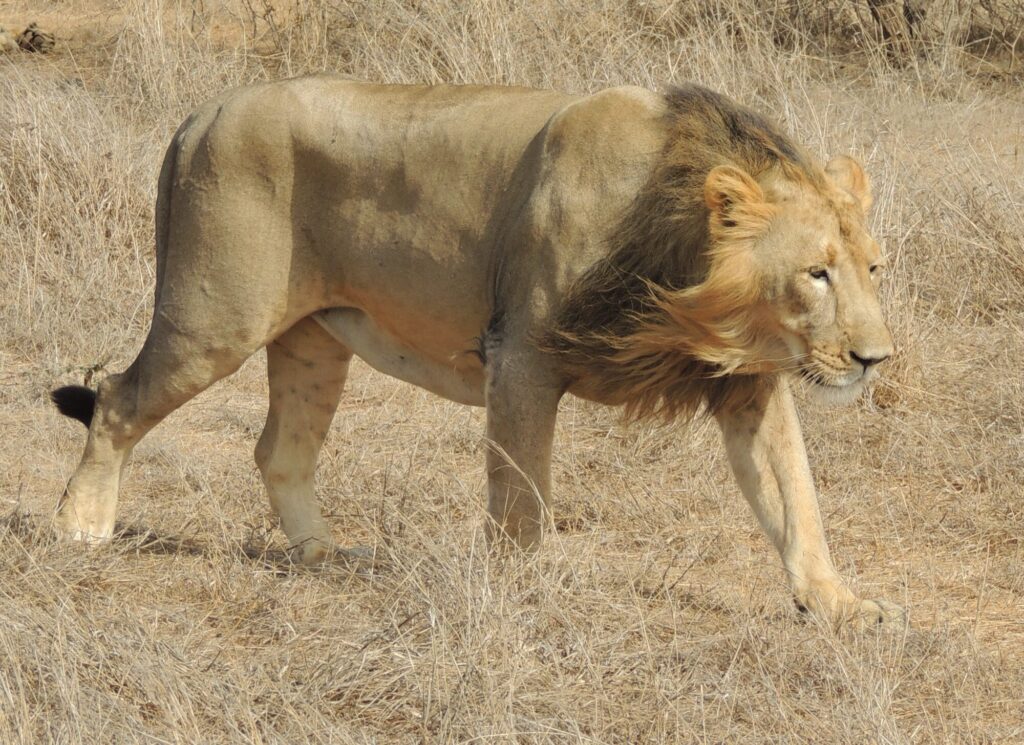
The Asiatic Lion is the only wild lion population outside Africa, and every individual alive today walks the dry deciduous forests of one Indian landscape: Gir in Saurashtra, Gujarat. Less than two centuries ago, this lion roamed from the banks of the Euphrates to the plains of Bengal. Trophy hunting, habitat loss, and shrinking prey reduced the species to a dozen or so animals by the early 1900s. What stands today is one of the most quietly successful conservation comebacks in modern wildlife history.
The 2020 census put the Asiatic Lion population at 674 individuals across the Gir landscape, up from 523 in 2015. The 2025 estimate placed the count near 891. Yet the species remains classified as Endangered on the IUCN Red List, and the entire population still lives in a single contiguous habitat — a textbook risk factor for any wild species. One outbreak, one fire, one prolonged drought, and decades of recovery could unravel.
This article walks through the biology, history, legal protection, ongoing translocation debate, and UPSC-relevant context of the Asiatic Lion in India.
Quick Facts About the Asiatic Lion
- Scientific name: Panthera leo persica (a subspecies of Panthera leo)
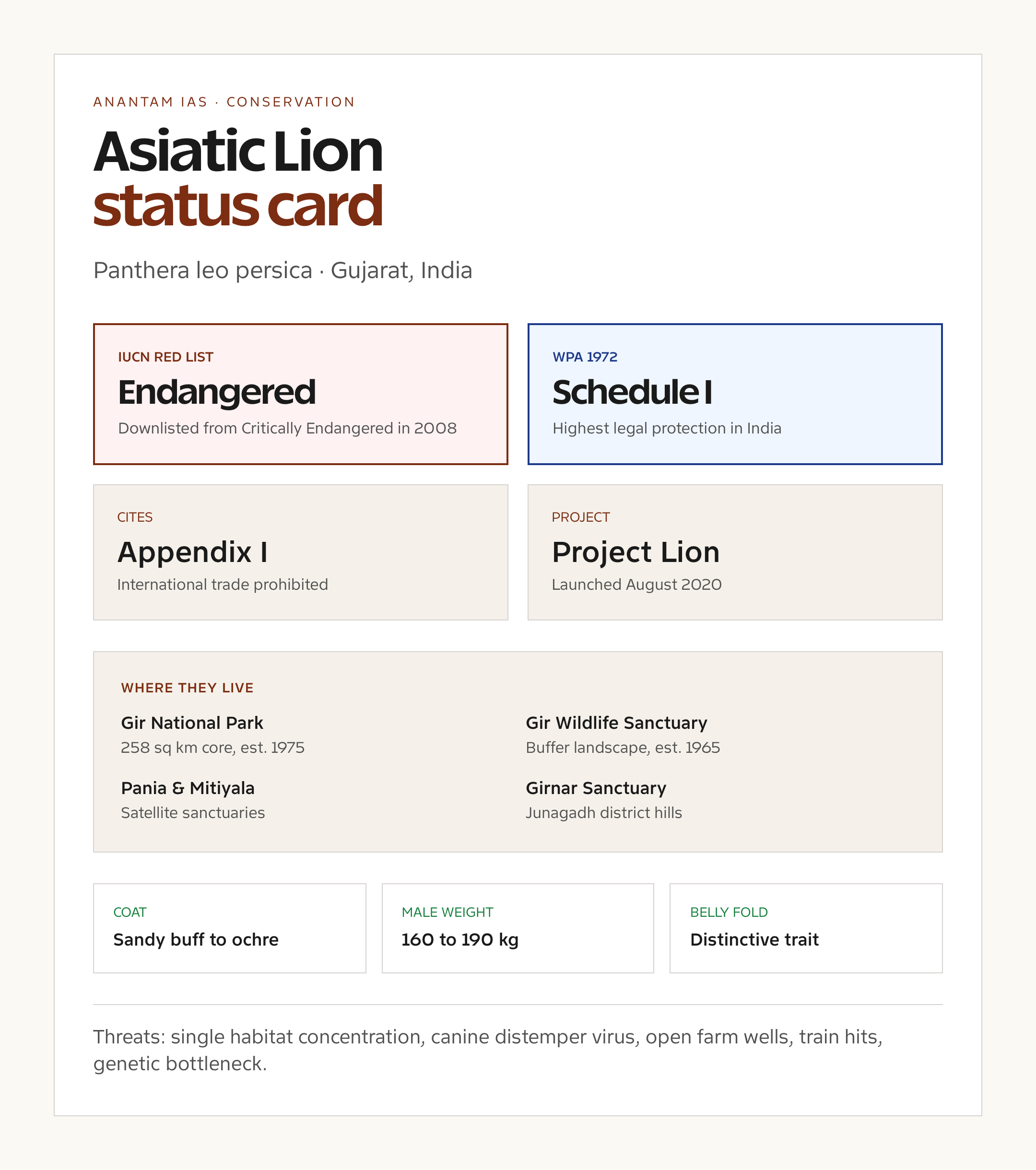
- IUCN Red List status: Endangered (downlisted from Critically Endangered in 2008)
- CITES listing: Appendix I
- Wildlife (Protection) Act 1972: Schedule I
- Sole habitat: Gir landscape, Gujarat (Gir National Park, Gir Wildlife Sanctuary, Pania, Mitiyala, Girnar)
- 2020 census count: 674 individuals
- 2025 estimate: around 891 individuals
- Project Lion: launched 2020 by the Government of India
Taxonomy and Physical Characteristics
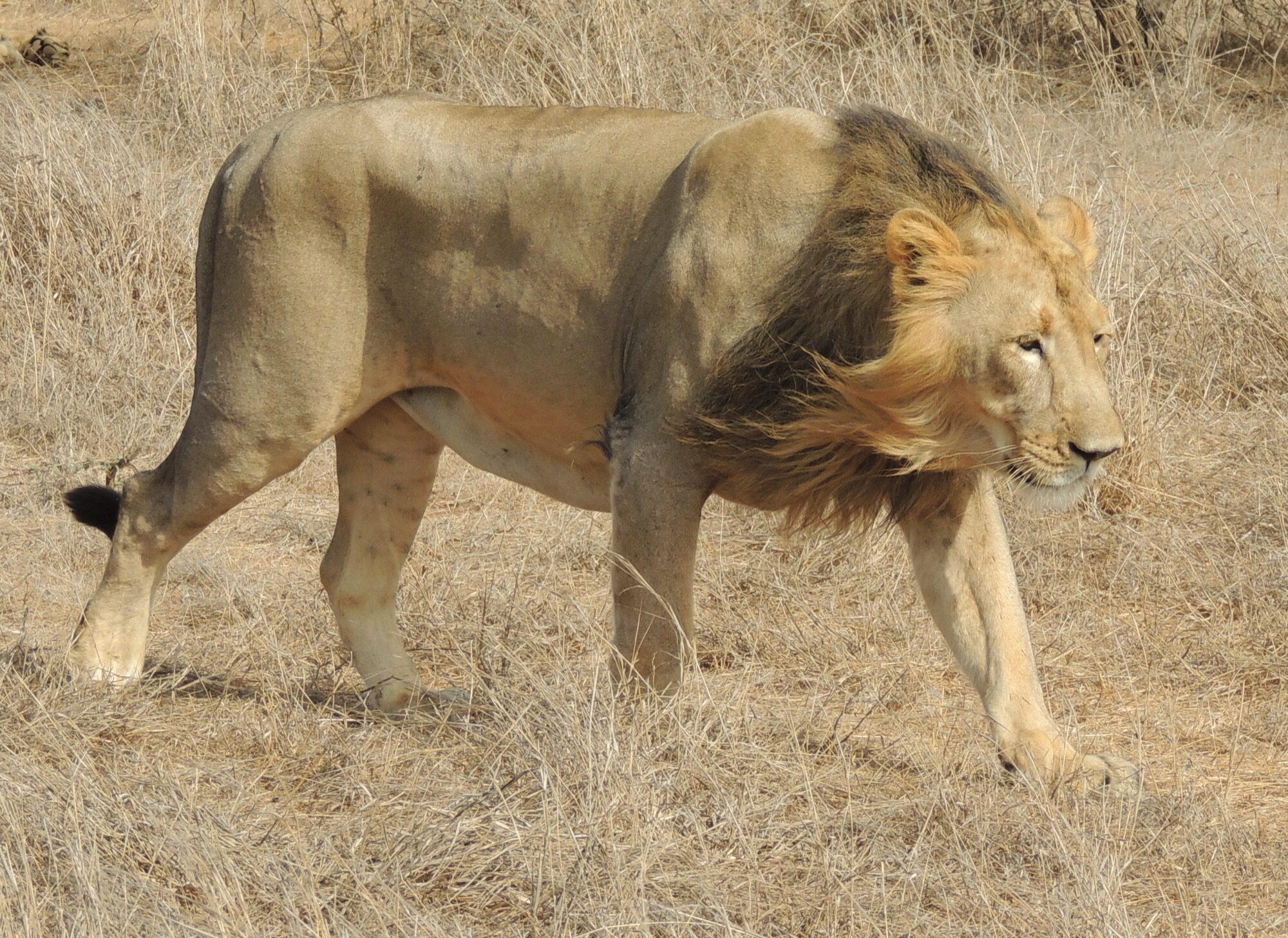
The Asiatic Lion belongs to the genus Panthera, family Felidae. Genetic studies place it as a subspecies of Panthera leo, separated from African lions by roughly 100,000 years of evolutionary divergence. Compared with African lions, the Asiatic Lion is slightly smaller, has a less developed mane that leaves the ears visible, and shows a prominent longitudinal skin fold along the belly — a feature almost absent in African populations.
Males weigh 160 to 190 kilograms, females 110 to 120 kilograms. Shoulder height stands at around 110 centimetres. Coat colour ranges from sandy buff to dark ochre. The tail tuft is dense and black-tipped. Cubs are spotted at birth and lose the markings by their second year.
The species lives in prides, though Asiatic Lion prides are smaller than African ones — typically two to three adult females with cubs, while males live separately and join only during mating or large kills. Average lifespan in the wild is 16 to 18 years.
Historical Range and Collapse
Until the 19th century, the Asiatic Lion roamed across West Asia, the Caucasus, Persia, Mesopotamia, and the Indian subcontinent from the Indus to the Narmada and east to Bihar. The Mughal emperors hunted them in Rajasthan and Haryana. By 1810, the species had vanished from large parts of north India. The last recorded sighting in Iran was in 1942. By 1900, Indian populations were reduced to fewer than 50 animals.
Two factors drove the collapse: unchecked trophy hunting by British and Indian rulers, and conversion of grassland and scrub habitat into agriculture. The Nawab of Junagadh banned lion hunting in his princely state around 1879 and again more strictly in the 1900s, an act that almost certainly saved the species. By 1936, the Gir population was estimated at around 234. The 1960s census, the first organized count, found only 177 lions. Every Asiatic Lion alive today descends from that small founder population.
Gir National Park and Wildlife Sanctuary
Gir was declared a wildlife sanctuary in 1965 and upgraded to a national park (over a 258 sq km core) in 1975. The wider protected landscape covers about 1,412 square kilometres. The terrain is dry deciduous forest interspersed with scrub, grasslands, and seasonal rivers like the Hiran, Shetrunji, and Datardi. Maldhari pastoralist communities have lived inside the forest for generations, sharing space with the lions. The relocation of several Maldhari nesses (settlements) in the 1970s and 80s reduced cattle pressure inside the core zone.
Prey species include chital, sambar, nilgai, chowsingha, wild boar, and chinkara. Livestock kills do occur outside the protected area, leading to compensation schemes managed by the Gujarat Forest Department. Gir also supports leopards, striped hyenas, jungle cats, marsh crocodiles in the Kamleshwar reservoir, and over 300 bird species.
To understand how Gir fits into India’s broader protected area framework, see the wildlife protection regime under the Schedule I list and the Sixth Schedule areas that govern tribal landscapes elsewhere.
Asiatic Lion Census 2020 and Population Distribution
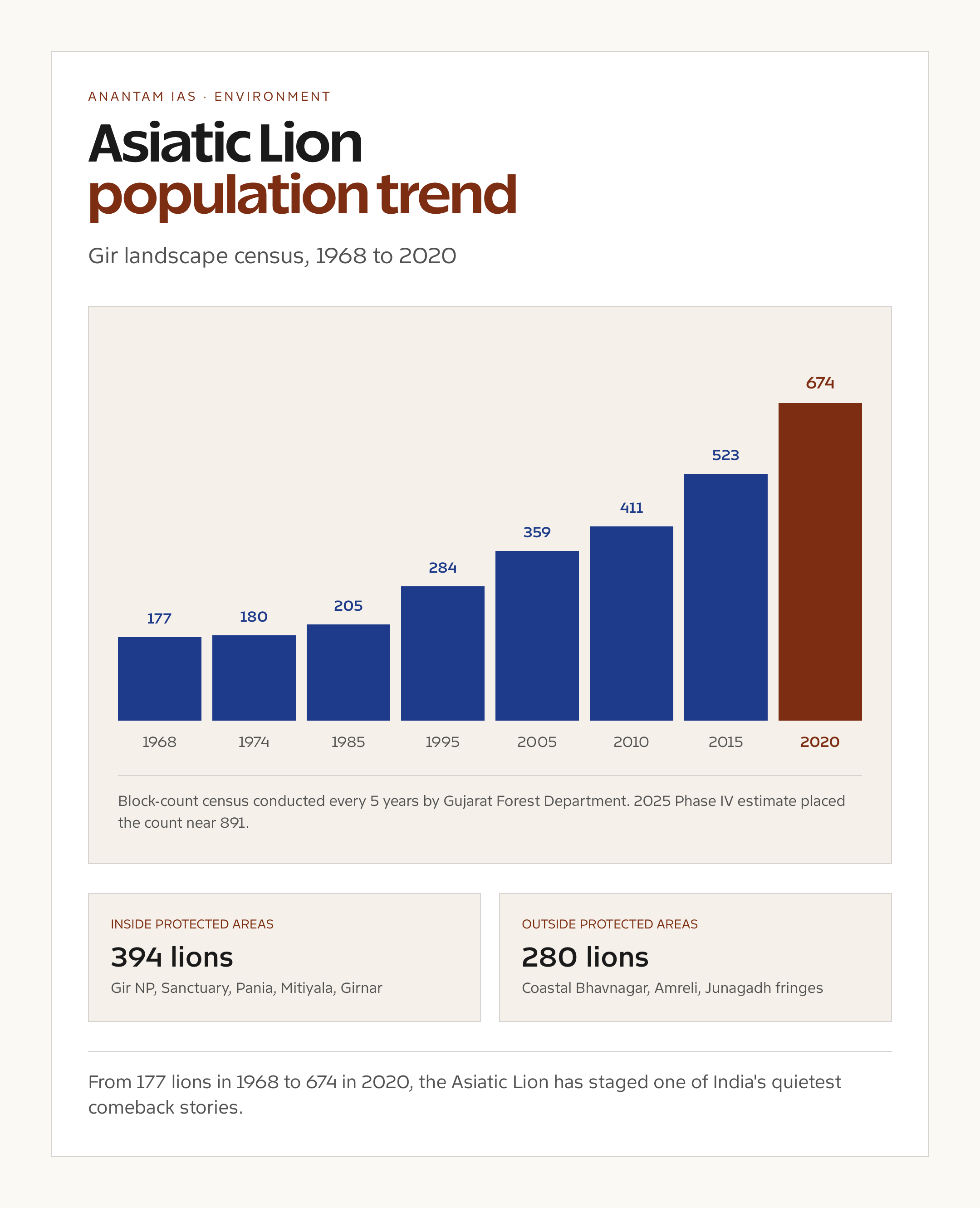
The Gujarat Forest Department conducts a lion census every five years using the block-count method along with photo-identification of individuals. The 2020 census covered around 30,000 square kilometres across nine districts of Saurashtra. Key findings:
- Total population: 674 individuals (up from 523 in 2015)
- Adult males: 161
- Adult females: 260
- Cubs and sub-adults: 253
- Lions inside protected areas (Gir, Pania, Mitiyala, Girnar): around 394
- Lions outside protected areas (satellite populations): around 280
The satellite populations are the most striking finding. Lions have moved out of Gir and established themselves in coastal Bhavnagar, Amreli, Junagadh outskirts, and as far as the Diu coast. Some prides live in revenue forests and agricultural mosaics, hunting nilgai and feral cattle. The 2025 estimate, based on the Phase IV Asiatic Lion Population Estimation, placed the count near 891, a roughly 32 percent jump in five years.
IUCN Red List and Legal Protection
The IUCN reclassified the Asiatic Lion from Critically Endangered to Endangered in 2008, citing the steady population growth. Even so, the species meets the Endangered criterion under D, which applies to populations with fewer than 250 mature individuals — though the Gir population now exceeds that threshold, the single-location risk keeps the classification cautious.
Within India, the Asiatic Lion enjoys the highest level of legal protection:
- Wildlife (Protection) Act 1972: Schedule I, Part I (maximum penalty for hunting, trade, or trafficking)
- Indian Forest Act 1927: habitat falls under reserved and protected forest categories
- CITES Appendix I: international commercial trade in specimens and parts prohibited
- Project Lion (2020): central scheme covering habitat development, prey augmentation, disease surveillance, and community livelihoods
The Convention on Migratory Species does not list the Asiatic Lion, since the population is non-migratory and confined to a single landscape.
The Kuno Translocation Debate
In April 2013, the Supreme Court of India ordered the translocation of some Asiatic Lions from Gir to Kuno-Palpur Wildlife Sanctuary in Madhya Pradesh, citing the danger of keeping all individuals in one habitat. The Wildlife Institute of India had identified Kuno as ecologically suitable as early as the 1990s, and villages inside Kuno had already been relocated in preparation. The court gave the Centre six months to execute the move.
Twelve years later, no Asiatic Lion has been moved to Kuno. The Gujarat government has consistently resisted on grounds ranging from disease risk to local identity and tourism stakes. In 2022, Kuno instead received African cheetahs under Project Cheetah, a separate scheme. Conservation biologists remain divided. Many argue that establishing a second viable population is non-negotiable for long-term security — single-population species are one outbreak away from extinction, as the 2018 canine distemper virus outbreak in Gir (which killed 23 lions) underscored. Others believe Gir’s success is built on the local political economy and that splitting the population could create two weak groups instead of one strong one.
The unresolved Kuno question remains a recurring UPSC Prelims and Mains theme on environmental policy, federalism, and Supreme Court enforcement.
Threats to the Asiatic Lion
The Asiatic Lion is no longer at the brink, but the threat profile is real:
- Single-habitat concentration: one epidemic could devastate the population
- Disease: canine distemper virus, babesiosis, and tick-borne illnesses from livestock and feral dogs
- Habitat fragmentation outside protected areas: open wells, agricultural fences, railway lines, and roads
- Train and road accidents: at least 17 lion deaths from train hits between 2015 and 2020
- Open wells: lions occasionally fall into uncovered farm wells in surrounding villages
- Human-lion conflict: cattle depredation triggers retaliation, though largely managed via compensation
- Genetic bottleneck: every lion descends from fewer than 20 founders, raising inbreeding concerns
- Climate stress: prolonged droughts reduce prey base and surface water
Project Lion and Conservation Strategy
The Union Government announced Project Lion in August 2020 from the ramparts of the Red Fort. The scheme builds on the framework of Project Tiger and Project Elephant. Core components include:
- Habitat development across the Greater Gir landscape
- Wildlife corridor strengthening between Gir, Girnar, Pania, and Mitiyala
- Veterinary infrastructure for disease surveillance and rapid response
- Community-based livelihood programmes for Maldharis and forest-fringe villages
- Eco-development around protected area boundaries
- Lion safari and ecotourism with revenue sharing
- Scientific research, radio collaring, and disease genomics
A dedicated Lion Conservation Breeding Centre at Sakkarbaug Zoological Park in Junagadh maintains ex-situ populations and serves as a genetic reserve. The Sakkarbaug centre has supplied Asiatic Lions to zoos worldwide under the European Endangered Species Programme.
Asiatic Lion in Culture, Symbolism, and UPSC Relevance
The Asiatic Lion sits at the centre of Indian state iconography. The Lion Capital of Ashoka at Sarnath, which became the State Emblem of India in 1950, depicts four Asiatic Lions back-to-back atop an abacus. Every government letterhead, passport, and currency note carries this symbol. The animal also appears in Hindu mythology as the vehicle of Goddess Durga and in the avatar of Narasimha.
For UPSC aspirants, the Asiatic Lion connects multiple themes:
- Environment and Ecology: endemism, single-population species, IUCN categories, conservation success stories
- Polity: Supreme Court orders, Centre-State coordination, federalism in wildlife management
- Geography: dry deciduous biome, Saurashtra peninsula, Gir landscape
- History and Culture: state emblem, Junagadh Nawab’s hunting ban
- Schemes: Project Lion, Project Tiger comparison
Compare the Asiatic Lion recovery with the Greater One-Horned Rhinoceros conservation story — both species rebounded from near-extinction through a combination of legal protection, political will, and habitat focus.
Frequently Asked Questions
Where is the Asiatic Lion found today?
The Asiatic Lion is found only in the Gir landscape of Saurashtra, Gujarat. This includes Gir National Park, Gir Wildlife Sanctuary, Pania, Mitiyala, and Girnar sanctuaries, along with satellite populations spread across nine districts of Saurashtra including Amreli, Bhavnagar, and Junagadh.
What was the Asiatic Lion population in the 2020 census?
The 2020 census of the Asiatic Lion counted 674 individuals across the Gir landscape, up from 523 in 2015. The 2025 phase IV estimate placed the count at around 891 lions, a roughly 32 percent increase over five years.
What is the IUCN status of the Asiatic Lion?
The Asiatic Lion is listed as Endangered on the IUCN Red List. It was downlisted from Critically Endangered in 2008 following sustained population growth, but the single-habitat concentration keeps the species in the Endangered category.
Why was the Asiatic Lion translocation to Kuno not implemented?
In 2013 the Supreme Court ordered translocation of some Asiatic Lions from Gir to Kuno-Palpur in Madhya Pradesh to create a second population. The Gujarat government has resisted, citing disease risk and local identity concerns. As of 2026, no lion has been moved. Kuno now hosts African cheetahs under a separate scheme.
What is Project Lion?
Project Lion is a Government of India scheme launched in 2020 to secure the long-term future of the Asiatic Lion. It covers habitat development, disease surveillance, veterinary infrastructure, community livelihoods, ecotourism, and scientific research across the Greater Gir landscape.
How is the Asiatic Lion different from the African Lion?
The Asiatic Lion is smaller, has a less developed mane that leaves the ears visible, carries a distinctive longitudinal belly fold, and lives in smaller prides. Genetically the two diverged around 100,000 years ago and are now classified as separate subspecies of Panthera leo.
Tell Google you want more of this.
Add Anantam IAS as a preferred sourceOne tap, and this site shows up more often in your own Top Stories, AI Overviews and AI Mode. Remove it any time.






