XPoSat: India’s X-Ray Polarimeter Satellite and the New Frontier of Cosmic Polarimetry
A complete UPSC GS-III explainer on the XPoSat mission. Covers the physics of X-ray polarisation, the POLIX and XSPECT payloads, the PSLV-C58 launch, ISRO's place in global X-ray astronomy, and what XPoSat can teach us about black holes, neutron stars, and active galactic nuclei.
On 1 January 2024, India became only the second country in the world to operate a dedicated X-ray polarimetry satellite. The Polar Satellite Launch Vehicle, in its PSLV-C58 configuration, lifted off from the First Launch Pad at Sriharikota and placed XPoSat into a low Earth orbit at about 650 kilometres altitude. The launch put the Indian Space Research Organisation alongside NASA, which had launched its IXPE polarimeter in December 2021, as one of only two operators of an active X-ray polarimetry mission.
X-ray astronomy is a relatively young field. The Earth’s atmosphere absorbs X-rays before they reach the surface, so the entire science depends on instruments flown above 100 kilometres. From the early sounding-rocket experiments of the 1960s to large flagship observatories like Chandra and XMM-Newton, every step has required new technology. Polarimetry, which measures how X-ray photons are oriented in their oscillation plane, opens a new window into the geometry and physics of the most extreme objects in the universe.
For UPSC, XPoSat sits in the space technology corner of GS-III, intersects the broader ISRO missions portfolio, and contributes to India’s emerging role in global astrophysics. This article walks through what XPoSat is, the science behind X-ray polarimetry, the two payloads, the launch and mission profile, the scientific targets, comparisons with international missions, and what the mission means for India’s space science programme.
What XPoSat Is
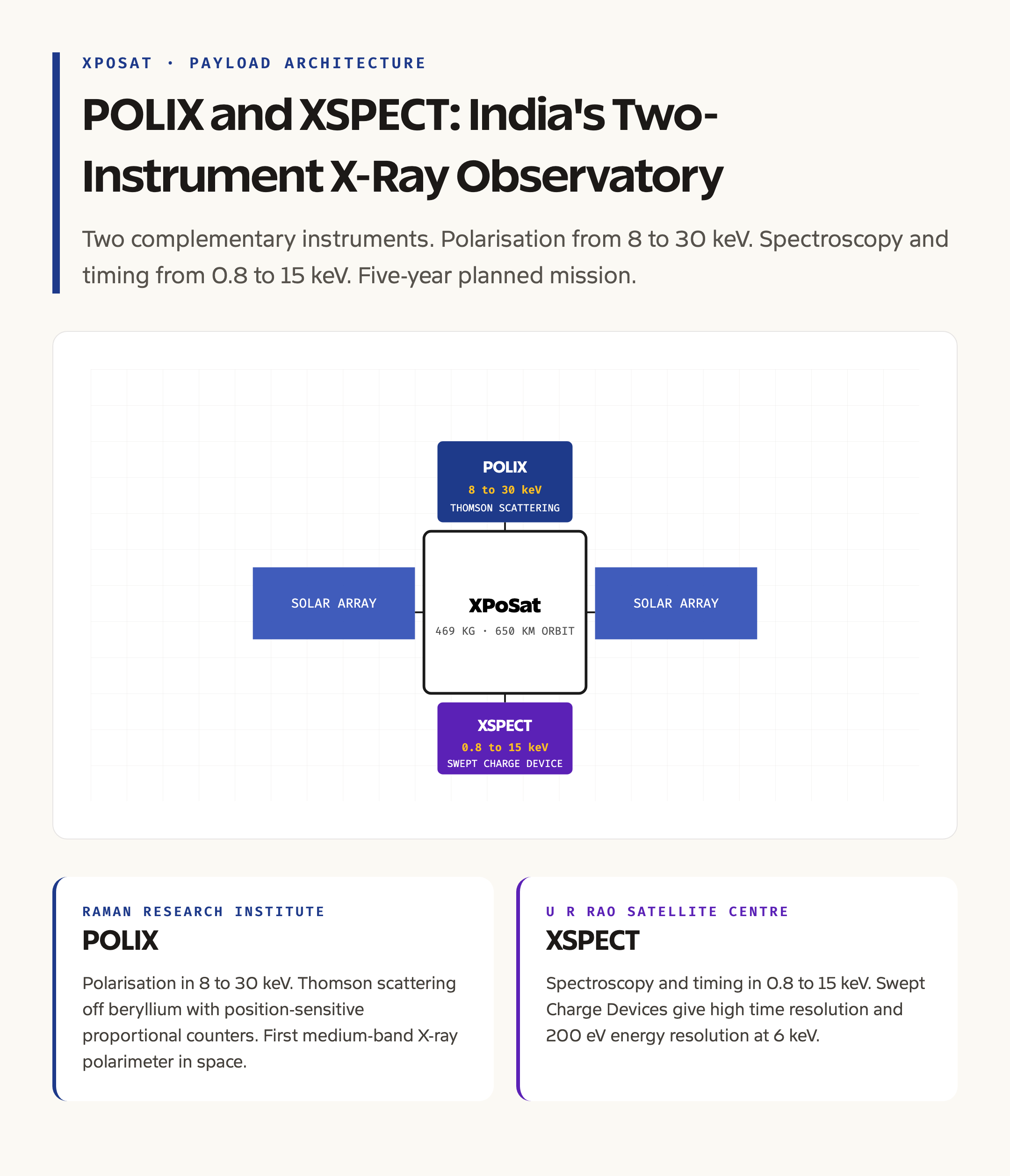
XPoSat is the X-ray Polarimeter Satellite, a space observatory designed by ISRO to study the polarisation of X-rays from cosmic sources. The satellite has a mass of about 469 kilograms at launch and is built around a small, dedicated science platform rather than a multi-purpose bus. It was launched into a 650-kilometre near-equatorial orbit at an inclination of about 6 degrees, which keeps it largely outside the high-radiation South Atlantic Anomaly and improves observation efficiency.
The mission carries two payloads, POLIX and XSPECT, which work in complementary energy bands. POLIX, the Polarimeter Instrument in X-rays, was developed by the Raman Research Institute in Bengaluru and measures polarisation in the medium-energy range from 8 to 30 kiloelectronvolts. XSPECT, the X-ray Spectroscopy and Timing instrument, was developed by the U R Rao Satellite Centre and provides spectroscopy and timing data in the lower-energy range from 0.8 to 15 kiloelectronvolts.
The mission has a planned operational life of about five years. During that period, XPoSat will observe about 50 X-ray sources, including pulsars, black hole binaries, active galactic nuclei, supernova remnants, and magnetars, building up the first systematic catalogue of polarisation measurements at these energies.
The Physics of Polarisation
Light, including X-rays, can be described as an electromagnetic wave with electric and magnetic field components vibrating perpendicular to the direction of travel. Unpolarised light has its electric field oscillating randomly in all directions perpendicular to the wave vector. Polarised light has the electric field oscillating in a preferred plane, either entirely so for fully polarised light or partially so for partially polarised light.
Polarisation can arise from several physical processes. Reflection off a surface partially polarises light, which is why polaroid sunglasses reduce glare from water and roads. Scattering polarises light, as in the partial polarisation of the blue daytime sky. Synchrotron radiation, emitted by relativistic electrons spiralling in a magnetic field, is intrinsically polarised in a direction set by the field geometry. Inverse Compton scattering, where low-energy photons are kicked to higher energies by relativistic electrons, also produces polarised light under the right geometry.
Two quantities are measured for any polarised source. The degree of polarisation is the fraction of the total intensity that is polarised, expressed as a percentage from zero to one hundred. The angle of polarisation is the orientation of the electric field vector projected onto the plane of the sky, given relative to a reference direction.
X-ray polarimetry, the measurement of these two quantities for X-ray photons, is technically demanding because X-ray detectors traditionally measured energy and arrival time but not direction of oscillation. Modern instruments use either Compton scattering, where the angular distribution of scattered photons depends on the polarisation, or photoelectron tracking in gas pixel detectors, where the direction of the ejected photoelectron correlates with the polarisation angle.
The POLIX Payload
POLIX is the principal scientific payload on XPoSat. It is a Thomson scattering polarimeter, meaning that it uses the angular distribution of X-rays scattered off a low-atomic-number target to infer the polarisation of the incoming beam. The instrument consists of a collimator, a scattering element made of beryllium, and an array of position-sensitive proportional counters that record where the scattered photons land.
The energy range is 8 to 30 keV, which is well-matched to the brightest non-thermal X-ray sources in the sky. The collimator gives a field of view of about 3 degrees, narrow enough to isolate a single source at a time. The instrument is designed to detect a polarisation signal as low as a few percent in bright sources after a typical observation of about a million seconds, which is roughly two weeks of integrated exposure across multiple visits.
POLIX is the first dedicated medium-band X-ray polarimeter ever flown. Earlier polarimetric measurements have been made with the OSO-8 satellite in the 1970s and the IXPE mission since 2021, but neither covered the same energy range. POLIX therefore opens a new observational window.
Its prime targets include the Crab Nebula, a supernova remnant whose X-ray emission is known to be polarised, X-ray binaries containing accreting neutron stars and stellar-mass black holes, and a few selected active galactic nuclei whose polarisation properties remain unknown.
The XSPECT Payload
XSPECT, the X-ray Spectroscopy and Timing instrument, complements POLIX by providing detailed spectral and temporal information in the same observations. It uses Swept Charge Devices, advanced silicon detectors that combine the sensitivity of charge-coupled devices with fast read-out, allowing high time resolution while preserving spectral resolution.
The energy range is 0.8 to 15 keV, overlapping the lower end of POLIX coverage and extending well below it. The effective area is around 30 square centimetres at 6 keV, which is modest by flagship-mission standards but sufficient for the bright sources XPoSat targets. Energy resolution is about 200 electronvolts at 6 keV.
XSPECT data tells the observer what physical state the source is in during a polarimetric observation. A neutron-star binary may switch between accretion regimes on timescales of hours, and the polarisation properties depend strongly on which regime is active. By observing simultaneously, XSPECT pins down the spectral state and lets POLIX results be interpreted correctly.
The instrument can also conduct independent observations during periods when POLIX is in safe mode or when its targets are unfavourably positioned, ensuring continuous scientific return.
The Launch and Mission Profile

PSLV-C58 was a four-stage variant of the Polar Satellite Launch Vehicle. The mission used the PSLV-DL configuration with two strap-on boosters, sized for the medium-mass payload. Lift-off occurred at 09:10 IST on 1 January 2024 from the First Launch Pad at the Satish Dhawan Space Centre. About 22 minutes after launch, XPoSat separated from the fourth stage in a 650-kilometre circular orbit at 6-degree inclination.
The PSLV-C58 mission is also notable for carrying ten secondary payloads as part of the POEM-3 experiment, in which the spent fourth stage was used as an orbital platform for in-situ experiments rather than being abandoned as space debris. POEM-3 demonstrated controlled de-orbit of the upper stage at the end of its experiment phase, an early example of the kind of debris-mitigation engineering that the Kessler syndrome discussion has made urgent.
XPoSat itself reached its operational orbit, deployed its solar arrays, and entered the in-orbit commissioning phase that lasted several weeks. Both POLIX and XSPECT achieved their performance targets in commissioning, and the satellite began routine science operations in early 2024.
Scientific Targets
The most famous X-ray polarimetry target is the Crab Nebula, a supernova remnant left over from a stellar explosion observed by Chinese astronomers in 1054. The Crab is dominated by a young, rapidly rotating neutron star whose magnetic field powers a wind of relativistic particles that emit polarised synchrotron radiation. The OSO-8 measurements of the Crab in the 1970s established the polarisation level at around 19 percent, and modern observations refine the geometry of the magnetic field around the pulsar.
X-ray binaries are another major target. These systems pair a compact object, either a neutron star or a stellar-mass black hole, with a normal stellar companion that supplies matter through accretion. The geometry of the accretion disc, the shape of the corona of hot electrons, and the way matter falls onto the compact object all leave imprints on the polarisation of the emitted X-rays. Polarimetry can distinguish between models of the corona that have similar spectral signatures, helping to settle long-standing debates in high-energy astrophysics.
Magnetars, neutron stars with magnetic fields a thousand times stronger than ordinary neutron stars, are particularly interesting for polarimetry. Quantum electrodynamics predicts that the vacuum itself becomes birefringent in such strong fields, which would produce a characteristic polarisation pattern. Confirming this prediction has been a long-standing goal of fundamental physics.
Active galactic nuclei, the supermassive black holes at the centres of galaxies that pull in matter and emit relativistic jets, are a third major target. The polarisation of the X-rays they emit constrains the orientation of the accretion disc, the geometry of the jet, and the role of magnetic fields in the launching process.
Place in the Global Landscape
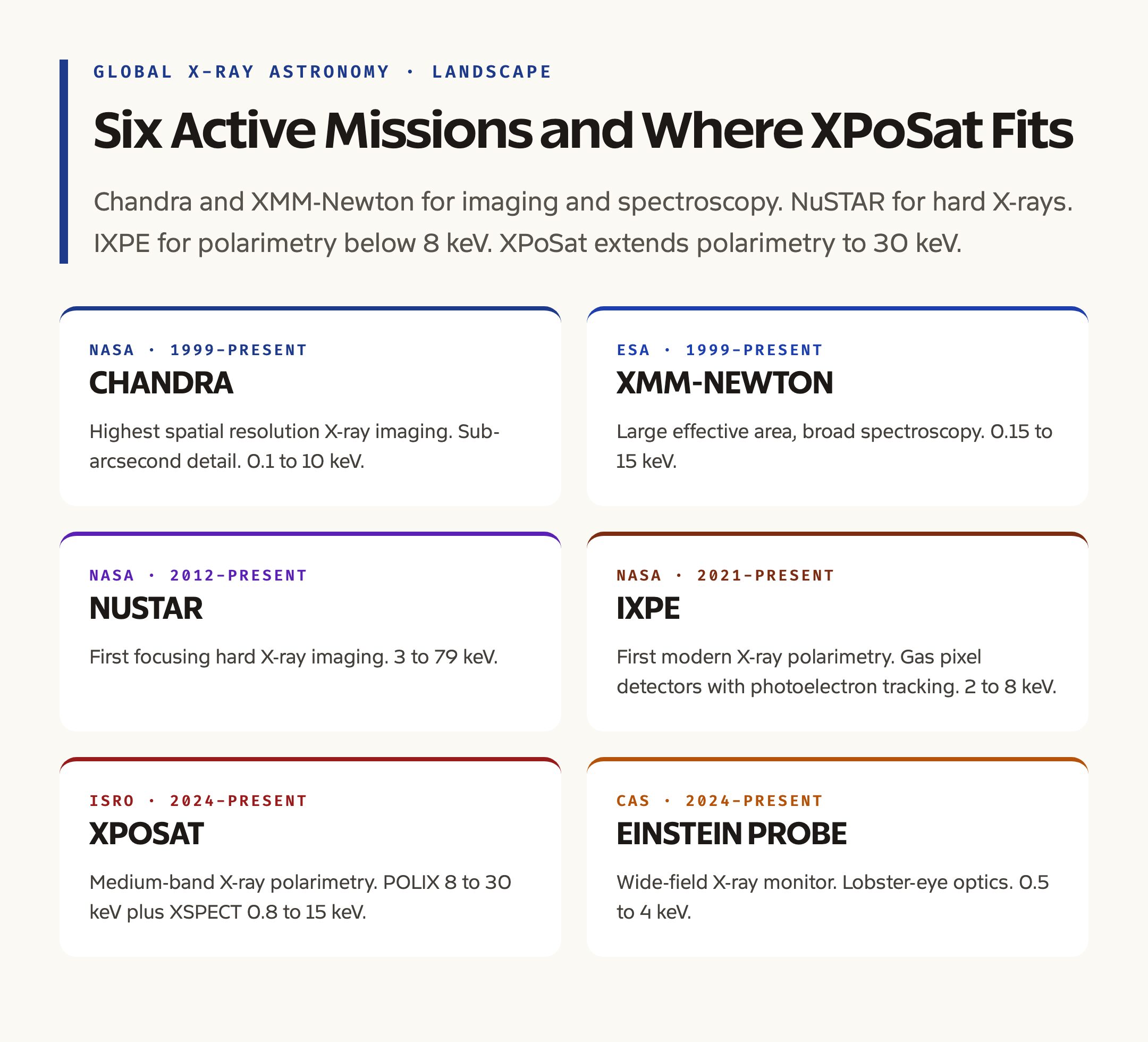
X-ray astronomy as a whole is dominated by a handful of flagship missions. NASA’s Chandra X-ray Observatory, launched in 1999, provides the highest spatial resolution images, with sub-arcsecond detail. ESA’s XMM-Newton, launched the same year, offers larger collecting area and broader spectral coverage. NASA’s NuSTAR, launched in 2012, extends sensitive imaging to higher energies up to 79 keV.
NASA’s IXPE, launched in December 2021, was the first dedicated X-ray polarimetry mission of the modern era. It covers 2 to 8 keV and uses gas pixel detectors with photoelectron tracking. IXPE has produced first-of-their-kind polarimetry results on the Crab, supernova remnants, X-ray binaries, and active galactic nuclei in its first three years of operation.
XPoSat is complementary to IXPE rather than directly competitive. POLIX covers a higher energy band, 8 to 30 keV, where IXPE has no sensitivity. The two missions together provide broader spectral coverage of the same sources, and the cross-calibration between them is itself scientifically valuable. XPoSat also observes a different set of priority targets focused on the brightest sources in its energy range.
China’s Einstein Probe, launched in January 2024, brings a wide-field X-ray monitor capability that complements both polarimetry and pointed observation. The next decade will see ESA’s NewAthena, launching in the late 2030s, as the successor flagship.
ISRO’s Astronomy Programme
XPoSat is the latest in a sequence of Indian space-science missions. AstroSat, launched in 2015 and the first multi-wavelength observatory built by ISRO, observes simultaneously in the ultraviolet, visible, and X-ray bands. It has produced strong scientific output and remains operational ten years after launch. Aditya-L1, launched in September 2023 and parked at the Sun-Earth L1 point in January 2024, studies the Sun’s corona and chromosphere.
Beyond these, the Chandrayaan series in lunar science, the Mars Orbiter Mission of 2014, and the Indian-led contribution to international missions like the Atmospheric Waves Experiment have established a credible Indian presence in space science. XPoSat extends this into a niche where India is now an early contributor rather than a follower.
The science is led by ISRO with strong involvement from the Raman Research Institute, U R Rao Satellite Centre, Indian Institute of Astrophysics, Tata Institute of Fundamental Research, and university groups across India. The data flow follows a calibration and validation phase, then a guaranteed-time science phase for the instrument teams, and eventually open access for the broader astronomical community.
Why XPoSat Matters
The mission matters at three levels. Scientifically, it adds a unique observational capability in a band where no other current instrument operates, and it produces results that constrain models of black hole, neutron star, and active galactic nucleus physics. The polarisation data is complementary to spectroscopic and timing data, and many models that fit existing data equally well predict different polarisation signatures.
Strategically, the mission demonstrates India’s ability to design, build, and operate a niche space-science instrument from end to end. The instrument hardware, the satellite platform, the launch vehicle, the ground segment, and the science analysis are all Indian. That kind of vertical integration is rare and reflects the maturity of the Indian space programme.
For students and researchers, XPoSat opens new opportunities. PhD theses, postdoctoral positions, and international collaborations are all easier to build around an active mission with Indian leadership. The Indian astrophysics community has grown substantially in the last two decades, and XPoSat data will sustain that growth for the next several years.
Prelims Pointers
XPoSat is India’s X-ray polarimetry mission launched on 1 January 2024 by PSLV-C58 in the PSLV-DL configuration. The orbit is about 650 kilometres altitude at 6 degrees inclination. The mission carries two payloads: POLIX from the Raman Research Institute, covering 8 to 30 keV, and XSPECT from the U R Rao Satellite Centre, covering 0.8 to 15 keV. POLIX uses Thomson scattering. XSPECT uses Swept Charge Device detectors. Mission life is five years. The PSLV-C58 mission also carried POEM-3, in which the fourth stage was used as an orbital experiment platform. NASA’s IXPE, launched December 2021, is the only other dedicated X-ray polarimetry mission. India is the second country in the world to operate such a mission. The Crab Nebula is a key polarimetry target.
Mains Practice Questions
- The launch of XPoSat establishes India as a serious participant in space-based observational astronomy. Discuss the technical capabilities of the mission and its place in the global X-ray astronomy landscape. (250 words)
- Examine ISRO’s evolution from a launch and applications agency to a producer of dedicated space-science missions, with reference to AstroSat, Aditya-L1, and XPoSat. (250 words)
- Polarimetry adds a new dimension to X-ray astronomy beyond spectroscopy and timing. Discuss with examples of the scientific questions XPoSat is designed to answer. (250 words)
Way Forward
The XPoSat mission is a beginning rather than an endpoint. The natural follow-on is a larger polarimetry mission with greater effective area, finer energy resolution, and extended energy coverage. Discussions within ISRO and the Indian astronomy community have already raised the prospect of a successor mission in the 2030s, possibly with international partners.
A second priority is operational and data-handling capacity. The volume of scientific data from XPoSat is modest by the standards of large observatories, but the quality of pipeline software, archive management, and user-facing tools determines whether the data finds its full audience. Investment in the Indian Space Science Data Center and in capacity at participating universities is essential.
A third priority is human capital. The shortage of trained astrophysicists and instrumentation engineers limits how many future missions India can run simultaneously. Expansion of postdoctoral programmes, support for early-career scientists returning to India, and stronger ties between ISRO and the university system would all help.
Finally, international collaboration. The scientific value of XPoSat grows when its data is combined with observations from Chandra, XMM-Newton, NuSTAR, IXPE, and other current missions. Formal partnerships, shared analysis tools, and cross-calibration campaigns multiply the scientific return for relatively modest investment.
XPoSat is a small mission with an outsized statement. India can build niche, high-quality space-science instruments, fly them, and contribute to the international scientific conversation. The next missions should aim higher, but they all stand on this foundation.
Frequently Asked Questions
What is XPoSat?
XPoSat is the X-ray Polarimeter Satellite launched by ISRO on 1 January 2024 using the PSLV-C58 vehicle. It is India’s first dedicated X-ray polarimetry mission and the second such mission in the world after NASA’s IXPE.
What does XPoSat study?
XPoSat measures the polarisation of X-rays from cosmic sources including the Crab Nebula, X-ray binaries, magnetars, supernova remnants, and active galactic nuclei. Polarimetry constrains the geometry of magnetic fields and accretion flows around the most extreme objects in the universe.
What are POLIX and XSPECT?
POLIX, the Polarimeter Instrument in X-rays, was developed by the Raman Research Institute and measures polarisation in the 8 to 30 kiloelectronvolt range using Thomson scattering. XSPECT, developed by the U R Rao Satellite Centre, provides X-ray spectroscopy and timing in the 0.8 to 15 kiloelectronvolt range using Swept Charge Devices.
How does XPoSat measure polarisation?
POLIX uses Thomson scattering off a beryllium target. The angular distribution of scattered X-rays depends on the polarisation of the incoming beam, so position-sensitive detectors around the scatterer can reconstruct both the degree and angle of polarisation.
What is the difference between XPoSat and IXPE?
NASA’s IXPE, launched in December 2021, covers 2 to 8 keV using gas pixel detectors with photoelectron tracking. India’s XPoSat, launched in January 2024, covers 8 to 30 keV with POLIX and 0.8 to 15 keV with XSPECT. The two missions are complementary, providing broader spectral coverage when their data is combined.
What is the orbit of XPoSat?
XPoSat is in a near-circular low Earth orbit at about 650 kilometres altitude with an inclination of about 6 degrees, near the equatorial plane. This orbit minimises exposure to the South Atlantic Anomaly and improves observation efficiency.
What is the planned mission life?
XPoSat has a planned operational life of about five years. The instruments and bus are designed for that lifetime, and continued operations beyond that depend on the health of the spacecraft.
What is POEM-3?
POEM-3, the PSLV Orbital Experimental Module, was a secondary mission element on PSLV-C58 in which the spent fourth stage of the rocket was used as an orbital experiment platform. It carried ten experimental payloads and demonstrated controlled de-orbit, contributing to space debris mitigation.
Why does X-ray astronomy require space-based observatories?
The Earth’s atmosphere absorbs X-rays before they reach the ground. Any instrument observing cosmic X-ray sources must be flown above about 100 kilometres altitude, which means sounding rockets, balloons, or satellites.
What is the role of polarimetry in astrophysics?
Polarimetry adds a fourth observational dimension to astrophysics, after intensity, spectrum, and timing. The polarisation of X-rays from a source carries information about magnetic field geometry, accretion flow orientation, and the underlying emission mechanism that no other measurement can provide. Many models that fit spectral and timing data equally well predict different polarisation signatures, so polarimetry resolves ambiguities.