Low Earth Orbit is roughly the volume of space between two hundred and two thousand kilometres above the surface. Almost everything that matters for civilian life on the surface, including weather satellites, navigation ground links, broadband constellations, Earth observation, and the International Space Station, lives inside that thin shell. The shell is also where almost all human-made space junk has accumulated. There is now a credible scenario in which the density of debris in this shell becomes high enough that collisions among objects start producing more debris than they remove, and the orbit becomes effectively unusable for decades. That scenario is called Kessler Syndrome.
The name belongs to Donald J. Kessler, who in 1978 was a NASA scientist working on orbital debris. His paper proposed that beyond a critical density of objects in a given orbital shell, collisions become self-sustaining. Each collision produces more fragments, those fragments collide with other satellites, and the population grows even after new launches stop. The official term in the literature is collisional cascading. The popular term is the Kessler cascade, or simply the Kessler scenario.
This article walks through the physics of orbital collisions, the current debris population and the events that pushed it sharply upward, the mitigation toolkit being deployed by space agencies including India’s ISRO and the European Space Agency, the active debris removal missions now in flight, and the international legal vacuum that still surrounds the problem.
Why Space Junk is a Real Problem
The intuition that space is empty is correct in absolute terms. The orbital shell where most satellites live has a volume measured in trillions of cubic kilometres. The total mass of all human-made objects ever placed in orbit is about thirteen thousand tonnes. By any normal density calculation, the average distance between two pieces of debris is enormous. The catch is the orbital velocity. Objects in Low Earth Orbit travel at roughly seven and a half kilometres per second. Two objects on intersecting orbits can meet at relative speeds of more than fifteen kilometres per second, which is more than ten times the speed of a high-velocity rifle bullet.
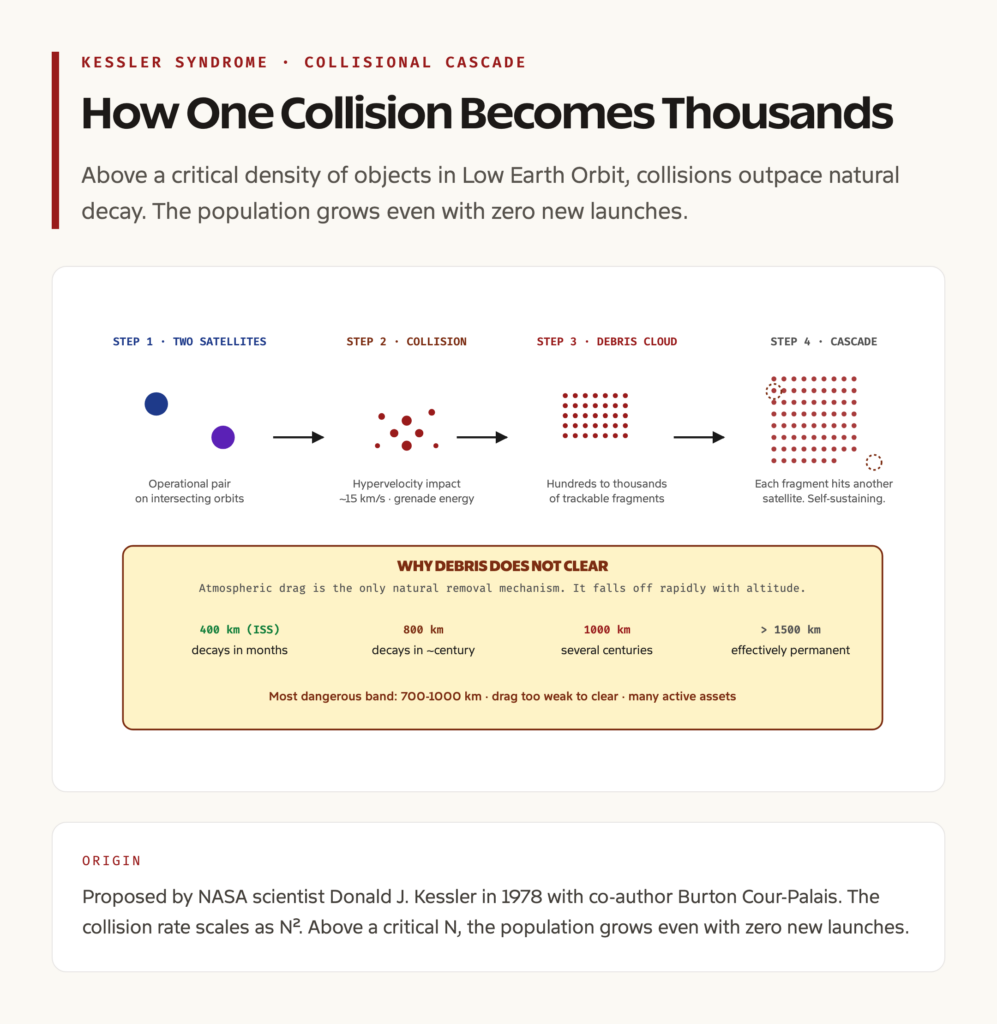
At those speeds, energy scales with the square of velocity. A one-centimetre fragment of aluminium hitting a satellite at fifteen kilometres per second carries the kinetic energy of a hand grenade. The collision shatters the satellite, produces hundreds or thousands of new fragments, and each fragment then becomes its own projectile. The mass does not need to be large. The velocity does the work.
The 1978 Kessler Paper
Donald Kessler and Burton Cour-Palais published the original analysis in the Journal of Geophysical Research. They worked out a simple population model. The rate of new collisions is proportional to the square of the number of objects in a given orbital shell, because each pair of objects has a finite collision probability and the number of pairs grows as N squared. Each collision produces a finite number of new fragments. If the new fragments outpace the natural rate at which atmospheric drag pulls debris back to Earth, the population grows.
Kessler showed that there is a critical density above which the population grows even with zero new launches. The orbit becomes self-cluttering. The cleanup of such an orbit, if it is possible at all, takes decades to centuries because atmospheric drag is the only natural removal mechanism and drag falls off rapidly with altitude. At eight hundred kilometres, the natural decay time of a typical debris fragment is more than a century. At one thousand kilometres, it is several centuries. Above one thousand five hundred kilometres, debris is effectively permanent on human timescales.
The Current Debris Population
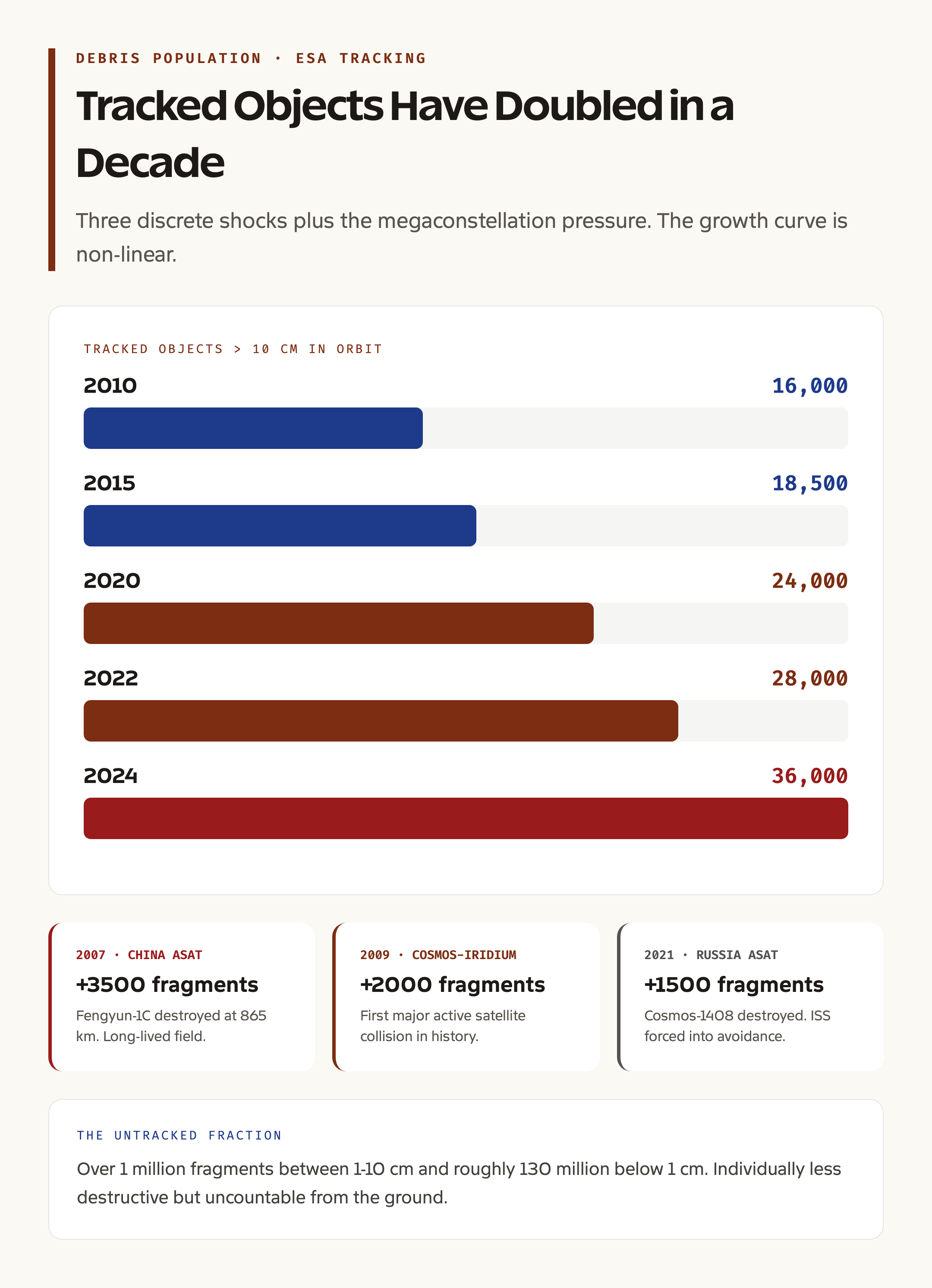
The European Space Agency tracks roughly thirty-six thousand objects larger than ten centimetres in orbit around Earth. The United States Space Surveillance Network tracks a similar number with overlapping coverage. The actual population including untracked smaller fragments is estimated at one million pieces between one and ten centimetres, and roughly a hundred and thirty million pieces below one centimetre. The smaller fragments are individually less destructive but more numerous, and they cannot be tracked from the ground.
The total population grew steadily through the early space age and then stepped up sharply at three discrete events. The first was the 2007 Chinese anti-satellite test, in which China destroyed its own Fengyun-1C weather satellite at eight hundred and sixty-five kilometres altitude with a kinetic kill vehicle. The single collision produced more than three thousand five hundred trackable fragments and left a long-lived debris field. The second was the 2009 collision between the operational Iridium-33 communications satellite and the defunct Russian Cosmos-2251, which generated another two thousand trackable fragments. The third was the 2021 Russian anti-satellite test against its own Cosmos-1408, which forced the International Space Station to perform an avoidance manoeuvre and added another one thousand five hundred trackable fragments.
The newer pressure on the debris environment comes from megaconstellations. The Starlink constellation alone now operates more than six thousand active satellites and continues to grow. OneWeb, Project Kuiper, and several Chinese and European constellations add to the total. The active satellite population in LEO has roughly tripled in a decade. More objects mean more collision pairs, and the pair count grows quadratically.
How a Kessler Cascade Would Unfold
The cascade does not look like a single dramatic moment. It looks like a slow drift in the statistics of conjunction warnings. A conjunction is an event where two tracked objects are predicted to pass within a few kilometres of each other. Operators of active satellites already receive multiple conjunction warnings per satellite per week from the Space Surveillance Network. Each warning triggers a calculation of collision probability, and if the probability exceeds a threshold the satellite performs a small thruster manoeuvre to dodge.
In a Kessler scenario, the rate of conjunction warnings climbs faster than operators can respond. Some warnings escalate into actual collisions because dodging consumes propellant and a satellite has only finite reserves. Each collision adds debris, raising the warning rate further. The slow drift becomes a non-linear takeoff. The endpoint is an orbital shell where insurance for new launches becomes unaffordable, where active satellites cannot survive beyond a few months without depleting their propellant on avoidance manoeuvres, and where new launches into the affected altitude band are abandoned.
The most dangerous altitude band is somewhere between seven hundred and one thousand kilometres, where atmospheric drag is too weak to clear debris in human timescales but where many active assets including Earth observation satellites and several megaconstellations operate. A cascade in that band would lock out a major class of capabilities including weather monitoring, defence reconnaissance, and crewed flight to the International Space Station altitude.
Mitigation: Tracking and Avoidance
The first line of defence is space situational awareness, which is the catalogue of what is up there and what its trajectory looks like. The United States Space Surveillance Network and the European Space Surveillance and Tracking system have historically dominated this work, sharing conjunction warnings with global operators. Several other agencies are building independent capacity.
ISRO operates Project NETRA, which stands for Network for Space Object Tracking and Analysis. NETRA combines a multi-object tracking radar at Sriharikota, a long-range telescope, optical observation stations, and a control centre at Bengaluru. The objective is to give India an indigenous catalogue of tracked debris and an autonomous capacity to issue conjunction warnings to Indian space assets. NETRA started operating in pilot mode and has been progressively expanded.
ISRO also runs the IS4OM, the ISRO System for Safe and Sustainable Operations Management, headquartered in Bengaluru. IS4OM is the operational coordination layer that consumes the NETRA catalogue, performs collision risk analysis for ISRO missions and Indian commercial satellites, and issues avoidance recommendations to the operators. The two together give India a complete sense-and-respond loop on orbital debris.
Mitigation: Design Standards and the 25-Year Rule
The second line of defence is mission design. The international consensus, codified by the Inter-Agency Space Debris Coordination Committee and adopted by most major agencies, is the 25-year rule. Any satellite launched into Low Earth Orbit must include a plan for either deorbiting through the atmosphere within twenty-five years of mission end, or boosting to a graveyard orbit if it cannot reach atmospheric drag. The European Space Agency tightened this further in 2023 with the Zero Debris Charter, an industry pledge to stop generating any new persistent debris by 2030. ESA Member States and major satellite operators have signed on.
The Zero Debris Charter is voluntary, which is its strength and its weakness. It is voluntary because the international space treaty system does not have an enforcement mechanism for debris standards. Each country regulates its own operators through licensing rules. The United States Federal Communications Commission has cut the deorbit deadline to five years for new licences. India’s IN-SPACe authorisations and the Indian Space Policy 2023 include similar requirements.
Mitigation: Active Debris Removal
The third line of defence is going up to physically remove existing junk. Active Debris Removal is the umbrella term. Several approaches are being trialled. ClearSpace-1, an ESA-funded mission led by the Swiss startup ClearSpace SA, was scheduled to be the first dedicated debris removal flight, targeting a Vespa upper stage left in orbit by an earlier ESA launch. The mission slipped its 2026 launch window after the target object itself was struck by another piece of debris in 2023, which is a small example of how the problem is already affecting its own solutions.
Astroscale, a Japanese company, ran the ELSA-d mission to demonstrate magnetic capture of a cooperative client target. A follow-on mission, ELSA-M, will target a real defunct satellite. Astroscale also performed a successful close-approach inspection of a Japanese H-IIA upper stage in 2024, photographing the rocket body from close range to characterise its tumbling state for a future capture mission.
Other approaches in research include laser nudging from ground-based or space-based lasers to slow debris and lower its perigee, electrodynamic tethers that drag debris using interaction with Earth’s magnetic field, drag sails that increase atmospheric coupling, and net or harpoon capture systems for cooperative or non-cooperative targets. None of these is yet operational at scale. The economics is the binding constraint. Removing one piece of debris currently costs tens of millions of dollars and there are tens of thousands of pieces.
The International Legal Framework
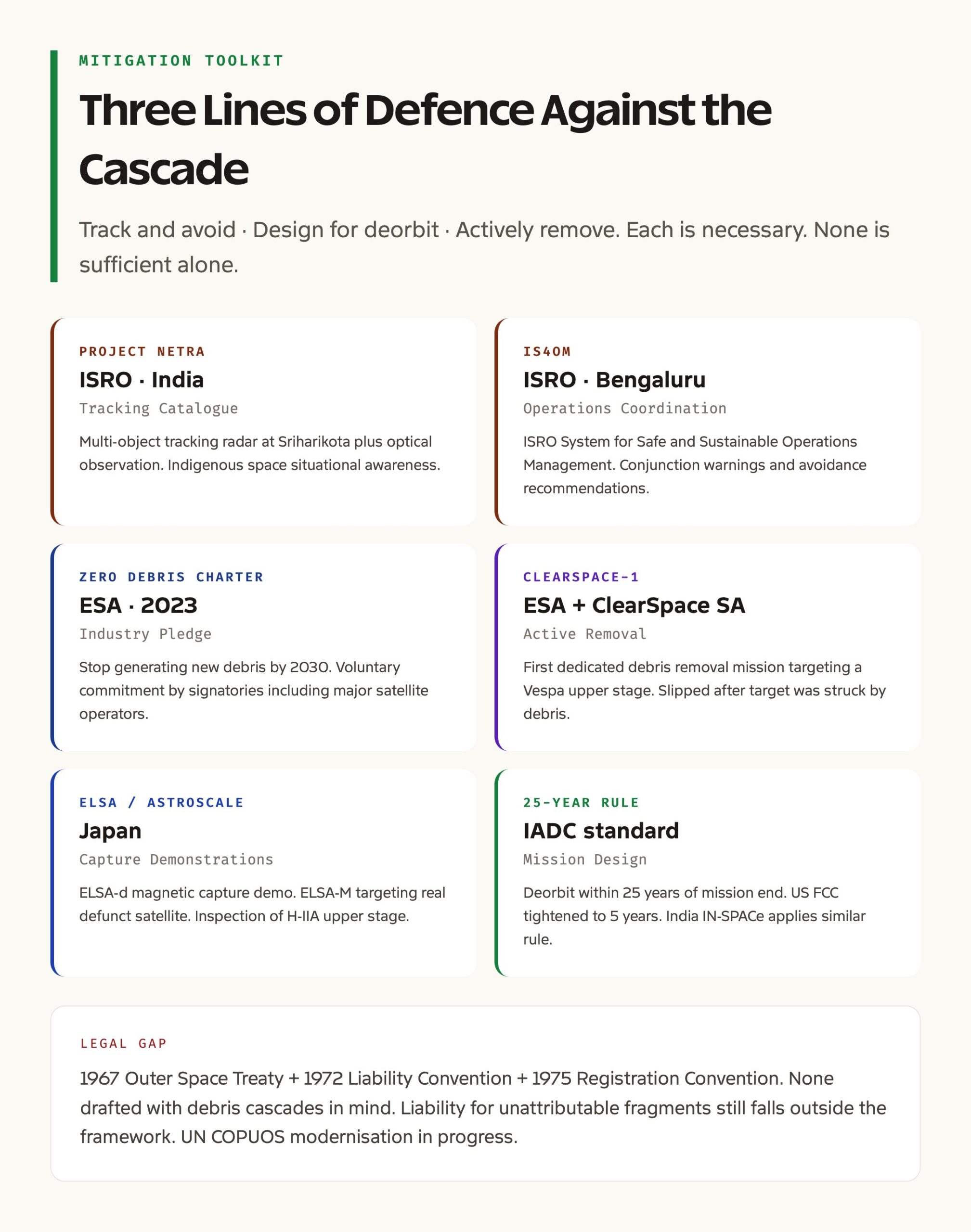
The 1967 Outer Space Treaty, the 1972 Liability Convention, and the 1975 Registration Convention together form the legal scaffolding. The Outer Space Treaty assigns responsibility for objects in space to the launching state. The Liability Convention makes the launching state strictly liable for damage caused by its space object on the surface or in airspace, and liable on a fault basis for damage in space. The Registration Convention requires registration of every object launched into outer space.
The gap is that none of these treaties was written with debris cascades in mind. The Liability Convention defines damage in terms of identifiable harm by an identifiable object. A collision with an unattributable fragment, which is the typical outcome of a Kessler cascade, falls outside the treaty’s working definition. A modernisation of this framework is overdue and is being discussed at the United Nations Committee on the Peaceful Uses of Outer Space.
Why This Matters for India
India has a fast-growing space economy, an expanding satellite fleet across communications, navigation, Earth observation, and science, and an active commercial space sector under IN-SPACe. A Kessler cascade in a populated shell would threaten Indian assets, raise insurance costs for Indian operators, and constrain future launches. The mitigation work through Project NETRA, IS4OM, and India’s adoption of debris-friendly mission design is therefore not optional. It is operational risk management for the entire programme. The same logic applies internationally. Debris is a shared commons problem. Whoever generates it imposes a cost on every other operator. The solutions, like the problem, will have to be shared.
Tell Google you want more of this.
Add Anantam IAS as a preferred sourceOne tap, and this site shows up more often in your own Top Stories, AI Overviews and AI Mode. Remove it any time.