Disclosure: this guide contains Amazon affiliate links. As an Amazon Associate, Anantam IAS earns from qualifying purchases — at no extra cost to you.
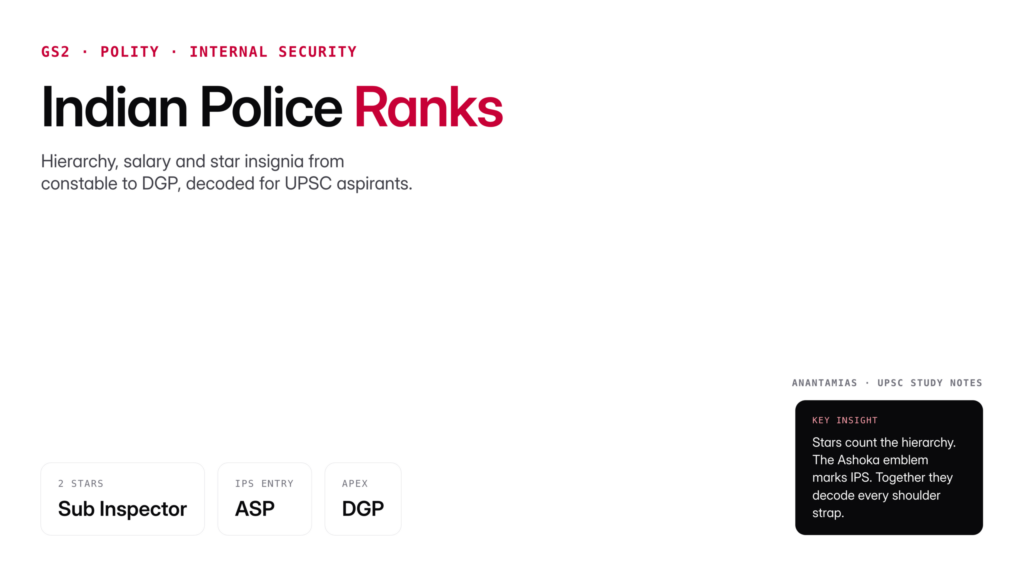
Two stars on a police officer’s shoulder strap identify a Sub Inspector (SI) — the “2 star police rank” in most Indian state police forces, worn with a red-and-blue ribbon at the outer edge of the strap. A Sub Inspector sits at Pay Level 6 of the 7th Central Pay Commission pay matrix (basic pay ₹35,400), usually serves as the Station House Officer (SHO) of a smaller or rural station, and is the first rank empowered to lead investigations and file charge sheets under the criminal procedure code. (For reference: one star = Assistant Sub Inspector, three stars = Inspector.)
| Attribute | 2 Star Rank — Sub Inspector (SI) |
|---|---|
| Insignia | Two stars + red-and-blue ribbon on shoulder strap |
| Tier | Non-gazetted officer (above ASI, below Inspector) |
| Pay Level (7th CPC) | Level 6 |
| Basic pay | ₹35,400 per month |
| Gross salary (approx.) | ₹55,000–₹70,000/month (varies by state DA and HRA) |
| Typical role | Station House Officer (SHO) of a smaller or rural station |
| Recruitment | Direct state police SI exam or departmental promotion |
| Next promotion | Inspector (three stars) |
Introduction
Indian police ranks form a tightly ordered hierarchy that links every constable on a beat to the Director General of Police at the state headquarters. The shoulder insignia, especially the number of stars and the Ashoka emblem, encode that hierarchy at a glance. Among the most searched questions in this space is the meaning of the 2 star police rank, which corresponds to the Sub Inspector in most state police forces and signals entry into the subordinate officer ranks.
For UPSC aspirants, understanding police ranks is not trivia. It connects Police Act 1861, Code of Criminal Procedure, state police acts modelled on the Model Police Act 2006 and the recurring Second Administrative Reforms Commission (ARC) recommendations on police reform. This guide maps every rank from Constable to Director General of Police, explains insignia, pay levels under the 7th Central Pay Commission, and situates the Indian Police Service (IPS) within the larger structure.
Quick Facts at a Glance
| Parameter | Detail |
|---|---|
| Legal basis | Police Act 1861; Model Police Act 2006; state police acts |
| Top rank | Director General of Police (DGP) |
| Lowest rank | Constable |
| 2 star rank | Sub Inspector (SI) in most state police |
| Entry to Gazetted | Deputy Superintendent of Police (Dy SP) or ACP |
| Entry for IPS | Assistant Superintendent of Police (ASP) |
| Insignia symbol for senior ranks | Ashoka emblem / crossed sword and baton |
| Parent service for top ranks | Indian Police Service (IPS), All-India Service |
| Constitutional head | Governor (State List, Entry 2) |
| Recruitment to IPS | Civil Services Examination (UPSC) |
Background and Historical Context
The architecture of Indian policing descends from the Police Act 1861, enacted after the Revolt of 1857 to create a tightly controlled, subordinate constabulary accountable to district magistrates and, ultimately, to the colonial state. This Act still forms the spine of police organisation across most states despite repeated calls for comprehensive reform. The Indian Police (IP) service, renamed Indian Police Service (IPS) in 1948 and constitutionally recognised as an All-India Service under Article 312, provides the senior leadership cadre.
After independence, police remained a State subject under Entry 2 of the State List, Seventh Schedule, though the Centre controls the IPS cadre, central armed police forces and inter-state coordination through the Ministry of Home Affairs. The National Police Commission (1977–1981), the Ribeiro Committee (1998), the Padmanabhaiah Committee (2000), the Malimath Committee (2003) and the Second Administrative Reforms Commission (2007) all recommended professionalising the hierarchy, separating law and order from investigation, and creating Police Complaints Authorities.
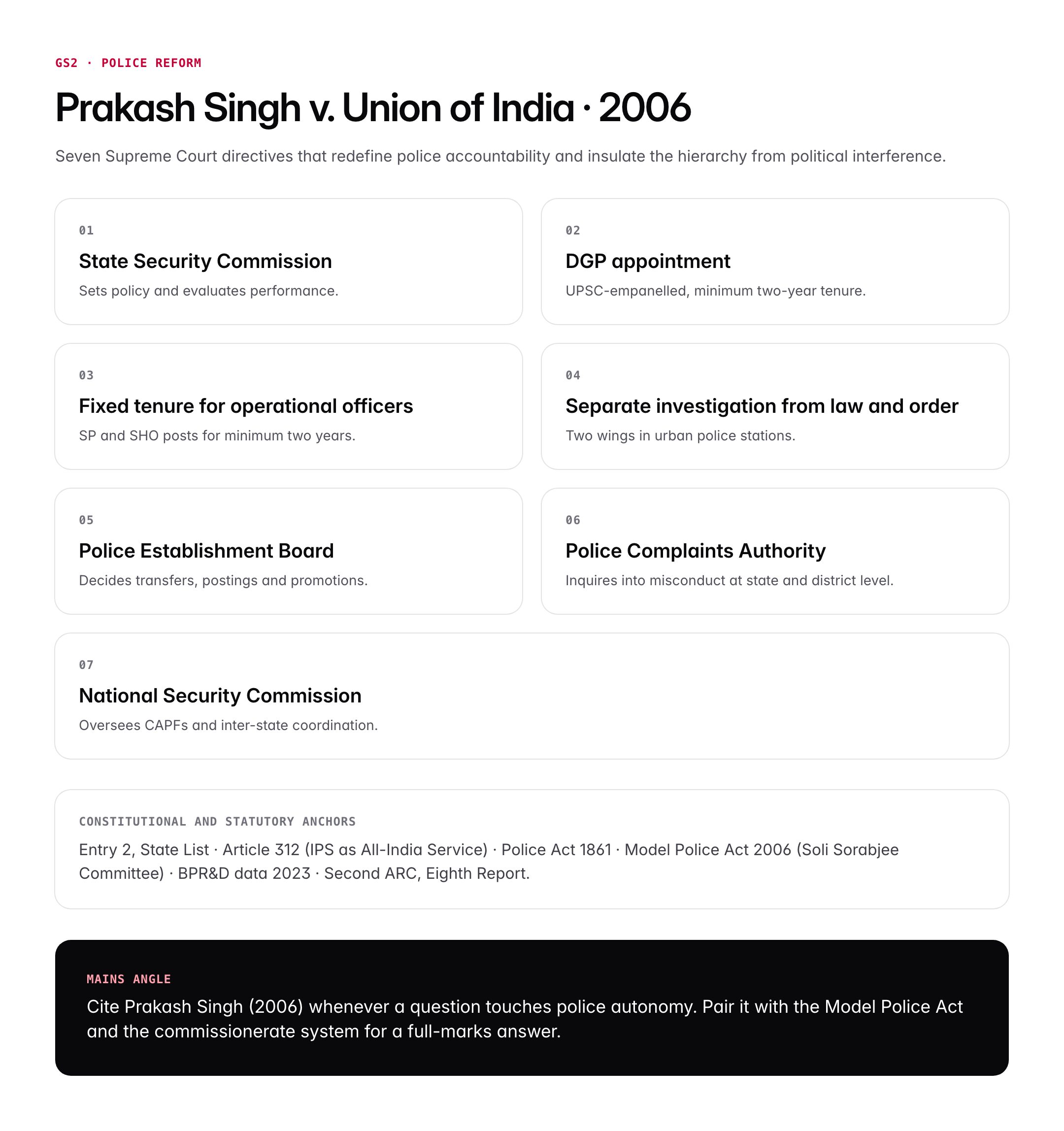
The Supreme Court’s Prakash Singh judgment (2006) crystallised seven directives: a State Security Commission, fixed tenure of two years for DGP and SP, separation of investigation from law and order, constitution of a Police Establishment Board, a Police Complaints Authority, and establishment of a national security commission. Most states have only partially complied. The current rank structure, with its insignia grammar, reflects both the colonial inheritance and the post-1948 IPS overlay.
Key Features: Rank-by-Rank Structure
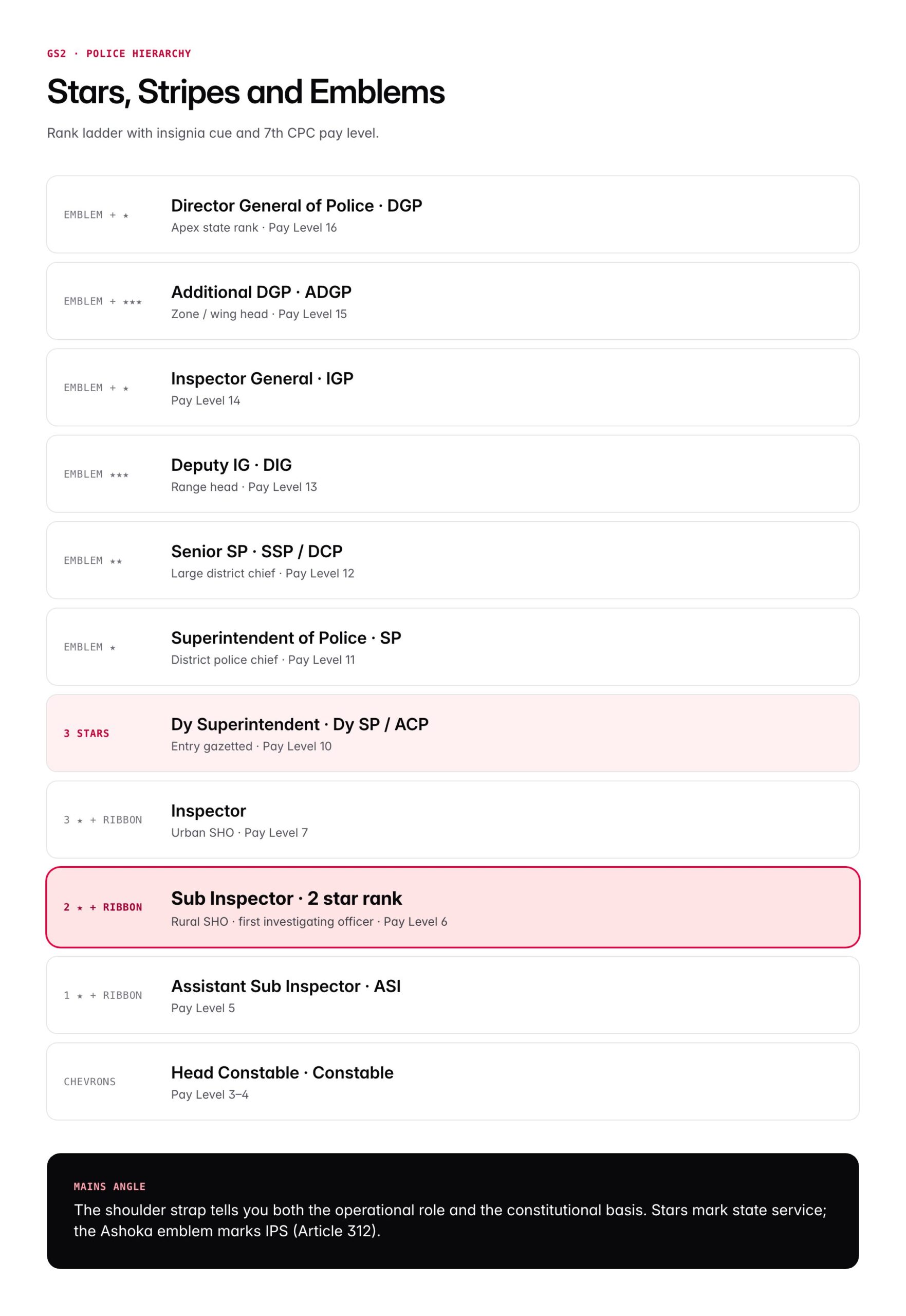
Indian police ranks fall into three broad tiers. Subordinate ranks (Constable to Head Constable) carry out ground-level policing. Upper subordinate or non-gazetted officer ranks (Assistant Sub Inspector to Inspector) supervise stations and investigations. Gazetted ranks, from Deputy Superintendent upwards, constitute the officer cadre, with IPS entry at ASP level.
Subordinate Ranks
Constable (no star on shoulder strap) is the entry rank, recruited through state police boards. Head Constable wears a single chevron or two stripes. The Assistant Sub Inspector (ASI) carries one star with a red-and-blue ribbon on the shoulder. ASIs can register First Information Reports in several states.
Non-Gazetted Officer Ranks
The Sub Inspector (SI) is the 2 star police rank, carrying two stars with the red-and-blue strip. An SI is typically the Station House Officer (SHO) of a rural or smaller urban police station and is the first rank empowered to lead investigations under the CrPC in most states. The Inspector wears three stars with the red-and-blue ribbon and usually heads the bigger urban police stations, reporting to a Circle Officer.
Gazetted Officer Ranks
Deputy Superintendent of Police (Dy SP) or Assistant Commissioner of Police (ACP) in commissionerate systems wear three stars without the ribbon. This is the entry gazetted rank for state police service officers. Assistant Superintendent of Police (ASP) is the IPS probationer rank, wearing one star and the Ashoka national emblem.
Superintendent of Police (SP) or Deputy Commissioner of Police (DCP) wears the Ashoka emblem with one star. SP is typically the district police chief. Senior Superintendent of Police (SSP) wears the Ashoka emblem with two stars in large districts. Deputy Inspector General (DIG) wears three stars with the national emblem and commands a police range.
Inspector General of Police (IGP) wears the Ashoka emblem above crossed sword and baton with one star. Additional Director General of Police (ADGP) carries Ashoka emblem above crossed sword and baton with three stars. Director General of Police (DGP) is the apex state rank, wearing the national emblem above crossed sword and baton with one star and a gorget patch.
Significance for UPSC and General Knowledge
- Police organisation is directly examined under GS Paper II, linking Entry 2 of the State List, Article 312 and the Second ARC’s Eighth Report.
- The 2 star police rank question helps aspirants internalise the difference between non-gazetted and gazetted officers.
- Prakash Singh v. Union of India (2006) and its seven directives are recurring Mains anchors on police reform.
- The IPS is an All-India Service, jointly controlled by the Centre and States, making federal friction points a regular answer theme.
- Central Armed Police Forces (CAPFs), though not state police, share ranks such as Commandant and DIG and feed into internal security questions under GS Paper III.
- The rank structure also shapes debates on women in policing, constabulary welfare, and vertical mobility, frequent essay themes.
Detailed Analysis: Salary, Pay Levels and Commissionerate System
Indian police salaries follow the 7th Central Pay Commission pay matrix for central services and equivalent state scales fixed by State Pay Commissions. Constables typically start at Pay Level 3 (Rs 21,700 basic, gross around Rs 30,000 to 40,000 depending on state allowances). Head Constables sit at Pay Level 4. Assistant Sub Inspectors start at Pay Level 5 (Rs 29,200 basic) and Sub Inspectors at Pay Level 6 (Rs 35,400 basic, gross typically Rs 55,000 to 70,000 with dearness and house rent allowances).
Inspectors fall at Pay Level 7 (Rs 44,900 basic). Deputy Superintendent or ACP sits at Pay Level 10 with a basic of Rs 56,100. IPS ASP is recruited at Pay Level 10 as well during probation. Superintendent of Police is at Pay Level 11 or 12 depending on state classification. DIG sits at Pay Level 13, IGP at Pay Level 14, ADGP at Pay Level 15 and DGP at Pay Level 16 (Rs 205,400). Apex Scale DGPs who also serve as Director of CBI or similar central posts draw Pay Level 17.
The commissionerate system, recommended by the Gore Committee and the Second ARC, grants magisterial powers of preventive action to senior police officers in large cities. Under this model, the DGP-equivalent state headquarters remains, but district SPs are replaced by Commissioners of Police. Mumbai, Kolkata, Delhi, Chennai, Hyderabad, Bengaluru, Ahmedabad and Pune use the commissionerate system. Corresponding ranks include Deputy Commissioner of Police (DCP) for SP, Additional DCP for Additional SP, Joint Commissioner for DIG, Additional Commissioner for IGP and Commissioner of Police for ADGP or DGP level officer.
This dual structure, district-magistrate-led and commissionerate, shapes accountability, executive magistracy and the interface between police and revenue administration. The Supreme Court’s Prakash Singh directives and the Model Police Act both push for more professional autonomy, separation of investigation from law and order, and fixed tenures, especially at the SP and DGP levels.
Comparative Perspective
Compared with federal policing systems abroad, India’s structure is distinctive for combining an all-India officer cadre (IPS) with state-recruited subordinate ranks. The United Kingdom uses county forces and ranks such as Constable, Sergeant, Inspector, Superintendent and Chief Constable. The United States decentralises further with municipal, county and federal layers. Australia, Canada and Germany operate state or provincial police with their own rank ladders.
| System | Entry rank | Mid rank | Head of state force |
|---|---|---|---|
| India (state police) | Constable | Sub Inspector (2 star) | DGP |
| India (IPS) | ASP | SP / DCP | DGP |
| United Kingdom | Constable | Inspector | Chief Constable |
| United States (municipal) | Officer | Sergeant / Lieutenant | Chief of Police |
| Australia | Constable | Senior Sergeant | Commissioner |
The Indian model maximises unity of command through IPS, which helps in inter-state coordination, but critics argue that it distances senior leadership from constabulary life and slows reforms. The constable-to-senior-officer promotion ceiling remains a persistent equity concern.
Challenges and Criticisms
Three structural issues dominate debate. First, under-staffing: India has around 152 police personnel per lakh population against a United Nations recommendation of 222, leaving constables overworked and superior officers stretched. Second, colonial architecture: the Police Act 1861 treats the constabulary as a subordinate tool of the executive rather than a public service accountable to citizens. Third, political interference in postings, transfers and investigations undermines the professional autonomy envisaged by the Prakash Singh judgment.
Other criticisms include the wide hierarchical gap between IPS and subordinate ranks, absence of modern forensic training, poor gender representation (women constitute around 12 per cent of police personnel per 2023 Bureau of Police Research and Development data), and the under-utilisation of the Crime and Criminal Tracking Network and Systems (CCTNS). States have partially implemented Prakash Singh directives, and Police Complaints Authorities exist on paper in most but function effectively in only a few.
Balanced preparation for Mains should recognise genuine reform efforts, such as the Model Police Act adoption in several states, growing use of body cameras, the Bureau of Police Research and Development modernisation grants, and the trend towards commissionerate systems in urban agglomerations.
Prelims Pointers
- The 2 star police rank refers to Sub Inspector, the first rank empowered to investigate most cases.
- One star with red-and-blue ribbon identifies an Assistant Sub Inspector.
- Three stars with ribbon identifies an Inspector; without ribbon identifies a Dy SP or ACP.
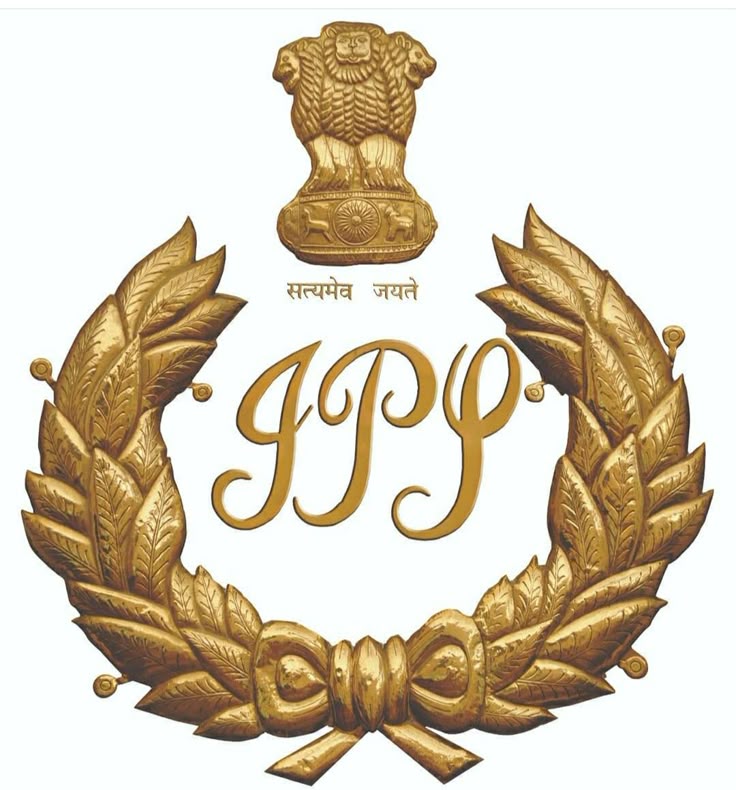
- IPS officers wear the Ashoka national emblem on shoulder straps.
- DGP wears the Ashoka emblem above crossed sword and baton.
- IPS is recognised as an All-India Service under Article 312.
- Police is State List Entry 2, Seventh Schedule.
- Prakash Singh v. Union of India, 2006, issued seven police-reform directives.
- The Police Act 1861 remains the base law in many states.
- Model Police Act 2006 was drafted by the Soli Sorabjee Committee.
- Commissionerate system gives senior officers magisterial powers of preventive action.
- Director of the Intelligence Bureau and CBI are typically drawn from IPS.
Mains Practice Questions
Q1. The rank structure of Indian policing reflects both colonial inheritance and post-independence federal compromises. Discuss with reference to the Police Act 1861 and the Indian Police Service. (15 marks, 250 words)
- Start with Entry 2 State List and the 1861 Police Act origins; note state control and district magistrate supremacy.
- Describe the IPS as an All-India Service (Article 312) providing senior cadre while subordinate ranks are state recruited.
- Close with reform recommendations: Prakash Singh directives, Model Police Act 2006, commissionerate model.
Q2. Evaluate the extent to which the Prakash Singh judgment has transformed the accountability structure of Indian police. (10 marks, 150 words)
- Summarise the seven directives on State Security Commission, fixed tenures, PEB, PCA and separation of functions.
- Give examples of partial compliance and persistent political interference.
- Suggest integration with Model Police Act, CCTNS and capacity-building grants.
Conclusion
Indian police ranks are more than chevrons and stars. They codify a nearly two-century-old administrative lineage, from the Police Act 1861 through the constitutional recognition of the Indian Police Service. Knowing that the 2 star police rank marks a Sub Inspector, or that the Ashoka emblem signals a gazetted IPS officer, equips an aspirant to decode news reports, press briefings and Supreme Court orders with precision.

Lucent's General Knowledge 2026 — English (15th revised edition)
- 460 pages, Lucent Publications, 15th revised edition for 2026
- Static GK in the compressed, list-heavy form these tables come from
- Overrated for UPSC Prelims; exactly right for state PSC, SSC and factual recall
For Prelims, the rank ladder and insignia cues are low-risk, high-yield facts. For Mains, the same ladder becomes an entry point into federal structure, police reform, Second ARC recommendations and internal security. Treat the hierarchy as the scaffolding on which police accountability, CAPF deployment and commissionerate debates rest, and every related GS Paper II or III answer becomes sharper and more grounded.
This list is the kind of static fact Lucent holds in one chapter. The Lucent GK reading guide covers which sections of the book are worth reading and which are not.
Frequently Asked Questions
What is the 2 star police rank in India?
The 2 star police rank refers to the Sub Inspector (SI), who wears two stars with a red-and-blue ribbon on shoulder straps in most state police forces. A Sub Inspector is typically the Station House Officer of a smaller police station and is the first rank empowered to lead investigations and file charge sheets under the Code of Criminal Procedure.
What are the ranks in Indian police from lowest to highest?
The sequence is Constable, Head Constable, Assistant Sub Inspector, Sub Inspector, Inspector, Deputy Superintendent or Assistant Commissioner, Additional SP, Superintendent of Police or DCP, Senior SP, Deputy Inspector General, Inspector General, Additional Director General and Director General of Police. IPS officers enter at the Assistant Superintendent of Police rank.
Why is understanding Indian police ranks important for UPSC?
Police ranks and insignia are tested in Prelims and Mains under GS Paper II on governance and internal security. The topic links Entry 2 of the State List, the Police Act 1861, the Indian Police Service as an All-India Service under Article 312, and the Prakash Singh directives of 2006. It anchors questions on police reform, CAPFs and commissionerate systems.
How is a Sub Inspector related to a Station House Officer?
In most states a Sub Inspector functions as the Station House Officer (SHO) of a smaller or rural police station, while Inspectors head larger urban stations. The SHO is the administrative head of the station, responsible for registering FIRs, supervising investigations, preventive action under Section 151 CrPC and day-to-day law and order.
What is the salary of a Sub Inspector in India?
A Sub Inspector is at Pay Level 6 of the 7th CPC matrix, with a basic pay of Rs 35,400 and gross salary usually between Rs 55,000 and Rs 70,000 per month depending on state allowances, dearness allowance and house rent allowance. State pay commissions may revise these slabs for state police services.
Who wears the Ashoka emblem on police insignia?
The Ashoka national emblem on shoulder straps identifies gazetted Indian Police Service officers from Assistant Superintendent of Police upwards. Superintendents wear the emblem with one star, DIGs with three stars. The most senior ranks, IGP, ADGP and DGP, wear the Ashoka emblem above a crossed sword and baton.
What is the Indian Police Service?
The Indian Police Service is one of the three All-India Services under Article 312 of the Constitution, alongside the IAS and the Indian Forest Service. IPS officers are recruited through the Civil Services Examination conducted by UPSC, allotted to state cadres, and rise from Assistant Superintendent of Police to Director General of Police.
What is the commissionerate system in Indian policing?
Under the commissionerate system, large cities such as Mumbai, Delhi, Kolkata, Chennai, Hyderabad, Bengaluru and Pune are policed by Commissioners of Police who hold magisterial powers of preventive action, bypassing the district magistrate route. Ranks change to DCP, Joint CP, Additional CP and CP, though the broader IPS hierarchy and state DGP remain unchanged.
Tell Google you want more of this.
Add Anantam IAS as a preferred sourceOne tap, and this site shows up more often in your own Top Stories, AI Overviews and AI Mode. Remove it any time.