Introduction
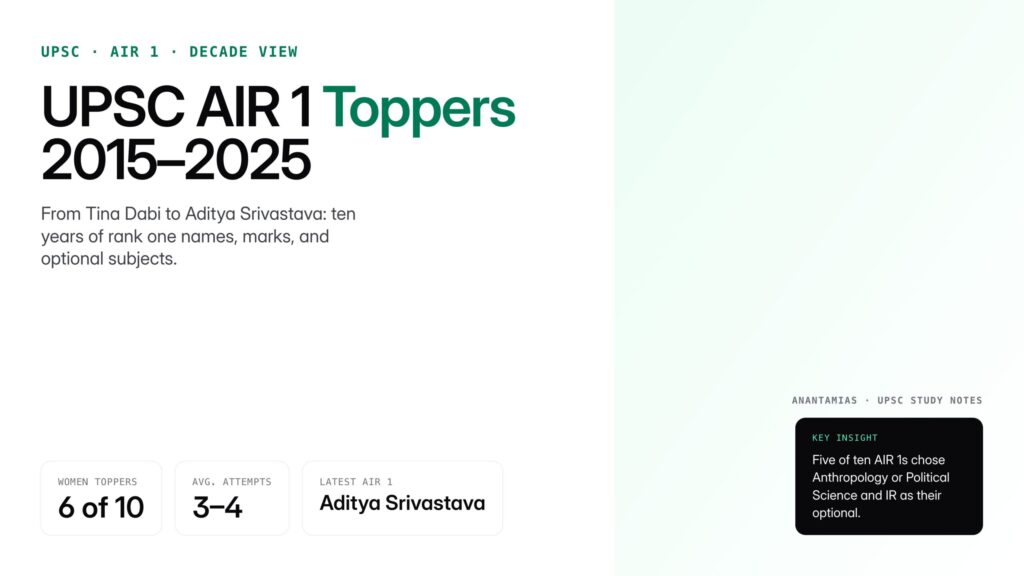
Every year the Union Public Service Commission declares the results of the Civil Services Examination and the country turns its attention to one name: the All India Rank 1 topper. In 2023 that name was Aditya Srivastava, a 26-year-old IIT Kanpur alumnus from Lucknow who cleared the exam on his third attempt while serving in the Indian Police Service Telangana cadre. For aspirants who begin their preparation each year, the AIR 1 story is more than trivia. It is a data point about which optional subject worked, how many attempts it took, which educational background bred success, and what daily routine produced a mark sheet at the top of a list of more than ten lakh registrations.
This guide compiles the UPSC CSE AIR 1 toppers of the past ten years, from 2015 to 2025, with their marks, optional subjects, hometowns, and preparation profiles. It is designed as a single reference table you can return to during strategy planning, optional selection, and interview preparation. Beyond the rankings, the page draws patterns across a decade of results so that the next aspirant, whoever she is, can calibrate her own plan to what has worked at the very top.
Quick Facts at a Glance
| Parameter | Value |
|---|---|
| Latest AIR 1 (CSE 2023, result 2024) | Aditya Srivastava |
| Aditya Srivastava’s Optional | Electrical Engineering |
| Aditya Srivastava’s Alma Mater | IIT Kanpur |
| Number of Attempts | 3 |
| Total Marks (2023) | 1099 out of 2025 |
| Women toppers in the decade (2015–2024) | 5 of 10 |
| Most common optional among AIR 1 | Anthropology and Political Science (IR) |
| Youngest decade-topper | Tina Dabi (2015, age 22) |
| Oldest attempt count for AIR 1 | Third or fourth attempt (majority) |
Background and Historical Context
The UPSC Civil Services Examination is the oldest competitive examination for recruitment to the All India Services, the Central Civil Services Group A, and the Central Civil Services Group B. It traces its lineage to the Indian Civil Services examination instituted in 1855 and conducted in London until its Indian centres opened in 1922. Post-independence, the Union Public Service Commission was established under Article 315 of the Constitution on 26 January 1950. The CSE, as it exists today, is a three-stage examination: Prelims, Mains, and Interview, with the Mains comprising nine papers including an essay, four General Studies papers, two optional papers, and two language qualifying papers.
The AIR 1 list is more than a roll of honour. It reflects shifts in preparation trends. Until the early 2010s, humanities optionals such as Public Administration, History, and Geography dominated the top ranks. The introduction of the new pattern in 2013, which made General Studies weightier and reduced the optional component from two subjects to one, reshaped topper profiles. Since then, optional subjects such as Anthropology, Sociology, Political Science and International Relations, and Electrical Engineering have repeatedly appeared on the AIR 1 mark sheet. The rise of self-study resources, free online content, and the normalisation of drop years has also changed who sits at the top of the list. The 2015–2025 cohort reflects this transition in full.
Key Toppers of the Decade
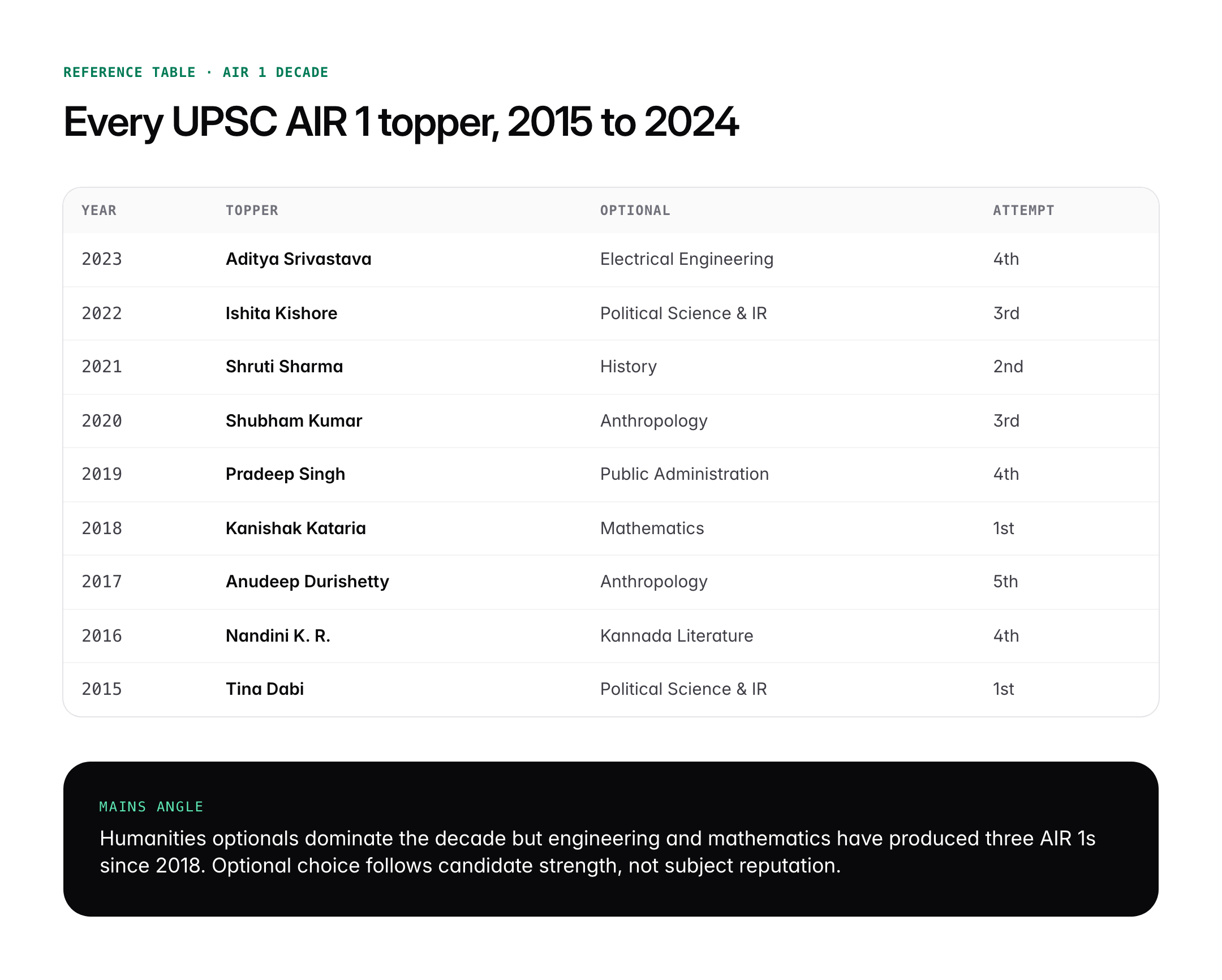
Aditya Srivastava (CSE 2023, Result 2024)
Aditya Srivastava topped CSE 2023 with an aggregate of 1099 marks. From Lucknow, Uttar Pradesh, he completed his B.Tech and M.Tech in Electrical Engineering from IIT Kanpur under a dual-degree programme. He worked briefly in the private sector, cleared CSE 2021 with AIR 236, joined the Indian Police Service and was allotted the Telangana cadre. He continued attempting and secured AIR 1 in his fourth attempt. His optional was Electrical Engineering. He has credited a habit of daily answer-writing, repeated revision of NCERTs, and integrated coverage of Current Affairs with static Polity for his success.
Ishita Kishore (CSE 2022, Result 2023)
Ishita Kishore topped CSE 2022. A graduate of Shri Ram College of Commerce, Delhi University, she took Political Science and International Relations as her optional. She secured AIR 1 in her third attempt and has a background in business and HR. Her ranking made it three consecutive years of a woman topper at AIR 1.
Shruti Sharma (CSE 2021, Result 2022)
Shruti Sharma from Bijnor, Uttar Pradesh, topped CSE 2021 with History as her optional. She is a graduate of St. Stephen’s College, Delhi, and later pursued a postgraduate degree at JNU. Her strategy relied on extensive reading of standard History textbooks and daily newspaper analysis.
Shubham Kumar (CSE 2020, Result 2021)
Shubham Kumar, an IIT Bombay Civil Engineering graduate from Katihar, Bihar, topped CSE 2020 in his third attempt. His optional was Anthropology. He was allotted the IAS and his success highlighted how engineering graduates successfully pivot to humanities optionals.
Pradeep Singh (CSE 2019, Result 2020)
Pradeep Singh from Sonipat, Haryana, topped CSE 2019 in his fourth attempt. His optional was Public Administration. A graduate from Kurukshetra University, he had previously served as an Indian Revenue Service probationer before securing AIR 1.
Kanishak Kataria (CSE 2018, Result 2019)
Kanishak Kataria from Jaipur, Rajasthan, topped CSE 2018 with Mathematics as his optional in his first attempt. An IIT Bombay Computer Science graduate, he was working at Samsung before turning to the civil services. His profile proved that technical optionals remain viable when backed by strong conceptual preparation.
Anudeep Durishetty (CSE 2017, Result 2018)
Anudeep Durishetty from Jagtial, Telangana, topped CSE 2017 in his fifth attempt. His optional was Anthropology. He was an Indian Revenue Service officer at the time. His meticulously written preparation strategy blog became one of the most widely read resources in aspirant circles.
Nandini K. R. (CSE 2016, Result 2017)
Nandini K. R. from Kolar, Karnataka, topped CSE 2016 in her fourth attempt. Her optional was Kannada Literature, making her the rare AIR 1 with a regional literature optional. She had previously cleared the exam at a lower rank and worked as an Indian Revenue Service (Customs) officer.
Tina Dabi (CSE 2015, Result 2016)
Tina Dabi from Delhi topped CSE 2015 in her first attempt at the age of 22. Her optional was Political Science and International Relations. A Lady Shri Ram College graduate, she went on to serve in the IAS Rajasthan cadre and remains one of the most recognisable civil servants of her generation.
Significance for UPSC and General Knowledge
- The AIR 1 list is a barometer of optional subject viability across exam cycles.
- Six of the ten decade-toppers are women, signalling durable progress in gender representation at the top of the merit list.
- Engineering undergraduates who switched to humanities optionals dominate the 2018 to 2023 cohort.
- Multiple attempts are the norm: only Tina Dabi and Kanishak Kataria topped in their first attempt within this decade.
- The list is cited in Parliament, MoPPG annual reports, and UPSC press communications, so it has reference value beyond aspirant use.
Detailed Analysis: Trends from the Decade
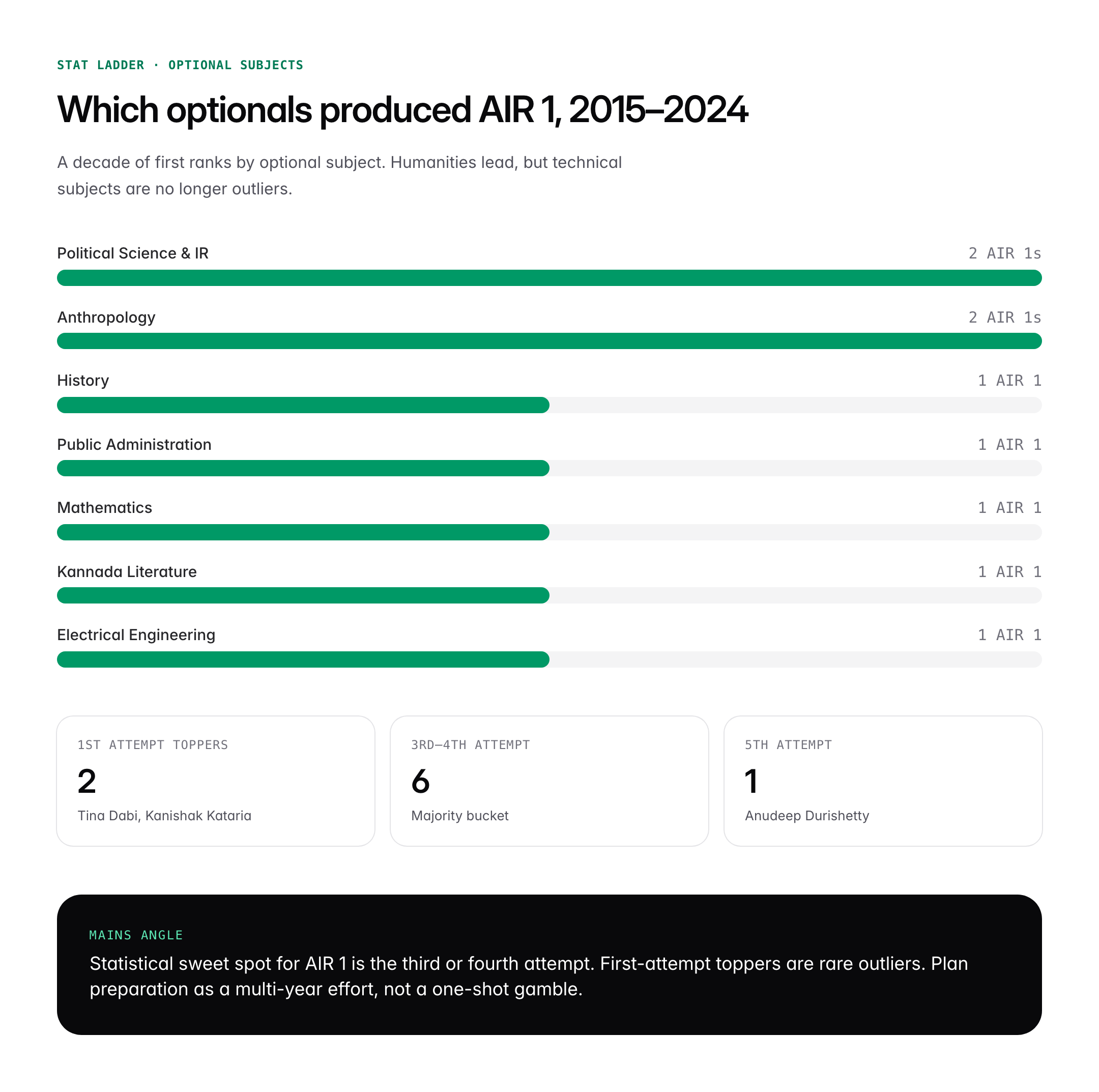
A close reading of ten years of AIR 1 results yields several empirical patterns. First, optional subjects cluster. Anthropology and Political Science and IR account for five of the ten AIR 1 positions. History and Public Administration each claim one. Regional literature (Kannada), Mathematics, and Electrical Engineering each claim one. This distribution suggests that while optional choice still matters, the best predictor of AIR 1 is not the subject itself but the candidate’s comparative advantage in it.
Second, the number of attempts has a U-shape. First-attempt toppers (Tina Dabi, Kanishak Kataria) are rare but exist. Toppers typically succeed in their third or fourth attempt. Anudeep Durishetty’s fifth attempt is the outlier on the higher end. This confirms the widely cited UPSC advice that the first attempt should be treated as a full-dress rehearsal and the third to fourth attempts are statistically the sweet spot for final rank improvement.
Third, alma maters skew toward premier institutions. IIT Kanpur, IIT Bombay, SRCC, LSR, and JNU dominate the list. This is not because elite campuses teach UPSC content but because their students bring stronger foundational reading habits, access to peer discussion, and earlier exposure to analytical writing. The UPSC itself publishes no institutional bias, and candidates from regional universities (Kurukshetra, Kolar) also break through, especially when they have prior civil service or IRS experience.
Fourth, geographic distribution is broad. Toppers have come from Delhi, Uttar Pradesh, Haryana, Rajasthan, Bihar, Karnataka, Telangana, and West Bengal in adjacent years. Coaching-hub cities (Delhi, Allahabad, Mukherjee Nagar) are represented but so are smaller towns such as Bijnor, Katihar, and Kolar. The expansion of online resources since 2020 has measurably narrowed the geographic gap.
Fifth, the marks range compresses at the top. The AIR 1 aggregate has hovered between 1050 and 1100 out of 2025 through the decade. The difference between rank 1 and rank 10 is often fewer than 40 marks across a nine-paper examination. This is a reminder that incremental improvements in answer writing and interview performance decisively matter.
Comparative Perspective
How do India’s AIR 1 toppers compare with their global peers and with other Indian examinations?
| Examination | Selection Ratio | Profile of top ranker | Preparation time |
|---|---|---|---|
| UPSC Civil Services (India) | ~0.1% | Avg. age 26, 3-4 attempts | 1-2 years focused |
| China National Civil Service Exam | ~1.5% | Avg. age 24, 1 attempt | 6-12 months |
| UK Civil Service Fast Stream | ~2% | Recent graduate, 1 attempt | 3-6 months |
| French ENA (now INSP) | ~3% | Sciences-Po graduate | 2 years post-grad |
| Indian Engineering Services (IES) | ~0.3% | Engineering graduate | 1 year |
The UPSC CSE’s selection ratio is among the most competitive in the world. The French ENA, until its 2022 replacement by the Institut national du service public, and the UPSC CSE are the only two major civil service examinations that require candidates to write long-form essays on multiple subjects. This explains why Indian toppers tend to be older and more experienced than their UK or Chinese counterparts.
Controversies and Debates
The AIR 1 focus is not without critique. A first strand of criticism argues that hero-worship of toppers distorts the preparation ecosystem. Coaching institutes lionise top rankers in advertising, creating pressure on aspirants to replicate routines and booklists that may not suit them. The UPSC itself does not release detailed topper interviews, but private media interviews set expectations that can mislead.
A second strand concerns the representation question. The dominance of English-medium, urban, and upper-caste toppers in the early part of the decade prompted UPSC to conduct periodic reviews. The most recent data shows gradual diversification, with Hindi-medium toppers appearing in the top 50 more frequently and first-generation learners reaching AIR 1 territory. The Baswan Committee Report (2016) and subsequent NITI Aayog consultations have continued to examine access questions.
A third debate centres on the optional subject itself. Since the 2013 pattern change, proposals to abolish the optional entirely have resurfaced in almost every five-year review. Proponents argue that the optional creates scaling disparities across subjects. Opponents counter that it allows specialists from diverse academic backgrounds to play to their strengths. The UPSC has so far retained the optional.
Prelims Pointers
- Aditya Srivastava was AIR 1 in CSE 2023, result declared in April 2024
- His optional subject was Electrical Engineering
- He is an IIT Kanpur alumnus and was serving in the IPS Telangana cadre
- Ishita Kishore topped CSE 2022 with Political Science and IR
- Shruti Sharma topped CSE 2021 with History
- Shubham Kumar topped CSE 2020 with Anthropology
- Pradeep Singh topped CSE 2019 with Public Administration
- Kanishak Kataria topped CSE 2018 with Mathematics in his first attempt
- Anudeep Durishetty topped CSE 2017 with Anthropology in his fifth attempt
- Nandini K. R. topped CSE 2016 with Kannada Literature
- Tina Dabi topped CSE 2015 with Political Science and IR at age 22
- UPSC CSE is conducted under Article 320 of the Constitution
Mains Practice Questions
Q1. “A civil services examination must balance breadth of general knowledge with depth of specialised study.” Discuss this statement in the context of the optional subject in the UPSC Civil Services Examination.
- Argue for breadth through the four General Studies papers and the Essay, which test candidates across subjects.
- Argue for depth through the optional, which allows specialists in Anthropology, Mathematics, or Engineering to demonstrate analytical rigour.
- Conclude that the optional survives recurring review because it protects academic pluralism in the Indian civil service.
Q2. Examine the role of the Union Public Service Commission in ensuring an impartial merit-based selection for the All India Services.
- Cite Article 315 to 323 of the Constitution and the Civil Services Examination Rules.
- Discuss the three-stage process, interview board composition, and transparency measures such as the publication of final marks.
- Evaluate criticisms of interview subjectivity, coaching influence, and the Baswan Committee recommendations on reform.
Conclusion
The AIR 1 toppers list of the past decade is a compressed biography of Indian administrative aspiration. It records who tried, who succeeded, and what mix of subject, attempt count, and preparation culture produced the single highest score each year. For the aspirant, it is not a template to copy. It is a distribution to study. Aditya Srivastava’s 2023 result continues the pattern of multi-attempt, technically trained, answer-writing-focused candidates taking the top rank. Ishita Kishore, Shruti Sharma, and Shubham Kumar immediately preceded him with comparable profiles.
Any serious aspirant should take two lessons from this decade. First, the optional is less about the subject and more about the candidate’s command of it. Second, attempt number three or four is usually the sharpest. Settling in for a multi-year effort, with steady answer writing and ruthless revision, is the strategy that has produced ten AIR 1 ranks in a row. The next name on this list will be added in the year that follows, and the preparation cycle begins again.
Frequently Asked Questions
Who is Aditya Srivastava and why is he famous?
Aditya Srivastava is the All India Rank 1 topper of the UPSC Civil Services Examination 2023, declared in April 2024. He is a 26-year-old IIT Kanpur dual-degree alumnus from Lucknow, Uttar Pradesh. He secured the top rank in his fourth attempt while already serving as an Indian Police Service officer in the Telangana cadre. His optional subject was Electrical Engineering.
What is the UPSC AIR 1 toppers list?
The UPSC AIR 1 toppers list is the official record of candidates who secured the top rank in each year’s Civil Services Examination. It is released by the Union Public Service Commission after the Mains and Interview rounds. The list includes the topper’s name, roll number, and final merit position. Aspirants study it to track optional subject trends and preparation strategies.
Why is the UPSC toppers list important for aspirants?
The toppers list is important because it offers empirical evidence of what has worked at the highest level of the examination. It reveals optional subject trends, attempt-number patterns, educational backgrounds, and interview performance distribution. Serious aspirants use the list not as a template to copy but as a data distribution to calibrate their own strategy, timeline expectations, and optional choice.
How is Aditya Srivastava related to other recent UPSC toppers?
Aditya Srivastava is the fourth consecutive engineering-background AIR 1 topper if we include Kanishak Kataria (2018), Shubham Kumar (2020), and the broader pattern. Like Anudeep Durishetty (2017) and Shubham Kumar, he took multiple attempts. Like Ishita Kishore and Shruti Sharma immediately before him, he relied on integrated answer writing and a structured optional. His profile reflects the dominant topper archetype of the 2020s.
How many attempts did Aditya Srivastava take to clear UPSC?
Aditya Srivastava took four attempts to secure AIR 1. He cleared the examination in his third attempt with AIR 236 in CSE 2021 and joined the Indian Police Service Telangana cadre. He continued attempting the examination while in service and topped it in his fourth attempt in CSE 2023. His trajectory is consistent with UPSC data showing that most AIR 1 toppers succeed in their third or fourth attempt.
Which optional subject did Aditya Srivastava take?
Aditya Srivastava took Electrical Engineering as his optional subject in the UPSC Civil Services Mains. This choice reflected his IIT Kanpur dual-degree background in the subject. Electrical Engineering as an optional is uncommon but has produced consistent performers. Aditya’s success demonstrates that when a candidate has strong conceptual foundations and a disciplined answer-writing routine, technical optionals remain fully competitive with humanities choices.
Who topped UPSC before Aditya Srivastava?
Ishita Kishore topped the Civil Services Examination 2022, with the result declared in 2023. A graduate of Shri Ram College of Commerce, Delhi University, she cleared the exam in her third attempt with Political Science and International Relations as her optional. Before her, Shruti Sharma topped CSE 2021 with History, and Shubham Kumar topped CSE 2020 with Anthropology. The sequence reflects a decade of predominantly multi-attempt toppers.
Does the UPSC topper profile change over the decade?
Yes. Over 2015 to 2024 the topper profile has shifted in three ways. First, women now account for six of the ten AIR 1 positions, showing durable gender progress. Second, engineering graduates with humanities optionals have become the dominant archetype. Third, the average number of attempts for AIR 1 has settled around three to four. These shifts reflect broader changes in preparation culture, optional selection, and exam pattern since 2013.
Tell Google you want more of this.
Add Anantam IAS as a preferred sourceOne tap, and this site shows up more often in your own Top Stories, AI Overviews and AI Mode. Remove it any time.