
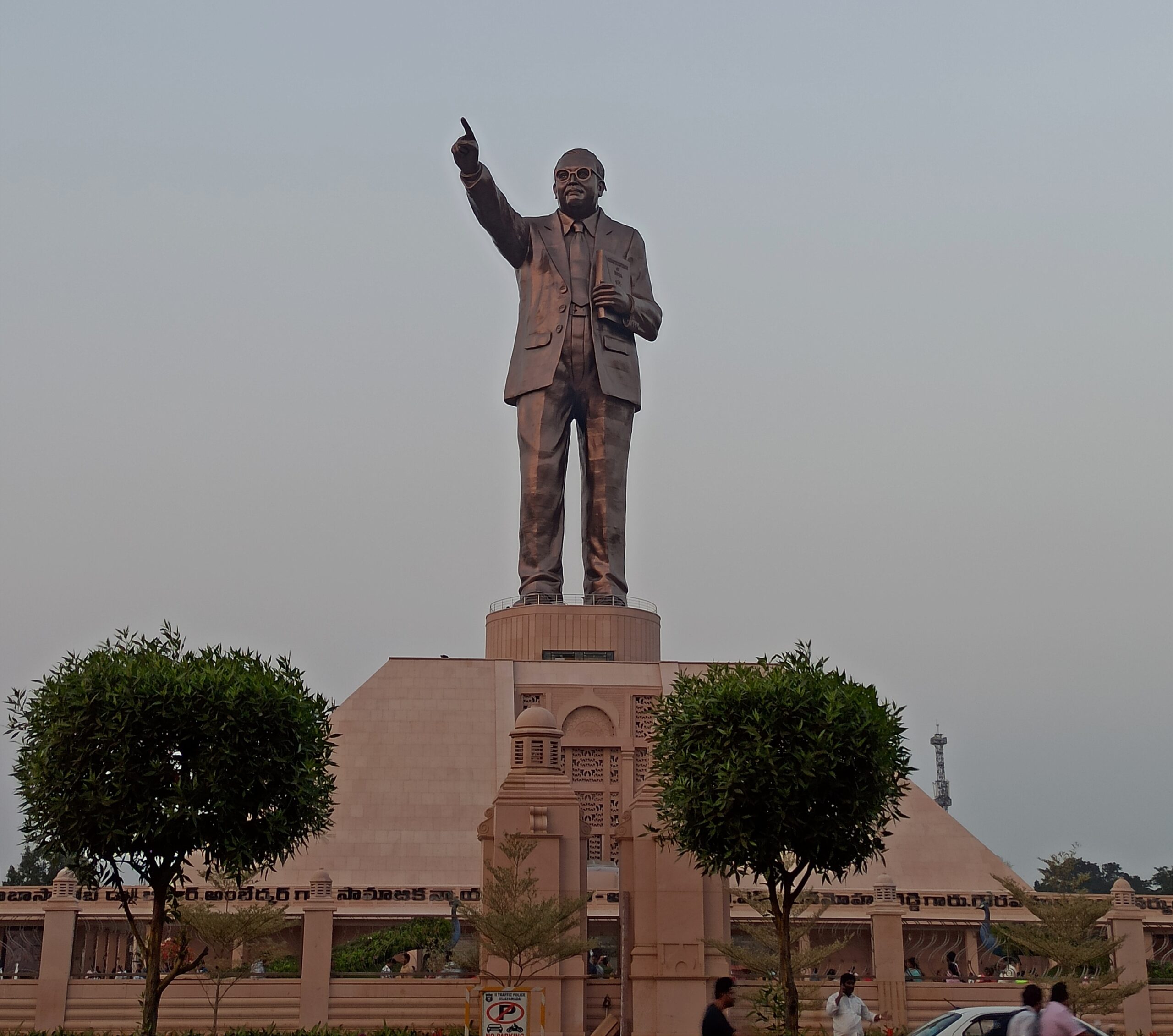
The Ambedkar statue in Vijayawada is the Statue of Social Justice, a 206-foot memorial to Dr B. R. Ambedkar on the banks of the Krishna river, inaugurated on 19 January 2024. Its 125-foot bronze figure stands on an 81-foot pedestal, making it the tallest Ambedkar statue in the world. It was sculpted by Ram Vanji Sutar — sculptor of the Statue of Unity — at a cost of about ₹404.35 crore.
Introduction
On 19 January 2024, the Andhra Pradesh government unveiled the Statue of Social Justice, a 206-foot bronze likeness of Dr B. R. Ambedkar on the banks of the Krishna river in Vijayawada. Overnight it became the tallest Ambedkar statue in the world and the country’s most prominent memorial to the chief architect of the Indian Constitution. For UPSC aspirants, the monument is more than a tourist landmark. It is a useful case study in public memory, social justice politics and the symbolic architecture of modern India.
This article covers the key facts about the Ambedkar statue in Vijayawada: its location, height, cost, design, political context and significance. We will also place it alongside other large Ambedkar memorials, examine the controversies around monumental statuary in India and draw out the themes that Prelims and Mains questions are most likely to test.
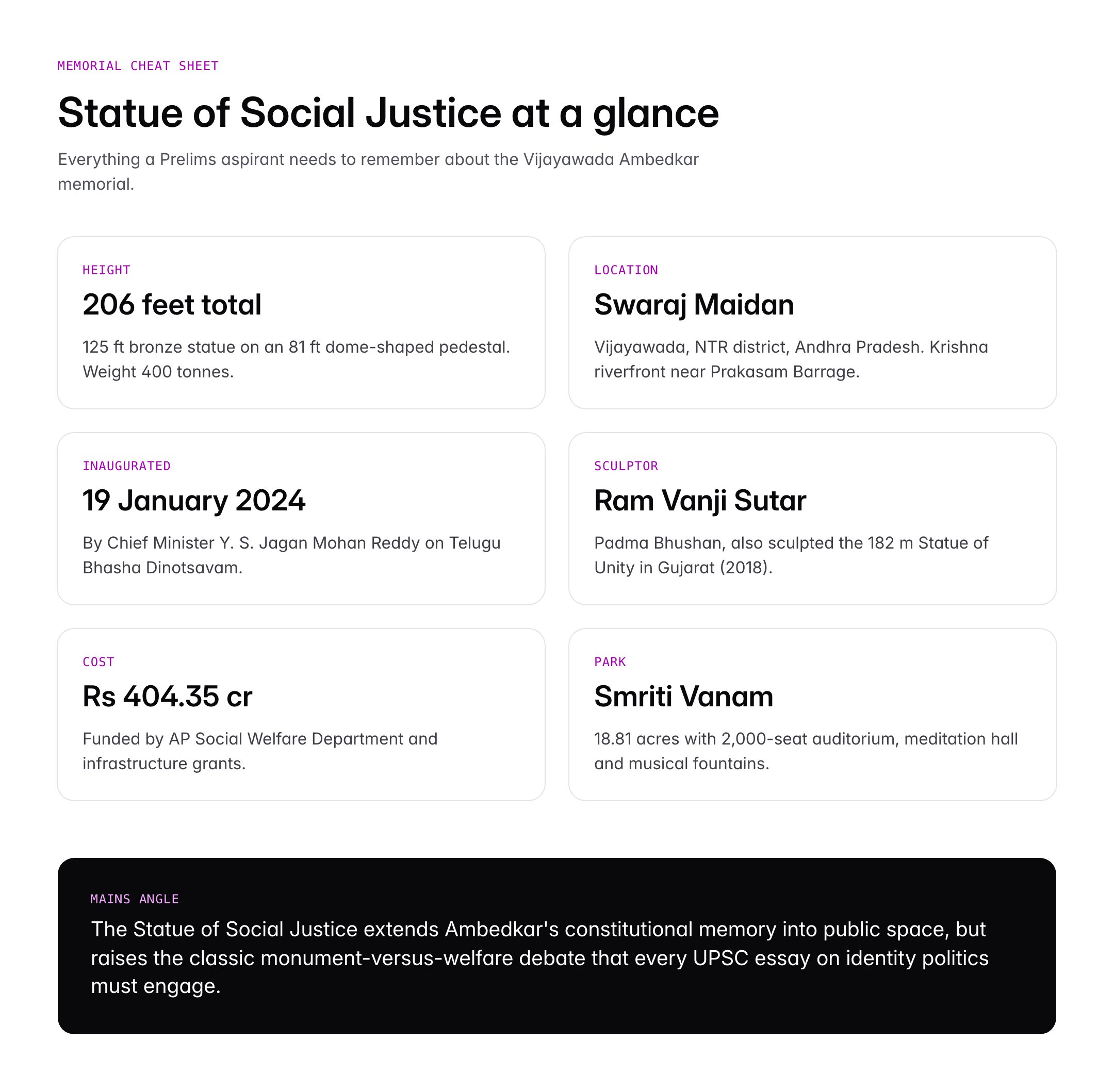
Quick Facts at a Glance
| Parameter | Detail |
|---|---|
| Official name | Statue of Social Justice |
| Location | Swaraj Maidan, PWD Grounds, Vijayawada, NTR district, Andhra Pradesh |
| Statue height | 125 feet (bronze) |
| Total height with pedestal | 206 feet |
| Pedestal | 81 feet, dome-shaped podium |
| Material | Bronze on a steel frame |
| Weight | Approximately 400 tonnes |
| Cost | About Rs 404.35 crore |
| Inaugurated | 19 January 2024 |
| Inaugurated by | Y. S. Jagan Mohan Reddy, then Chief Minister of Andhra Pradesh |
| Sculptor | Ram Vanji Sutar (same sculptor as the Statue of Unity) |
| Design inspiration | Statue of Unity proportions, seated Lincoln-style pose |
| Status | Tallest Ambedkar statue in the world |
Background and Historical Context
Ambedkar memorialisation in India is a relatively recent phenomenon that gathered pace only after the birth centenary in 1991 and the centenary of his conversion to Buddhism in 2006. The Mayawati-led governments in Uttar Pradesh between 1995 and 2012 built monumental Ambedkar parks in Lucknow and Noida, setting a template for large-scale public memorialisation of Dalit icons. Telangana unveiled a 125-foot bronze Ambedkar in Hyderabad in April 2023, currently the tallest Ambedkar statue on a single bronze count.
Andhra Pradesh under Chief Minister Y. S. Jagan Mohan Reddy announced the Vijayawada project in 2020 as part of a broader Navaratnalu welfare agenda aimed at consolidating support among Scheduled Caste, Scheduled Tribe and Backward Class voters. The site chosen was the historic Swaraj Maidan, originally known as PWD Grounds, where Mahatma Gandhi addressed public meetings during the freedom struggle. Construction was awarded to the Ram Sutar Art Creations studio in Noida, led by 97-year-old sculptor Padma Bhushan Ram Vanji Sutar, who also designed the 182-metre Statue of Unity in Gujarat.
The statue was unveiled on Telugu Bhasha Dinotsavam (Telugu Language Day), 19 January 2024, though the dedication to the nation was timed just weeks before the general election cycle began. The memorial includes a surrounding 18.81-acre park called Smriti Vanam, a 2,000-seat auditorium, musical fountains, a meditation hall, a photo gallery of Ambedkar’s life and a 3D visual-effects show. Illumination of the statue is provided by lotus-shaped LED lights that change colour at night.
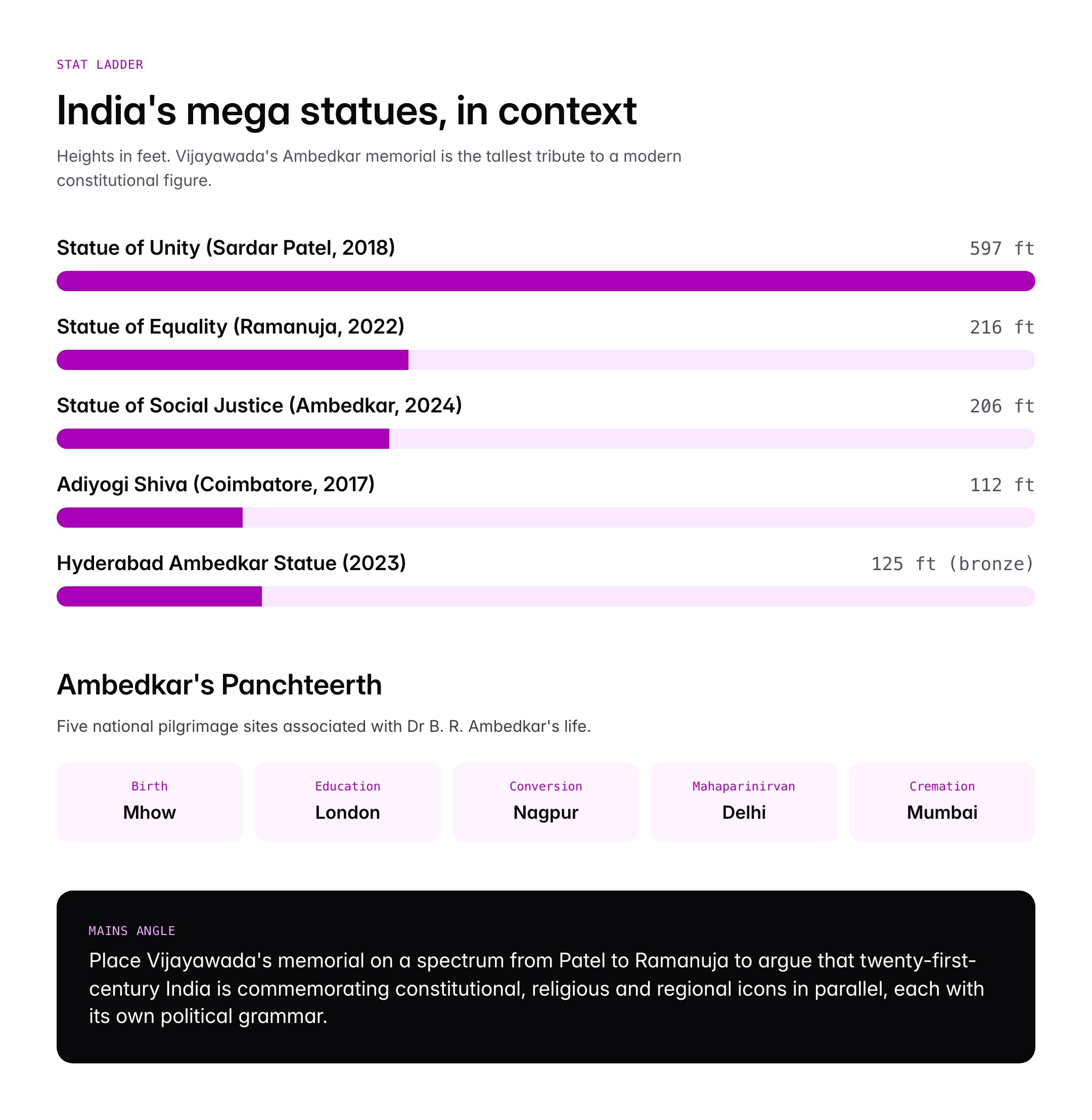
In scale and ambition, the Vijayawada memorial joins a small group of Indian mega-statues, alongside the Statue of Unity, the under-construction Shivaji statue off the Mumbai coast, the Adiyogi Shiva statue in Coimbatore and the Statue of Equality dedicated to Ramanuja in Hyderabad. It is the first mega-statue dedicated to a constitutional figure of the modern republic.
Key Features
Design and Symbolism
The Statue of Social Justice portrays Dr Ambedkar in his characteristic suit holding a copy of the Constitution of India in his left hand, the right hand raised in a gesture of teaching and reassurance. The pose deliberately evokes the image of Ambedkar at the Constituent Assembly. The bronze statue itself is 125 feet tall and rests on a circular dome-shaped pedestal of 81 feet, giving the monument a total height of 206 feet. The pedestal houses a museum, a meditation hall and exhibition space.
Ram Sutar’s design emphasises calm authority rather than movement. The face, based on the well-known Ambedkar portrait of 1950, is rendered with oversized detail so that it remains recognisable from the Vijayawada skyline. Inscriptions on the pedestal in Telugu and English carry excerpts from the Preamble to the Constitution and from Ambedkar’s famous speech to the Constituent Assembly on 25 November 1949.
Location and Visitor Experience
The memorial sits at Swaraj Maidan in Vijayawada, along the Krishna river and close to the Prakasam Barrage and the Kanaka Durga temple. The wider Smriti Vanam park spans 18.81 acres and includes landscaped lawns, an amphitheatre, musical fountains timed to Ambedkar-era speeches, a cafeteria and dedicated parking. An external elevator and viewing gallery at the base of the statue allow visitors to study the pedestal reliefs up close.
Cost and Construction
The project cost approximately Rs 404.35 crore, financed through the Andhra Pradesh Social Welfare Department and infrastructure grants. Construction employed more than 300 workers for roughly three years. The bronze skin was cast in 785 segments at Sutar’s Noida foundry and transported by road in convoys to Vijayawada, where it was welded onto a steel skeleton engineered to withstand wind speeds of up to 200 km per hour, a necessity on the Krishna-delta floodplain.
Political and Cultural Programming
The memorial is not a passive object. It is used year-round as a venue for Ambedkar Jayanti (14 April), Mahaparinirvan Diwas (6 December) and Constitution Day (26 November) gatherings. The auditorium hosts lectures on social justice, reservation policy and Dalit literature. A digital pavilion screens documentaries on Ambedkar’s journey from Mhow to the Drafting Committee and his conversion to Buddhism at Nagpur in 1956.
Significance for UPSC and General Knowledge
- The statue is directly relevant for GS1 Indian Society and Culture as a modern example of public memorialisation of a reformer.
- It connects with GS2 Polity and Constitution through its tribute to the architect of the Indian Constitution.
- Questions on Indian art, sculpture and recent mega-statues can draw on the Sutar family’s Statue of Unity and Statue of Social Justice as comparative cases.
- The memorial is a useful example in essays on social justice, affirmative action and symbolic politics.
- It illustrates the debate around public expenditure on monuments versus welfare schemes.
- For interview and ethics (GS4), the statue raises questions about how societies remember and instrumentalise reformers.
Detailed Analysis: Politics, Memory and Social Justice
The Vijayawada memorial must be understood within the layered politics of caste representation in contemporary India. Ambedkar has become, since the 1990s, a near-universal figure venerated across party lines, yet each government seeks to claim a particular reading of him. The Mayawati parks in Uttar Pradesh emphasised Bahujan self-respect. The Statue of Equality in Hyderabad foregrounded Telangana’s Dalit politics. The Vijayawada statue, built during the YSR Congress tenure, was framed around the phrase “Samajika Nyayam” or social justice, and tied to welfare schemes for SC, ST and BC communities under the Navaratnalu bouquet.
This claim on Ambedkar is not unique to Andhra Pradesh. The Maharashtra government has long maintained Chaityabhoomi in Dadar and is constructing a separate Indu Mills memorial in Mumbai. At the central level, the Panchteerth initiative designated five Ambedkar-related sites as national pilgrimage: Mhow (birthplace), London (education), Nagpur (conversion), Delhi (Mahaparinirvan at Alipur Road) and Mumbai (Chaityabhoomi). The Vijayawada memorial sits alongside this national network and is likely to attract growing numbers of pilgrims and students.
There is also an art-historical thread worth noting. Ram Sutar, born in 1925 in Dhule, Maharashtra, has sculpted more than 150 monumental figures of Indian leaders. His studio’s consistent aesthetic, solid bronze, calm frontal pose and figurative realism, has become the default visual grammar of post-liberalisation India’s civic sculpture. The Vijayawada statue fits squarely in this lineage, which scholars debate as either nation-building public art or a homogenised official style. A balanced UPSC answer should acknowledge both views.
Finally, the memorial intersects with the Buddhist turn in Dalit public culture. Ambedkar’s conversion to Buddhism in 1956 transformed millions of Dalits into Navayana Buddhists. The meditation hall at the base of the statue, the lotus motifs and the inclusion of the Dhammachakka symbolism in pedestal friezes connect the memorial to this ongoing spiritual movement.
Comparative Perspective
How does the Vijayawada Ambedkar statue compare with other mega-statues in India and the world? Scale alone is not the only metric; symbolic weight, visitor footfall and public spending all matter.
| Statue | Height | Subject | Year | Location |
|---|---|---|---|---|
| Statue of Unity | 182 m (597 ft) | Sardar Patel | 2018 | Kevadia, Gujarat |
| Statue of Social Justice | 206 ft (62.8 m) | B. R. Ambedkar | 2024 | Vijayawada, AP |
| Statue of Equality | 216 ft | Ramanuja | 2022 | Shamshabad, Hyderabad |
| Spring Temple Buddha | 128 m (420 ft) | Buddha | 2008 | Henan, China |
| Hyderabad Ambedkar statue | 125 ft (bronze) | B. R. Ambedkar | 2023 | Hyderabad, Telangana |
The Vijayawada memorial is not the tallest Indian statue, but it is the tallest Ambedkar likeness anywhere. It is also one of the few mega-statues dedicated to a modern constitutional figure rather than a religious or martial icon. This makes it a particularly interesting case for discussion on what modern India chooses to memorialise and why.
Controversies and Debates
Monumental public spending is rarely uncontested, and the Statue of Social Justice was no exception. Critics argued that Rs 404 crore could have been directed to scholarships, hostels, land titling or healthcare for the very communities Ambedkar fought for. Opposition parties questioned the timing of the unveiling just before state and general elections, reading it as electoral posturing. Supporters countered that public symbols matter for marginalised communities and that the welfare budget was not reduced to fund the memorial.
A second debate concerns design. Some Dalit intellectuals have argued that Ambedkar’s memory should be anchored in libraries, fellowships and research institutes rather than monumental bronzes, on the grounds that Ambedkar himself emphasised education over icon worship. Others welcome grand statues as overdue reparations for centuries of invisibility in the public sphere. A balanced view, as UPSC answers should adopt, is that both modes can coexist and that the real test lies in how the memorial programming translates symbolic recognition into substantive opportunity.
There has also been a minor dispute with Telangana over which state hosts the tallest Ambedkar statue. Hyderabad’s 125-foot bronze was unveiled months before Vijayawada’s and, at bronze-only measurement, is comparable, but Vijayawada’s 206-foot total height with pedestal is higher by the commonly accepted measure.
Prelims Pointers
- Official name: Statue of Social Justice.
- Total height: 206 feet, with 125-foot bronze statue on an 81-foot pedestal.
- Location: Swaraj Maidan, Vijayawada, NTR district, Andhra Pradesh, on the banks of the Krishna river.
- Inaugurated on 19 January 2024.
- Inaugurated by then Chief Minister Y. S. Jagan Mohan Reddy.
- Sculptor: Ram Vanji Sutar, also the sculptor of the Statue of Unity.
- Cost: approximately Rs 404.35 crore.
- Material: bronze on a steel frame, approximately 400 tonnes.
- It is the tallest Ambedkar statue in the world.
- Surrounding park is called Smriti Vanam, spread over 18.81 acres.
- Ambedkar’s Panchteerth: Mhow, London, Nagpur, Delhi (Alipur Road), Mumbai (Chaityabhoomi).
- Related: the 125-foot Hyderabad Ambedkar statue was unveiled on 14 April 2023.
Mains Practice Questions
Q1. Discuss the role of public monuments in shaping historical memory in India, using the Statue of Social Justice in Vijayawada as a case study. (250 words)
- Explain the function of monuments: collective memory, identity formation, symbolic recognition of marginalised groups.
- Use the Vijayawada statue to show how modern constitutional figures are memorialised, alongside the Statue of Unity and Statue of Equality.
- Critically weigh benefits of public symbolism against the opportunity cost of mega-projects and the need for substantive welfare.
Q2. “The memory of B. R. Ambedkar is better honoured through universities and scholarships than through monumental statues.” Critically examine. (250 words)
- Present the argument for substantive investment: education was Ambedkar’s own priority, as seen in his promotion of the Depressed Classes Education Society.
- Present the counter-argument: symbolic recognition matters for historically excluded communities and can catalyse political mobilisation.
- Conclude with a balanced view advocating both statues and scholarships as complementary rather than competing forms of commemoration.
Conclusion
The Ambedkar statue in Vijayawada, formally the Statue of Social Justice, is the most ambitious memorial yet to the architect of the Indian Constitution. At 206 feet it towers over the Krishna riverfront, and it reframes the public skyline of Andhra Pradesh’s commercial capital around a constitutional idea rather than a religious or martial hero. Built by the same studio that sculpted the Statue of Unity, it slots neatly into a new Indian tradition of large-scale civic statuary and into the wider politics of social-justice memorialisation.
For UPSC candidates, the monument is a compact case study that links constitutional history, Dalit politics, public finance and the aesthetics of memory. It can be cited in essays on identity, in GS1 answers on social reformers, in GS2 discussions on constitutional values and in ethics answers on the role of public symbols. Whether one sees it primarily as a tribute, a political statement or an investment in civic pride, the Statue of Social Justice is now part of the visual grammar of twenty-first century India.
Frequently Asked Questions
What is the Ambedkar statue in Vijayawada?
The Ambedkar statue in Vijayawada, officially named the Statue of Social Justice, is a 206-foot bronze memorial to Dr B. R. Ambedkar at Swaraj Maidan on the Krishna riverfront. Unveiled on 19 January 2024 by Chief Minister Y. S. Jagan Mohan Reddy, it is the tallest Ambedkar statue in the world and was sculpted by Padma Bhushan Ram Vanji Sutar.
Why is the Ambedkar statue in Vijayawada important for UPSC?
The memorial is useful in GS1 answers on Indian society and social reformers, GS2 answers on constitutional values, and essays on social justice. It illustrates how modern India memorialises constitutional figures and opens discussion on public expenditure versus welfare, the politics of Dalit representation and the role of symbolic recognition in a diverse democracy.
How is the Statue of Social Justice related to the Statue of Unity?
Both statues were designed by the same sculptor, Padma Bhushan Ram Vanji Sutar, and both belong to the post-2014 tradition of Indian mega-statues. The Statue of Unity in Gujarat (2018) honours Sardar Patel at 182 metres, while the Statue of Social Justice (2024) honours Ambedkar at 206 feet, together establishing a new civic vocabulary of monumental tribute to founding-era leaders.
What is the height of the Ambedkar statue in Vijayawada?
The Statue of Social Justice has a total height of 206 feet. The bronze statue itself measures 125 feet and sits on a dome-shaped pedestal that is 81 feet tall. The pedestal houses a museum, meditation hall, exhibition space and a 2,000-seat auditorium used for public lectures on social justice and constitutional values.
Who inaugurated the Statue of Social Justice and when?
The Statue of Social Justice was inaugurated on 19 January 2024 by Y. S. Jagan Mohan Reddy, then Chief Minister of Andhra Pradesh. The unveiling coincided with Telugu Bhasha Dinotsavam and was attended by senior state officials, Ambedkar-family representatives and diplomats. The memorial was dedicated to the nation as a tribute to the architect of the Indian Constitution.
How much did the Ambedkar statue in Vijayawada cost?
The total cost of the Statue of Social Justice was approximately Rs 404.35 crore. The amount was financed by the Andhra Pradesh government through the Social Welfare Department and infrastructure grants. The project covered the bronze statue, steel frame, 81-foot pedestal, 18.81-acre Smriti Vanam park, auditorium, museum and landscaping along the Krishna riverfront.
What is Smriti Vanam at the Vijayawada Ambedkar memorial?
Smriti Vanam is the 18.81-acre landscaped park that surrounds the Statue of Social Justice. It includes a 2,000-seat auditorium, musical fountains, a meditation hall, an amphitheatre, a photo gallery on Ambedkar’s life, a 3D visual-effects show and dedicated parking. The park hosts annual gatherings on Ambedkar Jayanti, Mahaparinirvan Diwas and Constitution Day.
Is the Vijayawada Ambedkar statue the tallest in the world?
Yes. At 206 feet including its 81-foot pedestal, the Statue of Social Justice in Vijayawada is the tallest Ambedkar statue in the world. The 125-foot bronze statue unveiled in Hyderabad in April 2023 is the tallest bronze-only likeness of Ambedkar, but the Vijayawada memorial is higher by total height, the commonly accepted measure for statue rankings.
Tell Google you want more of this.
Add Anantam IAS as a preferred sourceOne tap, and this site shows up more often in your own Top Stories, AI Overviews and AI Mode. Remove it any time.