

Introduction
Why does a giant steel ship float while a small iron nail sinks in the same water? The answer lies in a 2,200-year-old insight attributed to the Greek polymath Archimedes of Syracuse, one of the foundational laws of fluid mechanics. Archimedes’ Principle explains buoyancy, the upward force a fluid exerts on a body immersed in it, and it underpins everything from naval architecture and submarine operations to hot-air ballooning and the calibration of density instruments.
For UPSC aspirants, the principle appears across Prelims science questions, General Science sections of CSAT, and in descriptive answers touching on indigenous shipbuilding, defence technology, and oceanography. A firm grasp of the statement, its mathematical form, derivation, and applications equips candidates to handle both conceptual MCQs and interdisciplinary Mains questions on science, technology and society.

Quick Facts at a Glance
| Attribute | Detail |
|---|---|
| Discovered by | Archimedes of Syracuse (c. 287–212 BCE) |
| Field | Hydrostatics / Fluid mechanics |
| Core concept | Buoyant force equals weight of displaced fluid |
| Formula | F_b = ρ × V × g |
| SI unit of buoyant force | Newton (N) |
| Related law | Law of Flotation |
| Historical anecdote | “Eureka!” moment in the bath |
| Key applications | Ships, submarines, hot-air balloons, hydrometers |
Background and Historical Context
The classical account comes from the Roman architect Vitruvius. King Hiero II of Syracuse suspected that a goldsmith had adulterated his votive crown with silver. He asked Archimedes to determine the crown’s purity without melting it down. While stepping into a public bath, Archimedes noticed that the water level rose as he submerged his body, and realised that the volume of water displaced was exactly equal to the volume of the body submerged. He reportedly ran through the streets shouting “Eureka” (I have found it). By measuring the water displaced by the crown and comparing it against an equivalent weight of pure gold, he could detect the fraud because silver has lower density than gold.
Although the “Eureka” story is probably embellished, Archimedes’ actual treatise, “On Floating Bodies” (Peri ton ochoumenon), survives and remains one of the most rigorous works of classical physics. In it he deduces not only the buoyancy principle but also the conditions for stable equilibrium of floating solids and the behaviour of fluids under gravity.
The principle was largely dormant in Europe during the medieval period but was revived during the Renaissance. Galileo Galilei cited Archimedes extensively, and the principle became foundational to the scientific revolution of the seventeenth century. Blaise Pascal and Isaac Newton later integrated buoyancy into a unified framework of pressure, density and gravitation. Today the principle is taught in every high school physics syllabus across the world and forms the theoretical basis of naval architecture, oceanography and aerostatics.
Key Features and Derivation
Statement of the Principle
Archimedes’ Principle states that when a body is wholly or partially immersed in a fluid at rest, it experiences an upward force equal to the weight of the fluid displaced by the body. This upward force is called the buoyant force or upthrust.
Mathematical Formula
The buoyant force is expressed as:
F_b = ρ × V × g
where ρ is the density of the fluid (kg per cubic metre), V is the volume of fluid displaced (cubic metres), and g is the acceleration due to gravity (9.8 metres per second squared on Earth).
Derivation
Consider a cylindrical body of cross-sectional area A and height h immersed vertically in a fluid of density ρ. The pressure at the top surface at depth h1 is P1 = ρ × g × h1, and at the bottom at depth h2 = h1 + h it is P2 = ρ × g × h2. The net upward force equals (P2 − P1) × A = ρ × g × h × A = ρ × V × g, which is the weight of the displaced fluid.
Law of Flotation
A corollary of Archimedes’ Principle is the Law of Flotation: a body floats on a fluid when the weight of the fluid it displaces equals its own weight. The fraction of the body submerged equals the ratio of its density to the density of the fluid. Thus an iceberg, with density about 917 kg per cubic metre, floats with roughly nine-tenths of its mass below the water surface.
Apparent Weight
A body immersed in a fluid appears to weigh less. The apparent weight equals the true weight minus the buoyant force. This is why it is easier to lift a heavy rock underwater than in air.
Conditions of Equilibrium
Three possibilities arise. If the body’s density exceeds the fluid’s density, it sinks. If equal, it remains suspended. If lower, it floats with part of its volume above the surface.
Significance for UPSC and General Knowledge
- Core topic in Prelims general science, routinely appearing in NCERT-based questions from Class 9 Science.
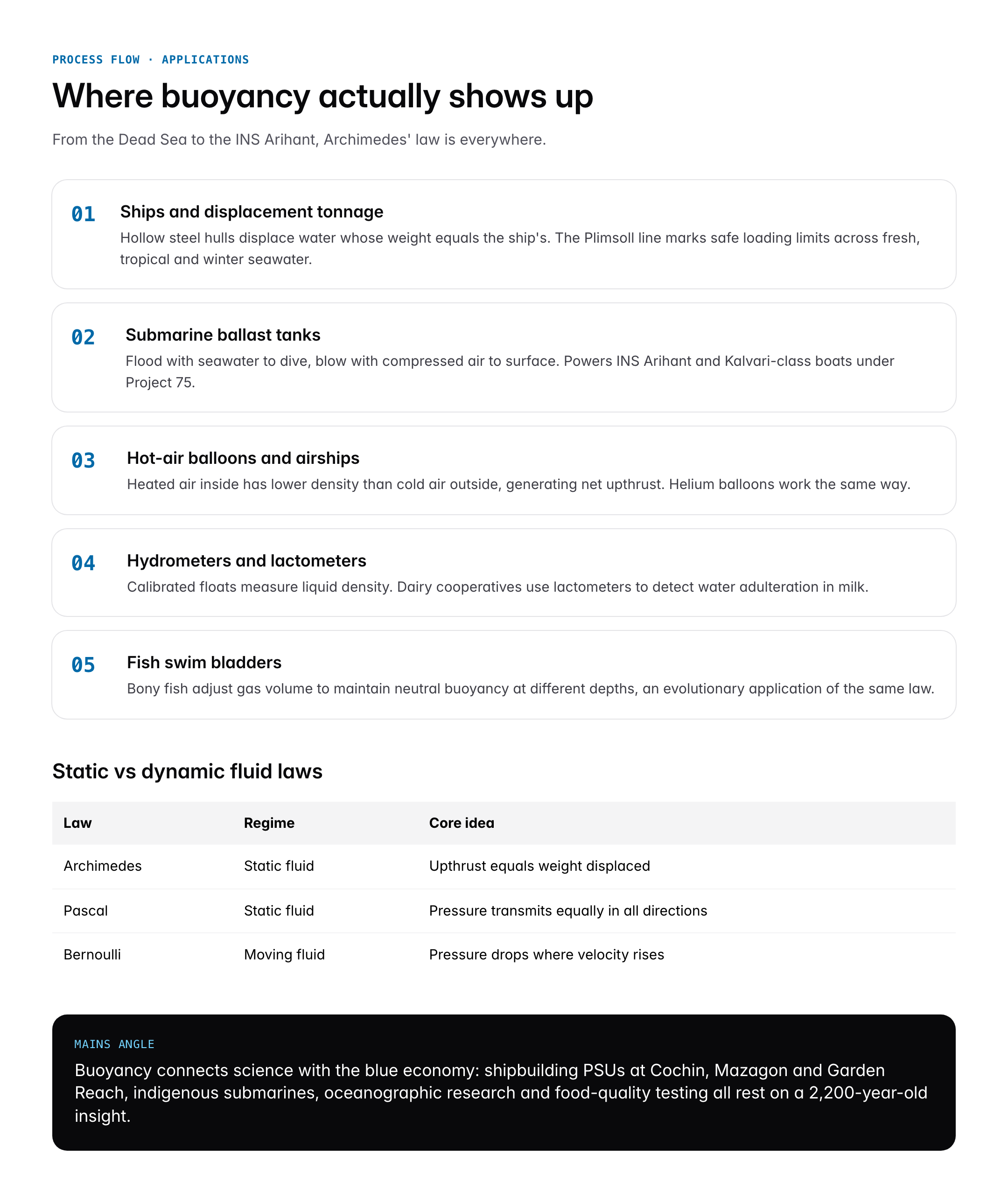
- Underlies indigenous shipbuilding at Cochin Shipyard, Mazagon Dock and Garden Reach Shipbuilders, which are strategic PSUs under GS3 economy and security.
- Basis for submarine ballast tank design, central to Project 75 and Project 75-I naval procurement.
- Key to understanding oceanography, seawater density, thermohaline circulation and climate science under GS3 environment.
- Principle is used in hydrometers to measure milk purity in cooperatives like Amul, linking to GS3 agriculture and food security.
- Foundation for hot-air balloon flight, airship design and atmospheric science.
Detailed Applications in Daily Life and Industry
Ships and Boats
Steel ships float because they are hollow and displace a volume of water whose weight exceeds the ship’s own. The Plimsoll line painted on a ship’s hull indicates the maximum safe loading for different water densities. Naval architects compute displacement tonnage, freeboard and metacentric height using Archimedes’ framework.
Submarines
Submarines adjust buoyancy by flooding ballast tanks with seawater to dive and expelling the water with compressed air to surface. Indian Navy’s Kalvari-class and the indigenous INS Arihant strategic submarine use the same principle.
Hot-Air Balloons and Airships
Heated air inside the envelope has lower density than the surrounding cool air. The balloon therefore experiences an upward buoyant force from the atmosphere greater than its total weight and rises. Helium and hydrogen airships work on the same logic.
Hydrometers and Lactometers
A hydrometer is a calibrated float used to measure the specific gravity of liquids. It sinks deeper in less dense fluids. Lactometers deployed at dairy collection centres detect water adulteration in milk.
Swimming and Human Body
The human body has an average density slightly less than fresh water, allowing most people to float. Salt water, being denser, provides greater buoyancy, which is why swimming is easier in the Dead Sea or the Gulf of Kutch.
Fish and Aquatic Life
Bony fish possess a swim bladder whose gas content they regulate to maintain neutral buoyancy at different depths, an evolutionary application of Archimedes’ Principle.
Comparative Perspective
| Principle | Domain | Key Insight |
|---|---|---|
| Archimedes’ Principle | Hydrostatics | Buoyant force equals weight of displaced fluid |
| Pascal’s Law | Hydrostatics | Pressure applied to an enclosed fluid transmits undiminished |
| Bernoulli’s Principle | Fluid dynamics | Pressure drops where fluid velocity rises |
| Newton’s Third Law | Classical mechanics | Action and reaction are equal and opposite |
Archimedes’ Principle is a static law, whereas Bernoulli’s principle deals with moving fluids. Pascal’s law explains pressure transmission in hydraulic machines like jacks and brakes. Together these three laws form the backbone of classical fluid mechanics and are often clubbed in Prelims questions on science and technology.
Challenges and Limitations
Archimedes’ Principle assumes a fluid in static equilibrium, uniform density and a complete contact between fluid and body. In real conditions these assumptions break down. In non-uniform gravitational fields, such as those near the Earth’s centre or in space, the formula needs modification. Surface tension effects dominate at small scales, which is why small insects can walk on water despite being denser than it.
In stratified fluids with varying density, such as the ocean with its thermocline and halocline, the principle must be applied layer by layer. At very high speeds or turbulent flow, dynamic effects governed by Bernoulli’s and Navier-Stokes equations take precedence. Modern naval architects use computational fluid dynamics to supplement static Archimedean calculations with wave-making resistance, slamming and seakeeping analyses.
Philosophically, a debate persists over whether the classical crown-weighing method actually detected Hiero’s fraud. Some historians argue the density difference between pure gold and a gold-silver alloy would have been too small for the crude water-displacement techniques of Archimedes’ era to resolve reliably, and that he likely used hydrostatic balancing rather than simple displacement.
Prelims Pointers
- Archimedes lived in Syracuse, Sicily, in the third century BCE.
- The principle is enunciated in his treatise “On Floating Bodies”.
- Buoyant force acts vertically upward through the centre of buoyancy.
- Density of pure water is 1,000 kg per cubic metre at 4 degrees Celsius.
- Density of seawater is about 1,025 kg per cubic metre.
- Density of gold is 19,320 kg per cubic metre, silver is 10,490 kg per cubic metre.
- An iceberg shows about one-ninth of its volume above water.
- Plimsoll line on ships is named after British MP Samuel Plimsoll.
- Submarines use variable ballast tanks for vertical manoeuvring.
- Lactometer works on the law of flotation.
- Helium-filled balloons rise because helium density (0.18 kg per cubic metre) is lower than air (1.29 kg per cubic metre).
- Acceleration due to gravity on Earth is taken as 9.8 metres per second squared.
Mains Practice Questions
- Explain Archimedes’ Principle and discuss its relevance to India’s naval modernisation and indigenous shipbuilding ecosystem.
- Statement and formula; link to displacement tonnage, submarine ballast design.
- Cochin Shipyard, Mazagon Dock, Garden Reach Shipbuilders; Project 75, INS Vikrant.
- Strategic autonomy, Atmanirbhar Bharat in defence, blue economy.
- How do classical principles of hydrostatics continue to shape modern technology and policy? Illustrate with reference to Archimedes’ Principle.
- Three pillars: Archimedes, Pascal, Bernoulli; real-world technologies.
- Dairy lactometers, hydraulic machinery, aviation, climate modelling.
- Integration with digital tools like computational fluid dynamics; limitations in non-static conditions.
Conclusion
Archimedes’ Principle is far more than a schoolroom formula. It is a founding stone of quantitative physics that bridges classical antiquity and twenty-first century engineering. The same insight that revealed a dishonest goldsmith now lifts aircraft carriers, keeps nuclear submarines on patrol and allows dairy cooperatives to test milk purity at scale.
For the UPSC aspirant, the principle offers a rare opportunity to weave together science, history, defence policy and economic development in a single coherent narrative. Memorising the formula is the easy part. Using it to interpret the world, from a floating iceberg to a submarine diving into the Arabian Sea, is what makes the study of science truly rewarding.
Frequently Asked Questions
What is Archimedes’ Principle?
Archimedes’ Principle states that any body wholly or partially immersed in a fluid at rest experiences an upward buoyant force equal to the weight of the fluid displaced by the body. It was formulated by the Greek mathematician Archimedes of Syracuse in the third century BCE and forms the foundation of hydrostatics and naval architecture.
What is the formula for Archimedes’ Principle?
The buoyant force is given by F_b equals ρ multiplied by V multiplied by g, where ρ is the density of the fluid in kilograms per cubic metre, V is the volume of fluid displaced in cubic metres, and g is the acceleration due to gravity, taken as 9.8 metres per second squared on Earth.
Why is Archimedes’ Principle important for UPSC?
The principle appears in Prelims general science questions from NCERT Class 9, and in Mains GS3 answers on indigenous shipbuilding, submarines, dairy quality testing and environmental oceanography. It connects physics with defence technology, the blue economy and Atmanirbhar Bharat, making it a frequent interdisciplinary topic.
How is Archimedes’ Principle related to the Law of Flotation?
The Law of Flotation is a direct corollary of Archimedes’ Principle. It states that a body floats when the weight of fluid it displaces equals its own weight. The fraction submerged equals the ratio of the body’s density to the fluid’s density, which explains why icebergs float with nine-tenths of their mass below water.
How does a submarine use Archimedes’ Principle?
Submarines control their buoyancy by filling ballast tanks with seawater to increase weight and dive, or expelling water with compressed air to surface. Indian Navy submarines like the Kalvari class and the indigenous INS Arihant rely on this principle of variable displacement for vertical manoeuvring.
Why do ships float while iron nails sink?
A steel ship is hollow and shaped to displace a large volume of water whose weight exceeds the ship’s total weight, creating sufficient upthrust to keep it afloat. A solid iron nail displaces only a tiny volume, and the buoyant force is far less than its weight, so it sinks.
What is the Eureka moment?
According to the Roman architect Vitruvius, Archimedes was asked by King Hiero II to detect fraud in a gold crown. While stepping into a bath he noticed water rising and realised he could measure the crown’s volume by displacement. He ran out shouting Eureka, meaning I have found it, giving the anecdote its fame.
What are limitations of Archimedes’ Principle?
The principle assumes a fluid in static equilibrium with uniform density. It does not directly apply to moving or stratified fluids, very small scales dominated by surface tension, or non-uniform gravitational fields. Modern naval architects therefore supplement it with computational fluid dynamics for accurate design of ships and submarines.
Tell Google you want more of this.
Add Anantam IAS as a preferred sourceOne tap, and this site shows up more often in your own Top Stories, AI Overviews and AI Mode. Remove it any time.