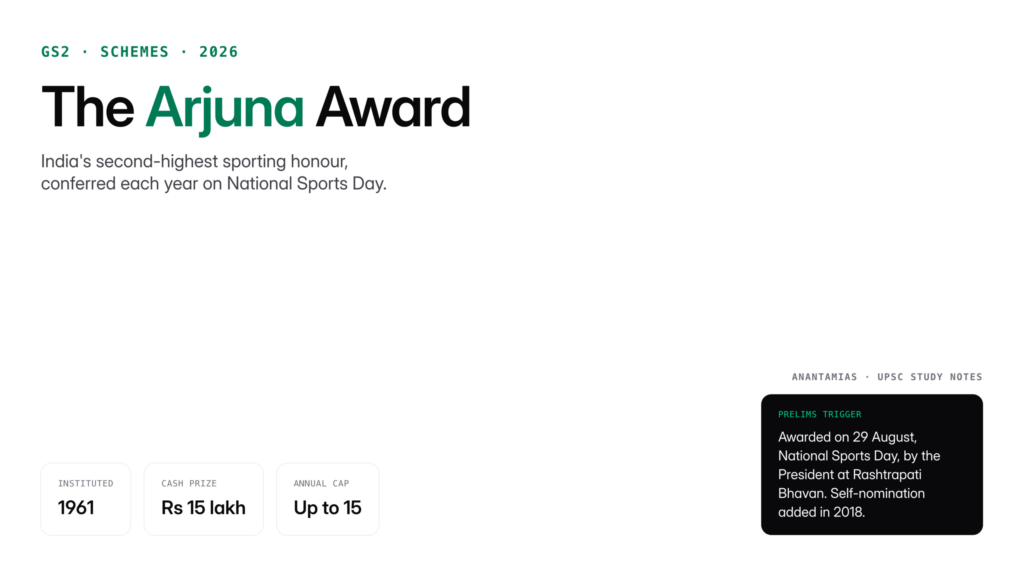
The Arjuna Award is India’s second-highest sporting honour, conferred each year by the Ministry of Youth Affairs and Sports for consistently outstanding performance over the preceding four years. It carries a cash component of ₹15 lakh (unchanged since the 2020 revision), a bronze statuette of Arjuna, and a certificate. The most recent edition, the National Sports Awards 2024, honoured 32 athletes in the competitive category (plus two lifetime awardees), conferred by the President at Rashtrapati Bhavan on 17 January 2025.
Introduction
The Arjuna Award is India’s second-highest honour for sporting achievement, instituted by the Government of India in 1961 and named after the mythological archer Arjuna of the Mahabharata. It is conferred each year by the Ministry of Youth Affairs and Sports as part of the National Sports Awards ceremony, and for six decades it has marked the passage of Indian athletes into the formal pantheon of national recognition. Though the Major Dhyan Chand Khel Ratna outranks it, the Arjuna is the award that every Indian sportsperson aspires to first, the one that certifies consistent excellence over four years rather than a single breakthrough performance.
For UPSC candidates, the Arjuna Award appears in two places. It surfaces as a factual question in the Prelims, linked to sports, schemes of the Ministry of Youth Affairs and Sports, and indigenous governance innovations. It also anchors Mains answers on sports governance, public recognition systems and the state’s role in nurturing Olympic and non-Olympic sport. This article walks through the history, eligibility norms, prize components, selection process, notable recipients and the continuing debates that surround the award.
Quick Facts at a Glance
| Attribute | Detail |
|---|---|
| Category | National Sports Award |
| Rank | Second-highest sporting honour in India |
| Year instituted | 1961 |
| Conferring authority | President of India |
| Administering ministry | Ministry of Youth Affairs and Sports |
| First recipient | C. K. Nayudu tribute was symbolic; formal 1961 awardees included Sarbjit Singh (athletics), Wilson Jones (billiards) and others |
| Named after | Arjuna, the Pandava archer of the Mahabharata |
| Number awarded annually | Up to 15, exceptions in Olympic, Asian and Commonwealth Games years |
| Current cash component | Rs 15 lakh, revised in 2020 |
| Other components | Bronze statuette of Arjuna, certificate, ceremonial dress |
| Eligibility window | Consistent performance in the preceding four years |
| Ceremony date | National Sports Day, 29 August |
Background and Historical Context
The National Sports Awards of India grew out of the post-independence consciousness that a new republic needed to publicly reward sporting achievement alongside scientific, literary and administrative excellence. The Padma honours had been instituted in 1954, the Sahitya Akademi awards in 1955, and by the late 1950s, sports officials in the Ministry of Education, which then administered sport, were pressing for a dedicated decoration. The Arjuna Award was accordingly established in 1961 and conferred that year for the first time. The mythological reference was deliberate: Arjuna, in the Mahabharata, represents disciplined excellence achieved through long practice, a quality the state wished to celebrate in modern athletes.
The award initially covered only disciplines formally recognised by the Indian Olympic Association. Over time, the list expanded. In 1985, traditional and indigenous sports such as kho-kho and kabaddi were brought in, and in 2001 the Government of India released revised guidelines formalising the four-year performance window and the cap of fifteen annual awardees. Parallel awards were added to the national sports suite: the Dronacharya Award for coaches in 1985, the Rajiv Gandhi Khel Ratna, now renamed the Major Dhyan Chand Khel Ratna, in 1991 for the single best performer, the Dhyan Chand Award for lifetime achievement in 2002, and the Rashtriya Khel Protsahan Puraskar for organisations in 2009.
In August 2021, in a move announced during the Tokyo Olympics after hockey legend Dhyan Chand’s 126th birth anniversary, the Khel Ratna was renamed from Rajiv Gandhi to Major Dhyan Chand. This reshuffle did not affect the Arjuna Award, which continues to carry the Pandava archer’s name. The cash component, which began as a modest sum, was revised upward several times, most recently in 2020 to Rs 15 lakh following the Ministry’s comprehensive overhaul of prize structures across all National Sports Awards.
The ceremony itself moved to 29 August, the birth anniversary of Dhyan Chand and India’s observed National Sports Day, from 2012 onward. The President of India confers the awards at Rashtrapati Bhavan in a formal investiture that concludes with a group photograph, a tradition intended to parallel the Padma ceremonies.
Key Features of the Arjuna Award
Eligibility
A nominee must have demonstrated consistently outstanding performance over the preceding four years at the international level. For Olympic, Asian, Commonwealth and World Championship medalists, a single year of exceptional achievement combined with a reasonable earlier track record is usually sufficient, but pure one-off performances are discouraged. Nominees must also show qualities of leadership, sportsmanship and discipline, and must not be the subject of pending disciplinary action or doping findings. Since 2018, a self-nomination route has been available, allowing athletes to apply directly alongside federation recommendations.
The Prize Package
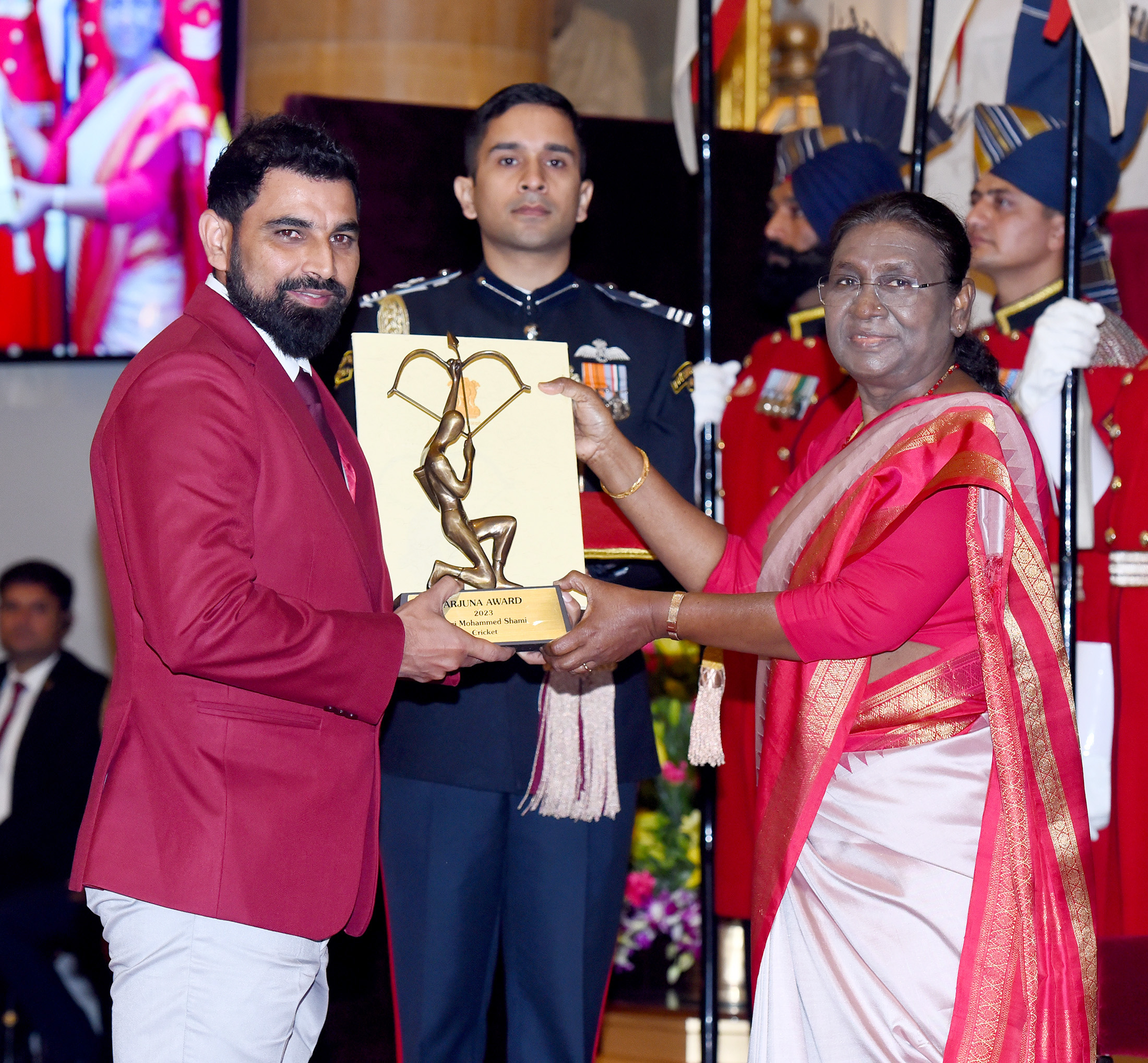
The honour comprises four elements. The bronze statuette of Arjuna is roughly 35 centimetres tall and depicts the archer drawing his bow. Each recipient receives an official certificate signed by the President, a ceremonial dress or blazer, and a cash award of Rs 15 lakh, credited after the ceremony. Recipients also become eligible for government reserved railway passes and enhanced pension benefits if they fall under the Pension to Meritorious Sports Persons Scheme.
Disciplines Covered
The Arjuna is open to athletes in any discipline included in the Olympic programme, the Asian Games, the Commonwealth Games, the World Championships, the World Cup or recognised indigenous sports. It also covers para-sports athletes under specific parity guidelines revised in 2015, and the disabled-sports medalists have received the award in growing numbers since the London 2012 Paralympics. Disciplines range from athletics, shooting, boxing and wrestling to chess, billiards, kabaddi and mountaineering.
Selection Committee and Process
Nominations are invited each year by the Ministry from National Sports Federations, the Indian Olympic Association, the Sports Authority of India and state governments. A Selection Committee, usually chaired by a retired Supreme Court judge and including Khel Ratna awardees, sporting administrators and journalists, evaluates nominees on a 90-point matrix that weights international medal performance, continuity, leadership and discipline. The committee’s recommendations go to the Minister of Youth Affairs and Sports, who forwards the final list to the President for approval.
Withdrawal Clause
Under the 2001 guidelines and their 2018 revision, the Ministry may withdraw the award if the recipient is later convicted of an offence, is found guilty of doping, or brings the award into disrepute. This clause has rarely been invoked but is visible in the governance framework, and it gives the government a tool to respond to anti-doping findings without which the award’s credibility would be vulnerable.
Significance for UPSC and General Knowledge
- The Arjuna Award is a frequent factual question in the Prelims on National Sports Awards and related schemes.
- It illustrates the state’s use of symbolic recognition alongside financial support under the Target Olympic Podium Scheme and the Khelo India initiative.
- The 2021 renaming of the Khel Ratna from Rajiv Gandhi to Major Dhyan Chand is relevant for GS2 questions on governance and symbolic politics.
- The self-nomination route added in 2018 is a case study in administrative reform and citizen-centric governance.
- Growing representation of para-athletes since 2012 is useful for GS1 and GS2 answers on inclusive governance.
- The award functions as an annual barometer of which disciplines India is developing beyond cricket and hockey.
Famous Recipients and State-wise Distribution
Across six decades the Arjuna Award has honoured more than eight hundred athletes across dozens of disciplines. Early recipients included billiards champion Wilson Jones and sprinter Milkha Singh, both conferred in the first cohort. Cricket was added in 1961 itself, with Polly Umrigar and Salim Durrani among early honourees. Subsequent decades saw wrestler Dara Singh, chess grandmaster Viswanathan Anand, tennis player Ramesh Krishnan, hockey captain Dhanraj Pillay, weightlifter Karnam Malleswari, boxer Mary Kom, badminton players Prakash Padukone, Saina Nehwal and P. V. Sindhu, sprinter P. T. Usha, cricketer Sachin Tendulkar, shooters Rajyavardhan Rathore and Abhinav Bindra, and many others added to the list.
The 2023 and 2024 cohorts continued this trajectory, with the Ministry of Youth Affairs and Sports announcing batches of athletes that included shooters, chess players, para-athletes and wrestlers. Among recent awardees were javelin thrower Kishore Jena, chess grandmaster R. Praggnanandhaa and para-archer Sheetal Devi, reflecting the widening spectrum of disciplines in which India now competes at the international level.
State-wise, Haryana, Punjab, Kerala, Tamil Nadu and Maharashtra have traditionally produced the largest number of awardees, though recent years have seen greater geographical spread with athletes from Manipur, Mizoram, Odisha and Telangana increasingly prominent. This spread reflects the impact of the Khelo India programme, launched in 2018, which has invested in training centres across states that were historically under-represented.
The Arjuna also tracks shifts in India’s sporting priorities. Wrestling, boxing and shooting dominate recent lists, reflecting the success of the Target Olympic Podium Scheme in focusing resources on medal-probable disciplines. Indigenous sports like kabaddi and kho-kho receive around two awards each year, a small but deliberate recognition of their place in India’s sporting identity. Para-sports representation has risen from near zero in the 2000s to several awardees each year since Tokyo 2020.
Comparative Perspective
The Arjuna sits within a hierarchy of Indian sporting honours and is best understood alongside them.
| Award | Year Instituted | Focus | Current Cash Prize |
|---|---|---|---|
| Major Dhyan Chand Khel Ratna | 1991 | Single best performance over four years | Rs 25 lakh |
| Arjuna Award | 1961 | Consistent excellence over four years | Rs 15 lakh |
| Dronacharya Award | 1985 | Coaches | Rs 10 to 15 lakh |
| Dhyan Chand Award | 2002 | Lifetime achievement | Rs 10 lakh |
| Rashtriya Khel Protsahan Puraskar | 2009 | Organisations promoting sport | Trophy and citation |
Internationally, the Arjuna is loosely comparable to the Order of Australia sports medals, the BBC Sports Personality honour or the Olympic Order, though none of these is an exact match. Unlike the American ESPY awards, which are media-driven, or Japan’s People’s Honour Award, which is occasional, the Arjuna is a scheduled annual state honour with codified eligibility, closer in spirit to France’s Ordre national du Mérite.
Controversies and Debates
The Arjuna Award has not been free of controversy. Several selections have been challenged by unsuccessful nominees in the Delhi High Court, most famously in 2009 and again in 2020, with petitioners arguing that selection committees gave disproportionate weight to federation affiliations rather than objective performance. The Ministry has responded by tightening the 90-point matrix and by publishing selection committee reports, but discretion remains an unavoidable feature of any honours system.
A second debate concerns the balance between Olympic and indigenous sports. Kabaddi and kho-kho practitioners periodically argue that they receive fewer Arjunas per capita than athletes in Olympic disciplines, a charge the Ministry rejects on the grounds that the selection process weighs international performance, which is harder to achieve in indigenous sports. A third concern is the long gap between performance and recognition. Some athletes have received the award years after their peak playing years, and the 2018 self-nomination route was partly introduced to correct this lag.
Doping is the most serious threat to the award’s standing. Since 2015 several recipients have been suspended or stripped following adverse findings by the National Anti-Doping Agency. Each such case reignites debate over whether the Ministry should publish a public registry of withdrawals, as the Padma awards list does.
Prelims Pointers
- The Arjuna Award was instituted in 1961, the first year of its conferral.
- It is the second-highest national sports honour, below the Major Dhyan Chand Khel Ratna.
- It is administered by the Ministry of Youth Affairs and Sports.
- Up to fifteen awards are given each year, with exceptions in multi-sport Games years.
- The current cash component is Rs 15 lakh, revised in 2020.
- The award is named after Arjuna, the Pandava archer.
- Recipients receive a bronze statuette, a certificate and ceremonial dress.
- The award ceremony is held on National Sports Day, 29 August.
- The Khel Ratna was renamed from Rajiv Gandhi to Major Dhyan Chand in August 2021.
- Self-nomination was introduced in 2018.
- Para-sports have been formally included since 2015 parity guidelines.
- Indigenous sports like kabaddi and kho-kho are eligible since 1985.
Mains Practice Questions
- “National honours like the Arjuna Award serve a governance purpose beyond mere recognition.” Discuss with reference to India’s sports policy architecture. (250 words)
- Explain the symbolic and material functions of the award
- Link to Target Olympic Podium Scheme and Khelo India
- Assess criticisms of selection discretion and doping withdrawals
- Evaluate the evolution of the National Sports Awards framework in India from 1961 to 2024, with a focus on reforms in eligibility, inclusion and prize structure. (150 words)
- Trace the institution of Arjuna, Dronacharya, Khel Ratna and Dhyan Chand
- Discuss 2015 para-sports parity and 2018 self-nomination
- Assess 2020 cash revision and 2021 renaming
Conclusion
The Arjuna Award is more than a bronze statuette of a mythological archer. It is a six-decade instrument of the Indian state’s effort to publicly value sporting discipline, to nudge federations toward transparent selection, and to mark the widening arc of Indian participation across Olympic, para and indigenous disciplines. Its governance has matured from a small circle of Olympic sports in the 1960s to a structured, codified and increasingly contested honours process that now covers a dozen-plus disciplines each year.
For the UPSC aspirant, the Arjuna Award is best remembered not as a list of names but as a live case study in how the Indian state recognises achievement. Its cash prize, its eligibility rules, its controversies and its inclusion of para-athletes all sit within the larger architecture of sports governance that includes the Khelo India mission, the Target Olympic Podium Scheme and the National Sports Development Code. Read that way, the statuette in the ceremonial case becomes a small, eloquent artefact of public policy.
Frequently Asked Questions
What is the Arjuna Award?
The Arjuna Award is India’s second-highest sporting honour, instituted by the Government of India in 1961 and administered by the Ministry of Youth Affairs and Sports. Named after the mythological archer Arjuna, it recognises consistently outstanding performance by athletes over the preceding four years and is conferred by the President of India on National Sports Day, 29 August.
Why is the Arjuna Award important for UPSC?
The Arjuna Award is a recurring Prelims factual question under National Sports Awards and Ministry of Youth Affairs and Sports schemes. It is also relevant for GS2 answers on sports governance, recognition systems, the 2018 self-nomination reform, the 2021 Khel Ratna renaming, and the state’s wider sports policy under Khelo India and the Target Olympic Podium Scheme.
How is the Arjuna Award related to the Khel Ratna?
Both are National Sports Awards administered by the same ministry. The Major Dhyan Chand Khel Ratna, instituted in 1991 and renamed in 2021, is the highest honour and recognises the single best performance over four years. The Arjuna Award is the second-highest, focuses on consistent excellence, and carries a smaller cash prize of Rs 15 lakh compared to the Khel Ratna’s Rs 25 lakh.
What is the prize money for the Arjuna Award?
The Arjuna Award carries a cash component of Rs 15 lakh, last revised by the Ministry of Youth Affairs and Sports in 2020. In addition to the cash, recipients receive a bronze statuette of Arjuna drawing his bow, a certificate signed by the President of India, and a ceremonial dress. Recipients also become eligible for related benefits including railway passes and enhanced pension under the Pension to Meritorious Sports Persons Scheme.
Who is eligible for the Arjuna Award?
An athlete is eligible if they have demonstrated consistently outstanding performance at the international level over the preceding four years, shown leadership and sportsmanship, and are not subject to any pending doping or disciplinary action. Para-athletes have been formally included since 2015 parity guidelines, and since 2018 athletes can self-nominate in addition to being nominated by their National Sports Federation.
How many Arjuna Awards are given each year?
Up to fifteen Arjuna Awards are given each year as per the 2001 Ministry guidelines. This cap can be exceeded in Olympic, Asian and Commonwealth Games years when exceptional medal performances justify additional awards. Recent years have typically seen between 15 and 30 recipients, reflecting both the standard cap and the expanded cohorts in major tournament years.
Who were the first recipients of the Arjuna Award?
The first cohort was conferred in 1961 and included athletes across disciplines: sprinter and billiards champion Wilson Jones, athletes in track and field, wrestling and other sports. Milkha Singh is often associated with the early recipients, and cricketer Polly Umrigar received the award in the same year. The full first-year list is available in Ministry of Youth Affairs and Sports archives.
How is the Arjuna Award different from the Dronacharya Award?
The Arjuna Award recognises athletes, the Dronacharya Award recognises coaches. Dronacharya was instituted in 1985 and is named after Arjuna’s teacher in the Mahabharata. Both are administered by the Ministry of Youth Affairs and Sports, both are announced around National Sports Day, but the Dronacharya specifically honours the coaches whose guidance produced international-level athletes.
Tell Google you want more of this.
Add Anantam IAS as a preferred sourceOne tap, and this site shows up more often in your own Top Stories, AI Overviews and AI Mode. Remove it any time.