Introduction
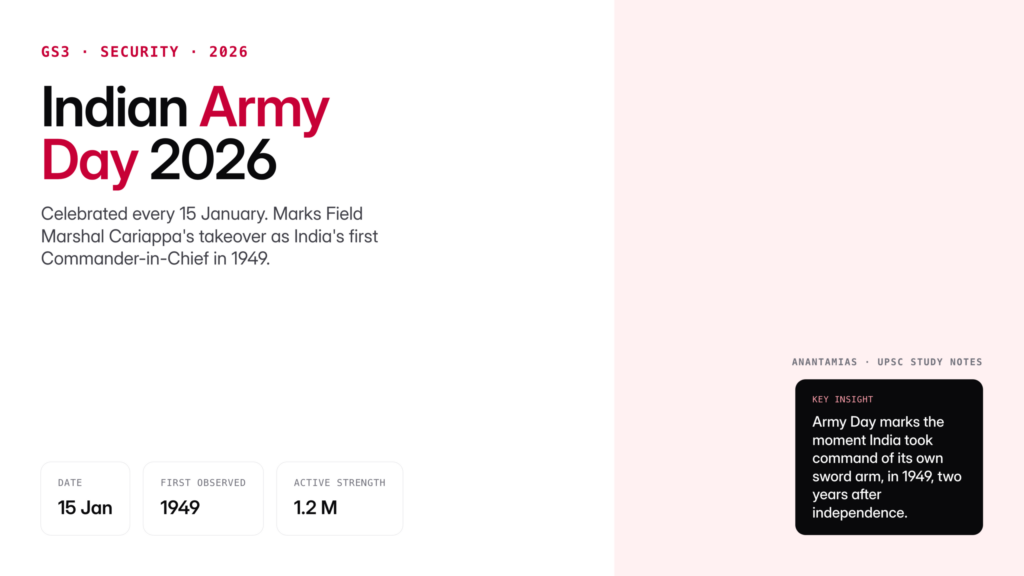
Every year on 15 January, India marks Army Day to commemorate the day in 1949 when Field Marshal Kodandera Madappa Cariappa took over as the first Indian Commander-in-Chief of the Indian Army from General Sir Francis Butcher, the last British holder of that office. The handover symbolised the final severing of colonial military command and the start of an independent, Indianised officer corps.
For UPSC aspirants, Army Day is more than a ceremonial occasion. It is a doorway into questions about civil-military relations, defence reforms, theatre commands, indigenisation under Atmanirbhar Bharat and India’s strategic environment. This note covers the date, history, parade location, significance, and the organisation and rank structure of the Indian Army with the level of factual density expected for Prelims and GS3 Mains answers.
Quick Facts at a Glance
| Attribute | Detail |
|---|---|
| Date | 15 January every year |
| First Army Day | 15 January 1949 |
| Marks | Transfer of command from General Francis Butcher to K M Cariappa |
| First Indian C-in-C | Field Marshal K M Cariappa |
| Current Chief of Army Staff (2026) | General Upendra Dwivedi (from 30 June 2024) |
| 2026 parade host city | Rotates between Delhi and regional HQs (Pune in 2024, Bengaluru in 2025) |
| Motto of Indian Army | “Service Before Self” (Seva Paramo Dharma) |
| Strength (approx.) | 1.2 million active personnel |
| Commands | 7 (6 operational + 1 training) |
| Highest gallantry award | Param Vir Chakra |
Background and Historical Context
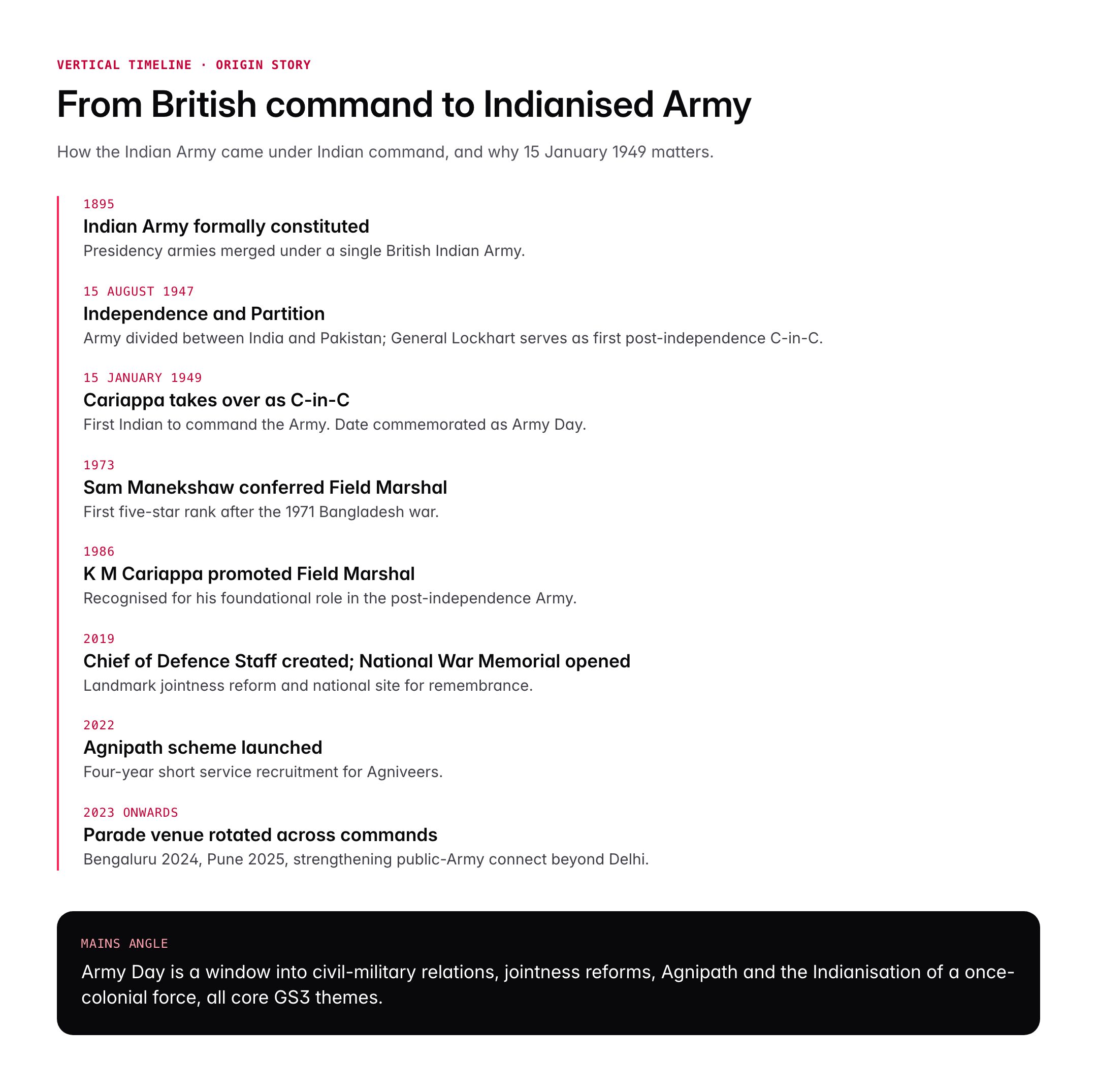
The Indian Army’s lineage dates to the regiments raised by the British East India Company in the 17th and 18th centuries, which evolved into the Presidency armies of Bengal, Madras and Bombay. The British Indian Army took formal shape in 1895. At independence in August 1947, the army was divided between India and Pakistan, with regiments, equipment and personnel distributed in proportions fixed by the Partition Council.
Even after independence, the Army’s top command remained with British officers. General Sir Robert Lockhart was the first post-independence C-in-C, followed by General Sir Roy Bucher. On 15 January 1949, Lieutenant General K M Cariappa succeeded Bucher, becoming the first Indian to hold the post. The symbolism was enormous: a 22-year-old republic, still drafting its Constitution, had taken control of its own sword arm.
Cariappa, a Kodava from Coorg in Karnataka, had commissioned into the 1/7 Rajputs in 1919 and seen service in Waziristan, Iraq and Burma. He led the Indian forces that repulsed the Pakistani advance in Jammu and Kashmir in 1947-48. After retirement he served as India’s High Commissioner to Australia and New Zealand. He was conferred the rank of Field Marshal in 1986, only the second after Sam Manekshaw.
Army Day was institutionalised to honour this moment of sovereignty. The first parade was held at the Cariappa Parade Ground in Delhi Cantonment. Until 2022 the parade remained in Delhi, but from 2023 onwards the government has rotated the venue among command headquarters to strengthen public connection with the Army across the country. Bengaluru hosted the 2024 parade and Pune hosted 2025.
Key Features of Indian Army Day Celebrations
Main Parade
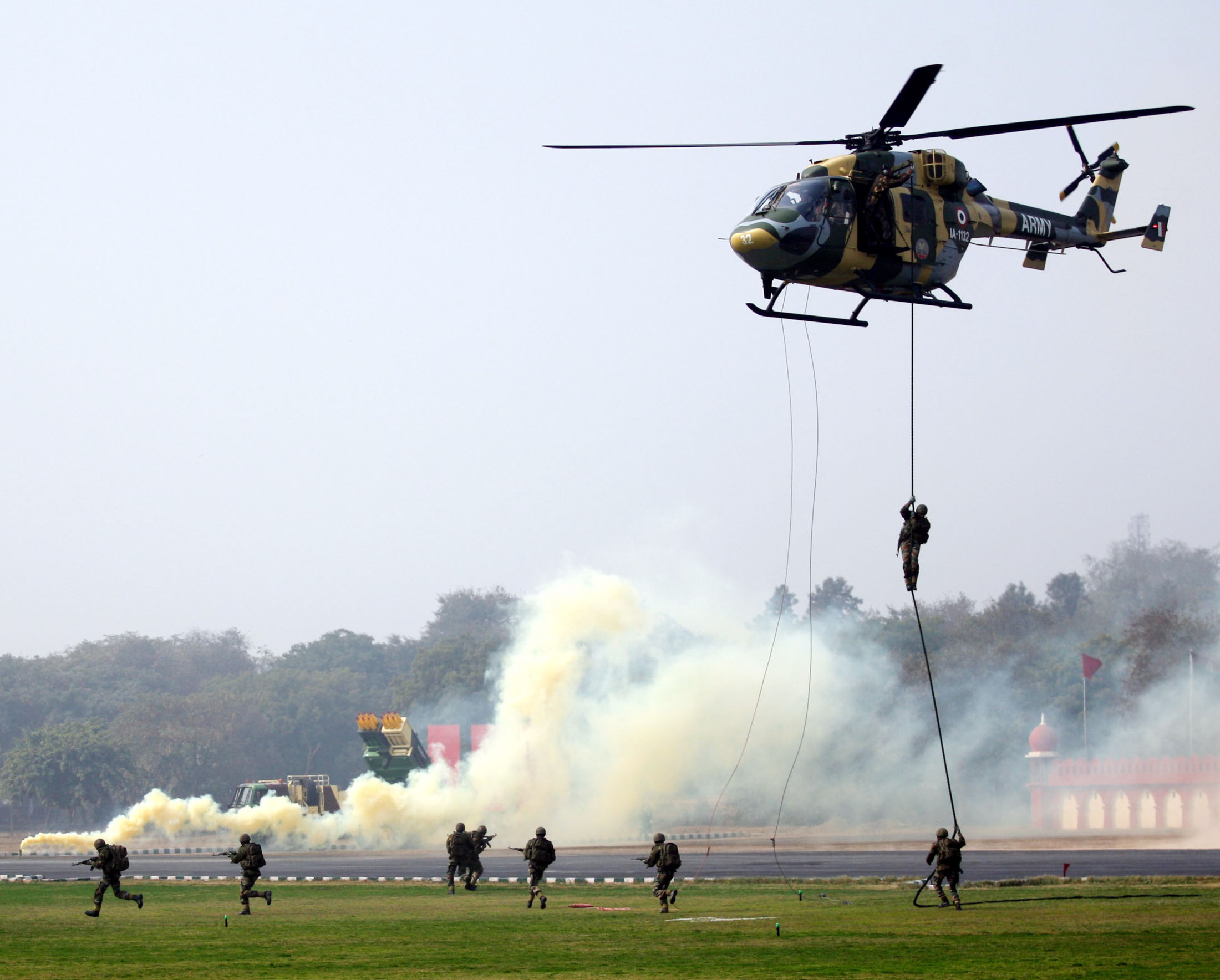
A ceremonial parade is conducted at the hosting command headquarters, featuring marching contingents, motorcycle display teams, mechanised columns of T-90 and T-72 tanks, BMP-2 infantry combat vehicles, artillery systems such as the Dhanush and K9 Vajra, and flypasts by Army Aviation Corps helicopters including Dhruv, Rudra, and the LCH Prachand.
Awards Ceremony
The Chief of the Army Staff (COAS) confers Sena Medals, Yudh Sewa Medals, Unit Citations and COAS Commendation Cards on soldiers and units. This is one of the most prestigious peacetime recognitions in the armed forces.
Veer Nari Felicitation
Widows of fallen soldiers, known as Veer Naris, are honoured alongside war veterans. The event emphasises the human cost of soldiering and the enduring obligation of the state to military families.
Cultural and Technology Showcase
The parade includes performances by the Army Military Band, the Gorkha pipes, cultural programmes reflecting regional diversity, and demonstrations of indigenous platforms such as the Arjun Mk-1A main battle tank, ATAGS artillery, Akash surface-to-air missile system, and swarm drones developed under the iDEX innovation programme.
Indigenous Equipment Focus
Since 2022 the parade has prominently featured equipment developed under Atmanirbhar Bharat and the Positive Indigenisation Lists issued by the Ministry of Defence, now running to over 500 items that may only be sourced from Indian industry.
Remembrance at National War Memorial
Senior leaders lay wreaths at the National War Memorial at India Gate, inaugurated in 2019, which commemorates soldiers killed since independence in conflicts from Kashmir 1947 to Galwan 2020 and peacekeeping missions abroad.
Significance for UPSC and General Knowledge
- Tested in Prelims under defence current affairs and the Internal Security portion of GS3.
- Links to the history of civil-military relations and the Indianisation of the officer corps.
- Provides a peg for Mains questions on theatre command reforms and CDS institution.
- Connects with defence indigenisation, DRDO, DPSUs like HAL and BEL, and iDEX.
- Foundation for questions on gallantry awards, National War Memorial and military diplomacy.
- Touches on women in the military, Agnipath scheme reforms and recruitment policy.
Detailed Structure and Organisation of the Indian Army
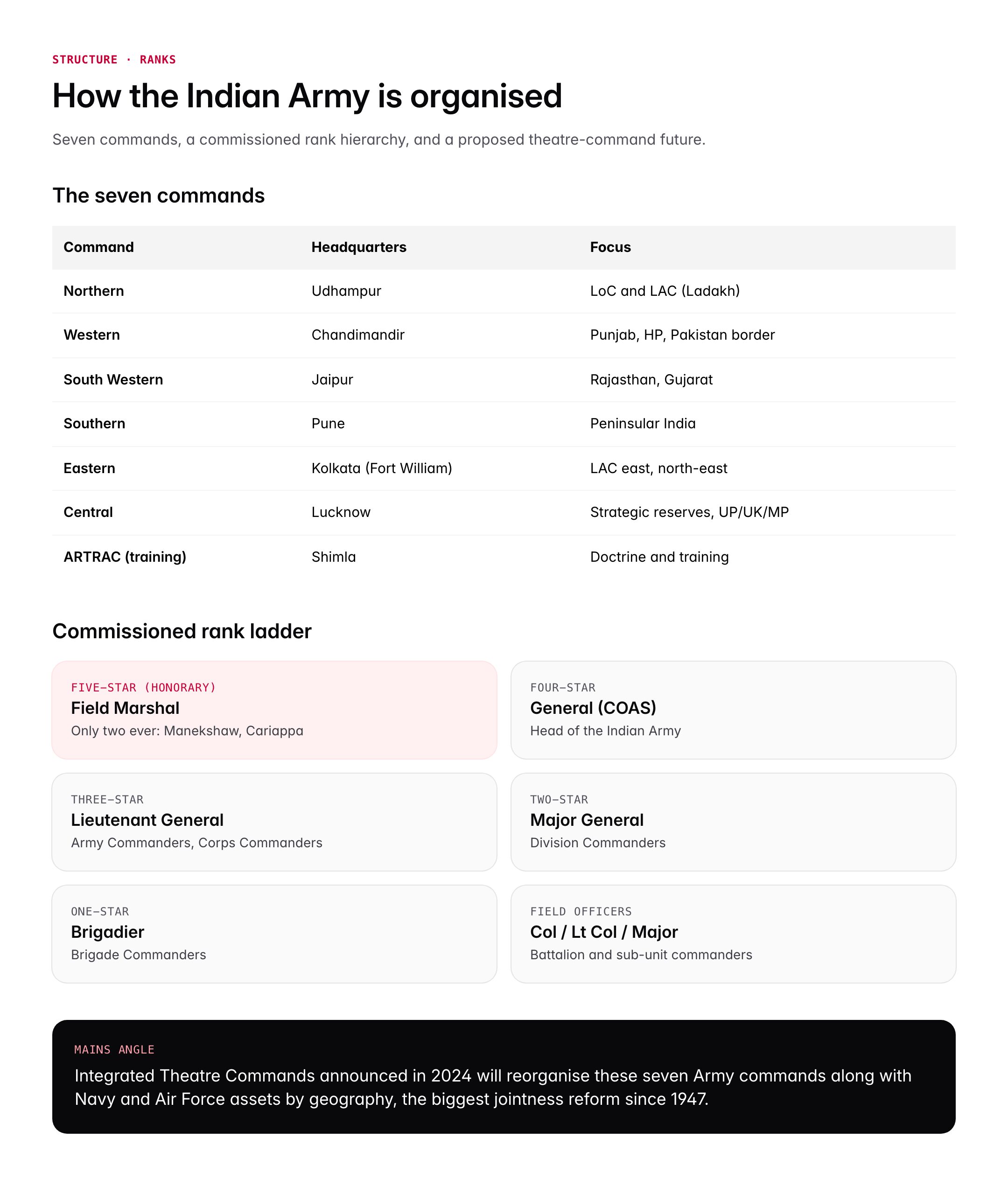
The Indian Army is organised around seven commands, six operational and one training:
Northern Command
Headquartered at Udhampur, Jammu and Kashmir. Responsible for the Line of Control and Line of Actual Control in Ladakh. Among the most operationally active commands, dealing with counter-terrorism in Kashmir Valley and border management with China in eastern Ladakh, including Galwan, Demchok and Depsang sectors.
Western Command
Headquartered at Chandimandir, Panchkula. Covers the international border with Pakistan from south of Pir Panjal to north Rajasthan, including Punjab and Himachal Pradesh.
South Western Command
Headquartered at Jaipur, the youngest of the operational commands, carved out in 2005. Covers Rajasthan, Gujarat and parts of Punjab.
Southern Command
Headquartered at Pune, the oldest command. Covers peninsular India, a vast area with limited land threats but significant coastal and disaster-response responsibilities.
Eastern Command
Headquartered at Kolkata (Fort William). Responsible for the Line of Actual Control in Sikkim and Arunachal Pradesh, and for counter-insurgency operations in the north-east. Manages formations facing China in the Tawang and Tuting sectors.
Central Command
Headquartered at Lucknow. Holds strategic reserves and covers states including Uttar Pradesh, Uttarakhand and Madhya Pradesh.
Army Training Command (ARTRAC)
Headquartered at Shimla. Responsible for doctrine, tactics and training across the force.
Rank Structure
The Army is led by the Chief of the Army Staff, a four-star General. Below are Lieutenant General (three-star, Army Commanders), Major General (two-star, Division Commanders), Brigadier (Brigade Commanders), Colonel, Lieutenant Colonel, Major, Captain and Lieutenant. The senior non-commissioned ranks are Subedar Major, Subedar, Naib Subedar, Havildar, Naik, Lance Naik and Sepoy. The ceremonial five-star rank of Field Marshal has only been conferred twice, on Sam Manekshaw (1973) and K M Cariappa (1986).
Integrated Battle Groups and Theatre Commands
The Army is undergoing the most significant restructuring since independence. The Chief of Defence Staff (CDS) post was created in 2019 and the Department of Military Affairs (DMA) established in the Ministry of Defence. Plans for Integrated Theatre Commands grouping land, air and naval assets by geography, announced in 2024, will transform how the three services fight jointly.
Comparative Perspective
| Country | Army Strength (approx.) | Annual Defence Budget (USD) | Notable Feature |
|---|---|---|---|
| China (PLA Ground Force) | 975,000 | 230 billion (total PLA) | Largest active force, theatre commands since 2016 |
| United States | 470,000 | 850 billion (total DoD) | Most advanced technology, global footprint |
| Russia | 550,000 | 100 billion | Combat experience, sanctions-hit |
| India | 1.2 million | 78 billion | Large volunteer force, mountain warfare expertise |
| Pakistan | 560,000 | 10 billion | Conventional plus nuclear posture |
India’s Army is the world’s second largest standing ground force by active personnel. Its mountain warfare experience in Siachen, Kargil and eastern Ladakh is unmatched. The defence budget, though the fourth largest in the world, remains under 2 per cent of GDP, a persistent concern raised by the Parliamentary Standing Committee on Defence.
Challenges and Criticisms
The Indian Army’s transformation agenda confronts several hurdles. Modernisation budgets have historically been squeezed by revenue expenditure on salaries and pensions. The Agnipath scheme launched in 2022, which introduces four-year short-service enlistment for most jawans, has stirred political and operational debate on training adequacy, regimental cohesion and post-service livelihood.
Theatre commands face inter-service turf battles and differing doctrinal preferences between the three services on geography, resource allocation and operational control. Critics of the theatre command roadmap argue that service chiefs risk becoming Chiefs of Staff rather than operational commanders.
Emerging technology gaps in cyber, space, artificial intelligence and unmanned systems require sustained investment in DRDO, iDEX start-ups and private industry. Defence exports have grown, crossing Rs 21,000 crore in 2024, but high-tech platforms still depend on imports from Russia, France, Israel and the United States.
Finally, border management along the LAC with China has required large-scale infrastructure push by the Border Roads Organisation, faster induction of drones and high-altitude artillery, and a reorientation of forces from Pakistan-facing to China-facing roles, an adjustment still underway.
Prelims Pointers
- Army Day is celebrated on 15 January every year.
- First Army Day was observed in 1949.
- Field Marshal K M Cariappa was the first Indian Commander-in-Chief.
- K M Cariappa was conferred Field Marshal rank in 1986.
- Sam Manekshaw was India’s first Field Marshal, appointed in 1973.
- Indian Army has 7 commands, 6 operational plus 1 training command.
- ARTRAC (Army Training Command) is headquartered in Shimla.
- Northern Command is headquartered at Udhampur.
- Eastern Command is headquartered at Kolkata (Fort William).
- National War Memorial was inaugurated in 2019 at India Gate.
- Agnipath scheme was launched in June 2022.
- Param Vir Chakra is the highest military gallantry award.
Mains Practice Questions
- Critically examine the significance of Army Day in the context of India’s post-independence civil-military relations and ongoing defence reforms.
- Origin in 1949 handover; Indianisation of officer corps.
- Theatre commands, CDS, DMA, Agnipath scheme.
- Indigenisation through Positive Indigenisation Lists, iDEX, defence exports.
- Discuss the rationale, structure and challenges of the proposed Integrated Theatre Commands in the Indian armed forces.
- Rationale: jointness, efficient use of resources, China factor.
- Structure: announced 2024, Army, Navy and Air Force assets grouped by geography.
- Challenges: inter-service turf, doctrinal differences, legislative changes, lessons from China and US.
Conclusion
Army Day is not merely a date on the calendar. It marks the moment a republic took full ownership of its own defence and set in motion seven decades of professional, apolitical soldiering across some of the most demanding terrain on earth. From the handover at Cariappa Parade Ground in 1949 to the flypasts of indigenous LCH Prachand helicopters in the 2026 parade, the Indian Army has travelled a considerable distance.
Yet the next decade will test that journey as never before. Theatre commands, Agnipath, cyber and drone warfare, and a contested border with China all demand decisions that go beyond barracks and parade grounds into Parliament and the Cabinet Committee on Security. For a UPSC aspirant, Army Day is an invitation to study the whole sweep of India’s security architecture, not just a single morning of ceremony.
Frequently Asked Questions
What is Indian Army Day and when is it celebrated?
Indian Army Day is observed every year on 15 January to commemorate the day in 1949 when Field Marshal K M Cariappa took over as the first Indian Commander-in-Chief of the Indian Army from General Sir Francis Butcher, the last British holder of the post. It marks the full Indianisation of the Army’s top command.
Why is Army Day celebrated on 15 January?
15 January 1949 was the date Lieutenant General K M Cariappa formally assumed charge as the first Indian Commander-in-Chief, ending over a century of British command of Indian regiments. The date became a symbol of sovereignty in national security and has been observed as Army Day ever since.
Who was Field Marshal K M Cariappa?
Kodandera Madappa Cariappa was an Indian soldier from Coorg in Karnataka who commissioned in 1919 and served in Waziristan, Iraq and Burma. He led Indian forces in Jammu and Kashmir in 1947, became the first Indian Commander-in-Chief in 1949 and was conferred the rank of Field Marshal in 1986, only the second after Sam Manekshaw.
Why is Army Day important for UPSC aspirants?
Army Day links to multiple GS3 topics including civil-military relations, theatre commands, the Chief of Defence Staff reform, Atmanirbhar Bharat in defence and internal security. It also supports GS1 questions on modern Indian history and the Indianisation of the armed forces after 1947.
How is Indian Army Day related to the National War Memorial?
The National War Memorial at India Gate, inaugurated in 2019, honours soldiers killed since independence. On Army Day, the Chief of the Army Staff and senior commanders lay wreaths at the memorial to pay tribute to fallen soldiers, integrating remembrance with the broader themes of the day.
How many commands does the Indian Army have?
The Indian Army has seven commands: six operational (Northern, Western, South Western, Southern, Eastern, Central) and one training command (ARTRAC at Shimla). These are led by Lieutenant Generals and fall under the Chief of the Army Staff, with integrated theatre commands proposed as a major restructuring from 2024.
Where is the Army Day parade held?
Until 2022 the parade was held at Cariappa Parade Ground in Delhi Cantonment. Since 2023 the government has rotated the venue among command headquarters to strengthen the Army’s connection with different regions. Bengaluru hosted in 2024 and Pune in 2025, with subsequent locations announced each year.
What is the Agnipath scheme and how does it relate to Army Day?
Agnipath is a recruitment reform launched in June 2022 that enrols most jawans as Agniveers on four-year short-service tenure, with 25 per cent retained for permanent service. Army Day parades since 2023 have featured Agniveers marching with regular contingents, spotlighting this major personnel policy shift.
Tell Google you want more of this.
Add Anantam IAS as a preferred sourceOne tap, and this site shows up more often in your own Top Stories, AI Overviews and AI Mode. Remove it any time.