Disclosure: this guide contains Amazon affiliate links. As an Amazon Associate, Anantam IAS earns from qualifying purchases — at no extra cost to you.
Introduction
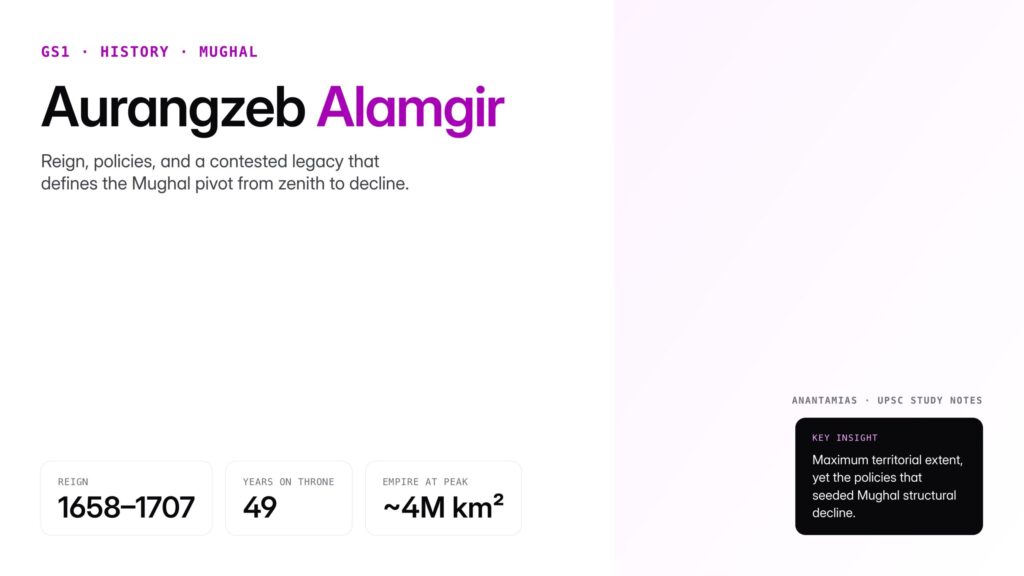
Few figures in Indian history generate as sustained a historiographical debate as Aurangzeb Alamgir, the sixth Mughal emperor, who ruled from 1658 to 1707. Over a reign of nearly half a century, Aurangzeb expanded the Mughal Empire to its greatest territorial extent, covering almost the entire subcontinent, and simultaneously presided over the conditions that produced its slow unravelling. His policies on taxation, religious endowments, succession, and imperial overreach in the Deccan are studied not as isolated events but as the pivot between Mughal zenith and decline.
For the UPSC aspirant, Aurangzeb sits at the intersection of GS Paper 1 (History and Culture), optional History, and Essay Paper themes on religion, state, and empire. He features in Prelims questions on revenue systems and administrative terms and in Mains questions on the evaluation of historical figures. This guide presents a consolidated biography, the administrative architecture he inherited and modified, his military campaigns, the contested religious question, and the legacy that persists in public memory and textbook revision debates.

Quick Facts at a Glance
| Parameter | Value |
|---|---|
| Full Name | Muhi-ud-Din Muhammad Aurangzeb Alamgir |
| Born | 3 November 1618, Dahod, Gujarat |
| Died | 3 March 1707, Ahmednagar, Maharashtra |
| Reign | 31 July 1658 to 3 March 1707 |
| Duration of Reign | 48 years 7 months |
| Dynasty | Mughal |
| Predecessor | Shah Jahan |
| Successor | Bahadur Shah I (Muazzam) |
| Father | Shah Jahan |
| Mother | Mumtaz Mahal |
| Titles | Alamgir (Conqueror of the World), Badshah Ghazi |
| Empire at Peak | ~4 million sq km, ~158 million subjects |
| Burial | Khuldabad, Maharashtra |
Background and Historical Context
Aurangzeb was the third son of Shah Jahan and Mumtaz Mahal, born in 1618 during a period of political instability within the empire. His elder brothers Dara Shikoh, Shah Shuja, and younger brother Murad Bakhsh were all candidates for the Mughal throne under the prevailing principle of jahanbani, the Persianate tradition of open succession through contest. In 1657, when Shah Jahan fell seriously ill, the four princes moved against one another in the War of Succession. Aurangzeb defeated Shah Shuja at Bahadurpur, crushed Dara Shikoh at the battles of Dharmat (April 1658) and Samugarh (May 1658), captured Murad Bakhsh, and imprisoned Shah Jahan in the Agra Fort, where his father would remain until his death in 1666. Aurangzeb was formally crowned at Delhi on 31 July 1658, adopting the regnal name Alamgir I.
He inherited a Mughal state at a moment of accumulated strength. Akbar had established the administrative scaffolding: the mansabdari system, Abu’l-Fazl’s revenue classification, and the policy of religious syncretism. Jahangir and Shah Jahan had extended and stabilised these arrangements and poured resources into monumental architecture and Persianate court culture. By 1658, Mughal sovereignty covered most of North India, Bengal, Gujarat, the Deccan plateau, and Kabul. Aurangzeb’s reign was the test of whether this architecture could absorb further expansion, demographic change, and the rise of regional polities such as the Marathas and the Ahoms. The record of the next half-century is the partial answer to that question.
Reign and Administration
Succession and Early Consolidation
The War of Succession (1657–1659) set the tone for Aurangzeb’s political method: decisive, patient, and willing to break kinship norms when expedient. After his coronation, he executed Dara Shikoh in August 1659 on charges of apostasy, a judgment that Mughal orthodoxy later used to legitimise the regime. He pursued Shah Shuja into Arakan. By 1661, all rival claims had been eliminated. Aurangzeb preserved the core administrative and revenue institutions he had inherited while tightening the ideological frame.
Administrative Structure
Aurangzeb retained and extended the mansabdari system, dividing officers by zat (personal rank) and sawar (cavalry contingent). He increased the number of mansabdars and absorbed Rajput, Maratha, and Deccani nobility into the hierarchy. The revenue system continued to follow the zabt and batai methods, with the kankut method applied in intermediate zones. The empire was divided into subahs (provinces) each governed by a subedar, with diwan, bakhshi, and sadr officers handling revenue, military, and religious matters respectively. At the district level, the faujdar, amalguzar, and kotwal continued the established division of labour.
Religious Policies
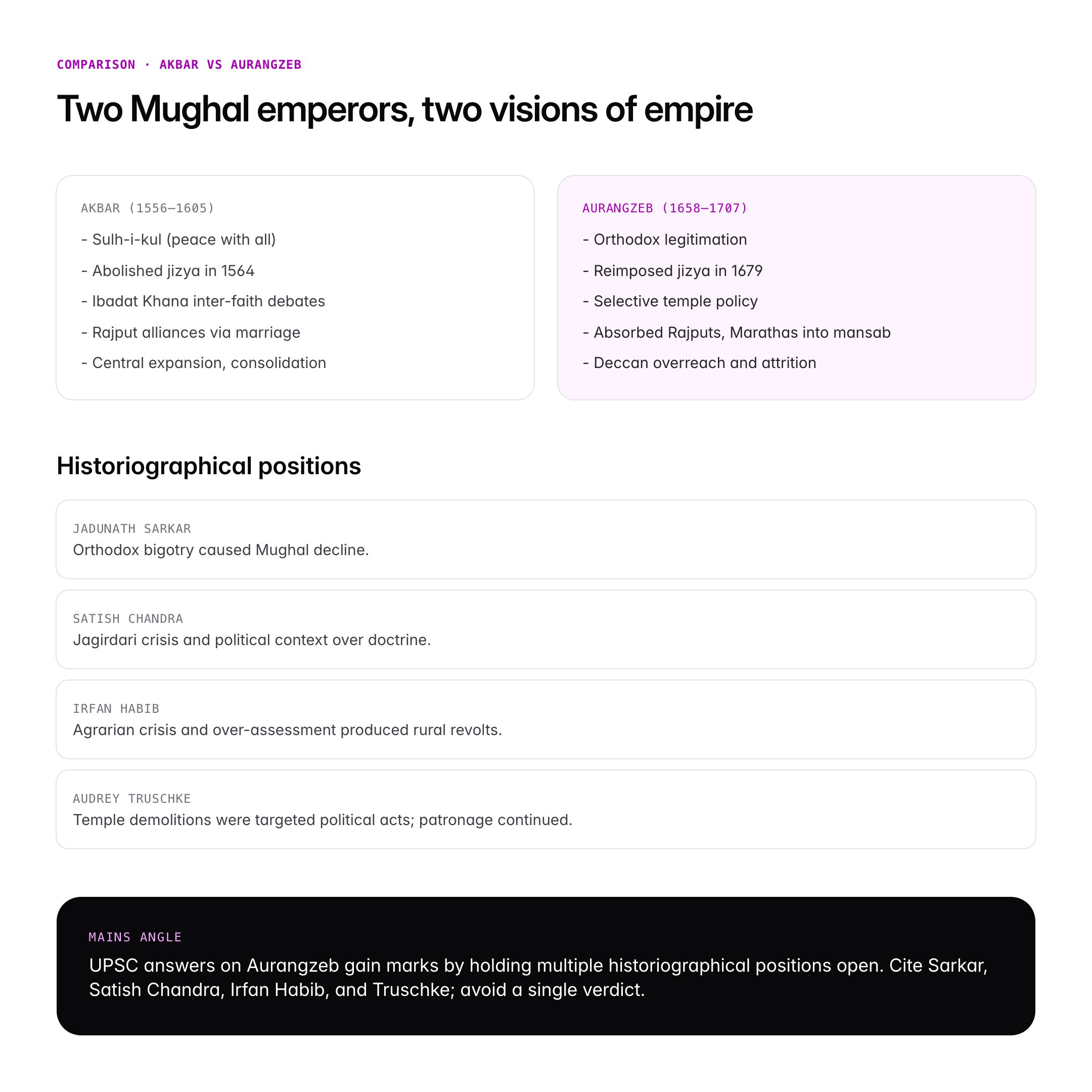
Aurangzeb’s religious policies remain the most debated aspect of his reign. In 1679, he reimposed the jizya, the discriminatory tax on non-Muslim subjects that Akbar had abolished in 1564. He ordered the demolition of temples including the Kashi Vishwanath temple at Varanasi (1669) and the Keshavadeva temple at Mathura (1670). He issued farmans granting land to Hindu temples and institutions as well, and his administration continued to employ Hindu officials, including the Maratha-origin Raja Jaswant Singh and Raja Jai Singh of Amber. Historians such as Jadunath Sarkar emphasised the orthodox turn, while Satish Chandra and Audrey Truschke have stressed pragmatic statecraft and selective temple policy. The aspirant should be able to present both views without flattening them.
Military Campaigns
Aurangzeb’s reign was one of continuous warfare. In the north, he faced the Jat rebellion under Gokula (1669) and Rajaram (1688), the Satnami uprising (1672), the Sikh resistance culminating in the execution of the ninth guru Guru Tegh Bahadur (1675), and later the consolidation of the Khalsa under Guru Gobind Singh. In the east, Mughal forces defeated the Ahoms temporarily at the Battle of Saraighat (1671) but ultimately failed to hold Assam. The defining theatre, however, was the Deccan.
The Deccan Campaigns
From 1681 to 1707, Aurangzeb shifted his court and army to the Deccan. He annexed Bijapur in 1686 and Golconda in 1687, terminating the two surviving Deccan sultanates. The Maratha challenge, rooted in Shivaji Maharaj‘s polity (d. 1680) and continued by Sambhaji (executed by Aurangzeb in 1689) and Shahu, proved intractable. Aurangzeb’s forces reduced hundreds of forts but never pacified the Maratha hinterland. The Deccan campaign drained the treasury, demoralised the nobility, and exposed the empire to overstretch. When Aurangzeb died at Ahmednagar in March 1707, the Deccan was still not secure.
Significance for UPSC and General Knowledge
- Aurangzeb’s reign is the template for discussions of imperial overreach in GS1 History.
- His religious policies are central to essay prompts on state and religion in pre-modern India.
- The Deccan campaigns are the case study for Mains questions on strategic culture and frontier policy.
- His handling of Sikh, Jat, Maratha, and Satnami movements illustrates centre-periphery tensions.
- The War of Succession and the succession question feature regularly in UPSC Optional History Paper 1.
- Aurangzeb’s administrative records, including the Mirat-i-Ahmadi and Akhbarat-i-Darbar-i-Mualla, are key primary sources cited in Mains answers.
Detailed Analysis: Reign and Administration
Aurangzeb’s 49-year reign can be periodised in three phases. The first phase (1658–1680) was one of consolidation in the north. The emperor reorganised finances, expanded the mansabdari network, and pursued wars of prestige against the Ahoms, the Jats, and the Afghans on the North-West Frontier. Revenue records show that Mughal land revenue rose from about 220 million rupees at Shah Jahan’s end to over 300 million rupees by 1680. The administrative machinery was still functional, and the imperial treasury held reserves from the Bijapur and Golconda conquests.
The second phase (1680–1689) was the pivot. Aurangzeb’s relocation to the Deccan was intended as a short military expedition to subdue Shivaji’s successors and absorb the sultanates. It became a 26-year campaign. The annexation of Bijapur and Golconda opened new revenue streams but also burdened the exchequer with larger contingents. The execution of Sambhaji in 1689 removed a central Maratha figure but produced a decentralised resistance that the Mughal army, built for set-piece sieges, struggled to counter.
The third phase (1689–1707) was one of attrition. The mansabdari system showed cracks as the jagirdari crisis deepened. Jagirs (assigned revenue units) were fewer than claimants. Nobles either received paibaqi (unassigned) holdings or reduced jagirs. Maratha guerilla tactics, expressed as Ganimi Kava, neutralised Mughal superiority in pitched battles. Correspondence from the last decade of Aurangzeb’s reign, preserved in the Ruqqat-i-Alamgiri, shows a ruler exhausted by the Deccan and anxious about succession. When he died, his will divided the empire among his three surviving sons, triggering another War of Succession in 1707 won by Bahadur Shah I.
The historical debate revolves around whether the decline of the Mughal empire was caused by Aurangzeb’s policies or structural forces that predated him. Irfan Habib’s agrarian crisis thesis locates the cause in over-assessment and peasant flight. Satish Chandra’s jagirdari crisis theory emphasises the shortage of productive jagirs relative to the growing nobility. M. Athar Ali foregrounded the size and composition of the mansabdari network. All these explanations turn on decisions taken during Aurangzeb’s reign, making his rule the crucial inflection point.
Comparative Perspective
Aurangzeb’s reign benefits from comparison with other early modern empire-builders grappling with religious pluralism and imperial overreach.
| Ruler | Empire | Policy on pluralism | Outcome |
|---|---|---|---|
| Aurangzeb (1658–1707) | Mughal | Orthodox Sunni turn, selective temple policy, jizya reimposed | Maximum extent, structural decline |
| Akbar (1556–1605) | Mughal | Sulh-i-kul, Ibadat Khana, abolition of jizya | Consolidation, expansion |
| Louis XIV (1643–1715) | Bourbon France | Revocation of Edict of Nantes (1685), Huguenot expulsion | Economic damage, religious uniformity |
| Kangxi (1661–1722) | Qing | Tolerance of Chinese, Manchu, Mongol identities | Stable expansion |
| Shah Abbas I (1588–1629) | Safavid Iran | Shia state consolidation with Armenian Christian utility | Economic flourishing |
The comparison with Akbar is obvious but instructive. Both emperors faced the same problem: how to govern a religiously plural empire of immense scale. They arrived at opposite answers. Akbar’s sulh-i-kul (peace with all) invested in elite co-optation and theological debate. Aurangzeb’s approach leaned on orthodox legitimation and legal uniformity. The Kangxi comparison is more fruitful for examining why some early modern rulers held together multi-ethnic empires and others did not.
Controversies and Debates
The historiography of Aurangzeb has been unsettled since the colonial period. Jadunath Sarkar, writing in the early twentieth century, painted Aurangzeb as a bigot whose policies caused Mughal decline. Sri Ram Sharma and later Satish Chandra complicated this view, emphasising political context and administrative continuity. Audrey Truschke’s 2017 biography, drawing on Persian primary sources, argues that Aurangzeb’s temple demolitions were targeted political acts rather than systematic persecution, and that he patronised more Hindu institutions than is often acknowledged. Critics of Truschke’s position argue that the aggregation of such acts produced a climate of insecurity for non-Muslim subjects.
A second controversy concerns textbook representation. Curricular revisions in recent years have altered the depth of coverage of Aurangzeb and of his contemporaries like Shivaji and Guru Tegh Bahadur. The debate is partly historiographical and partly political, involving the NCERT, state boards, and civil society commentators. For the UPSC aspirant, the safer path is to cite multiple scholarly positions and let the evidence speak, rather than adopting a single interpretive line.
A third debate, advanced by Jos Gommans and others, asks whether Aurangzeb’s empire was truly in decline during his lifetime or whether contemporaries would have seen it as stable and expanding. Revenue and territorial data support both readings depending on the metric. This is why answer-writing on Aurangzeb benefits from explicit definition of terms: decline of what, measured how, compared to when.
Prelims Pointers
- Aurangzeb was born on 3 November 1618 at Dahod in present-day Gujarat
- His mother was Mumtaz Mahal, in whose memory the Taj Mahal was built
- He defeated Dara Shikoh at the Battle of Samugarh on 29 May 1658
- He was formally enthroned at Delhi on 31 July 1658
- He adopted the regnal name Alamgir, meaning Conqueror of the World
- He reimposed jizya in 1679, reversing Akbar’s policy of 1564
- He annexed Bijapur in 1686 and Golconda in 1687
- He executed Sambhaji, son of Shivaji, in 1689
- He executed Guru Tegh Bahadur, the ninth Sikh Guru, in 1675
- He spent the last 26 years of his reign in the Deccan
- He died at Ahmednagar on 3 March 1707 and is buried at Khuldabad
- He was succeeded by his son Bahadur Shah I after a War of Succession
Mains Practice Questions
Q1. “Aurangzeb’s religious policies were motivated more by the political compulsions of empire than by doctrinal orthodoxy.” Critically examine.
- Present the orthodox-legitimation reading with reference to Jadunath Sarkar and the reimposition of jizya.
- Present the pragmatic-statecraft counter-reading with reference to Satish Chandra and Audrey Truschke.
- Conclude that both motivations operated at different moments, and that the historiographical debate turns on how much weight to assign each.
Q2. Analyse the factors that led to the decline of the Mughal Empire, with particular reference to the reign of Aurangzeb.
- Structural factors: jagirdari crisis (Satish Chandra), agrarian crisis (Irfan Habib), size of the mansabdari (M. Athar Ali).
- Policy factors: Deccan overextension, alienation of Rajput and Sikh allies, heavy fiscal pressure.
- External factors: rise of the Marathas, entry of European trading companies, weak post-Aurangzeb succession.
Conclusion
Aurangzeb’s half-century reign is the central pivot of Mughal history. Measured in territory and revenue, he took the empire to its peak. Measured in institutional strength, he left it strained. His policies on religion, succession, and the Deccan campaign each invite debate, and a confident aspirant’s answer holds those debates open rather than closing them prematurely. The emperor died a weary man in a tent at Ahmednagar, reportedly lamenting the state in which he left the empire. The Mughal polity survived him by only five decades of effective rule before the regional successor states and British East India Company reshaped the map.
For UPSC purposes, Aurangzeb is a figure to study in three layers: the biographical arc, the institutional record, and the historiographical debate. Competent answers will move across all three, cite both primary sources (Mirat-i-Ahmadi, Ruqqat-i-Alamgiri) and scholarly positions, and resist the temptation to flatten a complicated ruler into a single verdict. That complexity is precisely what the Civil Services Examination seeks to test.
Frequently Asked Questions
Who was Aurangzeb?
Aurangzeb, full name Muhi-ud-Din Muhammad Aurangzeb Alamgir, was the sixth Mughal emperor, ruling from 1658 to 1707. Born in 1618 to Shah Jahan and Mumtaz Mahal, he seized the throne after defeating his brothers in a War of Succession. He took the regnal title Alamgir, meaning Conqueror of the World, and expanded the Mughal Empire to its greatest territorial extent.
Why is Aurangzeb important for UPSC?
Aurangzeb is central to UPSC preparation because his 49-year reign is the pivot between Mughal zenith and decline. Questions appear in Prelims on administrative terms and revenue policy, in Mains GS1 on historical evaluation, and in History Optional Paper 1. His religious policies, Deccan campaigns, and succession politics support essay and answer-writing across multiple syllabus areas.
What were Aurangzeb’s main religious policies?
Aurangzeb reimposed the jizya tax on non-Muslims in 1679, reversing Akbar’s abolition of 1564. He ordered the demolition of select Hindu temples including those at Varanasi and Mathura, while continuing to patronise other Hindu institutions through farmans. He employed Hindu officials and absorbed Rajputs and Marathas into the mansabdari system. Historians debate whether his policies were orthodox doctrine or political statecraft.
How is Aurangzeb related to the decline of the Mughal Empire?
Aurangzeb’s reign produced the conditions for Mughal decline. The 26-year Deccan campaign drained the treasury, the jagirdari crisis reduced the productivity of assigned revenue units, and prolonged warfare alienated Rajput, Sikh, and Maratha allies. Structural explanations by Satish Chandra, Irfan Habib, and M. Athar Ali all locate key turning points in his reign, though debates continue about the weight of each factor.
Who succeeded Aurangzeb as Mughal emperor?
Aurangzeb was succeeded by his son Bahadur Shah I, originally named Muazzam, after a brief War of Succession in 1707. Bahadur Shah I ruled from 1707 to 1712 and attempted to stabilise the empire, but his short reign and the rapid succession of weaker emperors afterward marked the start of the Later Mughal period. The empire never recovered its pre-1707 cohesion.
What was Aurangzeb’s Deccan campaign?
The Deccan campaign was Aurangzeb’s 26-year effort from 1681 to 1707 to subjugate the Deccan sultanates and the Maratha polity. He annexed Bijapur in 1686 and Golconda in 1687, terminating two major Shia sultanates. He executed Sambhaji in 1689. However, Maratha guerilla resistance using Ganimi Kava tactics frustrated Mughal forces. The campaign drained imperial resources without producing lasting control.
How is Aurangzeb compared with Akbar?
Akbar and Aurangzeb represent opposite approaches to governing a plural Mughal empire. Akbar promoted sulh-i-kul, a policy of universal tolerance, abolished jizya, hosted inter-religious debates at the Ibadat Khana, and built alliances with Rajput nobles. Aurangzeb reimposed jizya, pursued orthodox legitimation, and relied more heavily on legal uniformity. The comparison is a staple of UPSC Mains answer-writing on state and religion.
What are the key primary sources for studying Aurangzeb?
The key primary sources include the Mirat-i-Ahmadi, an administrative chronicle of Gujarat; the Akhbarat-i-Darbar-i-Mualla, court newsletters; the Ruqqat-i-Alamgiri, Aurangzeb’s personal letters from the final phase of his reign; and the Alamgirnama, the official history covering 1658 to 1668. Mughal farmans, land records, and European travellers’ accounts by Bernier, Manucci, and Tavernier supplement these texts.
Tell Google you want more of this.
Add Anantam IAS as a preferred sourceOne tap, and this site shows up more often in your own Top Stories, AI Overviews and AI Mode. Remove it any time.