Introduction
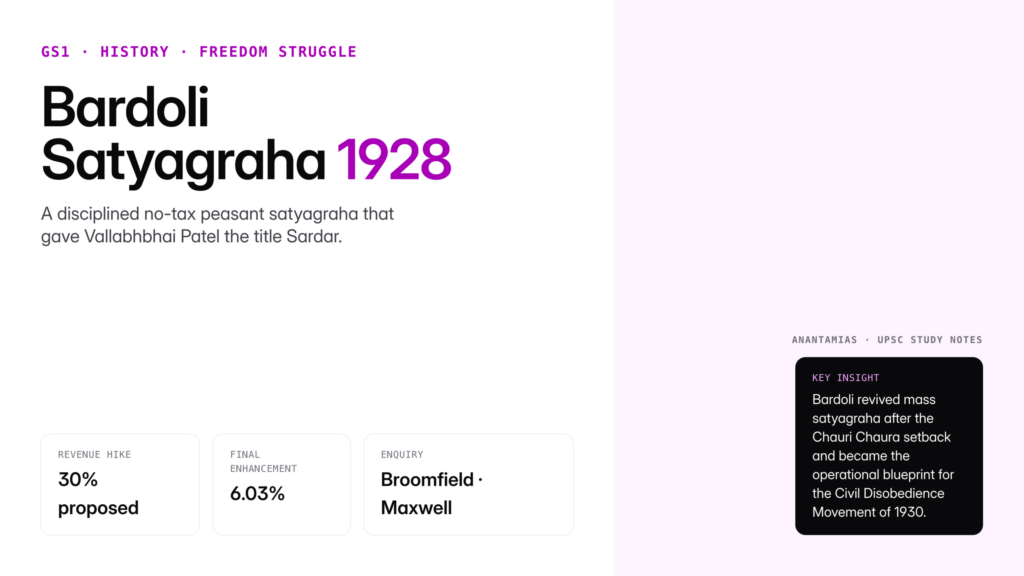
The Bardoli Satyagraha of 1928 is one of the most studied peasant movements of the Indian national struggle. It was a disciplined, non-violent no-tax campaign launched in the Bardoli taluka of Surat district, in present day Gujarat, against an unjust revenue hike by the Bombay Presidency. Under the leadership of Vallabhbhai Patel, the peasants of Bardoli refused to pay the enhanced land revenue, faced confiscation of cattle and land, stood firm for several months, and finally forced the colonial government to appoint an enquiry that rolled back the increase. The movement earned Patel the title of Sardar, meaning chief, a name by which history has remembered him ever since.
For the UPSC aspirant, Bardoli is a high value episode. It sits at the centre of the modern history syllabus of GS Paper 1, feeds into Mains questions on peasant movements, Gandhian technique, and the rise of Sardar Patel as a mass leader, and supplies factual pegs for Prelims on dates, personalities, committees and outcomes. This article explains the background, unfolding and legacy of the satyagraha, and its place in the wider arc of the freedom movement.
Quick Facts at a Glance
| Parameter | Detail |
|---|---|
| Location | Bardoli taluka, Surat district, Bombay Presidency |
| Year | 1928 |
| Trigger | Thirty per cent enhancement in land revenue by Bombay government |
| Leader | Vallabhbhai Patel |
| Form | No-tax satyagraha, non-violent |
| Duration | February 1928 to August 1928 |
| Title earned by Patel | Sardar |
| Enquiry committee | Broomfield and Maxwell Committee |
| Outcome | Revenue hike reduced to 6.03 per cent; confiscated lands and cattle returned |
| Successors | Civil Disobedience Movement 1930 |
Background and Historical Context
Bardoli was not a first draft. It sat at the end of a chain of local mobilisations and Gandhian experiments that shaped the technique of peasant satyagraha.
The colonial land revenue system in the Bombay Presidency was based on the Ryotwari settlement devised by Thomas Munro, under which revenue was assessed directly on the cultivator. Every thirty years the government reassessed land revenue. In the Bardoli settlement of 1927, the Bombay government’s revenue officer, Mr Jayakar, proposed a twenty two per cent increase. An independent assessment by the Jayakar report was itself criticised, and the final notification took the enhancement to an even higher effective level, about thirty per cent. Peasants argued that the hike was arbitrary, unrelated to actual crop yields, and came at a time when cotton prices had fallen and a malaria epidemic had thinned livestock.
Bardoli had already been primed for collective action. In 1921-22, during the Non-Cooperation Movement, Gandhi had planned to launch mass civil disobedience from Bardoli, only to call it off after the Chauri Chaura incident in Uttar Pradesh. The experience left a trained cadre of volunteers, a strong Congress committee, and a population familiar with constructive work, khadi, prohibition of liquor and social reform.
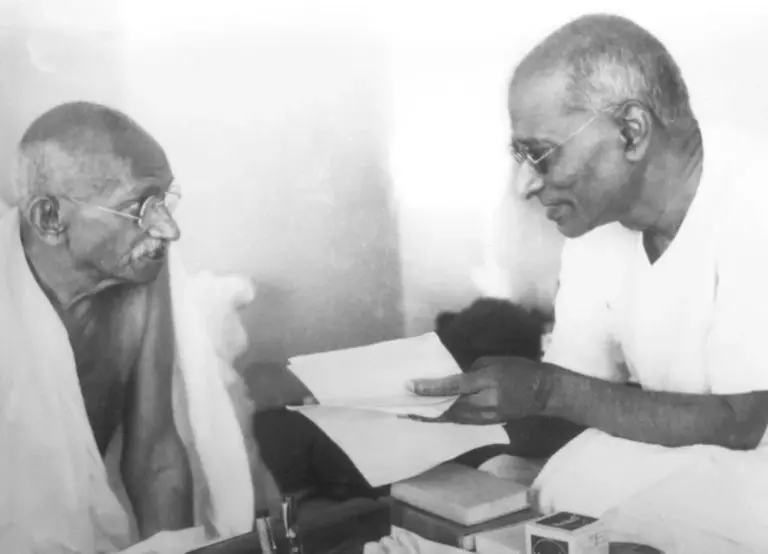
By early 1928 the Bardoli Taluka Congress Committee under Kunvarji Mehta and Dayalji Desai had appealed to Vallabhbhai Patel, who had just led a successful satyagraha in Kheda and Nagpur. Patel accepted the call, travelled through every village in the taluka, listened to grievances, reviewed revenue papers, and sought Gandhi’s approval. Gandhi gave the go-ahead, but made clear that Patel was in operational command and that the struggle must remain strictly non-violent. With that mandate the Bardoli Satyagraha began on 12 February 1928, the day peasants collectively signed a pledge not to pay the enhanced revenue.
Key Events and Phases
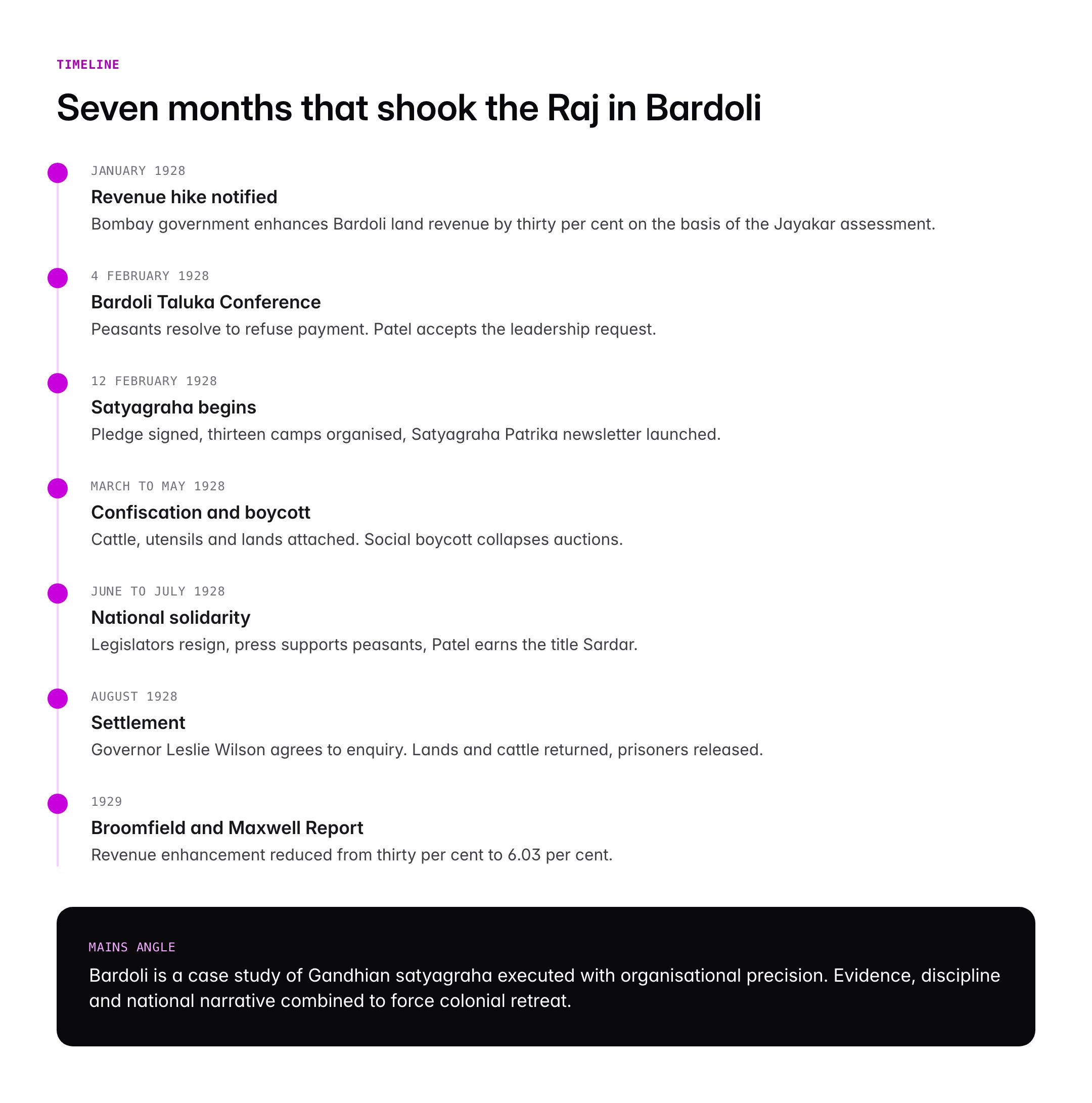
The Bardoli Satyagraha unfolded in four distinct phases over roughly seven months.
Phase One: Pledge and Organisation
At the Bardoli Taluka Conference on 4 February 1928, peasants resolved to refuse payment of revenue until the government either suspended the enhancement or agreed to an impartial enquiry. Patel organised the taluka into thirteen camps, each with a captain, and published a daily newsletter titled Satyagraha Patrika to carry news from village to village. Women’s volunteer corps were formed and played a major role in the movement. Kasturba Gandhi, Mithuben Petit, Maniben Patel and Bhaktiba were prominent.
Phase Two: Government Coercion
The Bombay government responded with confiscation. Revenue officials attached buffaloes, bullocks, household utensils, standing crops and finally land. The first auction was held in March 1928. Peasants refused to bid, outsiders were socially boycotted from bidding, and auctions collapsed repeatedly. The government then moved to sell lands to Pathan moneylenders and to British merchants from outside the taluka, but Patel’s organisation ensured that Bardoli villages remained closed to them through a comprehensive social boycott enforced by village panchayats.
Phase Three: National and Legislative Support
By May and June, the satyagraha had captured the national imagination. Newspapers across the country covered the auctions and the determined non-payment. Members of the Bombay Legislative Council, including Thakurdas, Jamnadas Mehta and later Kunzru, resigned or threatened resignation over the issue. Motilal Nehru, Jawaharlal Nehru, Rajagopalachari and even the Liberal leader Tej Bahadur Sapru publicly supported the peasants. The women of Bardoli gave Vallabhbhai Patel the affectionate title Sardar in recognition of his leadership, and the name stuck permanently.
Phase Four: Enquiry and Settlement
In August 1928, the Governor of Bombay, Sir Leslie Wilson, agreed to an independent enquiry after mediation efforts by KM Munshi and HB Shivdasani. The peasants were asked to first pay the enhanced revenue, and then the matter would be examined. A face-saving compromise was reached through which the peasants paid current rates, confiscated lands and cattle were returned, and prisoners released. The subsequent enquiry was conducted by Broomfield, a judicial officer, and Maxwell, a revenue officer. The Broomfield and Maxwell Committee submitted its report in 1929 and concluded that the thirty per cent enhancement was excessive. The final enhancement was reduced to just 6.03 per cent, a near total victory for the satyagrahis.
Significance for UPSC and General Knowledge
- It was the first major peasant satyagraha after the suspension of Non-Cooperation in 1922 to fully succeed, reviving confidence in mass struggle.
- It consolidated the leadership of Vallabhbhai Patel, later the first Home Minister and Deputy Prime Minister of independent India.
- It demonstrated the effectiveness of non-violent resistance, social boycott and disciplined organisation against colonial revenue power.
- It fed directly into the Civil Disobedience Movement of 1930, which drew heavily on Bardoli’s methods and trained cadre.
- It highlighted the role of women in mass mobilisation, an under-noticed dimension of the freedom struggle.
- It is a staple of GS Paper 1 questions on peasant and tribal movements and a reliable Prelims factual topic.
Reign and Administration: How Patel Led
The operational management of the satyagraha repays close attention because it became a template for later mass campaigns.
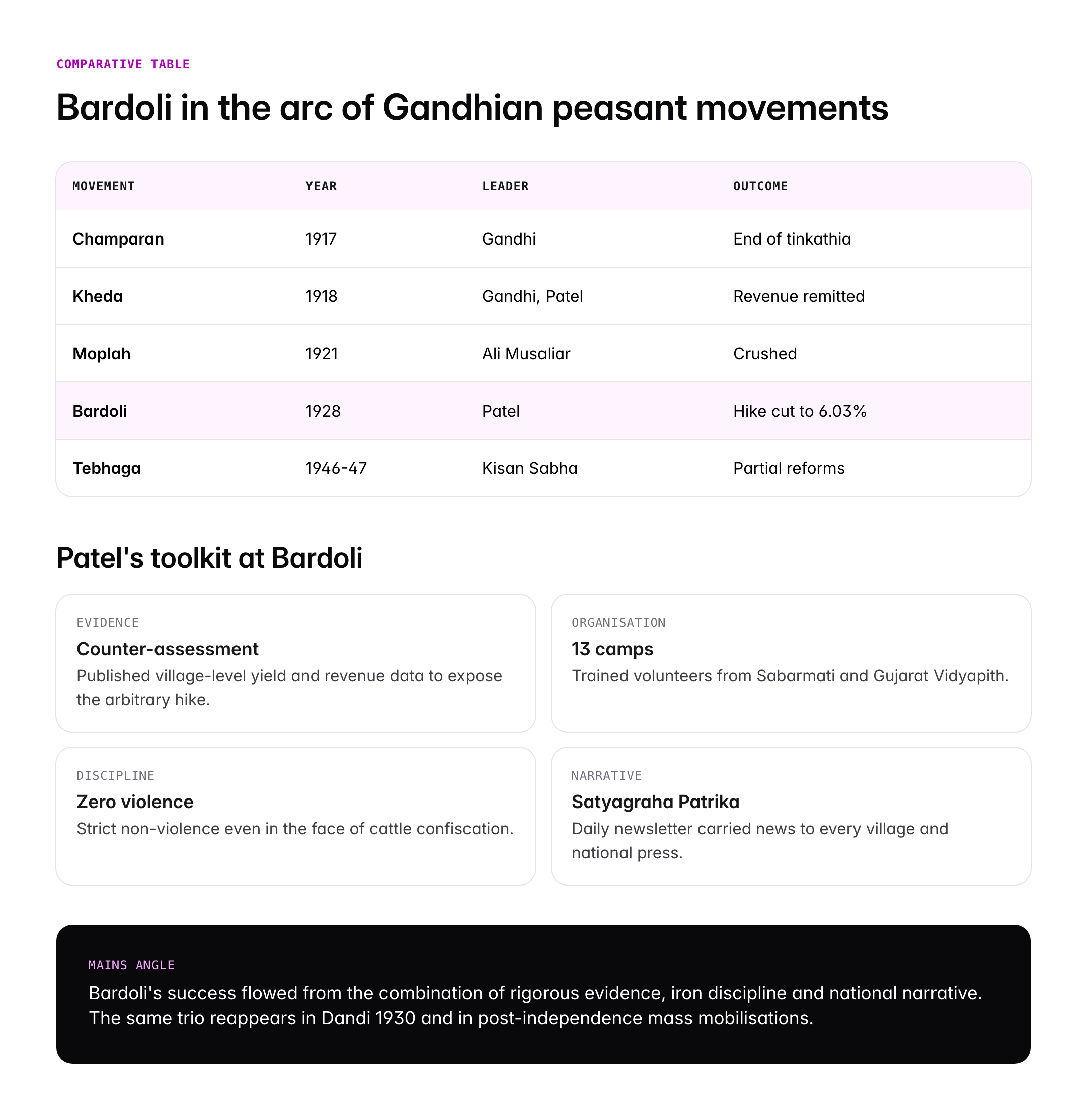
Patel began with intelligence. He and his team collected detailed revenue records, crop yields, and household budgets. They prepared a counter assessment to expose the arbitrariness of the thirty per cent hike. This evidence was published in Satyagraha Patrika and circulated to legislators in Bombay and Delhi, giving the movement a factual spine that the government could not easily dismiss.
He then built a disciplined volunteer corps. Each of the thirteen camps was led by a trained satyagrahi, drawn from Gandhi’s Sabarmati Ashram and from the Gujarat Vidyapith. Volunteers lived with the peasants, ate with them, organised prabhat pheris or early morning processions, and collected reports each evening.
Patel insisted on iron discipline. Not a stone was thrown, not a revenue officer was abused. A single act of violence, he warned, would hand the government a reason to suspend the struggle. When a confiscation officer was stoned by a crowd at Valod, Patel personally visited the village, apologised to the officer, and issued stern instructions for continued non-violence.
He practised social boycott with surgical precision. Any villager who paid the enhanced revenue or helped in auctions was placed under total social boycott. Barbers, washermen, shopkeepers, landlords refused to serve them. Religious and community ties were mobilised to enforce the boycott without physical coercion. This combination of economic pressure and moral censure proved devastating.
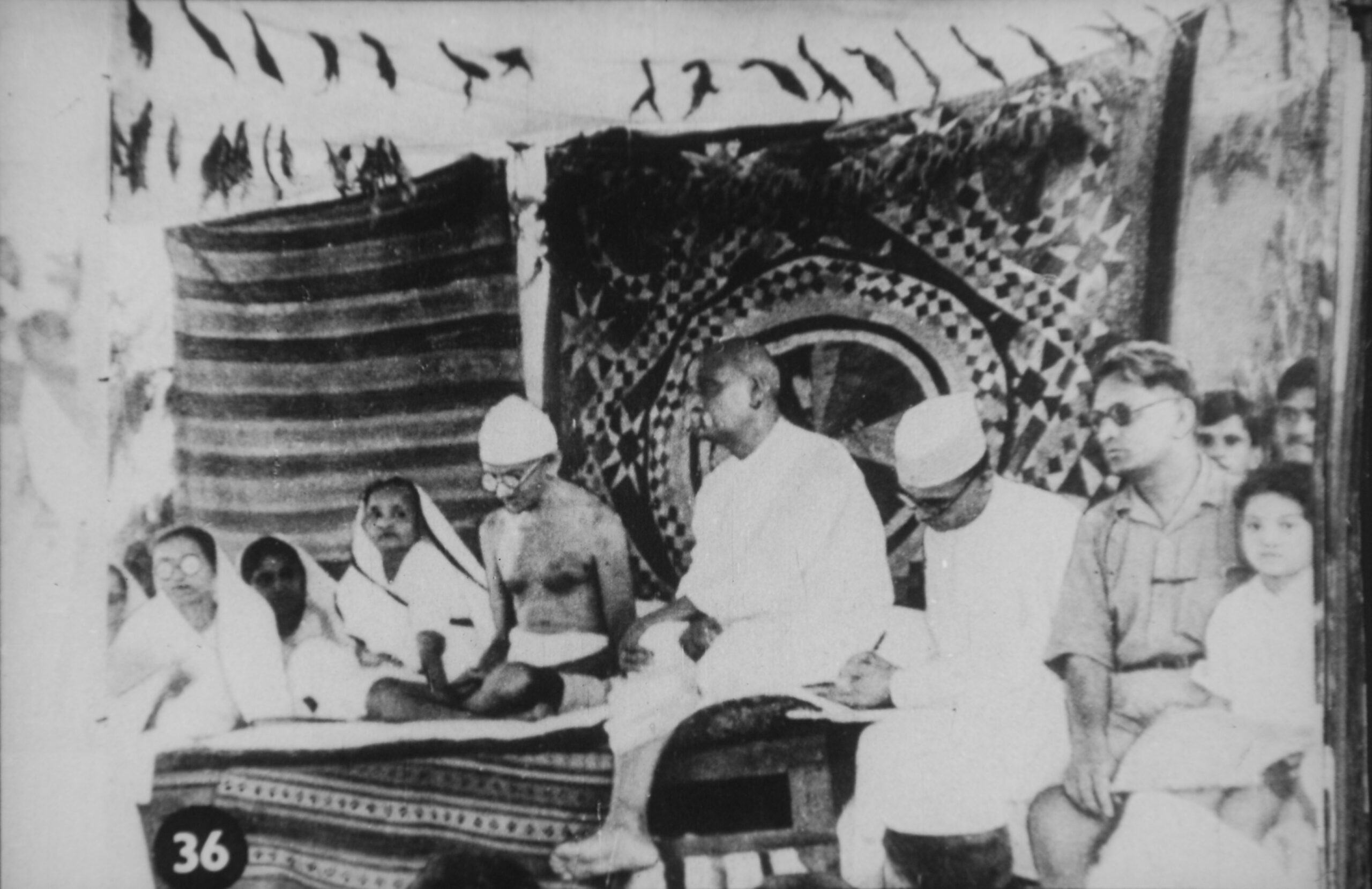
Patel also managed the national narrative. He wrote letters to newspapers, briefed visiting leaders, and invited press teams to walk through the villages and see confiscated homes. Gandhi visited Bardoli in August 1928 and gave his personal blessing, but he deliberately stayed in the background so that Patel’s authority was not diluted.
Finally, Patel handled the settlement with strategic flexibility. Once the government agreed to an enquiry, he accepted the compromise of paying current revenue rates, recognising that the enquiry’s report would almost certainly vindicate the peasants. The Broomfield and Maxwell report, by cutting the hike from thirty per cent to 6.03 per cent, validated that judgement.
Comparative Perspective
Bardoli did not happen in a vacuum. Its place among peasant movements becomes clearer through a direct comparison.
| Movement | Year | Region | Leader | Outcome |
|---|---|---|---|---|
| Champaran Satyagraha | 1917 | Bihar | MK Gandhi | Abolition of tinkathia system |
| Kheda Satyagraha | 1918 | Gujarat | Gandhi and Patel | Revenue remitted for poor peasants |
| Moplah Rebellion | 1921 | Malabar | Ali Musaliar, Kunhahamed Haji | Crushed by colonial forces |
| Bardoli Satyagraha | 1928 | Gujarat | Vallabhbhai Patel | Revenue hike cut to 6.03 per cent |
| Tebhaga Movement | 1946-47 | Bengal | Kisan Sabha leaders | Partial tenurial reforms |
Bardoli is distinguished by three features, the precise legal argument, the comprehensive non-violent discipline, and the national legitimacy the struggle earned for Patel. It is, in effect, the prototype for the 1930 salt satyagraha‘s mass participation model.
Controversies and Debates
Historians have debated the class character of the Bardoli struggle. Revisionist scholars such as Ghanshyam Shah and David Hardiman have argued that the movement was dominated by the upper-caste Patidar peasantry, and that the concerns of lower-caste Kaliparaj or dark-skinned agricultural labourers were subordinated. The Hali system of bonded labour, which tied Dubla and Halpati workers to Patidar landowners, did not receive the same reformist attention. Patel himself was seen as a more conservative figure compared to Gandhi on questions of caste and tenancy.
A second debate concerns the narrative dominance of Bardoli over other contemporaneous peasant movements. The Moplah rebellion in Malabar, which preceded Bardoli by seven years, involved deeper agrarian grievances and greater loss of life, yet occupies far less space in the standard textbook account, partly because it was violent and partly because it took on a communal character. Historians have cautioned against reading Bardoli as the norm and other movements as exceptions.
A third line of critique is about long term tenurial reform. Bardoli won a revenue reduction but it did not change the Ryotwari system, nor did it transform the power of landlords or the vulnerability of tenant cultivators. That transformation had to wait for post-independence land reforms, themselves incomplete.
Prelims Pointers
- Bardoli Satyagraha was launched on 12 February 1928 in Surat district of Bombay Presidency.
- It was a no-tax movement against a thirty per cent revenue enhancement.
- Vallabhbhai Patel led the movement at the request of the Bardoli Taluka Congress Committee.
- Patel earned the title Sardar from the women of Bardoli during this movement.
- The main English daily of the struggle was the Satyagraha Patrika.
- Kunvarji Mehta and Dayalji Desai were the local leaders who invited Patel.
- The Bombay Governor Sir Leslie Wilson eventually agreed to an enquiry.
- The enquiry was conducted by Broomfield and Maxwell, submitted in 1929.
- The final revenue enhancement was reduced to 6.03 per cent.
- Gandhi visited Bardoli in August 1928 during the final phase.
- Prominent women leaders included Kasturba Gandhi, Mithuben Petit, Maniben Patel and Bhaktiba.
- The struggle set the template for the Civil Disobedience Movement of 1930.
Mains Practice Questions
- The Bardoli Satyagraha of 1928 was both a local tax struggle and a milestone in the national movement. Discuss.
- Explain the immediate revenue cause and the deeper Gandhian groundwork since 1921.
- Show how disciplined non-violence, social boycott and legislative pressure worked together.
- Link the movement’s success to the revival of confidence leading into the Civil Disobedience Movement of 1930.
- Evaluate the role of Sardar Vallabhbhai Patel in the Bardoli Satyagraha and assess its significance for his later political career.
- Detail Patel’s operational methods, from camps to Satyagraha Patrika to enforcing non-violence.
- Trace the title Sardar and Patel’s emergence as a national leader.
- Connect Bardoli’s organisational style to Patel’s later role in integrating princely states.
Conclusion
The Bardoli Satyagraha is the kind of event that rewards careful study. On the surface it was a revenue dispute in a single taluka. Under the surface it was a test of the Gandhian method under the leadership of a new mass figure. The peasants of Bardoli, women and men, wealthier Patidars and poorer volunteers, stood firm through confiscations and social pressure, and in doing so they forced the colonial state to back down.
For the aspirant, the lessons are layered. It is a Prelims factual lodestone, a Mains case study of non-violent strategy, and a biographical anchor for understanding Vallabhbhai Patel. It also reminds us that mass politics in modern India was built from the village up, with careful preparation, factual rigour and moral authority, not only from grand declarations. The movement’s memory endures in the title that the women of Bardoli gave to a new leader, Sardar.
Frequently Asked Questions
What is the Bardoli Satyagraha?
The Bardoli Satyagraha was a non-violent no-tax campaign launched in February 1928 in the Bardoli taluka of Surat district, Bombay Presidency. Peasants refused to pay a thirty per cent enhancement in land revenue. Led by Vallabhbhai Patel, the disciplined struggle forced the colonial government to appoint the Broomfield and Maxwell enquiry, which cut the hike to 6.03 per cent.
Why is the Bardoli Satyagraha important for UPSC?
It is a core topic in GS Paper 1 modern history. Prelims asks for dates, the enquiry committee and Patel’s title Sardar. Mains answers use Bardoli to illustrate Gandhian satyagraha technique, non-violent discipline, peasant mobilisation, and the rise of Sardar Patel as a mass leader, so the event is examined repeatedly across years and question formats.
How is the Bardoli Satyagraha related to the Civil Disobedience Movement?
Bardoli directly inspired the 1930 Civil Disobedience Movement. It revived confidence in mass satyagraha after the suspension of Non-Cooperation in 1922, produced a trained volunteer cadre in Gujarat, validated the methods of social boycott and non-payment, and established Vallabhbhai Patel as a proven field general whom Gandhi could rely on for Salt Satyagraha and later campaigns.
Who led the Bardoli Satyagraha?
Vallabhbhai Patel led the movement at the request of local Congress leaders Kunvarji Mehta and Dayalji Desai. He organised thirteen camps across the taluka, ran the daily Satyagraha Patrika newsletter and enforced strict non-violence. Gandhi gave the movement his blessing from the Sabarmati Ashram but kept Patel in operational charge throughout the seven month struggle.
Why did Patel get the title Sardar?
During the Bardoli Satyagraha the women of Bardoli began addressing Vallabhbhai Patel as Sardar, meaning chief or leader, in recognition of his steady and disciplined leadership. The title was picked up by the press and national leaders, spread rapidly, and has been associated with him ever since. He later became independent India’s first Home Minister and Deputy Prime Minister.
What was the outcome of the Bardoli Satyagraha?
The Bombay government agreed to an enquiry conducted by Broomfield, a judicial officer, and Maxwell, a revenue officer. Their 1929 report concluded the thirty per cent revenue enhancement was excessive. The final enhancement was reduced to 6.03 per cent. Confiscated lands and cattle were returned, prisoners were released, and the satyagrahis were vindicated almost completely.
What role did women play in the Bardoli Satyagraha?
Women were central to Bardoli. Mithuben Petit, Maniben Patel, Bhaktiba and Kasturba Gandhi led women’s volunteer corps, organised village meetings, collected funds and resisted confiscation parties. They physically blocked auctions and enforced social boycott in their neighbourhoods. Their collective voice also gave Vallabhbhai Patel his lasting title Sardar during the movement.
What is the Broomfield and Maxwell Committee?
The Broomfield and Maxwell Committee was the enquiry the Bombay government set up in late 1928 to examine the Bardoli revenue enhancement. Broomfield was a judicial officer and Maxwell a senior revenue officer. Their 1929 report found the original thirty per cent hike to be excessive and unjustified, and recommended a reduction to 6.03 per cent, which the government accepted.
Tell Google you want more of this.
Add Anantam IAS as a preferred sourceOne tap, and this site shows up more often in your own Top Stories, AI Overviews and AI Mode. Remove it any time.