Bharatiya Antariksh Station: India’s Indigenous Space Station Programme Explained
A complete UPSC GS-III explainer on the Bharatiya Antariksh Station (BAS), India's first indigenous modular space station planned for the 2030s. Covers ISRO's phased architecture, the LVM-3 human-rated launcher, SpaDeX docking validation, life-support systems, scientific objectives in microgravity research, and where BAS sits relative to the ISS and China's Tiangong.
The Bharatiya Antariksh Station, or BAS, is the most ambitious space project India has ever announced. Where Chandrayaan placed a lander on the Moon and Mangalyaan slipped a probe into Martian orbit on a shoestring budget, BAS is a different category of programme. It commits ISRO to building, launching, docking, operating, and maintaining a permanently crewed outpost in Low Earth Orbit, roughly 400 kilometres above the planet, for years on end. The first module is targeted for 2028, the full station for around 2035, and the political signal is that India intends to be in the small club of countries that can put humans into space and keep them there.
This guide unpacks BAS for UPSC GS-III aspirants. It walks through what a modular space station actually is, how ISRO plans to assemble one with multiple LVM-3 launches and orbital dockings, why the SpaDeX experiment matters for the architecture, what the station will do scientifically, how it compares with the ISS and Tiangong, and what the strategic stakes are for India’s space economy and great-power positioning.
What the Bharatiya Antariksh Station Is
BAS is a proposed indigenous space station programme led by ISRO. It is not a satellite, not a one-time mission, and not a partnership where India contributes a module to someone else’s facility. It is a stand-alone Indian platform that will be designed, built, launched, and operated from Indian soil, with crews drawn from the Gaganyaan astronaut corps and follow-on selections.
The station will sit in Low Earth Orbit at an altitude of about 400 kilometres, the same band the International Space Station occupies. The architecture is modular, which means the station is not launched in one piece. Pressurised modules are launched separately on multiple flights, rendezvous in orbit, and dock together to form the full station. Each module brings a specific function: a core habitation module, science laboratory modules, an airlock for spacewalks, a node for berthing visiting crew vehicles, and eventually solar power and thermal control modules. The modular approach is what allows a country to build a station with launchers that cannot loft 400 tonnes in one go.
Why India Is Building Its Own Station
The strategic rationale rests on three pillars. First, the International Space Station is approaching the end of its design life around 2030, and the political settlement that built it is fraying. China was barred from the ISS by United States legislation, built Tiangong on its own, and has demonstrated that a middle-income economy with sustained political will can run a permanent crewed facility. India has watched that trajectory and concluded that owning the entire stack of human spaceflight, from launcher to crew vehicle to station, is now a marker of major-power technology status.
Second, microgravity research has commercial value. Pharmaceuticals, advanced materials, fluid physics, and biotech experiments behave differently in weightlessness, and the queue for ISS bench time is long and politically rationed. Owning a domestic platform gives Indian universities, public-sector laboratories, and private firms a place to run experiments without negotiating across borders.
Third, BAS anchors the broader human spaceflight programme. Without a destination, Gaganyaan is a flag-planting exercise that ends after a handful of crewed flights. With a station to operate, India has a multi-decade pipeline of crewed missions, ground infrastructure, training cadres, and supplier industries that justify the investment. For the policy frame around the broader sector, see the Indian Space Policy 2023 and the long-term blueprint in the NITI Aayog DPI 2047 roadmap.
The Modular Architecture
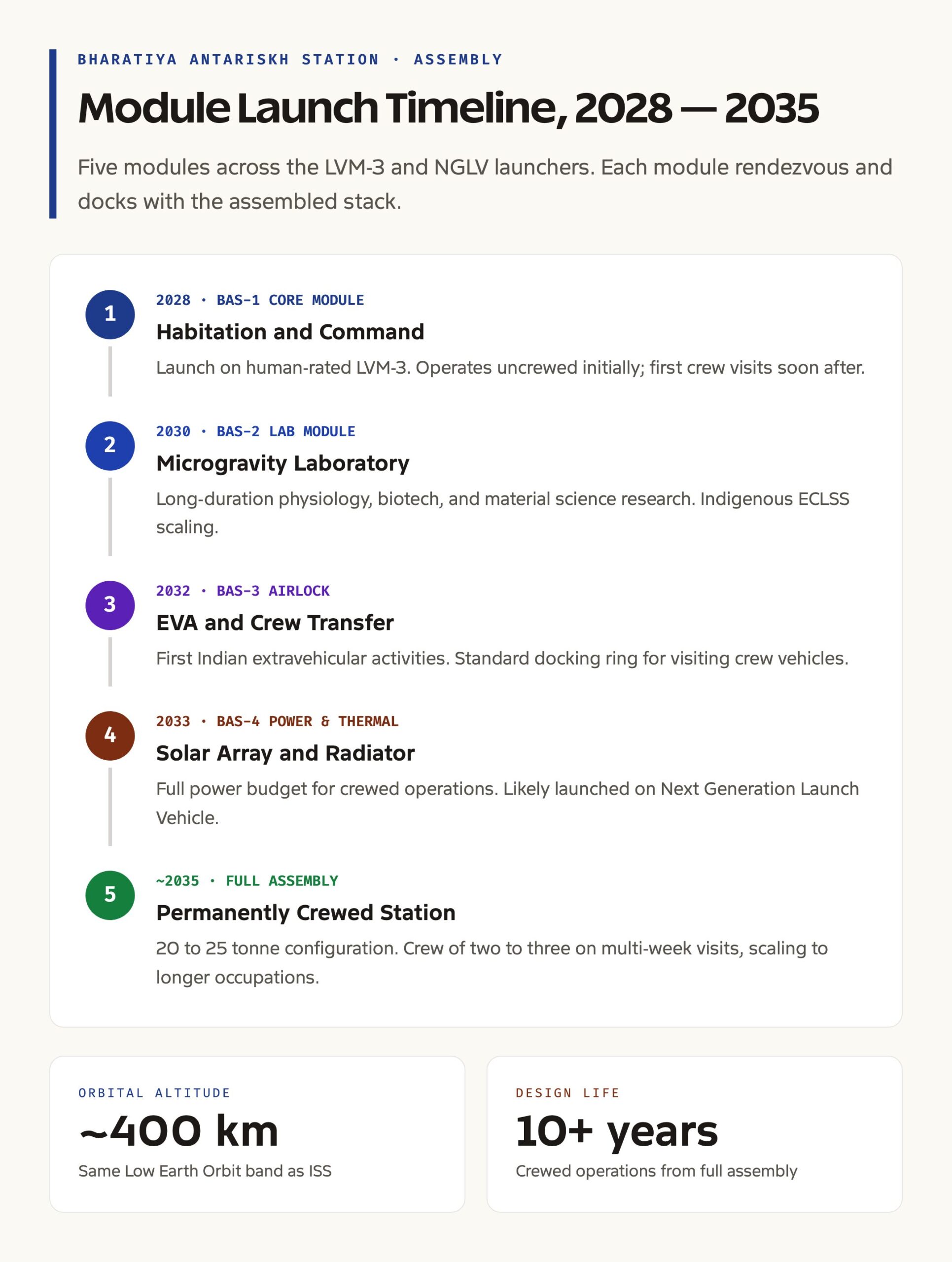
The current architecture, as described in ISRO presentations and government statements, is a five-module station with a total mass in the 20 to 25 tonne range when complete. The first module, often called the BAS-1, is a core habitation and command module, planned for launch around 2028 on a human-rated LVM-3. It will operate as a stand-alone uncrewed platform initially, then host the first short-duration crew visits as Gaganyaan astronauts arrive on follow-on flights.
Subsequent modules add laboratory volume, an airlock for extravehicular activity, and additional power and life-support capacity. The modules are designed to be launched on the LVM-3 in its human-rated configuration, with the option of using the under-development Next Generation Launch Vehicle, or NGLV, for heavier modules in the second half of the assembly campaign. Each module carries its own propulsion for orbital insertion, attitude control, and rendezvous, and is fitted with the standard Indian docking interface that flight-tested under SpaDeX.
The SpaDeX Foundation
A space station cannot exist without docking. Modules dock to each other to assemble the station. Crew vehicles dock to the station to deliver and recover astronauts. Cargo vehicles dock to deliver supplies. Without an indigenous, flight-proven, autonomous docking system, BAS is a slide deck, not a programme.
That is why the Space Docking Experiment, SpaDeX, mattered so much. SpaDeX validated India’s autonomous docking technology in orbit using two small satellites that maneuvered together, achieved soft capture, and rigidised. The systems demonstrated in SpaDeX, including the rendezvous sensors, the proximity operations algorithms, and the mechanical docking ring, scale up directly to the BAS-class hardware. Without SpaDeX, ISRO would have had to develop docking on the critical path of the station programme itself, which would have delayed BAS by years and added enormous risk.
Life Support and Crew Systems
A space station is fundamentally a closed life-support box. Air, water, food, waste, and thermal energy must all be managed continuously for the crew to survive. ISRO is developing the Environmental Control and Life Support System, or ECLSS, indigenously. The system handles atmospheric pressurisation, oxygen generation by water electrolysis, carbon dioxide scrubbing, humidity control, water recycling from urine and condensate, and thermal regulation through a coolant loop and external radiators.
The Gaganyaan crew capsule is the test bed for the first generation of these systems. The capsule’s life-support gear is sized for short-duration crewed flights of three to seven days, and lessons from those flights feed directly into the station-class hardware that has to operate for months at a time. Other systems on the critical development path include long-duration food storage, exercise countermeasures for muscle and bone loss in microgravity, in-flight medical kits, and radiation shielding for the higher dose environment of LEO.
Scientific and Operational Objectives
BAS is justified to the public on two grounds: science and capability-building. On the science side, the station will host long-duration microgravity research across human physiology, space medicine, biotechnology, and material science. Indian researchers will study how the cardiovascular system, bone density, muscle mass, and the immune system respond to weeks and months in orbit. Material scientists will run protein crystallisation, fluid physics, and combustion experiments that cannot run on Earth. Earth observation payloads will use the station as a stable platform for high-resolution imaging, atmospheric science, and ocean monitoring.
The capability-building case is broader. A working station means India has mastered human-rated launchers, crew capsules, life-support systems, autonomous rendezvous and docking, extravehicular activity, in-orbit assembly, ground operations for crewed flight, and astronaut training. Each of those capabilities has spillover into satellite servicing, deep-space missions, lunar landers, and the eventual human missions to the Moon that ISRO has signaled for the late 2030s. For the launcher backbone, the article on ISRO missions and the Gaganyaan mission walk through the vehicles that BAS depends on.
How BAS Compares with ISS and Tiangong
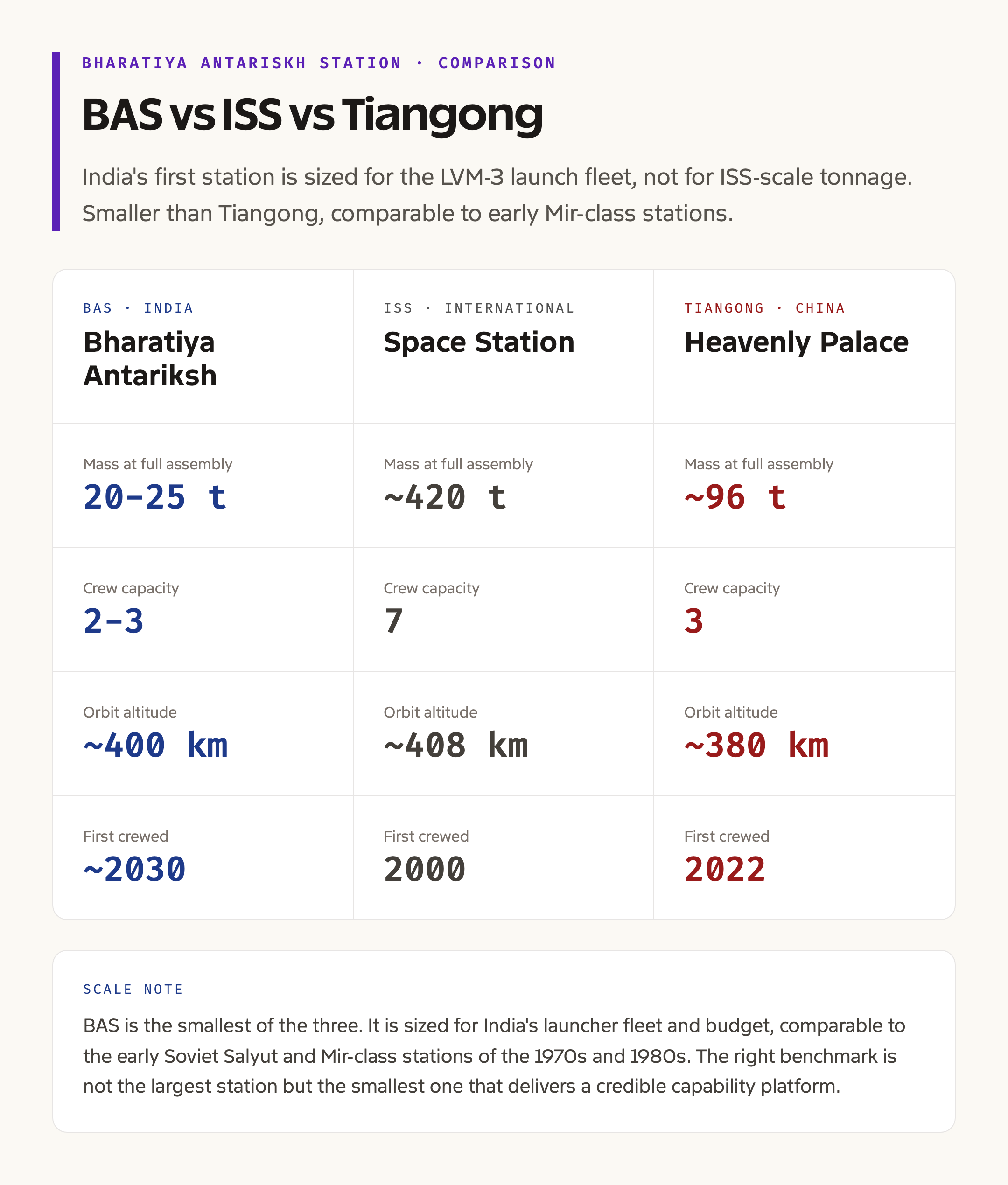
The International Space Station is the largest crewed object ever built in space, with a mass of about 420 tonnes, a permanent crew of seven, and an orbit at about 408 kilometres. It has been continuously crewed since 2000. China’s Tiangong is smaller, with a mass of about 96 tonnes after the addition of its second laboratory module, a standard crew of three, and an orbit at about 380 to 400 kilometres. Tiangong has been continuously crewed since 2022.
BAS, in its planned five-module configuration, will be in the 20 to 25 tonne class. That puts it at roughly the size of the original Salyut and early Mir stations of the Soviet era, smaller than Tiangong, and far smaller than the ISS. The crew complement will start at two to three astronauts on visits of a few weeks, scaling up to longer-duration occupations once the station is fully assembled and life-support is proven. The lifespan target is at least a decade of operations from the time of full assembly.
This is not a deficiency. India is not trying to match the ISS or Tiangong in mass. BAS is sized for the Indian launcher fleet, the Indian budget, and the Indian science programme. The right comparator is not the largest station ever built but the smallest one that delivers a credible capability platform.
Programme Timeline
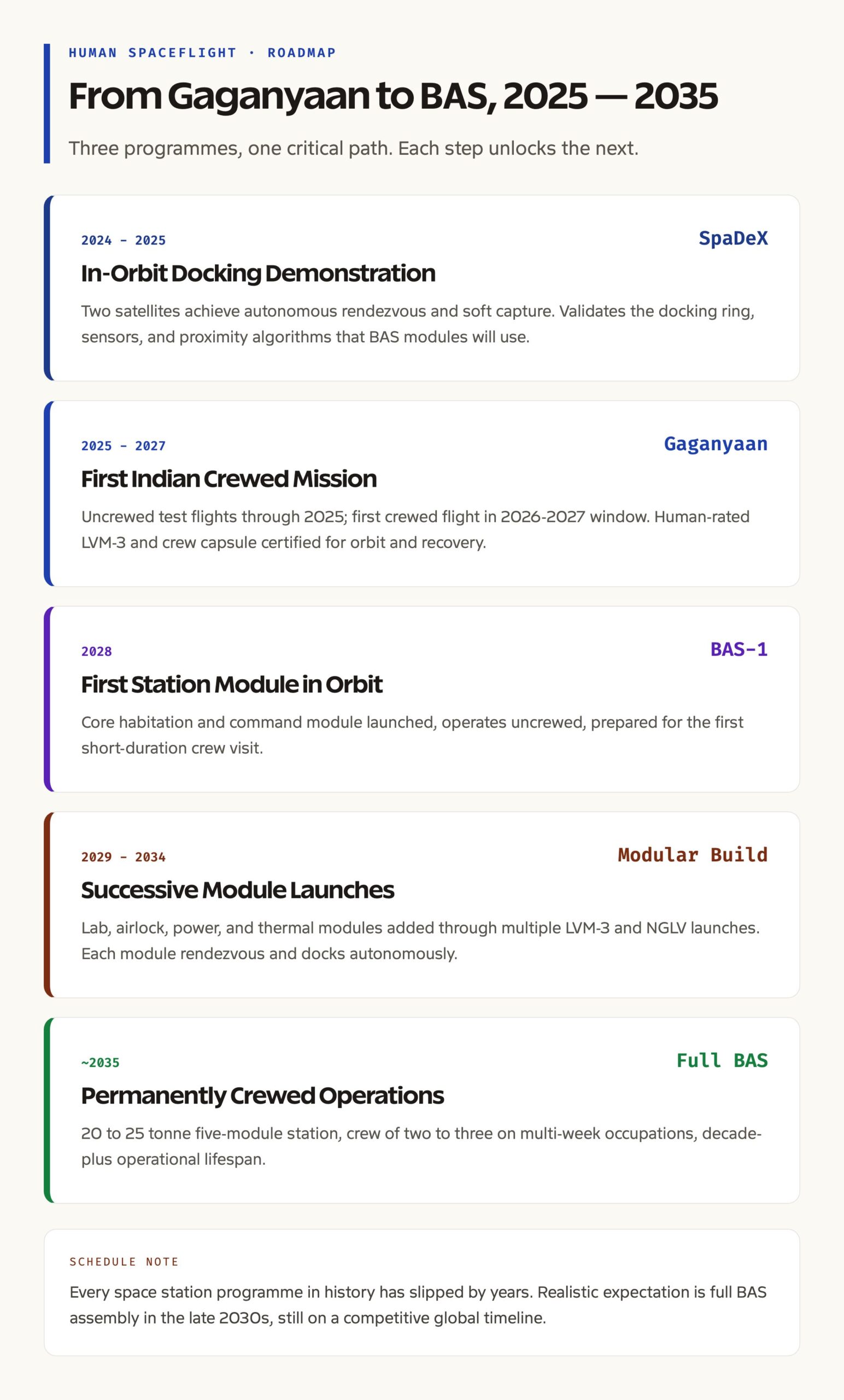
The publicly stated timeline is staged. Gaganyaan uncrewed test flights run through 2025. The first crewed Gaganyaan flight is targeted for the 2026 to 2027 window. The first BAS module launches around 2028. Additional modules are added across 2029 and the early 2030s, with full station assembly targeted for 2035. The station is then expected to operate at least through the mid-2040s.
The schedule is aggressive. Every space station programme in history has slipped, often by years. The ISS slipped by close to a decade. Tiangong slipped from its original 2010s timeline. The realistic expectation is that BAS slips by two to four years against the official dates, which would place full assembly in the late 2030s. That is still on a competitive global timeline.
Strategic and Industrial Stakes
The industrial spillover is significant. A space station programme creates sustained demand for human-rated launchers, pressurised module fabrication, life-support hardware, space-grade electronics, propellant systems, ground infrastructure, and astronaut training facilities. Indian private firms have begun to enter every layer of this stack under the IN-SPACe regime, and a domestic station gives them a long-horizon customer that is not vulnerable to foreign export-control regimes.
The strategic stakes are equally clear. A country that operates a crewed space station is a different category of space power from one that only flies satellites and probes. It signals confidence in the launcher fleet, in the engineering culture, and in the political commitment to long-duration programmes. It puts India in conversations about lunar gateways, asteroid missions, and Mars architecture that would otherwise route around New Delhi. The long-term significance of BAS is less about the specific science returned and more about the position it secures for Indian space industry over the next four decades.
Risks and Open Questions
Three risks deserve flagging. First, the human-rated LVM-3 has not yet flown a crewed mission. Any anomaly in the 2025 to 2027 Gaganyaan flights ripples directly into the BAS schedule. Second, life-support hardware tested in short Gaganyaan flights does not automatically scale to months-long station operations. The transition from days to months is where most space stations have hit their hardest engineering walls. Third, the budget. ISRO’s annual outlay is a fraction of NASA’s or CNSA’s, and a station programme is a relentless drain on operations funds for as long as the station flies. The political settlement that funds BAS over four decades has to survive several changes of government.
None of these risks are deal-breakers. All of them are reasons to expect the timeline to be longer and the cost to be higher than the public numbers suggest. That is the normal experience of every space station programme ever built.
Frequently Asked Questions
What does Bharatiya Antariksh Station mean?
Bharatiya Antariksh Station translates from Hindi as u0022Indian Space Station.u0022 It is the formal name of India’s planned indigenous space station to be built and operated by ISRO in Low Earth Orbit.
When will the first BAS module launch?
The first module, BAS-1, is officially targeted for 2028 on a human-rated LVM-3. The full five-module station is planned for around 2035. Both dates are likely to slip by two to four years given the historical record of space station programmes.
How is BAS different from the International Space Station?
BAS is much smaller, in the 20 to 25 tonne class compared with the ISS at about 420 tonnes. It is a fully Indian programme rather than a multinational partnership. The crew complement, science capacity, and orbit lifetime are all sized for India’s launcher fleet and budget.
What role does SpaDeX play in BAS?
SpaDeX validated India’s autonomous in-orbit docking technology. Every module of BAS, every crew vehicle that visits the station, and every cargo flight that resupplies it depends on docking. Without the SpaDeX flight, BAS could not have been declared a credible programme.
How does BAS connect to the Gaganyaan mission?
Gaganyaan is the human-rated crew vehicle and the source of the first generation of life-support hardware. The astronauts who will fly to BAS are drawn from the Gaganyaan corps. Without Gaganyaan, there is no way to put humans into the station.
Will BAS support international crews or only Indian astronauts?
The publicly stated policy is that BAS will be open to international cooperation, including hosting astronauts from partner countries. The architecture is being designed with standard docking interfaces that are compatible with crew vehicles from other space programmes.
What is the operational lifespan of BAS?
The current target is at least ten years of crewed operations from the date of full station assembly. Most space stations end up exceeding their design life by several years. A realistic horizon is operations from the mid-2030s to the mid-2040s.