Introduction
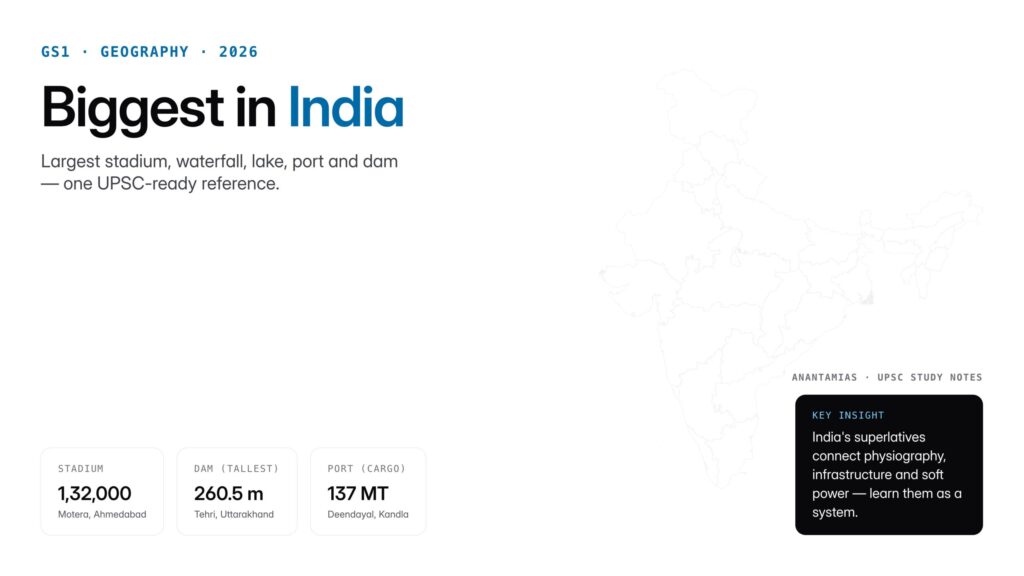
Records and superlatives are a favourite hunting ground in the UPSC Prelims. Questions on the biggest stadium in India, the largest waterfall, the largest lake, the biggest port by traffic and the largest dam have appeared consistently across state and central examinations, and they also form the backbone of general knowledge rounds. A single consolidated guide helps aspirants see the connections between infrastructure, physiography and human geography instead of memorising isolated facts.
This article brings together five of the most asked superlatives in Indian geography and infrastructure. Each section gives the current record holder, its location, its defining metric and the reason it matters for Prelims and Mains answer writing. Figures are drawn from the Ministry of Ports Shipping and Waterways, the Central Water Commission, the Board of Control for Cricket in India and the Geological Survey of India.
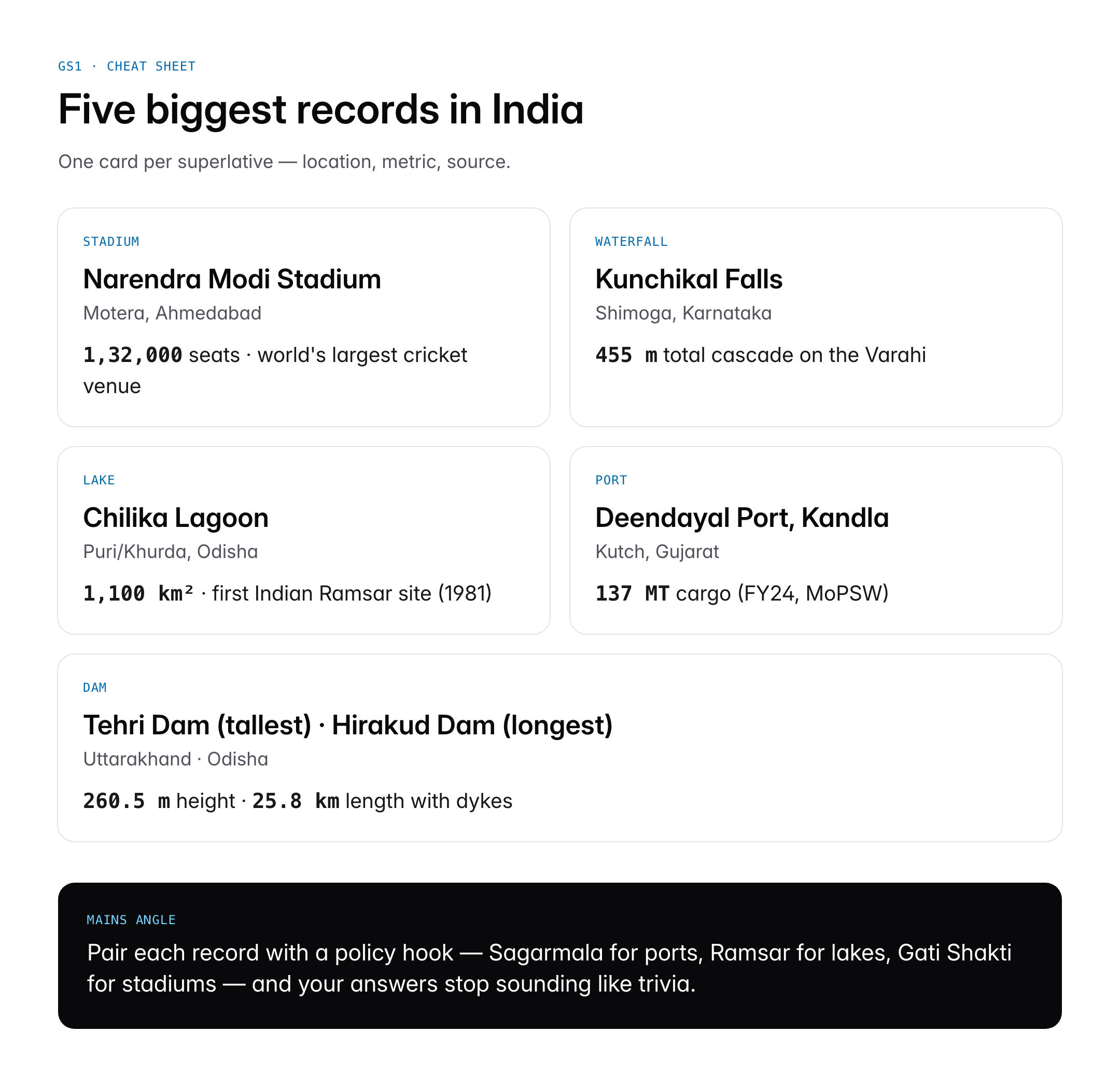
Quick Facts at a Glance
| Category | Record Holder | Location | Key Metric |
|---|---|---|---|
| Biggest Stadium | Narendra Modi Stadium | Motera, Ahmedabad, Gujarat | 1,32,000 seats |
| Biggest Waterfall | Kunchikal Falls | Shimoga, Karnataka | 455 metres total drop |
| Biggest Lake (freshwater) | Wular Lake | Bandipora, Jammu and Kashmir | ~200 sq km |
| Biggest Lake (saltwater) | Chilika Lake | Puri and Khurda, Odisha | 1,100 sq km (monsoon) |
| Biggest Port (cargo) | Deendayal Port, Kandla | Kutch, Gujarat | ~137 MT throughput (FY24) |
| Biggest Dam (height) | Tehri Dam | Uttarakhand | 260.5 metres |
| Biggest Dam (length) | Hirakud Dam | Odisha | 25.8 km (with dykes) |
Background and Historical Context
India’s record-holding infrastructure tells a story of post-independence ambition. The first five-year plans prioritised multipurpose river valley projects. Hirakud on the Mahanadi, commissioned in 1957, became the world’s longest earthen dam at the time and remains the longest in India by total length. Bhakra Nangra and Nagarjuna Sagar followed, and by the 1970s dam building had become a symbol of the country’s technical coming of age.
Stadium construction followed the broadcasting boom. Eden Gardens in Kolkata, established in 1864, long held the tag of India’s largest cricket ground before the redevelopment of the Sardar Patel Stadium at Motera in Ahmedabad. Reopened in 2020 and renamed the Narendra Modi Stadium, the venue overtook the Melbourne Cricket Ground to become the largest cricket stadium in the world by seating capacity.
Natural superlatives like Chilika Lake and Kunchikal Falls have been mapped since the colonial Survey of India era. Chilika was identified as a Ramsar site in 1981 and was the first Indian wetland to be listed. Port hierarchies have shifted with trade patterns. Kandla (now Deendayal Port) was developed after partition to replace the loss of Karachi as a western gateway. It has alternated with Paradip and Mundra at the top of the cargo throughput table in recent years, with Mundra leading among private ports and Deendayal leading among major public ports.
Key Features of Each Record Holder
Narendra Modi Stadium — the biggest stadium in India
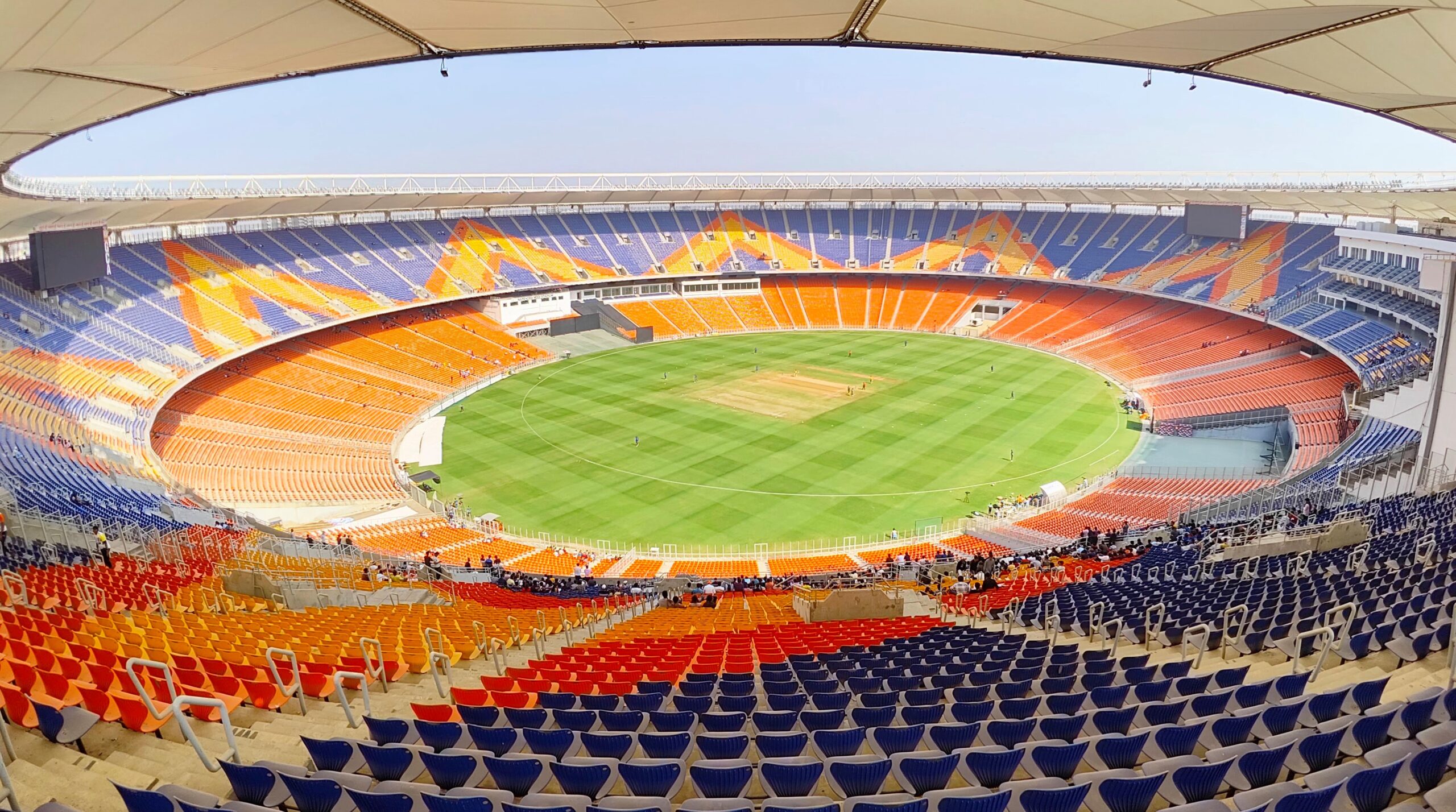
The Narendra Modi Stadium at Motera in Ahmedabad has a seating capacity of 1,32,000, the highest of any cricket stadium globally. It is spread over 63 acres and is owned by the Gujarat Cricket Association. Its design uses a bowl shape with no obstructive pillars, 11 centre pitches and four dressing rooms. The stadium hosted the 2023 ICC Cricket World Cup final between India and Australia.
Kunchikal Falls — the biggest waterfall in India
Kunchikal Falls is located on the Varahi River in Karnataka’s Shivamogga district. Its total cascade of 455 metres makes it the tallest waterfall in India by most authoritative compilations, including the Geological Survey of India. Jog Falls, often cited as India’s highest, is higher as a single-drop waterfall (253 metres) but shorter in total descent.
Wular and Chilika — the biggest lakes in India
Wular Lake in Jammu and Kashmir is India’s largest freshwater lake, fed by the Jhelum and covering up to 200 square kilometres during high water. Chilika Lake in Odisha is the country’s largest brackish water lagoon, expanding to about 1,100 square kilometres in the monsoon. It is a Ramsar wetland and the winter home of the Irrawaddy dolphin and more than a million migratory birds.
Deendayal Port (Kandla) — the biggest port by cargo
Among India’s 13 major ports, Deendayal Port at Kandla in Gujarat has consistently recorded the highest cargo traffic, crossing 137 million tonnes in FY 2023-24 according to the Ministry of Ports Shipping and Waterways. It is a tidal port on the Gulf of Kutch and handles crude oil, petroleum products, foodgrains and fertilisers.
Tehri and Hirakud — the biggest dams in India
Tehri Dam on the Bhagirathi in Uttarakhand is India’s tallest dam at 260.5 metres and among the ten tallest in the world. It has an installed hydro capacity of 2,400 MW. Hirakud Dam on the Mahanadi in Odisha is India’s longest dam at 25.8 km including its earthen dykes, and was one of the earliest post-independence river valley projects.
Significance for UPSC and General Knowledge
- Factual questions on superlatives appear in almost every state PSC and in UPSC CSE Prelims general studies paper one
- Stadium and infrastructure records intersect with Mains topics on urbanisation, sports economy and soft power
- Lakes like Chilika and Wular link the physiography syllabus to environment and biodiversity
- Major port data supports GS3 questions on infrastructure, logistics and the Sagarmala programme
- Dam records connect to GS1 physical geography, GS3 disaster management and recent debates on ageing dam safety
Detailed Analysis — Why These Records Matter
India’s superlatives are not just trivia. Each record holder sits at the centre of a larger policy conversation. The Narendra Modi Stadium illustrates the rise of sports infrastructure as a tool of city branding, a theme that GS1 answers on urbanisation and GS2 answers on governance can draw upon. Ahmedabad’s bid for the 2036 Olympics is anchored to this single facility.
Kunchikal Falls sits on the Varahi hydroelectric project, which means the falls are often reduced to a trickle because upstream water is diverted to the Mani Dam. This illustrates the classic tension between conservation and development. It is a ready-made example for GS3 answers on sustainable energy or environmental impact assessment.
Chilika and Wular are both Ramsar sites, yet both face shrinkage from siltation, encroachment and pollution. The Wular Conservation and Management Authority and the Chilika Development Authority are cited in NITI Aayog’s wetland health reports. Students can use these cases in GS3 answers on wetland policy, in GS1 answers on Indian geography and in ethics case studies on common pool resources.
Deendayal Port highlights the shift in India’s trade geography. The Gulf of Kutch coast has absorbed refinery clusters, LNG terminals and private ports at Mundra and Hazira. The port is central to the Sagarmala programme and to the Gati Shakti master plan. Tehri and Hirakud bracket India’s dam story from the Nehruvian era to the post-liberalisation era. Tehri’s construction displaced more than 1,00,000 people and was opposed by the Chipko activist Sunder Lal Bahuguna, a recurring example in ethics and environment papers.
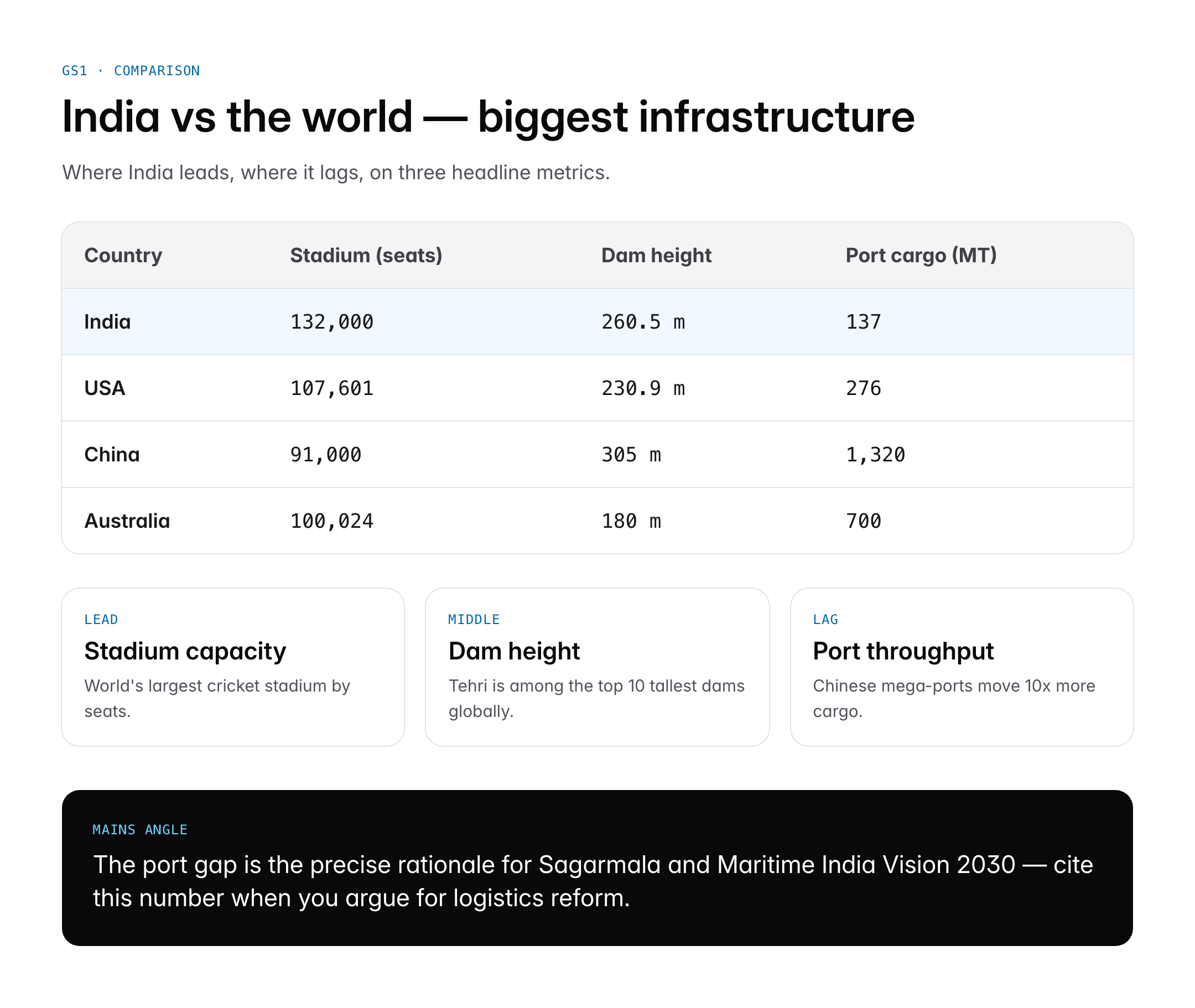
Comparative Perspective
| Country | Biggest Stadium | Biggest Dam (height) | Biggest Port |
|---|---|---|---|
| India | Narendra Modi Stadium (1,32,000) | Tehri Dam (260.5 m) | Deendayal (137 MT) |
| United States | Michigan Stadium (1,07,601) | Oroville (230.9 m) | Port of Houston (~276 MT) |
| China | Rungrado May Day (1,14,000, DPRK) / Beijing National (91,000) | Jinping-I (305 m) | Ningbo-Zhoushan (~1,320 MT) |
| Australia | Melbourne Cricket Ground (1,00,024) | Dartmouth (180 m) | Port Hedland (~700 MT) |
India’s stadium record is competitive at the global level, but its port throughput lags behind Chinese mega-ports by almost an order of magnitude. This gap is the precise rationale for the Sagarmala and Maritime India Vision 2030 programmes. On dams, India ranks among the top three countries in the world by number of large dams, behind China and the United States.
Challenges and Criticisms
Record-holding infrastructure attracts scrutiny. The Tehri Dam has been criticised for submerging the town of old Tehri and for lying in seismic zone IV. Activists and the Indian National Trust for Art and Cultural Heritage have repeatedly flagged the risk of a high-magnitude Himalayan earthquake. Hirakud faces silting and reduced live storage, issues highlighted in the Central Water Commission’s compendium on Indian dams.
Chilika and Wular have lost area to siltation and encroachment, with Wular shrinking by almost 45 per cent between 1911 and 2007 according to Wetlands International. Deendayal Port is vulnerable to cyclonic storms in the Arabian Sea, as seen during Cyclone Biparjoy in 2023. Even the Narendra Modi Stadium has drawn debate for the economics of mega stadium construction in a country where smaller ground upgrades are chronically underfunded. A balanced UPSC answer acknowledges records alongside these trade-offs.
Prelims Pointers
- Narendra Modi Stadium is the largest cricket stadium in the world with a capacity of 1,32,000
- It is located at Motera in Ahmedabad and owned by the Gujarat Cricket Association
- Kunchikal Falls on the Varahi River in Karnataka is India’s tallest waterfall at 455 m total drop
- Jog Falls at 253 m is the highest single-drop waterfall in India
- Wular Lake in Jammu and Kashmir is India’s largest freshwater lake, fed by the Jhelum
- Chilika Lake in Odisha is India’s largest brackish water lagoon and first Ramsar site
- Deendayal Port at Kandla, Gujarat is the largest public major port by cargo throughput
- Mundra Port in Gujarat is the largest private port in India by throughput
- Tehri Dam on the Bhagirathi is India’s tallest dam at 260.5 m
- Hirakud Dam on the Mahanadi is India’s longest dam at 25.8 km with dykes
- Bhakra Dam on the Sutlej is the tallest gravity dam in India at 226 m
- India has 13 major ports, 12 operated by the central government and Kamarajar as a corporate port
Mains Practice Questions
- Mega stadiums and mega dams are both symbols of national ambition. Evaluate their role in shaping India’s infrastructure narrative.
- Contrast the Narendra Modi Stadium and Tehri Dam as public infrastructure archetypes
- Discuss their economic, social and ecological trade-offs
- Suggest governance reforms for more balanced mega-project planning
- Lakes and wetlands are under-recognised as drivers of regional ecology in India. Comment with reference to Chilika and Wular.
- Describe the ecological role of Chilika and Wular
- Explain the threats from siltation, encroachment and pollution
- Outline policy responses including Ramsar listing and dedicated authorities
Conclusion
The biggest stadium, waterfall, lake, port and dam in India are more than entries in a general knowledge quiz. They show how the country has built, protected and sometimes over-extended its natural and human infrastructure. For an aspirant, holding these records in memory is the first step. The richer reward is to use each one as a hook into deeper GS1, GS2 and GS3 debates.
Memorise the numbers, but also learn the trade-offs. A well-framed answer that places Tehri beside the Chipko movement or Deendayal beside the Sagarmala programme will always score higher than a bare list of facts.
Frequently Asked Questions
What is the biggest stadium in India?
The Narendra Modi Stadium at Motera in Ahmedabad, Gujarat, is the biggest stadium in India with a seating capacity of 1,32,000. Reopened in 2020 after a full rebuild, it overtook the Melbourne Cricket Ground to become the largest cricket stadium in the world by capacity and hosted the 2023 ICC Cricket World Cup final.
Why is the biggest stadium in India important for UPSC?
The Narendra Modi Stadium is referenced in questions on sports infrastructure, urban regeneration and India’s 2036 Olympic bid. It is also relevant to GS1 urbanisation topics, GS2 questions on centre-state funding for sports and GS3 questions on the economy of mega-events, making it a small but recurring factual anchor in Prelims and essay writing.
How is the biggest stadium in India related to India’s Olympic bid?
Ahmedabad’s proposed bid for the 2036 Summer Olympics is built around the Sardar Vallabhbhai Patel Sports Enclave, of which the Narendra Modi Stadium is the centrepiece. The stadium’s 1,32,000 capacity, metro connectivity and international broadcast facilities make it the focal point of the city’s Olympic infrastructure case.
Which is the biggest waterfall in India?
Kunchikal Falls on the Varahi River in Karnataka’s Shivamogga district is the biggest waterfall in India, with a total cascade of 455 metres. Jog Falls, at 253 metres, is the highest single-drop waterfall. Kunchikal is often reduced to a trickle because upstream water is diverted to the Varahi hydroelectric project.
Which is the biggest lake in India?
Wular Lake in Jammu and Kashmir is India’s largest freshwater lake, fed by the Jhelum, covering up to 200 square kilometres. Chilika Lake in Odisha is India’s largest brackish water lagoon and expands to about 1,100 square kilometres in the monsoon. Chilika was the first Indian wetland listed as a Ramsar site in 1981.
Which is the biggest port in India?
Deendayal Port at Kandla in Gujarat is the biggest public major port by cargo throughput, handling around 137 million tonnes in FY 2023-24 according to the Ministry of Ports Shipping and Waterways. Among private ports, Adani’s Mundra Port in Gujarat is the largest and often leads overall cargo volumes in recent years.
Which is the biggest dam in India?
Tehri Dam on the Bhagirathi River in Uttarakhand is India’s tallest dam at 260.5 metres, and among the top ten tallest dams in the world. Hirakud Dam on the Mahanadi in Odisha is the longest at 25.8 kilometres including its dykes. Bhakra Dam on the Sutlej, at 226 metres, is India’s tallest gravity dam.
How many major ports does India have?
India has 13 major ports governed under the Major Port Authorities Act 2021. Twelve are operated by the central government, including Mumbai, JNPA, Kandla/Deendayal, Paradip, Chennai, Tuticorin/V.O. Chidambaranar, Visakhapatnam, Cochin, Kolkata/Shyama Prasad Mookerjee, New Mangalore, Mormugao and Vadhavan. Kamarajar Port near Chennai operates as a company under the Companies Act.
Tell Google you want more of this.
Add Anantam IAS as a preferred sourceOne tap, and this site shows up more often in your own Top Stories, AI Overviews and AI Mode. Remove it any time.