BirdLife International: Global Bird Conservation Network and India Partner BNHS
BirdLife International is the world's largest nature conservation partnership, headquartered at Cambridge. India partner is BNHS. IBA framework, IUCN Red List authority, flyways, and UPSC pointers.
When a UPSC question asks which organisation identifies “Important Bird and Biodiversity Areas,” the answer is BirdLife International. When the IUCN Red List needs an authoritative assessment of whether a bird species belongs in critically endangered, endangered, or vulnerable, the assessment is produced by BirdLife International. When the Convention on Migratory Species needs a coordinated network for tracking flyway-level conservation, BirdLife International convenes it. The organisation is, in short, the world’s principal scientific authority and policy advocate for birds.
It is also unusual in its structure. BirdLife is not a single NGO with a centralised office. It is a partnership of national-level conservation organisations, one per country, that share a common framework while retaining their independent identity. India’s BirdLife partner is the Bombay Natural History Society, which carries the BirdLife mandate within the Indian conservation landscape. Across 100 countries the same federal model applies, giving the partnership a reach that no single NGO could replicate.
For UPSC, BirdLife International appears in prelims through direct factual stems and in mains through the broader question of how international conservation governance works. This guide walks through what BirdLife is, how it grew, what it does, why its work matters for India, and what an aspirant must know for both stages of the examination.
Quick Facts
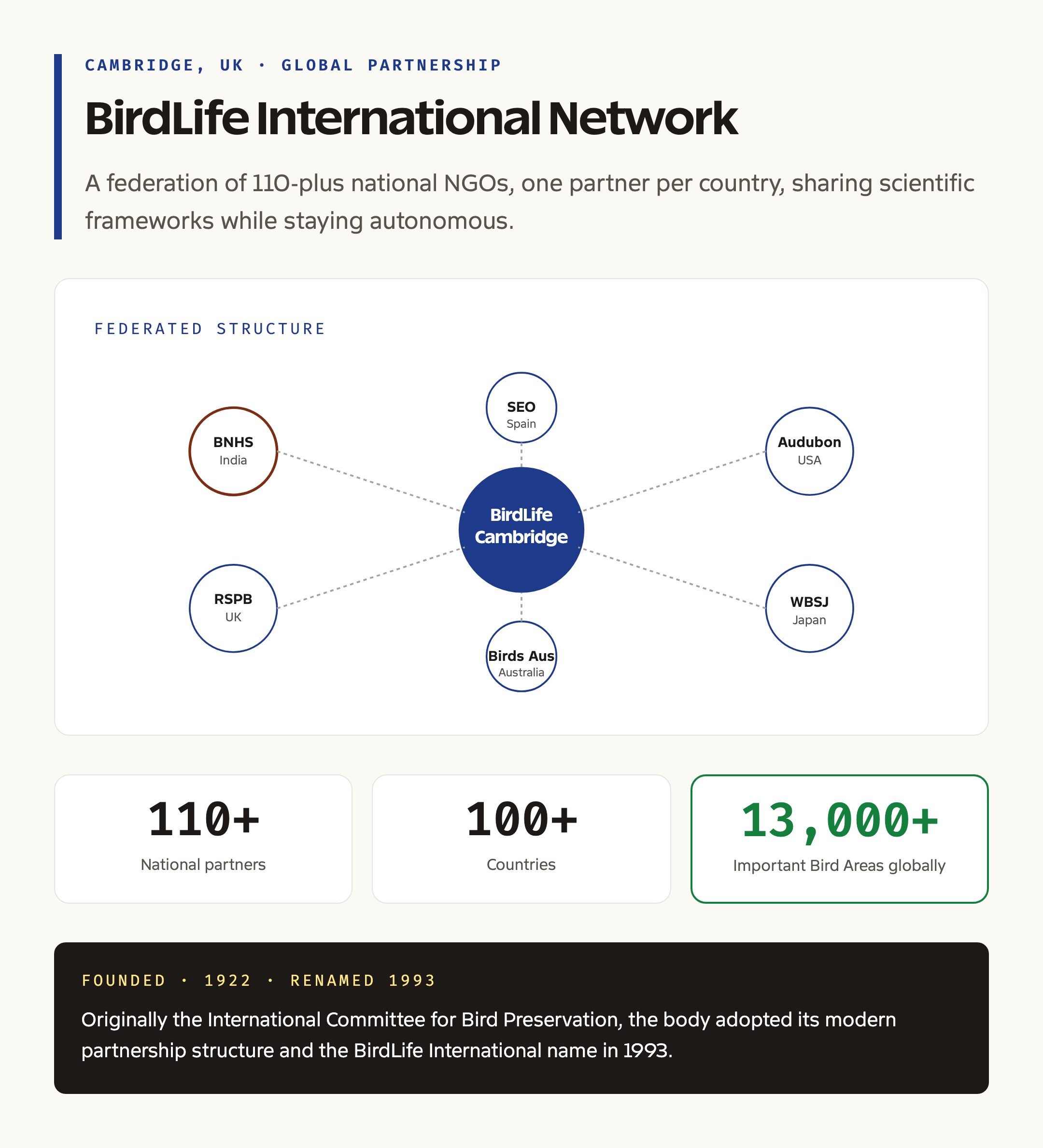
- Type: International partnership of national NGOs
- Headquarters: Cambridge, United Kingdom
- Year founded: 1922 (as International Committee for Bird Preservation)
- Renamed BirdLife International: 1993
- Partner organisations: Over 110 national partners across 100+ countries
- India partner: Bombay Natural History Society (BNHS)
- Key publications: State of the World’s Birds; Important Bird Areas Directory
- Red List authority: Official assessor for birds under the IUCN Red List
- Network framework: Important Bird and Biodiversity Areas (IBAs)
- IBAs identified globally: Over 13,000
- IBAs identified in India: Over 460 (mapped by BNHS)
- Major UN engagements: CMS, CBD, Ramsar, UNFCCC
- Flyway coordination: All 9 major global flyways
What Is BirdLife International
BirdLife International is the world’s largest nature-conservation partnership focused on birds and the ecosystems that support them. It is structured as a federation rather than a head-office NGO. Each member country has one BirdLife partner, an existing national conservation organisation that carries the BirdLife mandate domestically. The Cambridge secretariat provides scientific coordination, policy advocacy at UN-level forums, and shared analytical platforms, but the field work is delivered through the national partners.
The model has clear advantages. It avoids the colonial hangover of a foreign NGO operating in domestic forests. It leverages decades of accumulated local expertise. It allows national partners to engage their own governments through familiar institutional channels. The Bombay Natural History Society in India, the Royal Society for the Protection of Birds in the UK, and the Wild Bird Society in Japan each operate as autonomous national bodies while also carrying BirdLife responsibilities.
BirdLife’s three principal scientific products are the Important Bird and Biodiversity Areas framework, the Red List bird assessments, and the State of the World’s Birds reports. These are augmented by flyway-level coordination, particularly for migratory species whose conservation requires cross-border action.
Background and Historical Context
The institutional ancestry of BirdLife runs to 1922, when the International Committee for Bird Preservation was founded in London by ornithologists from Britain, France, the United States, and the Netherlands. The trigger was the catastrophic decline of several charismatic species, including the great auk, the passenger pigeon, and the Carolina parakeet, all of which were either extinct or close to it by the late nineteenth century.
Through the 1930s and 1940s the committee functioned as a loose federation, gathering scientific information and pressing for protective legislation in member countries. After the Second World War, conservation became a more institutionalised field, with the founding of the IUCN in 1948 and the World Wildlife Fund in 1961. The bird-preservation committee evolved alongside, broadening its mandate from species-by-species protection to habitat conservation.
The transformative shift came in 1993, when the organisation rebranded as BirdLife International and adopted its modern partnership structure. The change reflected three trends. First, the recognition that bird conservation could not be separated from habitat conservation. Second, the maturing of conservation science, which made systematic identification of priority sites possible at global scale. Third, the rise of international biodiversity governance under the Convention on Biological Diversity, which gave non-state actors a formal role in implementation.
The Important Bird Areas framework, which became the partnership’s signature instrument, was developed through the 1990s and rolled out region by region. India’s IBA mapping, led by BNHS, began in 2004 and has identified over 460 sites of critical importance for the country’s bird life, from Himalayan high-altitude wetlands to coastal mangroves.
Key Functions and Provisions
BirdLife International operates across four functional pillars.
Important Bird and Biodiversity Areas: The IBA framework identifies sites that meet specific criteria for global, regional, or national significance. The criteria include the regular presence of globally threatened species, of restricted-range species, of biome-restricted species, and of significant aggregations of birds during breeding, migration, or wintering. Once identified, IBAs are mapped, monitored, and used by governments and conservation agencies to inform protected-area planning. India’s IBAs include high-altitude lakes such as Tso Kar, riverine systems such as the Ganga, and coastal ecosystems including parts of the mangrove ecosystem India network.
IUCN Red List authority for birds: BirdLife is the official body that assesses bird species for the IUCN Red List. The assessment process uses standardised criteria, is peer-reviewed, and forms the scientific basis for international and national conservation action. Of the world’s roughly 11,000 bird species, around 14 percent are currently classified as threatened.
Flagship publications: The flagship publication is State of the World’s Birds, released periodically with a global stocktake of bird populations, threats, and policy responses. The Important Bird Areas Directory catalogues sites by region. Country-level checklists and threatened-species accounts are produced jointly with national partners.
Policy advocacy: BirdLife engages directly with the UN biodiversity bodies, particularly the Convention on Migratory Species, the Convention on Biological Diversity, the Ramsar Convention on wetlands, and the UNFCCC on climate. It coordinates conservation along the nine major global flyways, including the Central Asian Flyway, which passes through India and supports millions of migratory waterbirds each winter.
Why BirdLife Matters for India
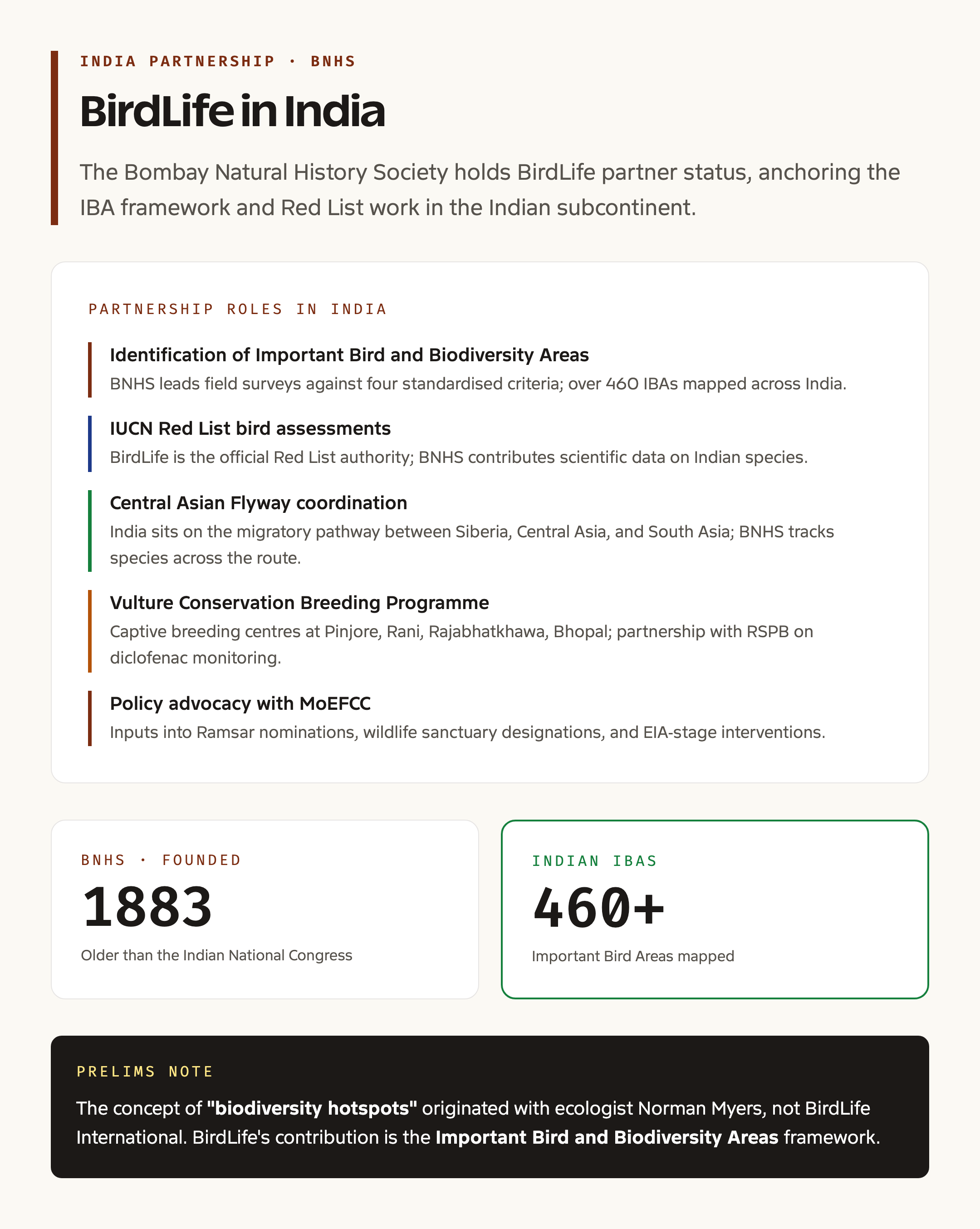
BirdLife’s significance for India operates on three levels. First, the scientific level. Without a globally accepted framework like the IBA, India’s site-level conservation planning would be running on weaker analytical foundations. The IBA criteria, peer-reviewed and applied uniformly across countries, give Indian conservation scientists a way to argue for protection of sites that might otherwise fall outside the formal protected-area network.
Second, the institutional level. BNHS’s status as the BirdLife partner gives Indian ornithology a global voice. BNHS scientists contribute to Red List assessments, flyway coordination, and regional bird-conservation strategies. The partnership also provides funding leverage, since several international conservation grants flow through the BirdLife network.
Third, the policy level. Many of India’s wetland and coastal conservation actions trace back to IBA designations and BirdLife-coordinated flyway-level concerns. The conservation priorities laid out for the Central Asian Flyway influence the Ramsar designation of Indian wetlands, the protection of bar-headed goose breeding sites, and the management of Bharatpur and Chilika. The Sundarbans, identified as both an IBA and a Ramsar site, illustrates this dual designation.
Detailed Analysis: The IBA Framework
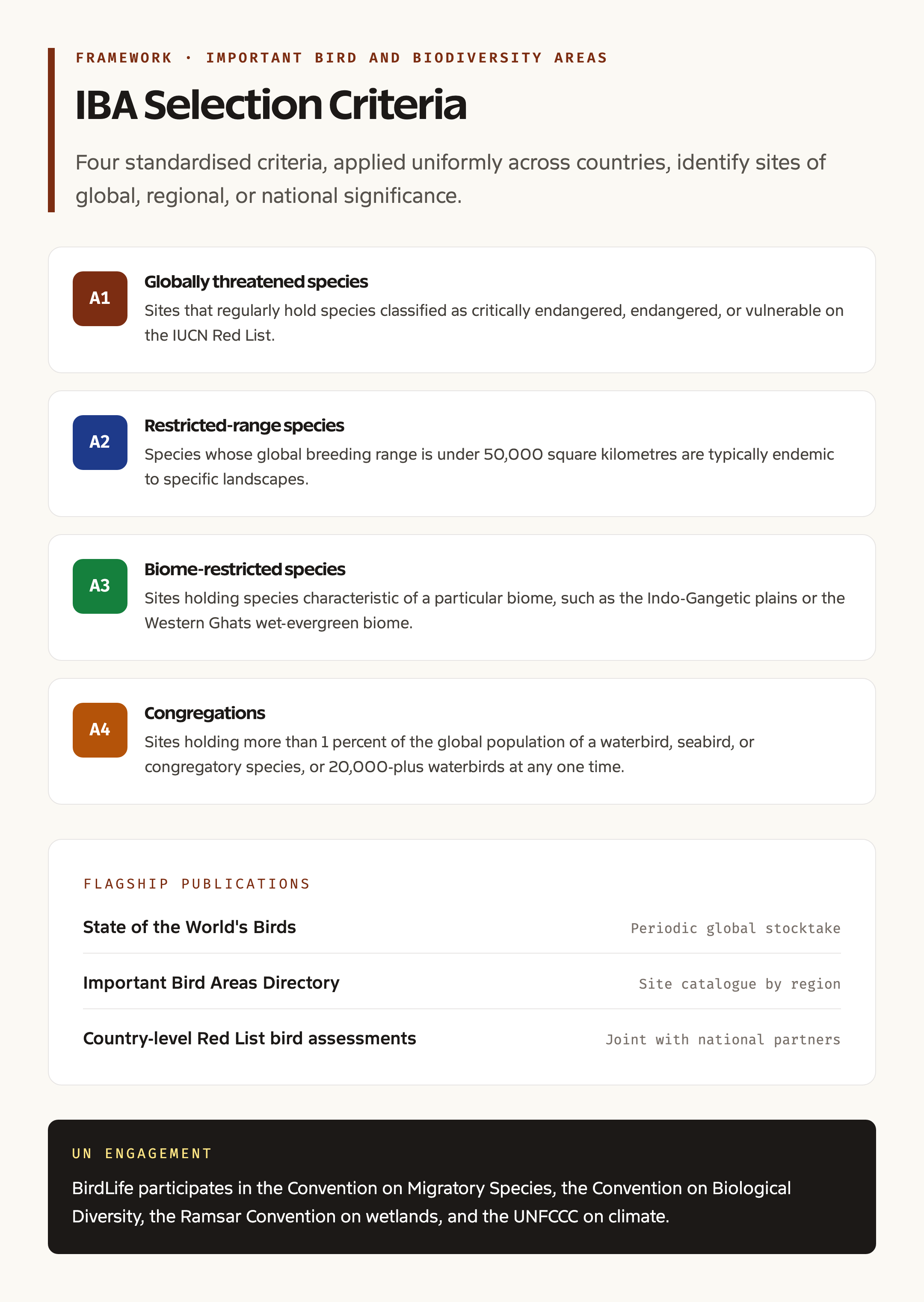
The Important Bird and Biodiversity Areas framework deserves a closer look because it has become a global standard. An IBA is a site that meets one or more of four criteria.
Criterion A1 applies to sites that regularly hold globally threatened species, that is, species classified as critically endangered, endangered, or vulnerable on the Red List. Criterion A2 applies to sites that hold restricted-range species, those whose global breeding range is under 50,000 square kilometres. Criterion A3 applies to sites holding species characteristic of a particular biome. Criterion A4 applies to sites holding more than one percent of the global population of any waterbird, seabird, or congregatory species, or sites holding 20,000 or more waterbirds at any one time.
These criteria are applied with peer-reviewed data, and the resulting designations are not legally binding but carry substantial moral and analytical weight. Governments use IBA designations to inform Ramsar nomination, national park gazettement, and environmental-impact-assessment red-flagging. India’s IBA network, with over 460 sites, overlaps significantly with the wetlands of India and the protected-area network. Some IBAs lie outside formal protected areas, and these are the sites where BNHS advocacy for protection has been most active.
Comparative Perspective
BirdLife’s federated structure is one of the more successful experiments in global conservation governance. It has avoided the centralisation pitfalls of single-headquarters NGOs while maintaining scientific coherence. Its closest comparators are the Wetlands International network, which performs a similar role for wetlands, and the IUCN itself, which is a federation of governments and NGOs.
Where BirdLife is distinctive is its laser focus on a single taxonomic group, birds, and its insistence that bird conservation cannot be separated from habitat. The combination of taxonomic depth and ecosystem-level thinking has made the partnership unusually effective at policy advocacy. Countries that ignore BirdLife’s flagged threats to bird populations often find themselves explaining the same threats to migratory species, climate change, and habitat loss in other UN forums.
In India, BirdLife’s analogue at a smaller scale is the Bombay Natural History Society itself, since BNHS predates BirdLife and continues to operate as an autonomous Indian institution that happens to also be the BirdLife partner. The relationship is collaborative rather than hierarchical.
Challenges and Issues
BirdLife and its partners face challenges that mirror the broader pressures on global biodiversity. Habitat loss is the dominant threat, with wetland drainage, forest conversion, and agricultural intensification continuing across the partnership’s geography. Climate change is shifting species ranges faster than IBA boundaries can be updated, creating mismatches between site designations and current bird use.
Funding is a persistent issue. The partnership relies on national-partner fundraising, donor agencies, and the IUCN-Red List contracted work. Data gaps remain large in tropical countries, where the bird-recording infrastructure is thinner than in Europe or North America. Hunting and persecution of migratory species, particularly along the Central Asian and East Atlantic flyways, undermines flyway-level conservation gains. India’s own contribution to these issues is mixed. The country has good IBA coverage but uneven enforcement, and several IBAs remain outside formal protection.
Prelims Pointers
- Headquarters: Cambridge, United Kingdom.
- Founded: 1922 (renamed BirdLife International in 1993).
- Type: Global partnership of national conservation NGOs.
- India partner: Bombay Natural History Society (BNHS).
- Indian IBAs: Over 460 sites identified.
- Red List role: Official IUCN Red List authority for birds.
- Flagship publications: State of the World’s Birds; IBA Directory.
- UN linkages: CMS, CBD, Ramsar, UNFCCC.
- Flyway coordination: All 9 major global flyways.
- Did not originate the term: “Biodiversity hotspots” originated with Norman Myers, not with BirdLife.
- Did originate the term: “Important Bird and Biodiversity Areas”.
Probable Mains Questions
- Examine the role of international conservation partnerships such as BirdLife International in shaping national wildlife policy. Use Indian examples. (250 words)
- The Important Bird and Biodiversity Areas framework offers a science-led alternative to formal protected-area planning. Discuss its strengths and limitations in the Indian context. (250 words)
- Discuss the institutional architecture of bird conservation in India, with reference to BNHS, BirdLife International, and the Wildlife Protection Act, 1972. (150 words)
Way Forward
BirdLife’s value to Indian conservation can be deepened in three ways. First, integration with formal protection. Several IBAs lie outside national parks and wildlife sanctuaries. Bringing them inside the formal protected-area framework, or at the minimum giving them legal recognition through community reserves, would translate scientific designation into binding protection.
Second, flyway-level cooperation. The Central Asian Flyway, which carries millions of waterbirds through India each winter, needs strengthened coordination across range states. India hosting Ramsar COP-15 in 2027 will be a useful platform.
Third, citizen-science scaling. The BirdLife model relies on networks of trained observers, and India has been expanding its eBird, BNHS Common Bird Monitoring Programme, and similar initiatives. Layering this data into IBA monitoring would refresh designations more frequently than the current cycle. Together with the broader biodiversity India framework and the wetlands of India network, BirdLife’s instruments can substantially strengthen Indian bird conservation.
Frequently Asked Questions
What is BirdLife International?
BirdLife International is a global partnership of national conservation NGOs focused on birds and their habitats. It is headquartered in Cambridge, United Kingdom, has over 110 country partners, and acts as the official IUCN Red List authority for birds.
Who is the India partner of BirdLife International?
The Bombay Natural History Society (BNHS), founded in 1883 and headquartered in Mumbai, is the BirdLife partner in India. BNHS leads the identification of Important Bird and Biodiversity Areas in the country.
What are Important Bird and Biodiversity Areas?
IBAs are sites identified by BirdLife International as globally, regionally, or nationally significant for bird conservation. They are selected against four standardised criteria covering threatened species, restricted-range species, biome-restricted species, and large congregations.
Did BirdLife International originate the concept of biodiversity hotspots?
No. The biodiversity-hotspots concept was developed by ecologist Norman Myers in 1988 and is associated with Conservation International. BirdLife originated the Important Bird and Biodiversity Areas concept, which is a different framework.
Where is BirdLife International headquartered?
The BirdLife secretariat is based in Cambridge, United Kingdom. The network operates through autonomous national partners across 100-plus countries, coordinated from Cambridge.
How many Important Bird Areas does India have?
India has over 460 IBAs identified by BNHS in collaboration with BirdLife International. These cover Himalayan high-altitude wetlands, riverine systems, coastal ecosystems, mangroves, and forested protected areas.
What is BirdLife’s role in the IUCN Red List?
BirdLife International is the official authority for assessing bird species under the IUCN Red List. Its assessments use standardised criteria, are peer-reviewed, and form the scientific basis for global and national conservation action on birds.
What flagship publications does BirdLife produce?
The two best-known publications are State of the World’s Birds, a global stocktake of bird populations and threats, and the Important Bird Areas Directory, which catalogues IBA sites by region. Country-level checklists are produced jointly with national partners.
Which UN bodies does BirdLife engage with?
BirdLife engages with the Convention on Migratory Species, the Convention on Biological Diversity, the Ramsar Convention on wetlands, and the UNFCCC on climate. It also coordinates conservation along the nine major global flyways.
What is the Central Asian Flyway?
The Central Asian Flyway is one of the nine major global migratory bird flyways. It connects breeding grounds in Siberia and Central Asia with wintering sites in South Asia, including India. BirdLife coordinates conservation across the flyway, working with range states on shared species.