Blue Dragons (Glaucus atlanticus): Anatomy, Habitat, Venom Storage, and Why They Wash Up on Indian Beaches
A complete UPSC GS-III explainer on Blue Dragons (Glaucus atlanticus). Covers anatomy, countershading camouflage, kleptocnidae venom storage from Portuguese man o' war, global distribution, climate-driven Indian sightings, and conservation status.
The Blue Dragon is one of the most photogenic creatures in the ocean, a two-inch slug that drifts upside-down on the sea surface, glittering in shades of cobalt and silver. It is also one of the strangest. The animal does not produce its own venom. It steals venom from the Portuguese man o’ war, stores the stinging cells alive in its body, and concentrates them at the tips of its finger-like extensions. A creature small enough to sit in a teaspoon ends up packing a sting more painful than the predator it eats.
For most of the twentieth century, Blue Dragons were considered a curiosity of the open ocean, rarely seen close to populated coasts. That has begun to change. Sightings on Indian beaches have multiplied since 2020, and beachgoers in Andhra Pradesh, Tamil Nadu, and Maharashtra have all reported wash-ups, sometimes with painful stings to follow. The species has become a useful, visible marker of changing wind patterns, surface currents, and warming oceans.
This article explains what a Blue Dragon is, how its biology works, where it lives, why it matters for India, and why it has slipped from a marine-biology curiosity into the GS-III environment syllabus.
Quick Facts on the Blue Dragon
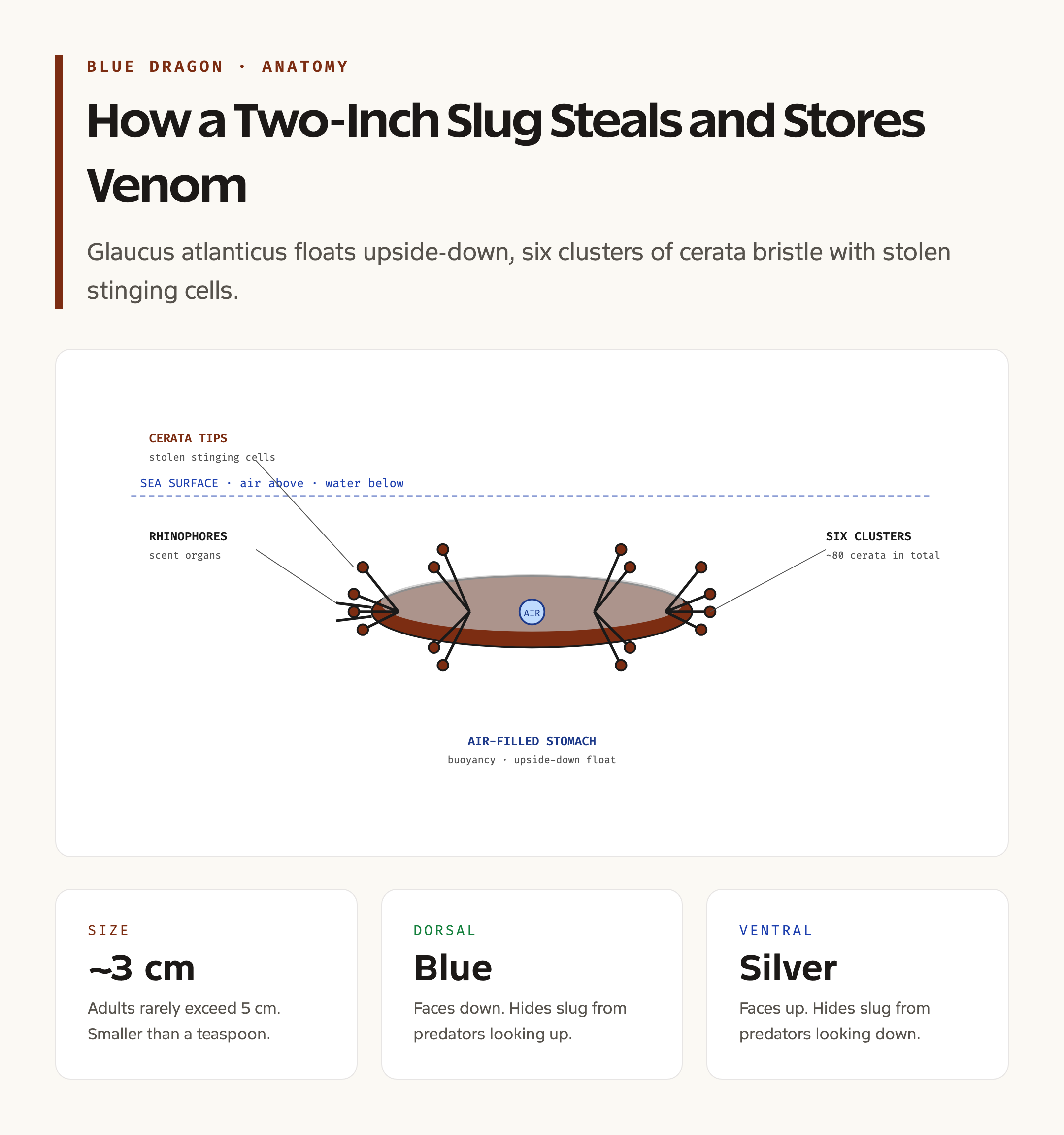
The scientific name is Glaucus atlanticus. The species belongs to the family Glaucidae, the order Nudibranchia, and the class Gastropoda. It is, in plain terms, a sea slug, a soft-bodied marine mollusc with no external shell. Adults grow to about three centimetres on average, and rarely exceed five.
The animal is pelagic, meaning it spends its life in the open water column rather than on the seabed. It floats at the very surface of the ocean, head down, supported by an air bubble swallowed and held in its stomach. The body is divided into a central trunk and six clusters of finger-like outgrowths called cerata. Each cluster fans out from the trunk like a tiny hand, and each individual cerata tip can fire a stolen stinging cell.
The colour pattern is the most photographed feature. The animal’s upper surface, which faces downward into the dark water, is a brilliant deep blue. The lower surface, which faces upward into the bright sky, is silver. This is countershading flipped on its head, designed for an animal that spends its life upside-down at the air-water interface.
What a Blue Dragon Actually Is
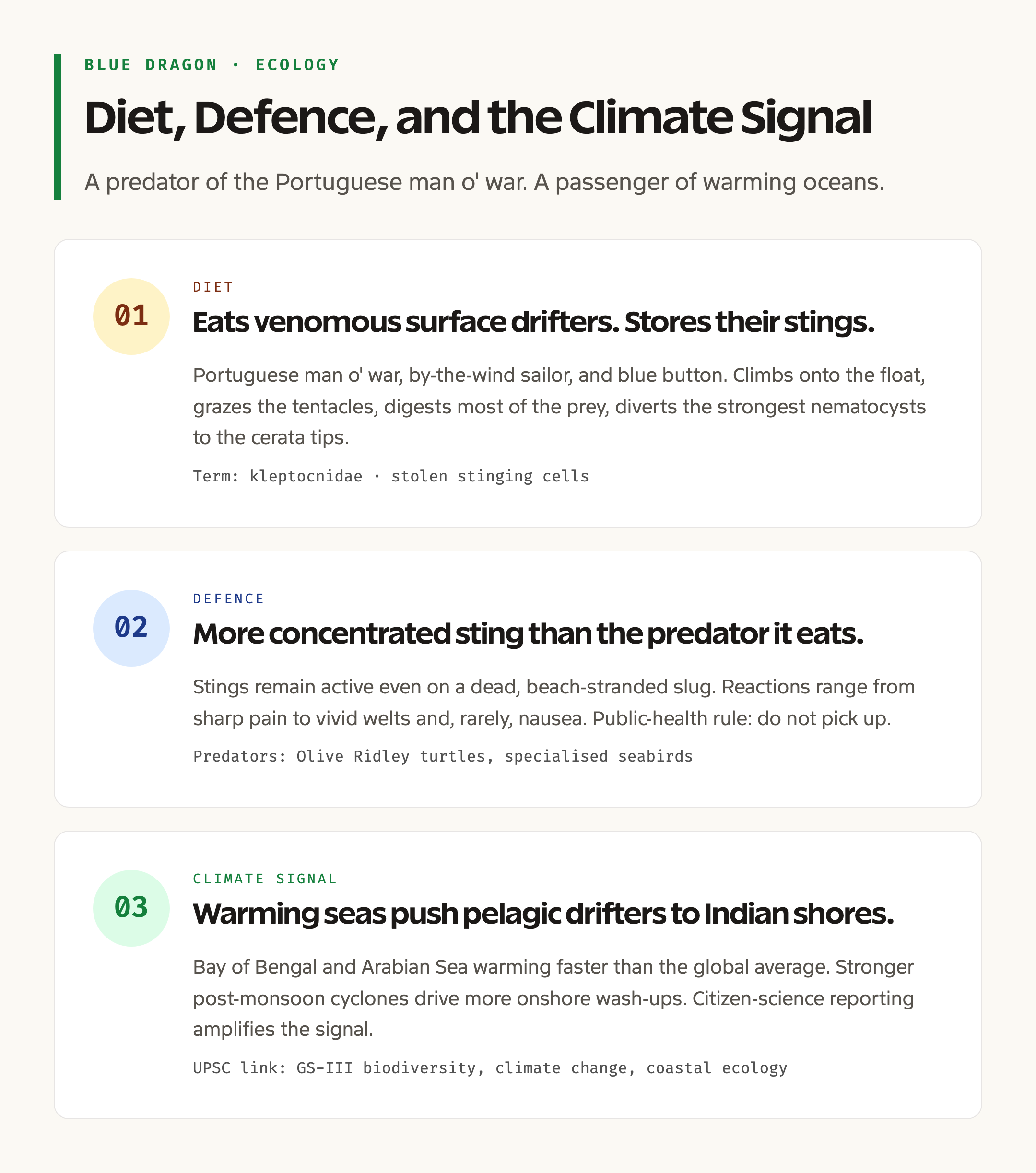
The Blue Dragon belongs to a group of sea slugs called aeolid nudibranchs. Aeolids are predators of cnidarians, the phylum that includes jellyfish, hydroids, and the Portuguese man o’ war. Almost all aeolids share a remarkable trick: they eat cnidarians, digest most of the prey, and divert the unspent stinging cells, called nematocysts, into their own cerata. The nematocysts continue to function inside the slug. When something brushes the cerata, they fire.
The technical term for these recycled weapons is kleptocnidae, literally “stolen stinging cells.” Glaucus atlanticus is the most extreme practitioner. It feeds primarily on the Portuguese man o’ war, on the by-the-wind sailor, and on the blue button. All three are surface-dwelling cnidarians that drift on the same winds and currents that carry the slug. The man o’ war is famous for its long, intensely venomous tentacles. The Blue Dragon eats those tentacles, stores the most powerful nematocysts at the tips of its cerata, and ends up with a more concentrated dose of venom than the prey itself ever delivered.
The animal also harvests something else from its prey. Like other sea-surface drifters, the Portuguese man o’ war is rich in symbiotic chemistry that protects it from ultraviolet radiation. The Blue Dragon recycles some of these protective compounds along with the stinging cells.
Anatomy and the Upside-Down Float
A Blue Dragon held in profile looks like a child’s drawing of a starburst with a tail. The trunk runs front to back. Three pairs of cerata clusters branch laterally, with up to eighty individual cerata across the body. Two short tentacles, called rhinophores, project forward as chemosensory probes that help the slug locate prey by scent.
The upside-down floating posture comes from a small but ingenious modification. The animal swallows a single bubble of air and holds it in a specialised pouch in its stomach. Buoyancy keeps the slug at the surface, with the dorsal side facing down and the ventral side facing up. Most of the body weight hangs below the waterline, which stabilises the float against waves. A small disturbance, such as a probing finger or an unwary fish, leaves the slug bobbing back into position within seconds.
The colour pattern follows the geometry. The dorsal side, now facing the dark blue water below, is intense blue, which makes the slug almost invisible to predators looking up from below. The ventral side, now facing the bright sky above, is silvery white, which makes the slug almost invisible to predators looking down. The two-tone scheme is a textbook case of inverted countershading, evolved to suit the upside-down lifestyle.
Where Blue Dragons Live
The species is pantropical and warm-temperate. The four major ranges are the eastern Pacific from California to Chile, the western Atlantic from the Carolinas to Argentina, the eastern Atlantic and Mediterranean, and the Indo-Pacific from East Africa across to Australia. Within these ranges, the slugs concentrate at the boundaries of subtropical gyres, where surface currents converge and where their cnidarian prey accumulates.
The animal is a passive disperser. It cannot swim against currents in any meaningful way. Wind drives the surface, the surface drives the slug, and the slug drifts with whatever water mass it happens to be in. This is why Blue Dragons appear in groups when they appear at all. A line of sea-surface convergence, a strong onshore wind after a storm, and a population of Portuguese man o’ war drifting nearby produce a beach event.
Indian sightings have spread along the southern and eastern coast. Andhra Pradesh has reported wash-ups at Visakhapatnam beach. Tamil Nadu has seen them on the Chennai coast and on the beaches near Rameswaram, in waters managed as part of the Gulf of Mannar biosphere reserves. Maharashtra has recorded events at Mumbai’s Juhu Beach. Odisha has had isolated reports on the Olive Ridley turtle nesting beaches. The dominant pattern is a post-monsoon or post-cyclone wash-up, with onshore winds bringing pelagic surface drifters to land.
Why Blue Dragons Are Showing Up in India
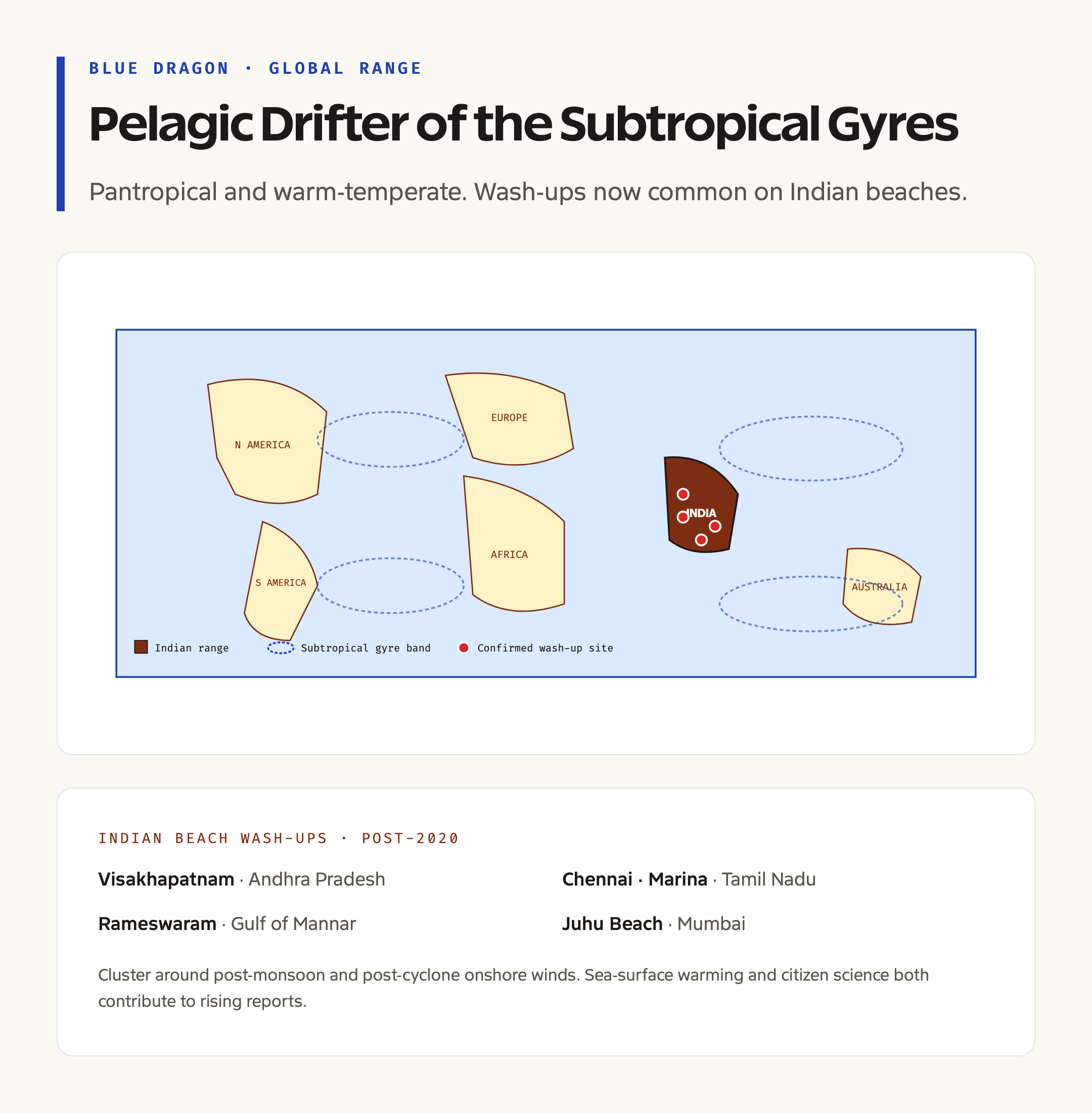
Three pressures converge to make Indian sightings more frequent. The first is sea-surface warming. The Bay of Bengal and the Arabian Sea have both warmed faster than the global average over the last two decades. Warmer water is more hospitable to tropical surface drifters, including the man o’ war and its predators.
The second is changing monsoon and cyclone patterns. Surface drifters move with winds. A more vigorous post-monsoon cyclone season pushes more pelagic species toward the coast. Indian Ocean Dipole anomalies and El Nino years also tend to coincide with stronger reports.
The third is the growth of citizen-science reporting. A creature that washes up dead or stranded would have gone unnoticed in 1990. In 2026, a smartphone, a beach walk, and a forwarded image bring the same event onto a marine-biology page within hours. Some apparent increase is genuine ecological change. Some is improved observation. Both effects are real.
The Sting and Why It Matters
A Blue Dragon sting is unpleasant. The kleptocnidae fire on contact and inject a venom drawn from the slug’s diet. Reactions range from sharp, bee-like pain to a vivid red welt and, occasionally, nausea or muscle cramps in vulnerable people. The stinging cells stay active even after the slug dies and dries out on a beach. A child picking up a “blue jewel” out of the sand has, on multiple recorded occasions, ended up at a hospital.
The risk is small in absolute terms compared with the Portuguese man o’ war itself, but it is not zero. Public health advisories from coastal municipalities now flag Blue Dragon wash-ups in the same notices that warn against jellyfish strandings. A safe-handling rule has emerged: do not pick them up, even when they look dead.
Diet and Predator-Prey Loop
The Blue Dragon’s diet is narrow. The Portuguese man o’ war, the by-the-wind sailor, and the blue button account for almost all of it. The slug climbs onto a man o’ war’s float, anchors itself with the foot, and grazes the venomous tentacles. Some of the prey’s venom is used by the slug. Some is digested. The slug’s blue mucus appears to neutralise the worst of the contact damage during feeding, though the chemistry is not fully resolved.
The Blue Dragon’s only consistent natural predators are sea turtles, particularly the Olive Ridley, and a few specialised seabirds. Most fish that try to attack a Blue Dragon get a faceful of stolen nematocysts and learn quickly. The slug’s countershading and its venom together produce one of the better-defended pelagic invertebrates of its size.
Reproduction and Life Cycle
Glaucus atlanticus is hermaphroditic. Each individual carries both male and female reproductive organs, and any two adults can mate. After mating, the slug lays eggs on the surface of the float of a Portuguese man o’ war or on a piece of floating debris. Larvae hatch into the plankton, drift with their food, and metamorphose into miniature adults. The full life span in the wild is short, often less than a year, and is limited mainly by prey availability and the chance of being washed ashore.
The reproductive flexibility helps the species occupy patchy, unpredictable environments. A bloom of man o’ war can support a local population spike in weeks. A scarcity collapses the local population just as fast.
Conservation Status and Legal Position
The Blue Dragon is not assessed by the IUCN at species level, which is common for small pelagic invertebrates. There is no specific listing under India’s Wildlife Protection Act 1972 and no targeted protection under the Biological Diversity Act 2002. Habitat-level protections, particularly within the Gulf of Mannar Biosphere Reserve and other coastal marine areas, do incidentally benefit the species by protecting its prey base and surface ecosystem.
Threats are not direct. No one targets Blue Dragons commercially. The threats are indirect: ocean warming, plastic pollution that displaces natural floats, microplastic ingestion, and degradation of the surface neuston community on which the species depends. The Global Wetland Outlook 2025 and similar assessments treat surface ecosystems as part of the broader ocean health audit. The Blue Dragon’s status is best read alongside the health of those systems.
Why This Matters for the UPSC Syllabus
Three threads link the Blue Dragon to GS-III. The first is biodiversity and species ecology, where it is a worked example of countershading, kleptocnidae, and pelagic dispersal. The second is climate change, where increased Indian sightings serve as a coastal indicator of warming sea-surface temperatures and shifting monsoon-driven currents. The third is environment and disaster management, where Blue Dragon wash-ups intersect with public-health advisories on stinging marine life and integrate into the coastal warning systems that already cover jellyfish and Portuguese man o’ war.
For prelims, the safe set of facts is the scientific name Glaucus atlanticus, the family Glaucidae, the order Nudibranchia, the upside-down floating posture, the kleptocnidae mechanism, the diet built around the Portuguese man o’ war, and the recent Indian wash-ups. For mains, the species is best deployed inside answers on marine biodiversity, climate-driven range shifts, and citizen-science as a tool for monitoring coastal ecology.
Frequently Asked Questions
Is the Blue Dragon a fish, a jellyfish, or a slug?
A slug. Glaucus atlanticus is a sea slug, in the order Nudibranchia, class Gastropoda. It is more closely related to garden snails than to fish or jellyfish.
Why is the Blue Dragon blue on top and silver on the bottom?
Because it floats upside-down. The dorsal blue side faces downward into the water and hides it from predators below. The ventral silver side faces upward and hides it from predators above. The countershading is inverted to match the inverted lifestyle.
Can a dead Blue Dragon still sting?
Yes. The stolen stinging cells remain active for some time after the slug dies. A washed-up specimen on a beach can still deliver a painful sting if handled.
Where in India have Blue Dragons been reported?
On the beaches of Visakhapatnam in Andhra Pradesh, Chennai and Rameswaram in Tamil Nadu, and Mumbai’s Juhu Beach in Maharashtra. Reports cluster after the post-monsoon cyclone season and on onshore-wind days.
Is the Blue Dragon listed under the Wildlife Protection Act 1972?
No. The species has no specific listing under India’s Wildlife Protection Act and no IUCN assessment. It benefits indirectly from coastal and marine protected areas that conserve its prey and habitat.