
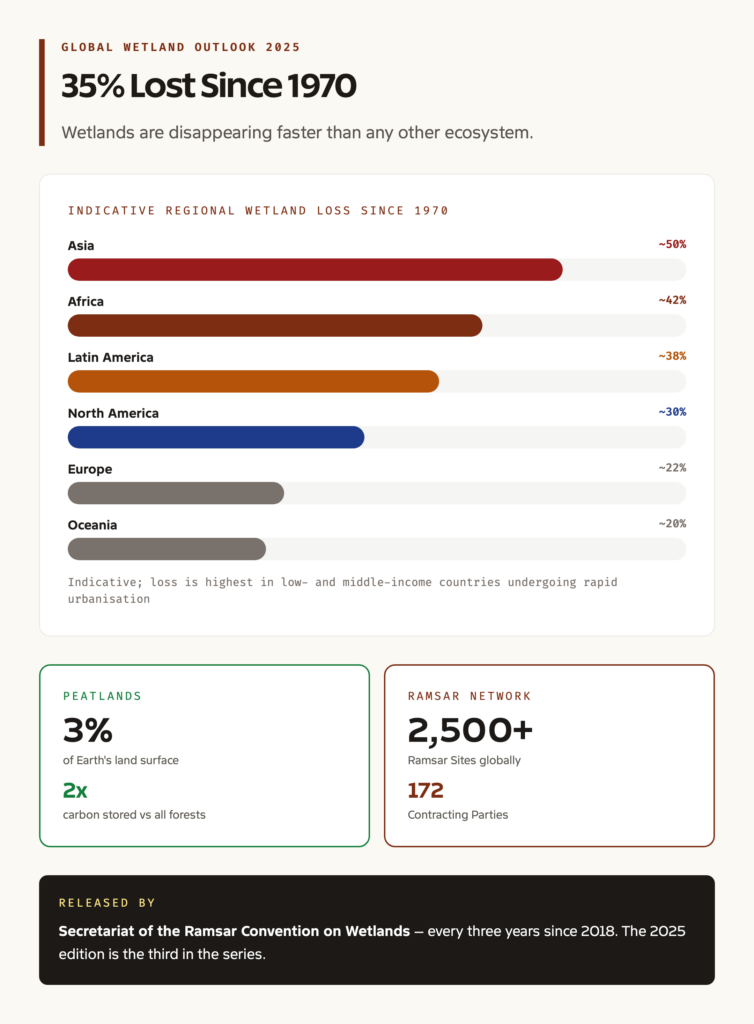
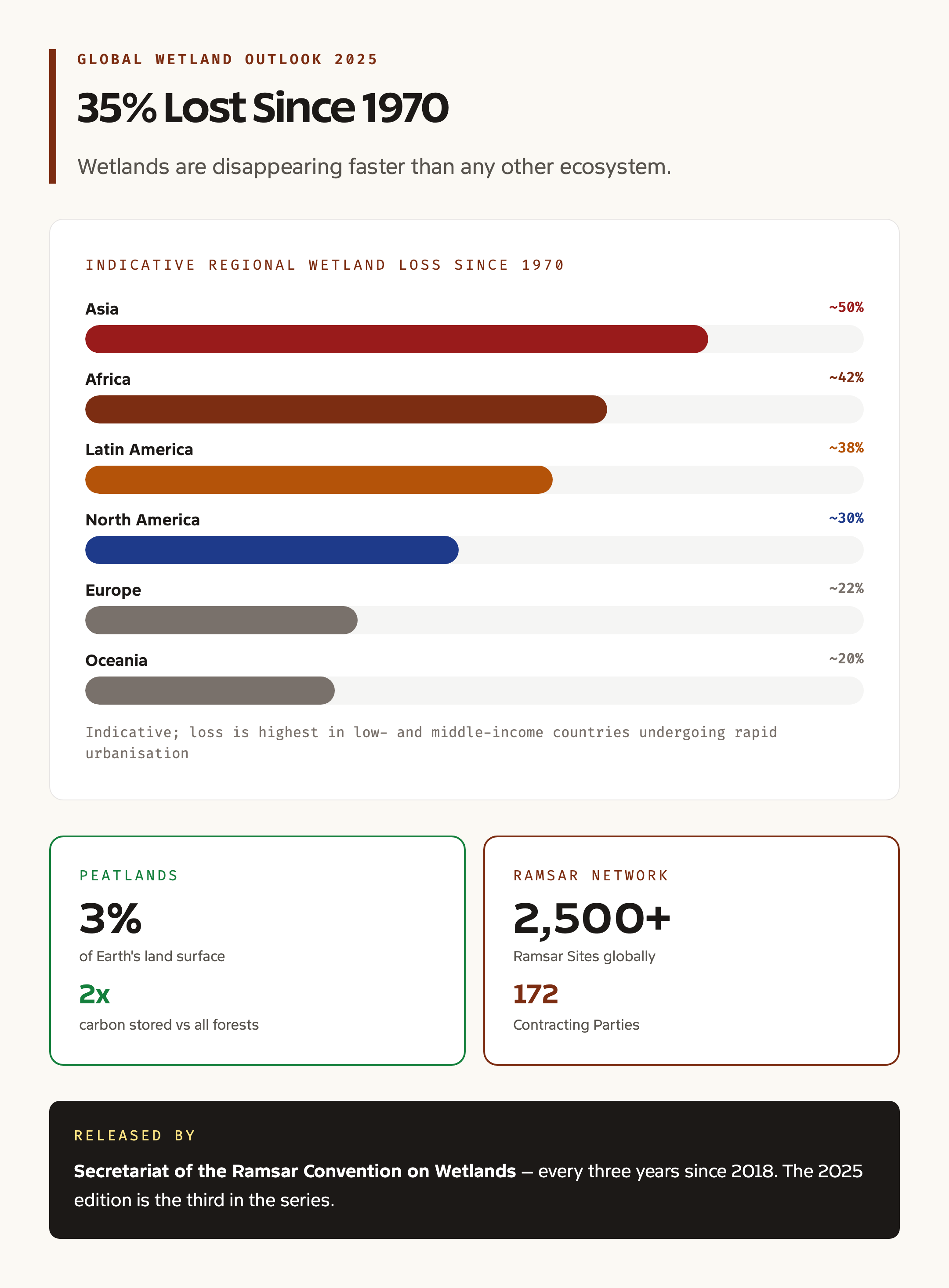
The world has lost more than a third of its wetlands in just over half a century. The Global Wetland Outlook 2025, released by the Ramsar Convention on Wetlands, calculates that 35 percent of the planet’s wetlands have disappeared since 1970, faster than any other ecosystem type. The report is the third in the GWO series after 2018 and 2021, and it lands in a moment when wetlands are simultaneously climate-critical and politically marginal. They store carbon at rates per hectare that match or exceed mature rainforests, they regulate flood flows for densely populated deltas, and they produce more fish protein per hectare than open seas. Yet they are drained, paved over, and polluted faster than they are protected.
The 2025 edition adds urgency by spotlighting peatlands, which cover only 3 percent of the Earth’s land surface but hold roughly twice as much carbon as the world’s forests. It also names the principal drivers — agricultural expansion, urbanisation, and climate change — and highlights the policy gap between national commitments and on-the-ground action. For India, the report notes both progress and concern: India now has more than 85 Ramsar Sites, the largest network in Asia, and the Amrit Dharohar Scheme is mobilising community participation around wetland conservation. But pollution loads, urban encroachment, and floodplain conversion continue to cut into wetland area across the country.
For UPSC, the GWO 2025 ties together multiple syllabus zones: international environmental conventions, biodiversity conservation, climate change mitigation, urban planning, and the federalism of natural resource governance in India. This guide builds out each layer.
Quick Facts
- Title: Global Wetland Outlook 2025
- Released by: Secretariat of the Ramsar Convention on Wetlands
- Frequency: Every three years (previous editions: 2018, 2021)
- Aim: Comprehensive global assessment of wetland health, trends, drivers of loss, and Ramsar site performance
- Headline finding: 35 percent of the world’s wetlands have been lost since 1970
- Primary drivers: Agriculture, urbanisation, and climate change
- Peatlands: Cover only 3 percent of land but store about twice the carbon of all forests combined
- Ramsar Convention: International treaty signed in Ramsar, Iran, on 2 February 1971; entered into force 1975
- World Wetlands Day: Observed every year on 2 February
- Ramsar Sites in India: 85+ (the largest network in Asia)
- First Ramsar Sites in India: Chilika Lake (Odisha) and Keoladeo National Park (Rajasthan), 1981
- Amrit Dharohar Scheme: Launched by MoEFCC to integrate community participation and economic benefits with Ramsar Site conservation
What Is the Global Wetland Outlook
The Global Wetland Outlook (GWO) is the flagship triennial assessment of the Ramsar Convention on Wetlands, the only international treaty dedicated exclusively to a single ecosystem type. The first edition was released in 2018 to coincide with the 13th Conference of the Parties (COP13). The 2021 edition followed, and the third edition, GWO 2025, was released ahead of COP15 of the Ramsar Convention.
Each edition combines satellite-derived land cover analysis, national-level reporting from Ramsar Contracting Parties, peer-reviewed scientific literature, and case studies from civil society and indigenous community partners. The result is the most authoritative single source on global wetland status, trends, and policy progress.
The 2025 report extends the series by focusing more sharply on three themes. First, it provides the strongest documentation yet of accelerating wetland loss, particularly in low- and middle-income countries undergoing rapid urbanisation. Second, it highlights the disproportionate climate role of peatlands. Third, it outlines a policy roadmap for integrating wetland protection into the post-2030 Sustainable Development Goals architecture and the Global Biodiversity Framework’s 30-by-30 target.
Background and Historical Context
The Ramsar Convention, formally the “Convention on Wetlands of International Importance Especially as Waterfowl Habitat,” was negotiated in the city of Ramsar in Iran on 2 February 1971. It came into force in December 1975 and is now signed by 172 Contracting Parties covering more than 2,500 designated Ramsar Sites globally, with a combined area exceeding 250 million hectares.
India became a party to the Ramsar Convention in 1982. The first Indian sites listed were Chilika Lake in Odisha and Keoladeo National Park in Rajasthan, both in 1981 (formally listed when India ratified in 1982). Over four decades, India’s Ramsar network has grown steadily, with the most rapid expansion occurring in the 2020s. As of 2025, India has 85+ Ramsar Sites covering approximately 1.33 million hectares — the largest network in Asia and the third-largest globally.
The Global Wetland Outlook reports build on a long tradition of wetland science. The Millennium Ecosystem Assessment of 2005 was the first global synthesis to highlight wetland loss as a top-tier ecological concern. The IPBES Global Assessment of 2019 reaffirmed and expanded the findings. The GWO series is the Ramsar Convention’s official translation of this scientific consensus into policy-actionable form.
Key Provisions and Findings of GWO 2025
The 2025 report frames its findings around three pillars: status, drivers, and response.
Status: Wetlands are being lost faster than any other ecosystem. Inland wetlands account for the bulk of the absolute loss, but coastal wetlands (mangroves, salt marshes, seagrass meadows) face higher relative pressures because of urban expansion in coastal zones. Africa, Asia, and Latin America have the highest rates of recent loss. Europe and North America have stabilised but at much-diminished baselines.
Drivers: Three forces dominate. Agricultural expansion remains the single largest driver globally, particularly conversion of inland wetlands to paddy, oilseeds, and aquaculture in Asia. Urbanisation is the second driver, with peri-urban wetlands, retention ponds, and floodplain stretches converted to housing, transport, and commercial real estate. Climate change is the emerging third driver, especially through altered precipitation patterns, sea-level rise affecting coastal wetlands, and shifts in glacier melt timing for high-altitude wetlands.
Response: Mixed progress. The Ramsar Site network has expanded, but designation alone does not guarantee good ecological status. Many designated sites face the same pressures as undesignated wetlands. The report calls for stronger national-level wetland inventories, integration with sectoral policies (agriculture, urban planning, water resources), and dedicated finance through climate funds and biodiversity finance instruments.
Why It Matters
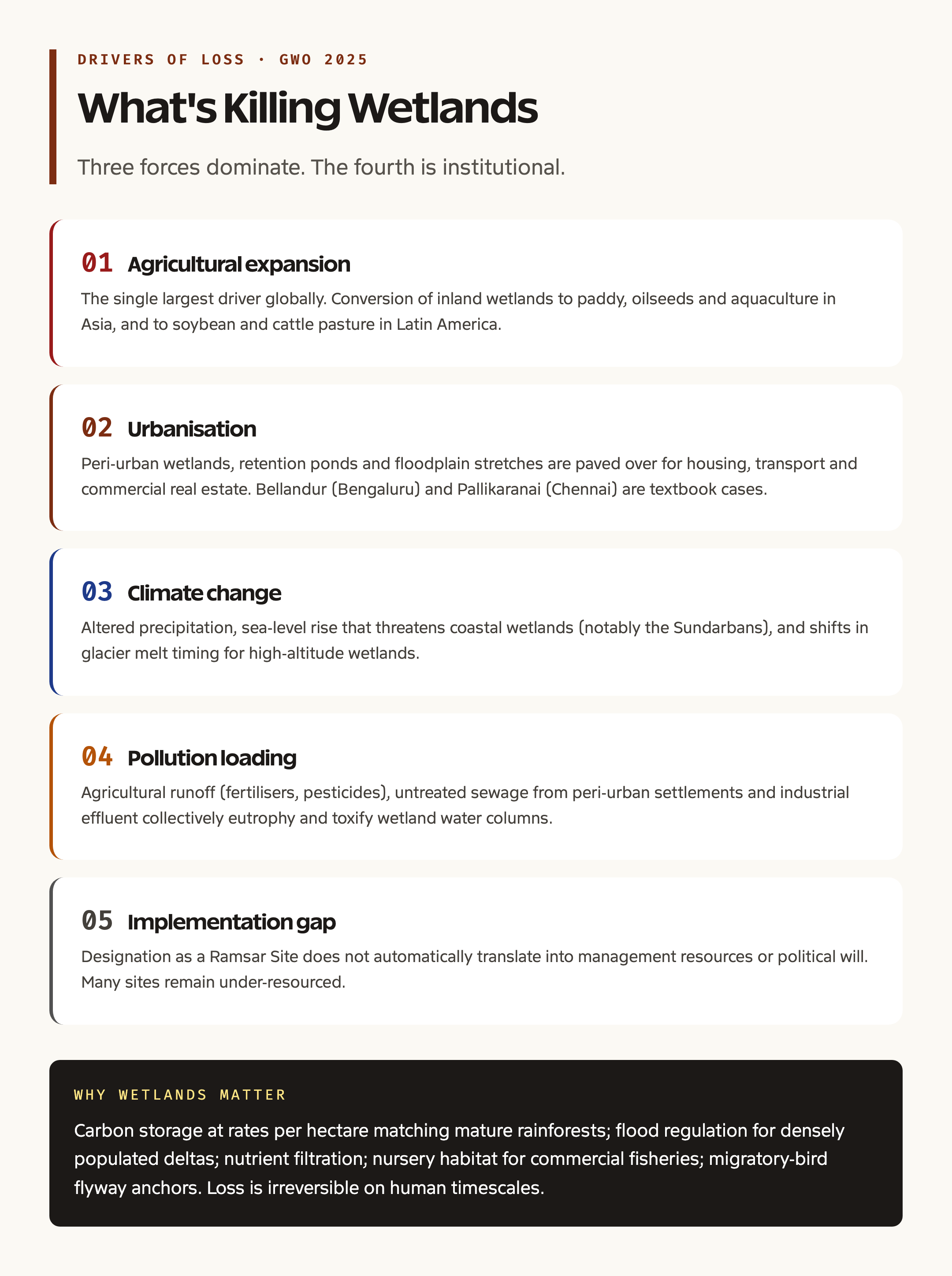
Wetlands punch far above their weight in ecosystem services. They store carbon at rates per hectare that match or exceed tropical rainforests; peatlands in particular sequester carbon over millennia. They regulate flood flows for densely populated deltas — the Sundarbans, the Mekong, the Mississippi — by absorbing peak discharges and releasing them slowly. They filter pollutants, particularly nutrients, by hosting communities of denitrifying bacteria and nutrient-absorbing plants. They are nurseries for fish and shellfish, supporting commercial and artisanal fisheries that feed hundreds of millions of people. They support the migratory bird flyways that link the Arctic with Africa, India with Siberia, North America with South America.
Loss of wetlands therefore translates directly into climate damage, flood risk, water pollution, fisheries decline, and biodiversity collapse. The economic value of wetland services has been estimated at trillions of dollars annually in studies by the United Nations Environment Programme and The Economics of Ecosystems and Biodiversity (TEEB). When wetlands are converted to agriculture or housing, this stream of services is replaced by a one-time gain in land value followed by long-term cost increases — for flood control infrastructure, water treatment plants, fisheries imports, and climate adaptation.
For India specifically, wetlands are critical to flood management in the Brahmaputra, Ganga, and Mahanadi basins, to coastal protection along the Sundarbans and the Gulf of Kutch, and to drinking water supply through groundwater recharge in inland wetland-dependent aquifers.
Detailed Analysis: India’s Wetland Profile
India’s wetland network is exceptionally diverse. It includes high-altitude Himalayan wetlands like Tso Moriri and Tsomgo (Sikkim), the desert wetlands of Sambhar Lake (Rajasthan), the inland tank systems of southern India, the coastal lagoons of Chilika and Pulicat, the deltaic mangroves of the Sundarbans, and a vast network of riverine floodplain wetlands across the Gangetic plain.
The Ramsar Sites network has grown rapidly. India had 26 Ramsar Sites at the end of 2018. By 2025 the number has crossed 85. The most recent additions include several wetlands across Tamil Nadu (which now has the largest state-level Ramsar count) and Madhya Pradesh, alongside high-altitude sites in Ladakh and Sikkim.
The Wetlands (Conservation and Management) Rules, 2017 are the principal regulatory framework. They define wetlands, require state-level wetland authorities, prohibit certain activities (industrial discharge, solid waste dumping, encroachment), and mandate a brief inventory of all wetlands above 2.25 hectares. Implementation has been uneven across states.
The Amrit Dharohar Scheme, launched in 2023 by the Ministry of Environment, Forest and Climate Change, is the most recent national initiative. It focuses on Ramsar Sites and aims to integrate community participation, biodiversity conservation, eco-tourism, and carbon sequestration. The scheme runs alongside the Save Wetlands Campaign launched on World Wetlands Day 2023.
Comparative Perspective: India in the Global Picture
India’s Ramsar network is the largest in Asia and third largest globally after the United Kingdom and Mexico. By area, India ranks lower because many of its sites are smaller wetlands rather than vast deltaic systems. Brazil’s Pantanal, Botswana’s Okavango, and Russia’s Kushevsky Wildlife Reserve are among the world’s largest individual Ramsar Sites.
| Metric | India | Global average |
|---|---|---|
| Wetland loss since 1970 | Significant but partially documented | 35 percent (GWO 2025) |
| Number of Ramsar Sites | 85+ | 2,500+ globally |
| Ramsar area (lakh ha) | About 13.3 | About 2,500 |
| Wetland regulatory framework | Wetlands Rules 2017 | Highly variable |
| Community-led conservation programmes | Amrit Dharohar (2023) | Present in some Parties |
| Peatland focus | Limited (mostly Himalayan bogs) | Major in EU, Russia, Indonesia |
India’s strength is in network breadth and emerging community-led mechanisms. Its weakness is in the implementation of pollution control, encroachment removal, and ecological flow maintenance for the listed sites.
Wetlands International and Other Key Bodies
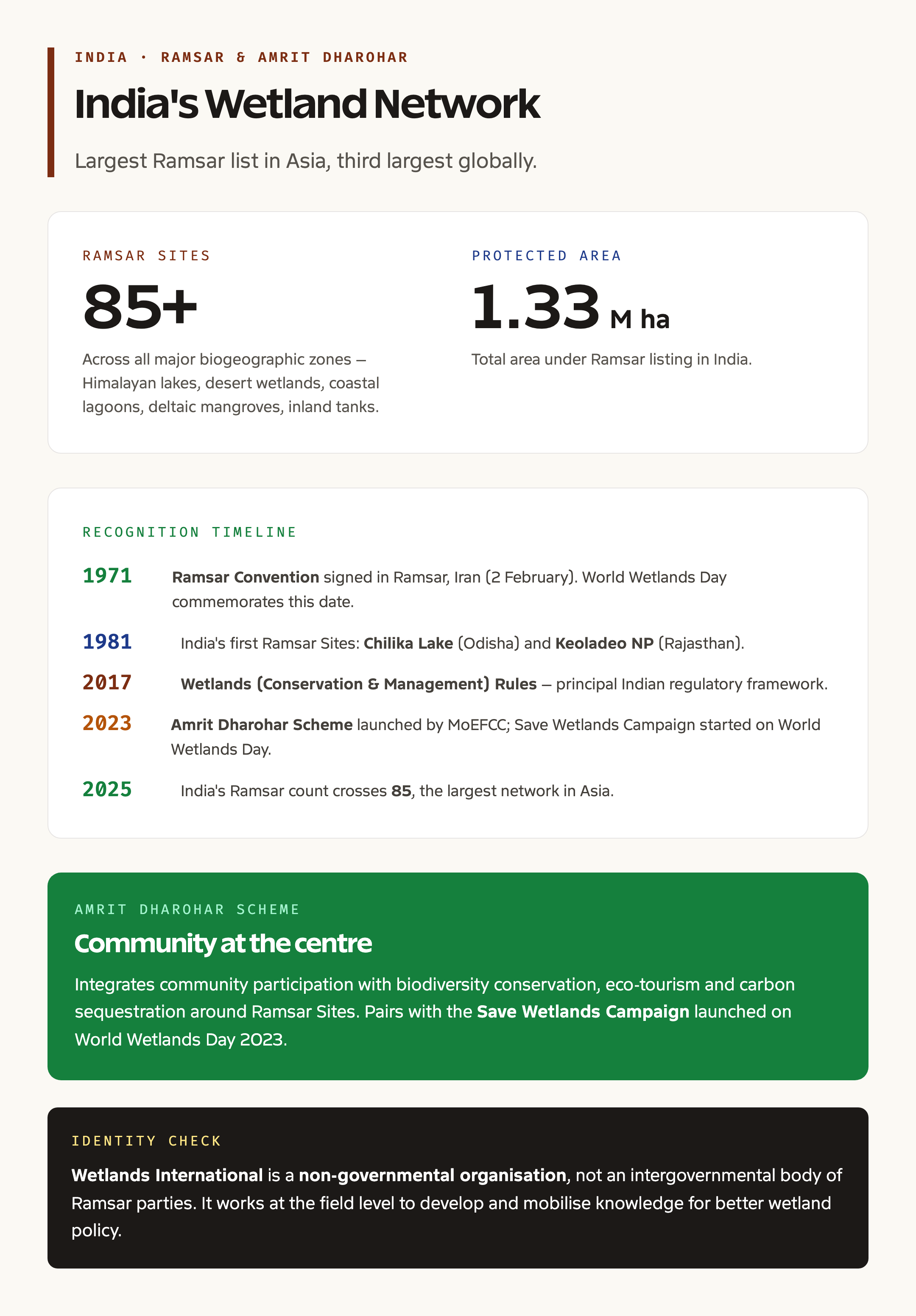
The 2025 report explicitly mentions the role of partner organisations like Wetlands International, BirdLife International, IUCN, and WWF. A common UPSC question revolves around the institutional identity of Wetlands International. The organisation is a non-profit, non-governmental body — not an intergovernmental organisation — that operates globally with a network of regional offices. It works at the field level to develop and mobilise knowledge, and uses practical experience to advocate for better wetland policies.
This distinction matters. Of the two statements often paired in UPSC prelims questions:
- Wetlands International is an intergovernmental organisation formed by the countries that are signatories to the Ramsar Convention.
- It works at the field level to develop and mobilise knowledge, and uses practical experience to advocate for better policies.
Statement 1 is incorrect: Wetlands International is an NGO, not an intergovernmental body. Statement 2 is correct.
Challenges and Threats
The first challenge is encroachment. Urban wetlands across India — Bellandur Lake in Bengaluru, Pallikaranai Marsh in Chennai, the East Kolkata Wetlands — face systematic conversion to housing and infrastructure despite legal protection. The pace of conversion, often documented through satellite imagery, has accelerated in the past decade.
The second is pollution. Agricultural runoff loaded with fertiliser and pesticides, untreated sewage from peri-urban settlements, and industrial effluent collectively degrade water quality in most Indian wetlands. The eutrophication of Bellandur and Varthur lakes in Bengaluru, with their iconic foaming and burning episodes, is the visible end of this pollution gradient.
The third is climate change. Sea-level rise threatens coastal wetlands, particularly the Sundarbans where saline incursion is already documented. Altered precipitation patterns affect inland wetlands, especially seasonal ones. High-altitude wetlands face changes in glacier melt timing.
The fourth is the gap between designation and management. A Ramsar listing carries international prestige but does not automatically translate into management resources or local political will. Many sites remain under-resourced.
Prelims Pointers
- The Ramsar Convention was signed in Ramsar, Iran, on 2 February 1971; entered into force in 1975
- World Wetlands Day is observed on 2 February
- The Global Wetland Outlook is published every three years by the Ramsar Convention Secretariat
- GWO 2025 reports a 35 percent loss of global wetlands since 1970
- The primary drivers are agriculture, urbanisation, and climate change
- Peatlands cover 3 percent of the Earth’s land surface but store about twice the carbon of all forests combined
- India became a Ramsar party in 1982; first sites: Chilika Lake and Keoladeo National Park (1981)
- India has 85+ Ramsar Sites as of 2025, the largest network in Asia
- The Wetlands (Conservation and Management) Rules, 2017 are the principal Indian regulatory framework
- The Amrit Dharohar Scheme was launched in 2023 to integrate community participation with Ramsar Site conservation
- Wetlands International is a non-governmental organisation, not an intergovernmental body
Mains Practice Questions
- Discuss the principal findings of the Global Wetland Outlook 2025 and the policy implications for India. (250 words)
- Examine the role of wetlands in climate change mitigation, with specific reference to peatlands. Suggest measures to integrate wetland conservation with India’s net-zero pathway. (250 words)
- The Wetlands (Conservation and Management) Rules, 2017 are a step in the right direction but suffer from implementation gaps. Critically evaluate. (150 words)
- Discuss the significance of community-led wetland conservation, with reference to the Amrit Dharohar Scheme. (150 words)
Way Forward
The post-2025 wetland agenda needs four levers operating in parallel.
A national wetland inventory using satellite data and ground truthing, with mandatory updates every three years, is the prerequisite for any monitoring system. The Space Applications Centre’s wetland atlas provides a starting point, but disaggregation to the village level is essential for enforcement.
Stronger regulatory enforcement of the Wetlands Rules, 2017, with penalties for encroachment that match the scale of the harm, is overdue. State Wetland Authorities need adequate budgetary support and field staff. The Central Wetlands Regulatory Authority should publish annual compliance audits.
Integration with sectoral policies is the lever the GWO 2025 emphasises most. Urban master plans, agricultural extension programmes, water resource policies, and climate adaptation strategies must all explicitly account for wetlands. Stand-alone wetland policies, however well-designed, will lose against the cumulative weight of sectoral neglect.
Climate finance is the missing piece. India’s National Adaptation Fund for Climate Change and the Green Climate Fund’s national readiness programmes can support wetland restoration as a nature-based climate solution. The 2025 report explicitly endorses this approach.
Frequently Asked Questions
What is the Global Wetland Outlook 2025?
The Global Wetland Outlook 2025 is the third edition of the Ramsar Convention’s flagship triennial assessment of wetland status, drivers of change, and policy responses worldwide. It was released ahead of the Ramsar Convention’s COP15.
Who releases the Global Wetland Outlook?
The Global Wetland Outlook is released by the Secretariat of the Ramsar Convention on Wetlands, headquartered in Gland, Switzerland.
How much wetland has the world lost since 1970?
According to GWO 2025, the world has lost approximately 35 percent of its wetlands since 1970, faster than any other ecosystem type.
What are peatlands and why do they matter?
Peatlands are wetlands where waterlogged conditions slow plant decomposition, allowing carbon to accumulate as peat over centuries. They cover only about 3 percent of the Earth’s land surface but store roughly twice as much carbon as all the world’s forests combined, making their protection a climate priority.
What is the Ramsar Convention?
The Ramsar Convention, signed in Ramsar, Iran, on 2 February 1971, is the only international treaty dedicated exclusively to a single ecosystem type — wetlands. India joined in 1982.
How many Ramsar Sites does India have?
India has 85 or more Ramsar Sites as of 2025, covering approximately 1.33 million hectares. This is the largest network in Asia and the third largest globally after the United Kingdom and Mexico.
Which were India’s first Ramsar Sites?
The first Ramsar Sites in India were Chilika Lake in Odisha and Keoladeo National Park in Rajasthan, listed in 1981 when India became a party to the Convention.
What is the Amrit Dharohar Scheme?
The Amrit Dharohar Scheme, launched in 2023 by the Ministry of Environment, Forest and Climate Change, is an initiative to conserve India’s Ramsar Sites by integrating community participation, biodiversity conservation, eco-tourism, and carbon sequestration. It runs alongside the Save Wetlands Campaign launched on World Wetlands Day 2023.
What law governs wetlands in India?
The Wetlands (Conservation and Management) Rules, 2017, framed under the Environment (Protection) Act, 1986, are the principal regulatory framework. They require state-level wetland authorities, prohibit certain destructive activities, and mandate inventories of wetlands above 2.25 hectares.
Is Wetlands International an intergovernmental organisation?
No. Wetlands International is a non-governmental, non-profit organisation that works globally with a network of regional offices. It works at the field level to develop and mobilise knowledge and advocates for better wetland policies. It is not an intergovernmental body formed by Ramsar parties.
Tell Google you want more of this.
Add Anantam IAS as a preferred sourceOne tap, and this site shows up more often in your own Top Stories, AI Overviews and AI Mode. Remove it any time.





